

At IAA Transportation 2026 in Hanover, Europe’s electric trucks stopped competing on range. MAN’s new eTGX claims up to 720 km on a charge, Volvo’s FH Aero Electric up to 700, and BYD’s ETT 44 around 600 — roughly a full legal day’s driving. The number that now separates them is not how far they go. It is how fast they refill.
For most of the past decade the electric truck’s problem was the battery: too heavy, too small, too far short of a diesel tank. That argument is largely over. The tractor units unveiled in Hanover on 14–15 September cluster between 600 and 720 km, and under European driving law a trucker cannot legally cover much more than that in a day without stopping anyway. The frontier has moved. It now sits at the megawatt charger and the grid connection behind it.
Why 720 km is the number that matters
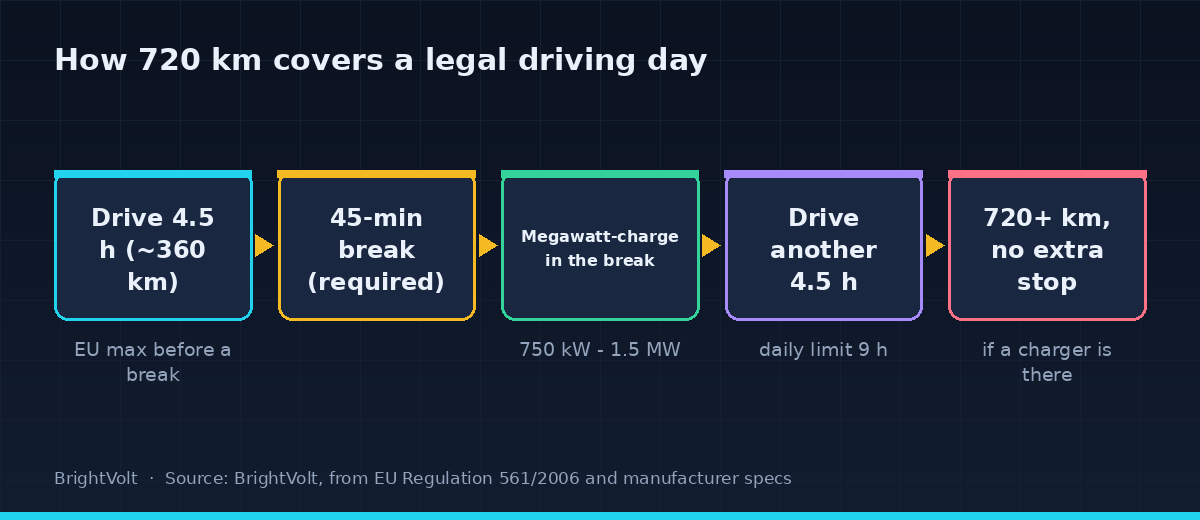
The range target was never “match diesel.” It was “cover a legal shift.” EU Regulation 561/2006 caps continuous driving at 4.5 hours before a mandatory 45-minute break, and daily driving at nine hours — ten twice a week. At a motorway cruise of roughly 80 km/h, nine hours is about 720 km. A truck that goes 720 km on one charge therefore covers a full legal driving day with nothing left to prove.
That reframes the whole engineering problem. Past a legal day’s distance, a bigger battery buys range the driver is not allowed to use, while adding weight and cost and eating into the payload — and payload is the only thing a haulier is paid to move. A truck that can out-drive its own driver’s legal hours is carrying dead weight, not range. So once the pack clears about 700 km, the sensible move is to stop enlarging it and start refilling it inside the 45-minute break the law already forces the driver to take. That is a charging problem, not a battery one.
The specs Europe’s makers brought to Hanover
The 2026 crop is tightly grouped, which is itself the story — nobody is chasing a headline range any more.
| Truck | Battery | Claimed range | Max charging |
|---|---|---|---|
| MAN eTGX (6×2) | 644 kWh | up to 720 km | MCS, ~750 kW |
| MAN eTGX (4×2) | 552 kWh | up to 660 km | MCS, ~750 kW |
| Volvo FH Aero Electric | not disclosed | up to 700 km | MCS |
| Mercedes-Benz eActros 600 | ~600 kWh | ~500 km | MCS, ~1 MW |
| BYD ETT 44 | 651 kWh | ~600 km | >1.5 MW; 420 kW CCS2 |
| SANY e263 | 636 kWh | >500 km | not disclosed |
| Farizon Homtruck | 600 kWh | ~500 km | not disclosed |
MAN’s new eTGX generation is the clearest example: 10% more usable energy than the previous pack, 660 km from the 4×2 tractor and 720 km from a 6×2 fitted with a seventh battery, and MCS charging from 20% to 80% in about half an hour. Production of the first MCS-ready eTGX began at the end of July. Alongside the incumbents sat a row of Chinese tractors aimed squarely at European fleets: BYD’s ETT 44, a 44-tonne rig on a 651 kWh Blade pack with over 1.5 MW of charging and European production promised by 2027; SANY’s e263; Geely-owned Farizon’s Homtruck; and Sinotruk and SuperPanther units already being assembled at Steyr in Austria, per trans.info’s show round-up. The Chinese lead in electric trucks that BrightVolt covered earlier this year has now walked onto the show floor in Hanover.
Megawatt charging is the new headline feature
The tell was on the component stands, not the truck stands. CATL’s Tectrans II battery platform, launched at the same show, sells itself on charging speed rather than capacity: up to 1,000 km of range, an 80% charge in 25 minutes, 170 Wh/kg, 96% round-trip efficiency and a 12-year, 1.5-million-km rated life, according to CarNewsChina. Range is now the supporting act.
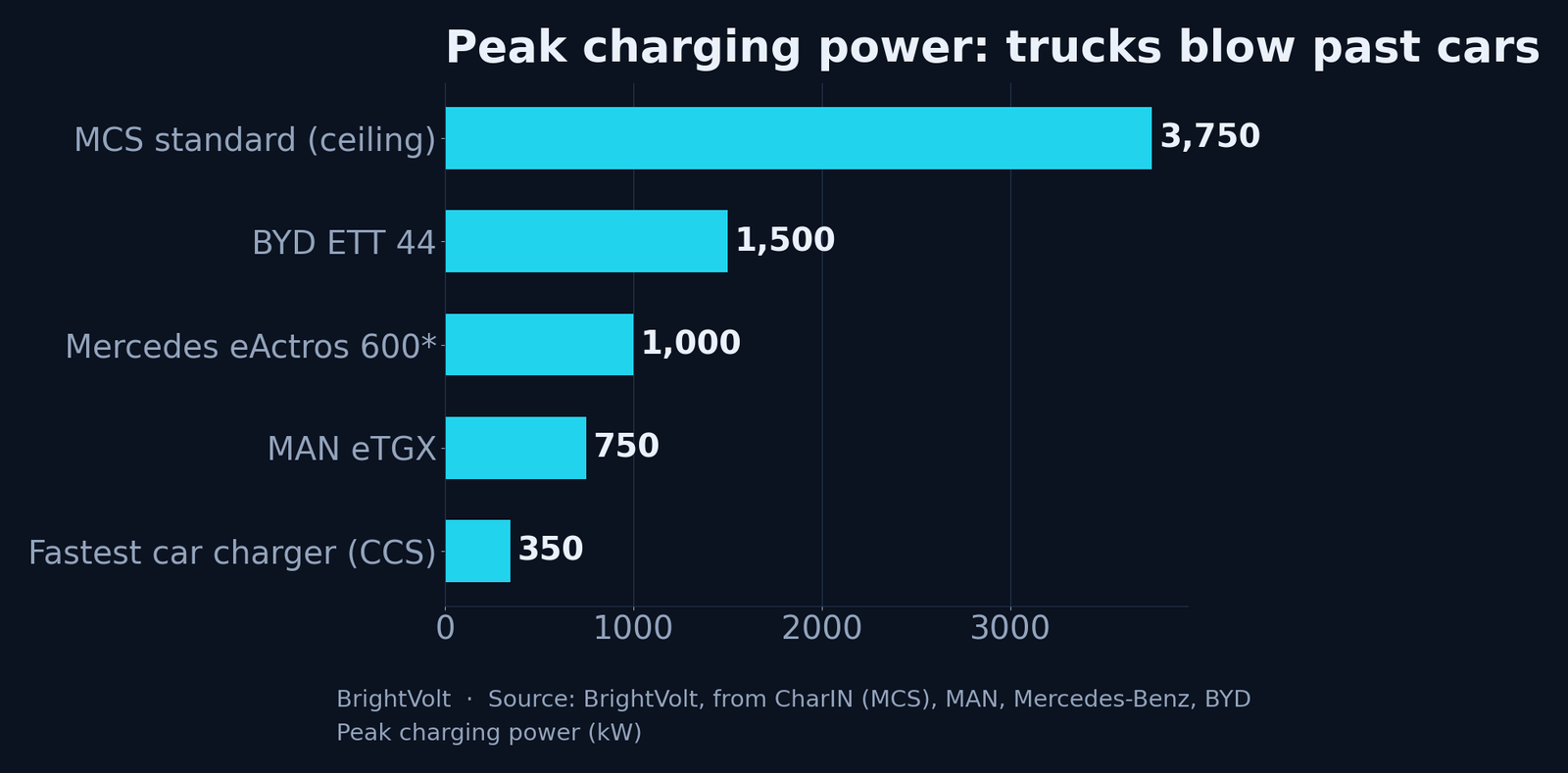
The enabling standard is the Megawatt Charging System (MCS), whose connector specification was finalised as IEC 63379 in February 2026. It tops out at 3.75 MW — 1,250 volts at 3,000 amps — more than ten times what the fastest car charger delivers. The trucks are built to use a serious fraction of it: MAN’s eTGX takes around 750 kW, the eActros 600 has demonstrated close to a full megawatt, and BYD claims more than 1.5 MW. Feed those rates into the mandatory break and the arithmetic closes.
The wall is no longer the truck
Which is exactly why the battery is no longer the hard part. A truck that accepts 750 kW to 1.5 MW is useless parked next to a charger that cannot supply it, and those chargers are barely in the ground. A single megawatt draw is more than a small factory pulls, so an MCS site needs either a heavy grid connection — on the same multi-year queue as everything else trying to plug in — or an on-site battery to buffer it, the same trick BYD uses on its car chargers. MAN now sells “smart depot charging” and energy management as part of the truck, which is a quiet admission that the vehicle is the easy half of the sale.
That is the real divide the Hanover show exposed. The battery-range problem, the one that filled a decade of electric-truck coverage, has effectively been solved for regional and national haulage. The charging-and-grid problem has not. Watch three things over the next year: whether MCS chargers actually appear along Europe’s freight corridors, whether grid connections keep pace with the trucks now rolling off MCS-ready lines, and whether the Chinese makers assembling in Austria undercut the incumbents badly enough to force the question. The read that would overturn all of this is simple to state: if genuine long-haul — beyond a legal day, across several days — turns out to need battery swapping or far larger packs after all, then range was only half-solved, and the swapping idea nobody wants to revive for trucks comes back onto the table.
Photo by Giovanni Spoletini on Pexels · Photo by Florian Avramescu on Pexels