
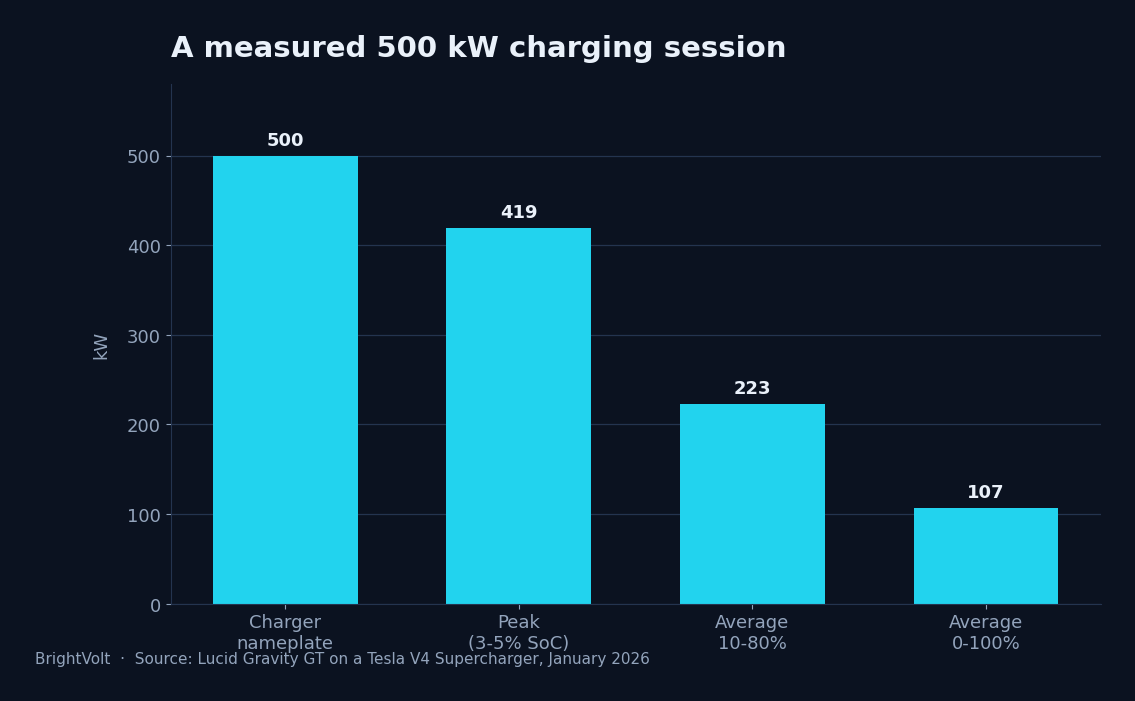
A Lucid Gravity GT was measured on a 500 kW Tesla V4 Supercharger in January 2026. It touched 419 kW — briefly, between 3% and 5% state of charge. It averaged 223 kW across the useful 10–80% window, and 107 kW across a full charge to 100%.
The number on the sign was 4.7 times the average the car actually received. That gap is not a fault. It is how charging works, and understanding the four reasons for it tells you more about an electric car than any range figure.
Reason one: the plug runs out of amps before the charger runs out of watts
Power is voltage multiplied by current. To pull 350 kW you need either high voltage or a great deal of current.
At a 400-volt pack you need 875 amps. At 800 volts, 438 amps. At 1,000 volts, 350 amps.
Most deployed CCS assemblies handle roughly 500 amps continuously — 700 in boost mode on premium liquid-cooled cables. So a 400-volt car on ordinary hardware cannot reach 350 kW through a CCS plug no matter what the charger is rated at. It hits the amperage wall somewhere around 200 kW. A newer generation of cable is pushing past 1,000 amps, which is how Alpitronic now claims a megawatt over CCS — but that is a handful of sites, not the plug in front of you.
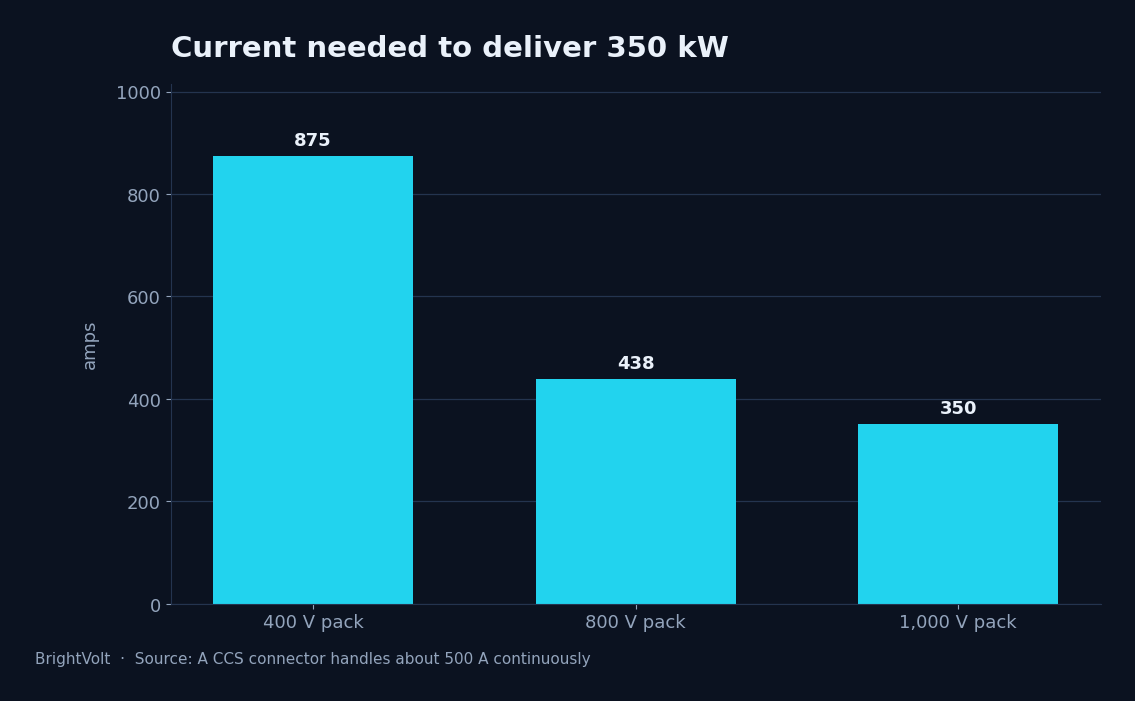
This is why 800-volt architecture is the specification worth caring about. It is not marketing; it is the difference between being able to use a fast charger and merely being plugged into one.
Reason two: heat rises with the square of current
Resistive loss scales with current squared. Double the amps and you quadruple the heat in the cable.
That is why high-power cables are liquid-cooled, and it produces a genuinely counterintuitive result: a liquid-cooled cable is thinner and lighter than an air-cooled one at the same power, because actively removing heat lets you use a smaller conductor. An air-cooled DC cable handles about 200 amps at 30–45 mm diameter and up to 2.8 kg per metre. A liquid-cooled one handles 400–600 amps at 22–30 mm and 1.2–1.6 kg per metre. Without that, nobody could lift the cable.
Temperature sensors sit in the plug and the cable, and they cut current as heat builds. The Megawatt Charging System specification caps pin and socket temperature at 100 °C.
Reason three: the battery decides, and it changes its mind as it fills
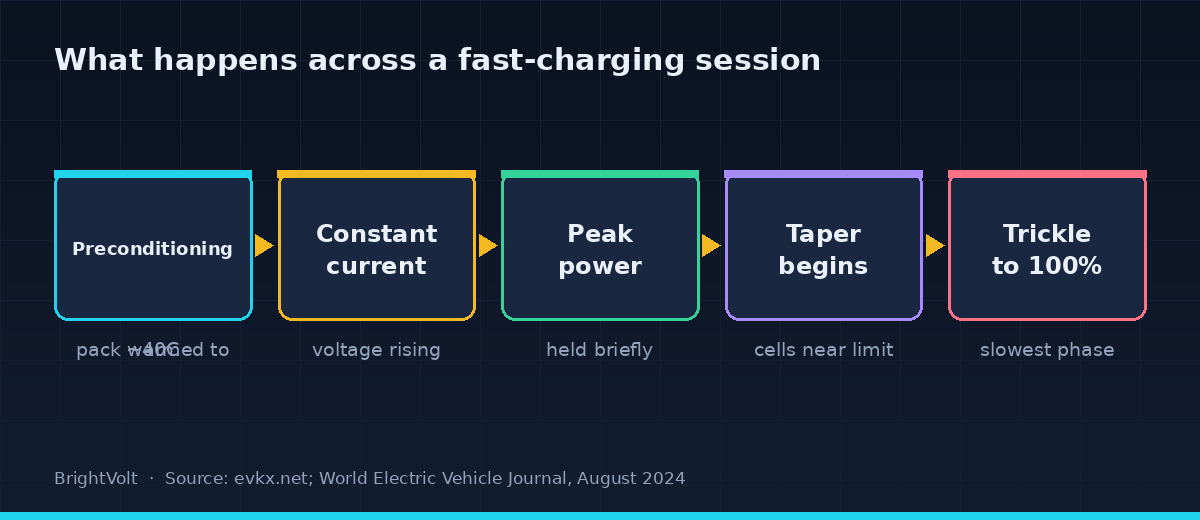
This is the big one. Tapering is not the charger throttling — it is the battery management system protecting the cells.
Early in a session the current is roughly constant and pack voltage rises. As the highest-voltage cell groups approach their limit, the BMS must cut current or risk overvoltage. Cold cells make it worse: higher internal resistance, slower ion movement, and a real risk of lithium plating, where lithium deposits as metal on the anode instead of intercalating. That damage is permanent, so the BMS is conservative.
Preconditioning matters more than most people realise. Peer-reviewed testing found that warming a pack to 40 °C an hour before charging cut charging time by up to 60% against an unheated pack — while the thermal management itself consumed over 10% of the energy delivered during an 18-minute charge.
Reason four: the rating on the cabinet is not the rating at your stall
Many stations split one power cabinet between two or more posts. Plug a second car in and your share drops.
Alpitronic’s HYC1000 illustrates it exactly. It can be fitted with up to four high-power dispensers, each capable of 1,000 kW over a CCS connector — and, in the manufacturer’s own words, the maximum system output remains one megawatt distributed among the vehicles charging in parallel. Four 1,000 kW dispensers on a 1,000 kW system.

C-rate, and why the numbers get quoted at all
C-rate is charging power divided by battery capacity. 250 kW into a 100 kWh pack is 2.5C; the same 250 kW into a 50 kWh pack is 5C. It normalises for pack size, which is why the industry uses it.
| C-rate | Theoretical time to add 70% | Where you see it |
|---|---|---|
| 1C | 42 min | Older, large-pack EVs |
| 2C | 21 min | Typical 2020-era premium EV |
| 4C | 10.5 min | Chinese truck supercharging |
| 6C | 7 min | Leading Chinese passenger packs |
| 10C | 4.2 min | BYD’s Super e-Platform claim |
| 12C | 3.5 min | CATL’s second-generation Shenxing claim |
Those times assume the rate is sustained across the whole window. No cell does that. Treat the column as an arithmetic ceiling, not a prediction.
Ten to eighty is the convention because that band is where charging is fastest and most linear. Watch for quotes that are not. Every European truck maker currently quotes 20–80%; BYD quotes 10–70% for its five-minute claim. Those are not comparable to each other, let alone to a 10–80% figure.
Where megawatt charging actually is
The Megawatt Charging System is not one finished standard. The connector was standardised as IEC TS 63379 in February 2026. The charger-side standard, IEC 61851-23-3, is still in draft. SAE’s J3271 remains a Technical Information Report rather than a recommended practice.
The theoretical ceiling is 3.75 MW — CharIN’s 1,250 volts at 3,000 amps. Figures of 4.5 MW in circulation use the connector’s insulation rating rather than the system operating point.
Reality is a long way below both:
| Power | |
|---|---|
| MCS specification ceiling | 3,750 kW |
| Best shipping charger (Power Electronics, Milence) | 1,440 kW |
| ABB, Kempower, Tesla Megacharger | 1,200 kW |
| MAN’s series-production MCS truck, July 2026 | 750 kW |
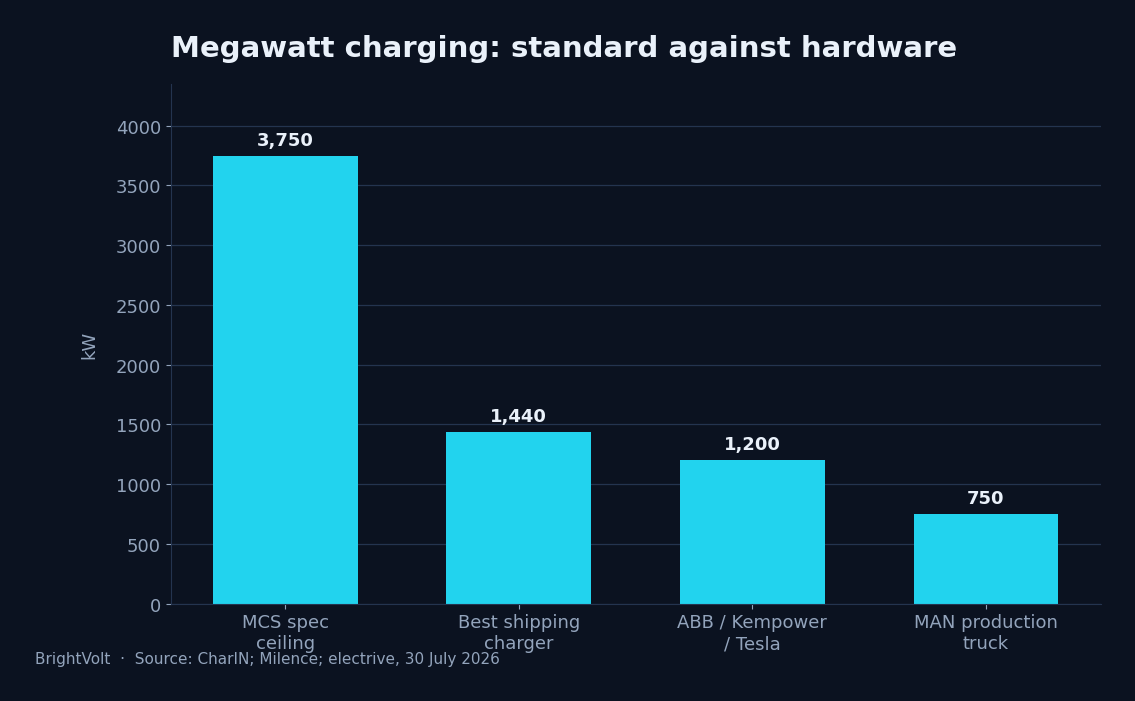
The truck that entered series production takes a fifth of what the standard allows.
China is doing something different, and it is not a standard
This is where most coverage goes wrong. BYD’s flash charging, Huawei’s 1.5 MW system, Zeekr’s 1.2 MW unit and Dongfeng’s 1,500 kW charger announced in July 2026 are all proprietary, not national standards. China’s actual standard, the 2023 GB/T revision with the ChaoJi interface, runs to 1,500 volts and 800 amps.
The deployment gap is worth holding onto. BYD had built 6,682 flash-charging stations across 321 cities by mid-June 2026 against a stated year-end target of 20,000 — meaning 13,318 in six months. Announced capacity and operating capacity are different industries, in charging as in everything else.
Meanwhile in the US, connector counts as of January 2026 were NACS 37,500, CCS1 31,350 and CHAdeMO 8,900 — and CCS1 grew faster in absolute terms during 2025 than NACS did, because federal funding rules still require a CCS1 connector on every subsidised port.
What to actually look for
Ignore the peak. Ask for average power over 10–80%, and the state of charge at which the peak occurred — a car that hits 400 kW at 4% and collapses below 150 kW by 40% will lose to one that holds 250 kW across the whole window.
Then check the pack voltage. An 800-volt car on a 350 kW charger is a different proposition from a 400-volt car at the same post, and no amount of charger upgrading changes that.
Photo by Kindel Media on Pexels · Photo by Reinhard Bruckner on Pexels