
OpenAI’s promise to cut up to 1,000 MW from its Georgia data centre when the grid is strained is the right idea, published as half a number. A megawatt figure with no hours, no event count and no notice period tells a grid planner almost nothing. And the best evidence says the missing hours would cost OpenAI very little — which is exactly why every large load should be made to state them.
The deal itself is real. Under a 25-year agreement with Georgia Power, announced in July and approved by state regulators in August, the utility can reduce power to OpenAI’s planned 3,200 MW campus in Effingham County “during certain times” by up to 1,000 MW. On 2 November OpenAI wrapped that into a national Grid Protectors Program and said future campuses would carry similar commitments. Georgia Power calls the Georgia contract “among the largest single-facility demand response commitments in the country.” That is probably true. It is also, as published, a capacity claim with no energy behind it.
What a 1,000 MW pledge actually promises
It promises a ceiling, not a service. The Georgia Power release says the utility “will have the ability to reduce energy delivered” to the site, and that this will let it “invest in fewer new generation resources.” It does not say for how long, how often, or with how much warning. OpenAI’s own announcement, as reported, says it will agree with each utility “how much power each campus can give up, how quickly and for how long”, and that terms will vary by site. Neither document publishes maximum curtailment hours or a notice period.
Those terms are not fine print. They decide whether the 1,000 MW is worth anything. A grid does not run short for an instant. It runs short through a winter cold snap or a run of August evenings. A load that drops 1,000 MW for twenty minutes and then comes back is worth very little to a planner sizing a fleet for a three-hour peak. If the same load holds the cut for four hours on any of fifty days a year, it is worth roughly a gas peaker. Same headline, very different asset.
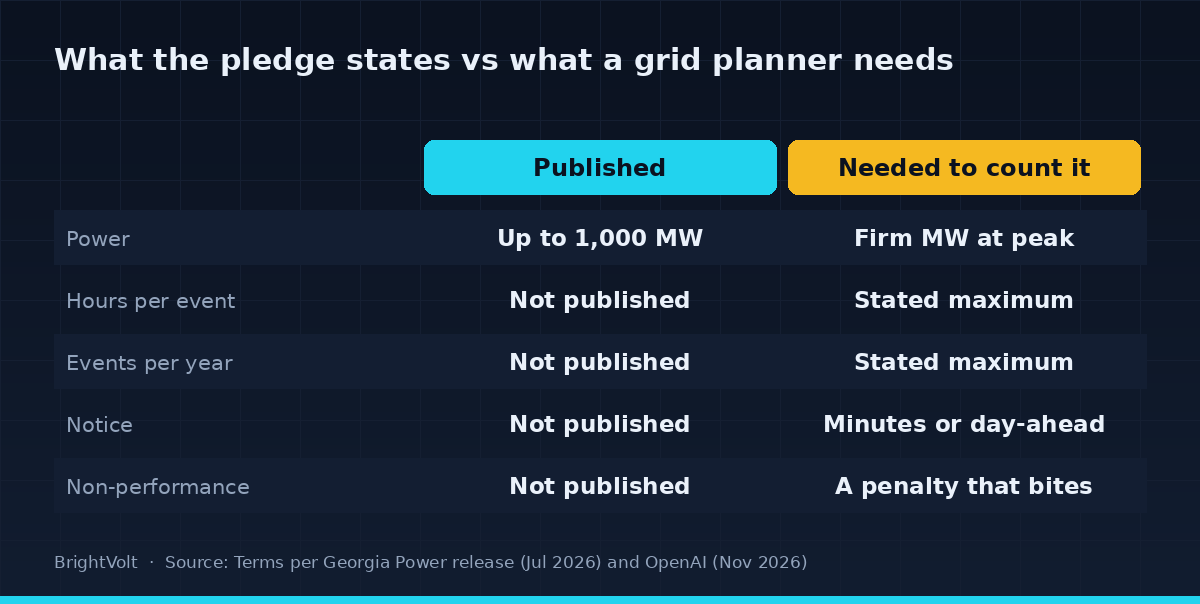
This is the same mistake we keep catching in storage headlines, where a gigawatt figure gets read as if it were gigawatt-hours. Flexible load is storage turned inside out: the energy that never gets drawn. It needs the same two numbers.
Why the missing hours are probably cheap to give
Here is the part that should make OpenAI comfortable publishing the hours: the grid needs remarkably few of them. Duke University’s Nicholas Institute modelled 22 US balancing authorities, covering about 95% of national peak load, and found they could take on 76 GW of new load if that load would accept curtailment of just 0.25% of its maximum annual energy. At 0.5% the figure rises to 98 GW; at 1%, 126 GW. Those are the report’s own numbers, and POWER’s coverage matches them.
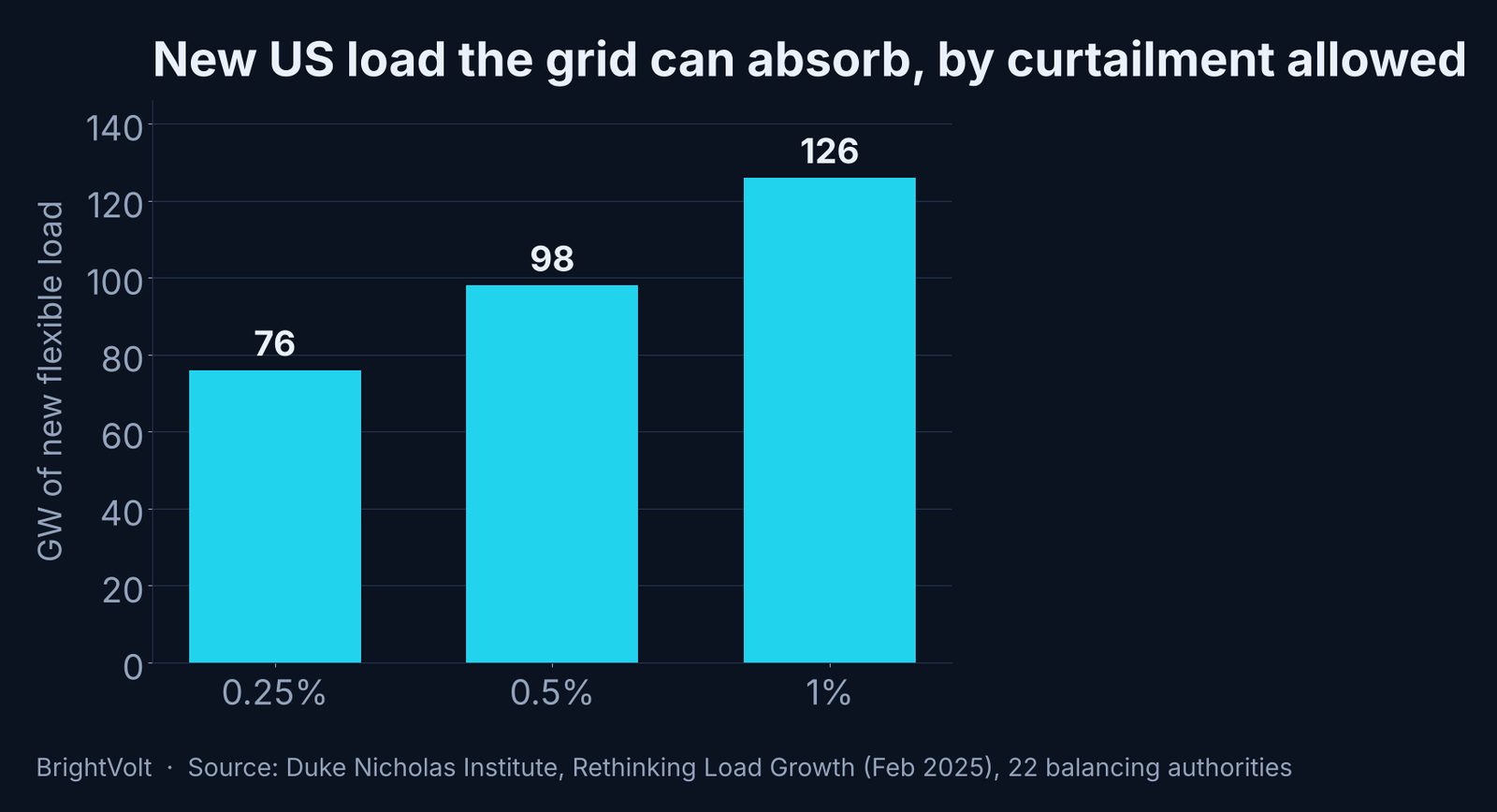
The shape of those cuts matters as much as the total. Average curtailment events in the study last 1.7 hours at the 0.25% rate, 2.1 hours at 0.5% and 2.5 hours at 1%. Nearly 90% of the hours that need curtailment still keep at least half of the new load running. In plain terms, 0.25% of a year’s energy is the equivalent of about 22 hours at full shutdown, spread across short, partial events. A cap of roughly a third of site load, which is what 1,000 of 3,200 MW comes to, fits that profile almost exactly.
The hardware evidence points the same way. In December 2025 National Grid, EPRI, Nebius, NVIDIA and Emerald AI ran a cluster of 96 Blackwell Ultra GPUs in London through more than 200 simulated grid events. The cluster cut demand by up to 40%, shed about 30% of load in around 30 seconds and followed reduction requests lasting up to ten hours. T&D World’s account confirms the cluster, the event count and the 40% and 30-second figures. An earlier Phoenix test at an Oracle site held a 25% cut for three hours during a peak afternoon, according to Emerald AI, which cites a Nature Energy paper. The trick is unglamorous: pause or throttle the deferrable work, such as batch training, evaluation and prefetch, and leave live inference alone.
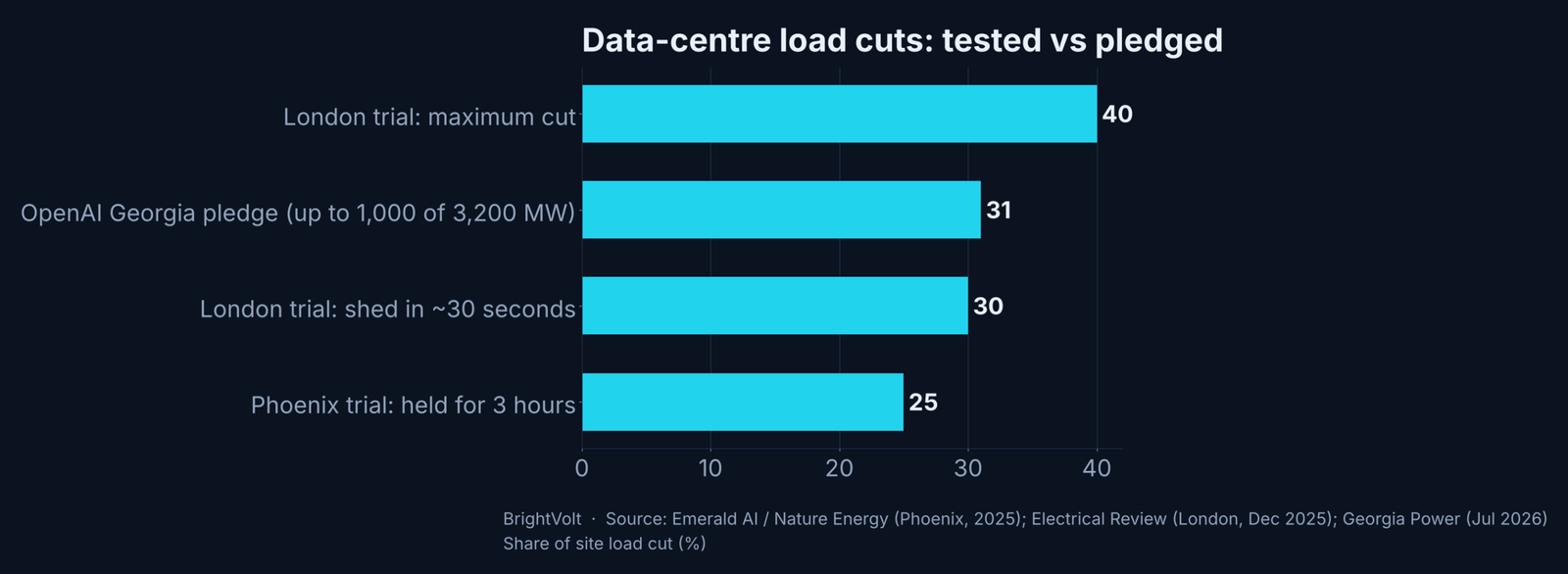
Caveat the scale, though. Ninety-six GPUs is a few racks, and a 3,200 MW campus is a power station’s worth of demand. The trials show the control works. They do not show it works at a thousand megawatts, on a 25-year contract, through a heatwave.

The strongest objection, and why it does not hold
The best case against our position is that AI compute is not a dishwasher. Training runs cost tens of millions of dollars, customers buy inference on uptime guarantees, and an operator that commits to being switched off takes on a financing risk its competitors do not. On that view, a voluntary, undisclosed pledge is the most anyone can reasonably ask, and publishing hard limits would only scare investors.
It is a serious argument. OpenAI has partly answered it already. Its 31% cap leaves more than two thirds of the campus untouched, and the workloads it would throttle are the deferrable ones. More to the point, financing risk is exactly what published terms reduce. A lender can price “no more than X hours across Y events, with Z minutes’ notice”. It cannot price “certain times.” The secrecy protects nobody except whoever wants the headline to sound bigger than the contract.
There is also a reason this matters beyond Georgia. Our recent Takes tracked data centres lining up gas to skip the interconnection queue and building it behind the meter, where no one counts it. Flexible load is the third route, and the only one that adds demand without adding a power station. It deserves to be judged on terms specific enough to compare with the other two.
What we would make the rule, and what would change our mind
Our view is that flexibility should be a condition of connection for any new load above a few hundred megawatts, not a pledge, and that the contract should publish five numbers: the megawatt cap, maximum hours per event, maximum events a year, notice time and the penalty for not delivering. OpenAI itself concedes that flexibility “cannot replace investment in new energy supply and transmission.” Fine. Then show how much of that investment it actually replaces.
Two things would prove us wrong. If the Georgia terms come out and the curtailment right turns out to be generous, say dozens of multi-hour events a year at short notice, then OpenAI has offered more than the Duke profile requires, and we have been unfair to the pledge. If instead Georgia Power’s next resource plan shows no reduction in new generation that could be traced to the contract, then the 1,000 MW was a press release, and “Grid Protectors” was branding. Either outcome would be informative. The current one, a big number with no hours, is not.
Photo by Robert So on Pexels · Photo by panumas nikhomkhai on Pexels