
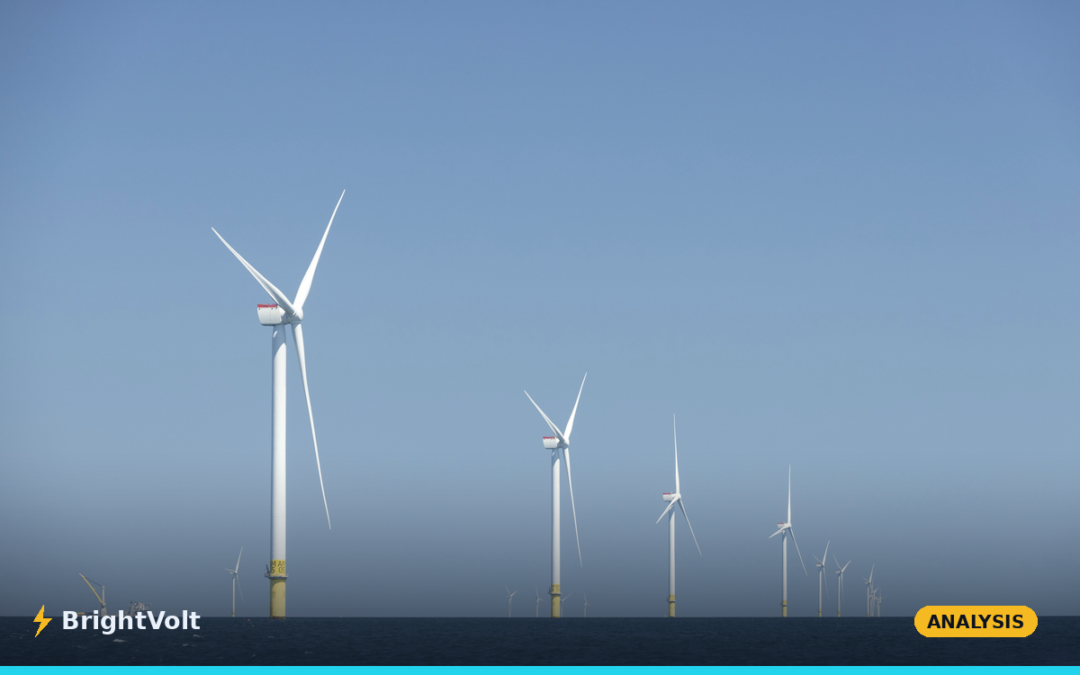
Revolution Wind, the 704 MW offshore wind farm 15 miles south of Rhode Island, entered full commercial operation in October, Ørsted confirmed on 5 November. Rhode Island buys its 400 MW share at a flat 9.84 cents per kWh for 20 years. That is above what New England’s wholesale energy averaged last year, and well below what households will pay for supply this winter.
Both of those facts are true, and the gap between them is the whole economic case for the project. Revolution Wind is not cheap electricity. It is a fixed price in a region whose prices are not fixed at all, and it earns its money in January.
What came online, and what it took
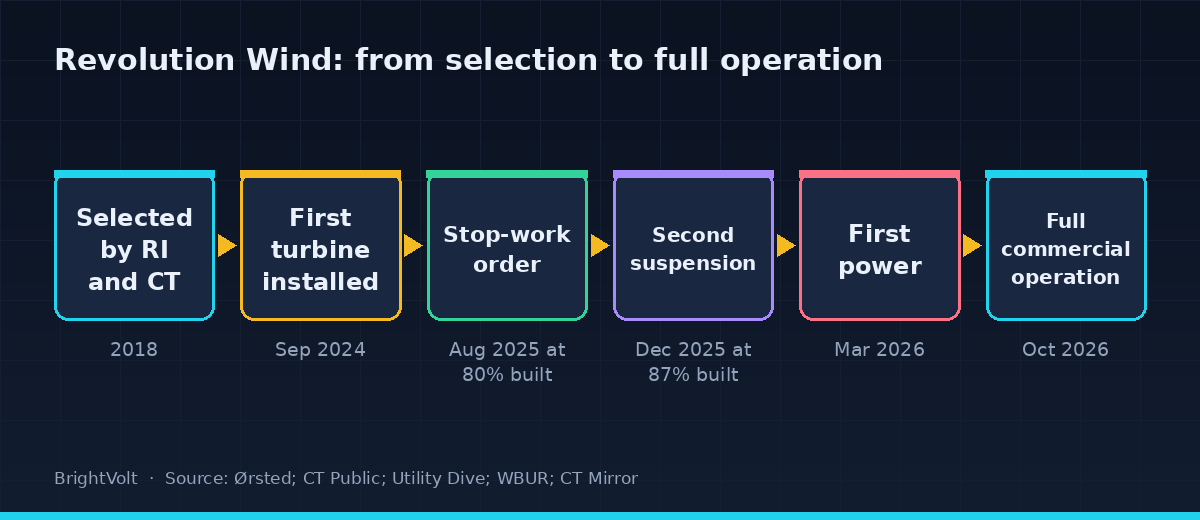
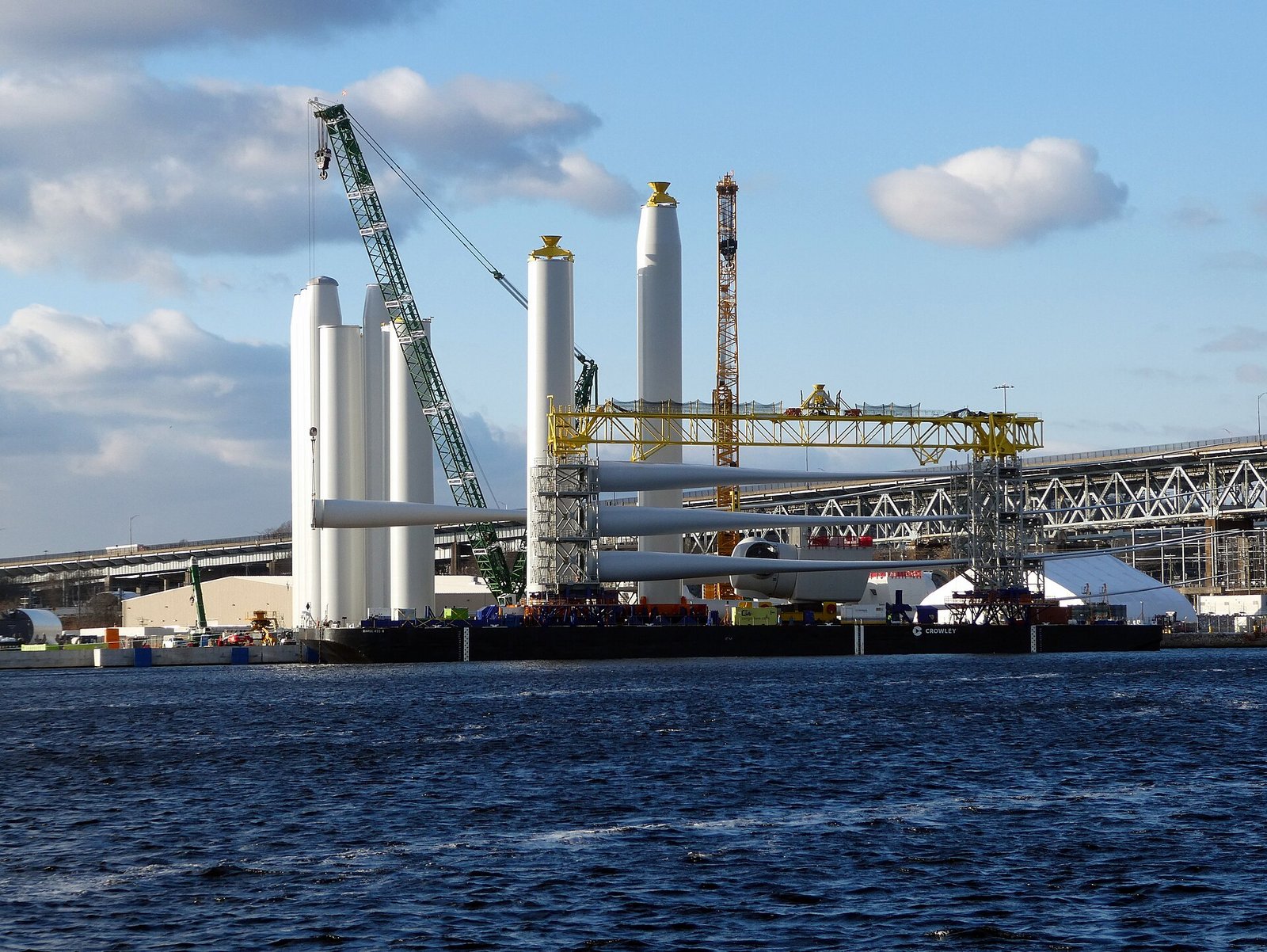
The farm is 65 Siemens Gamesa 11 MW-class turbines, built as a 50-50 venture between Ørsted and Skyborn Renewables at a cost of about $6bn, according to POWER and offshorewind.biz. The first turbine went in during September 2024, power first reached the grid in March 2026 and the last turbine was installed in September. Rhode Island takes 400 MW and Connecticut 304 MW; the developers put the output at the equivalent of about 350,000 homes.
The route there ran through two federal shutdowns. On 22 August 2025 the Bureau of Ocean Energy Management ordered work to stop on national-security grounds, when — by Ørsted’s own count that day — the project was 80% complete, with every foundation and 45 of 65 turbines installed. Judge Royce Lamberth lifted the order a month later, as Utility Dive reported. In December the Interior Department suspended five East Coast projects at once, Revolution Wind among them at roughly 87% built; a preliminary injunction in January let work resume, per WBUR.
It is not over. On 9 October, with the farm in final commissioning, the Justice and Interior departments asked the court to send the 2023 construction-plan approval back to Interior for reconsideration, as CT Mirror reported. That request is still pending. A finished, generating wind farm is now the subject of a bid to revisit whether it should have been permitted.
Revolution Wind was not alone. Vineyard Wind 1, the 62-turbine project off Massachusetts, reached full commercial operation on 29 October. In the space of a fortnight, US offshore wind in full commercial service went from 162 MW to about 1,670 MW.
| Project | Capacity | Status, November 2026 |
|---|---|---|
| Block Island (RI) | 30 MW | Operating since 2016 |
| South Fork (NY) | 132 MW | Operating since March 2024 |
| Revolution Wind (RI/CT) | 704 MW | Full commercial operation, October 2026 |
| Vineyard Wind 1 (MA) | 806 MW | Full commercial operation, 29 October 2026 |
| Coastal Virginia Offshore Wind | 2,600 MW | Partly generating; ~85% complete, finish targeted end-2027 |
| Empire Wind 1 (NY) | 810 MW | ~80% complete; first power first half of 2027 |
| Sunrise Wind (NY) | 924 MW | Foundations installed; full commissioning second half of 2027 |
Sources: LIPA, MV Times, offshorewind.biz, gCaptain, Ørsted.
Is 9.84 cents a kWh a good price?
It depends entirely on which New England you compare it with. The Rhode Island contract is $98.425 per MWh, flat for 20 years with no escalator, according to the state’s Office of Energy Resources. Connecticut’s share is priced at about $99 per MWh, unchanged since signing.
Against the ISO New England market monitor’s 2025 figures, that looks dear: day-ahead energy averaged $71.81 per MWh, or 7.2 cents. Against the region’s all-in wholesale cost of about $127 per MWh, once capacity and other charges are added, it looks cheap. And against Rhode Island Energy’s proposed winter supply rate of 17.03 cents, it is a bargain.
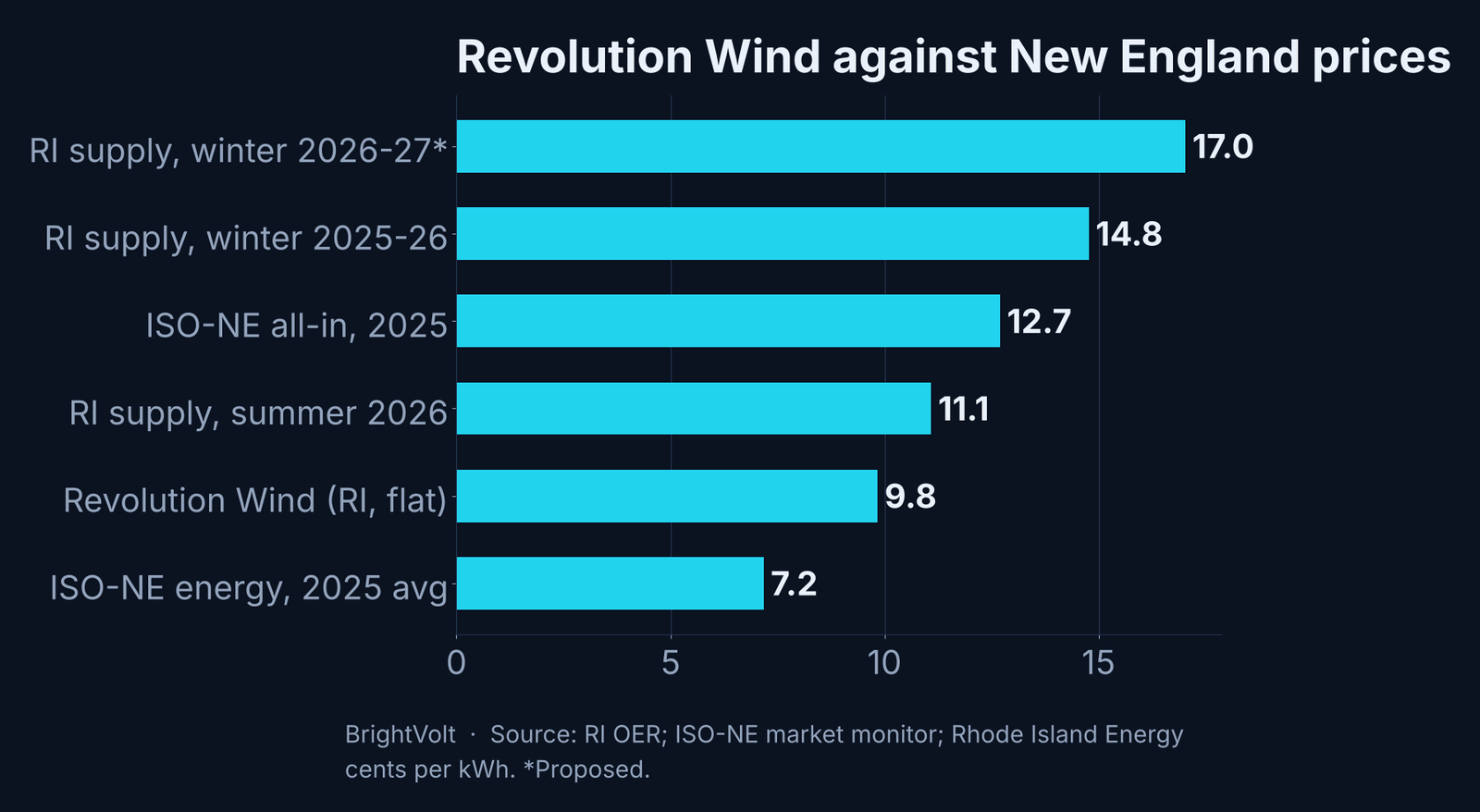
Some coverage this week described the contract as less than half the current average price. That only holds against the full retail bill, transmission and distribution included, which wind power does not replace. The honest comparison is the supply line, and there the contract is about 58% of this winter’s proposed rate. Still a good deal. Not a miracle.
The comparison is also not quite like for like. The contract price bundles renewable energy certificates, which Rhode Island’s utility would otherwise have to buy separately to meet the state’s renewable standard. The supply rate does not.
Where the savings actually come from
The state’s own analysis is clear about the mechanism. It credits the contract with $374m in direct net savings over 20 years, in 2026 dollars, plus $139m from pushing down wholesale prices, an average reduction of 0.24 cents per kWh across 2026–2046. Neither number comes from the farm undercutting gas on an average day. They come from New England’s habit of tying its electricity price to gas, and gas spiking when the weather turns.
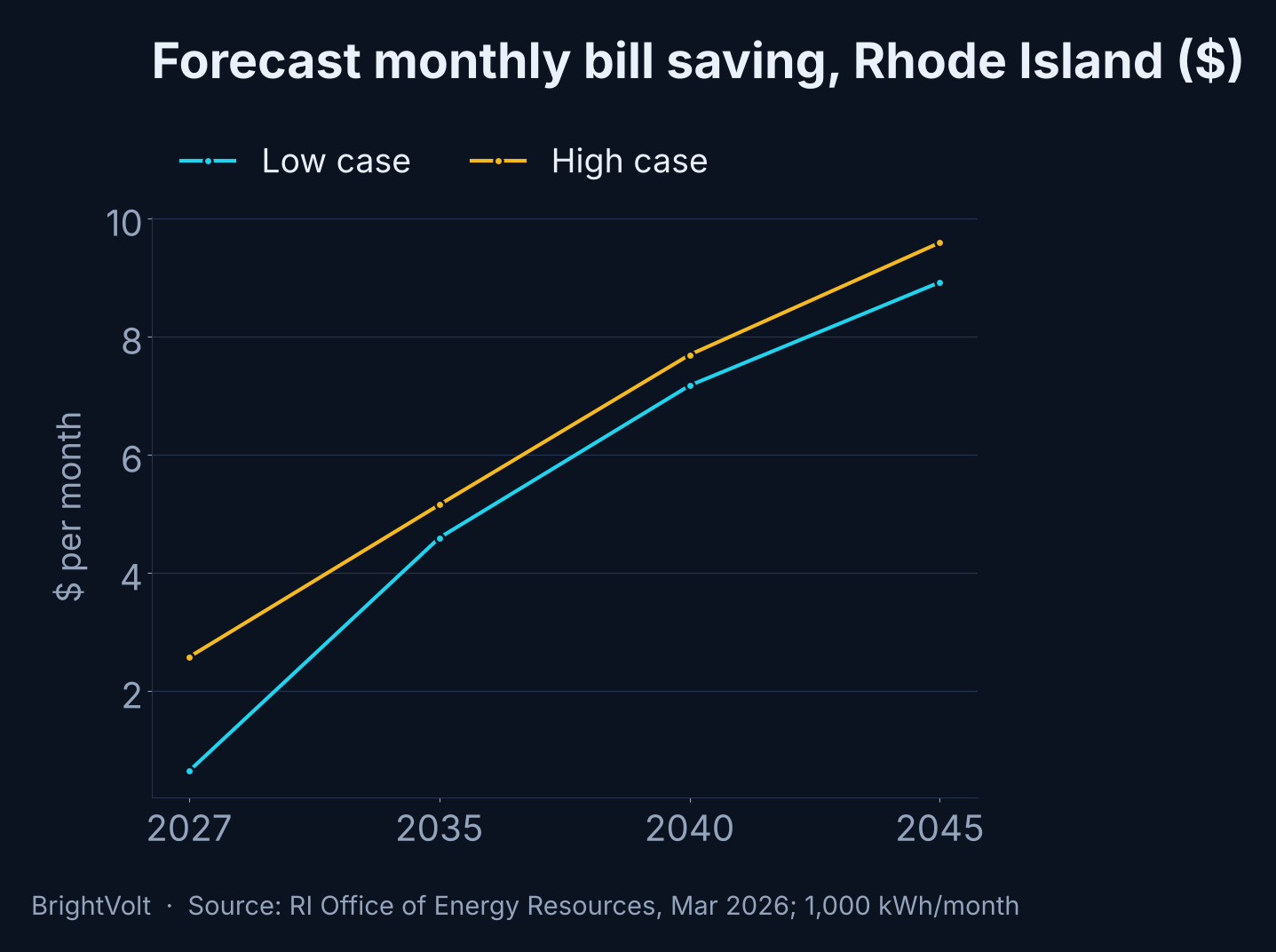
That is why the bill savings start small. For a household using 1,000 kWh a month, the office forecasts savings of $0.64 to $2.57 a month in 2027, rising to $8.92 to $9.59 by 2045. A flat nominal price gets cheaper in real terms every year it is held; the projected wholesale price around it does not.
This is the logic of the two-sided contracts for difference Britain uses, reached by a different route: lock the price of a capital-heavy asset with near-zero fuel cost, and let the gas price carry the volatility on its own. Connecticut’s energy department put its state’s share at $150m–$200m over 20 years, plus regional wholesale savings once the larger pipeline of projects arrives.
What would make the deal look bad
Two things, and both are measurable.
The first is cheap gas. ISO New England’s 2025 energy price was up 73% on 2024, on gas averaging $6.27 per MMBtu. Run that rise backwards and 2024’s day-ahead average was roughly $41.50 per MWh — less than half the contract price. If the region returns to that world and stays there, the $374m shrinks, and the early years could be a net cost. The state’s model assumes it will not. Given that a single cold week in January was worth $14m, we think the model has the better of the argument — but it is a bet, not a certainty.
The second is the court. If the remand request succeeds and the construction approval is reopened, a farm that is already built and already generating becomes a stranded-risk question rather than an energy one. Nobody has yet explained what remedy would follow for a project that is finished. The same pressure has already made Washington pay developers to abandon leases; a finished farm is a much larger target.
What to watch next
Lamberth’s decision on the October remand request is the first test. The second is this winter’s ISO New England price record: a cold January with gas above $10 would show the hedge working in a single month, and the state will almost certainly publish the figure. Sunrise Wind and Empire Wind, both due in 2027, will then show whether the 2026 finishes were the end of a cycle or the middle of one.
Our read: judged on the average day, Revolution Wind is a slightly expensive way to make electricity. Judged on the cold weeks that set New England’s bills, it is insurance, bought at a price fixed until 2046. What would prove that wrong is a run of mild, cheap-gas winters long enough that wholesale prices settle back near 2024’s levels and stay there.
Image: Ørsted · Photo: Pi.1415926535 / Wikimedia Commons (CC BY-SA 4.0)