
A contract for difference fixes the price a wind or solar farm is paid for its power, and it does it in both directions. When electricity sells below that agreed “strike price”, the generator is topped up to it. When it sells above, the generator pays the difference back. In Britain’s 2021–23 gas-price spike, that second clause turned wind farms into net payers and returned an estimated £660m to consumers. It is the single most important instrument in how offshore wind gets built, and “subsidy” is the wrong word for most of what it does.
What a contract for difference actually does
A contract for difference (CfD) is a 15-to-20-year agreement between a low-carbon generator and a government-owned counterparty — in the UK, the Low Carbon Contracts Company. It sets one number, the strike price, in pounds per megawatt-hour. Every settlement period, that strike price is compared against a market reference price. If the reference price is lower, the counterparty pays the generator the gap. If it is higher, the generator pays the gap back. The generator therefore earns the strike price and almost nothing else, whatever the market does.
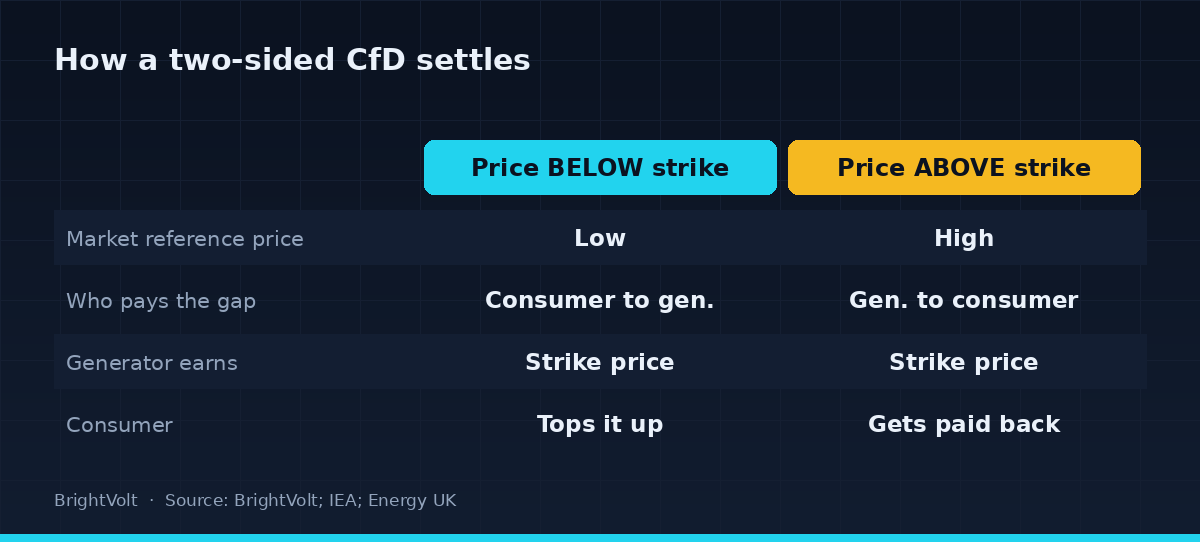
That symmetry is the whole design. A feed-in tariff, the older instrument, only ever pays out. A CfD is a hedge: it strips the wholesale price out of the generator’s revenue entirely, in exchange for handing the upside back to the consumer when prices run hot. The generator is not being handed money. It is being handed certainty, and paying for it whenever the market would have paid more.
Why a fixed price makes the power cheaper
An offshore wind farm is almost all upfront cost. The turbines, the foundations, the cables and the installation vessels are paid for before the first unit is sold, and the wind is then free for 25 years. When nearly all the cost is borrowed capital, the interest rate on that capital is most of the price of the electricity — far more than for a gas plant, which spends its life buying fuel.
This is why revenue certainty is worth so much. A developer facing the open wholesale market has to borrow against a price nobody can forecast for 25 years, and lenders charge dearly for that risk. Guarantee the revenue with a CfD and the same project borrows at a much lower rate, because the bank is now lending against a government-backed cashflow rather than a bet on gas prices. The lower cost of capital flows straight through into a lower strike price the developer can afford to bid. Fixing the price is not the opposite of cheap power. It is the mechanism that produces it.
Why “subsidy” is the wrong word
Call something a subsidy and you imply money flows one way, from the public to the company. A two-sided CfD does not reliably do that, and for a stretch of the last decade it did the reverse.
When wholesale power prices soared through 2021 and 2022 as gas prices spiked, they sat far above the strike prices that offshore wind farms had locked in years earlier at £40-something per megawatt-hour. Every one of those farms was now selling into a market paying two or three times its strike price — and under the CfD, it had to pay the surplus back. The Energy and Climate Intelligence Unit estimated wind farms would return around £660m to consumers over the 18 months to spring 2023, roughly £390m of it in 2022 alone. The CfD levy on household bills for April 2022 was set to essentially zero as a result, worth about £35 to a typical home against the previous year.
A feed-in tariff would have kept paying those same farms a fixed top-up through the whole crisis, on top of the sky-high market price. The two-way CfD did the opposite, and that is the point defenders make: the consumer buys down the developer’s risk in the lean years and collects the windfall in the fat ones.
The 2023 auction that bought nothing
None of this makes a CfD a magic wand, and the clearest proof came in 2023, when a UK auction for offshore wind received no bids at all. The government had set the administrative strike price — the ceiling a bidder cannot exceed — too low. Turbine, steel and financing costs had jumped, the ceiling had not moved with them, and at that number no developer could make the sums work. Zero megawatts were awarded.
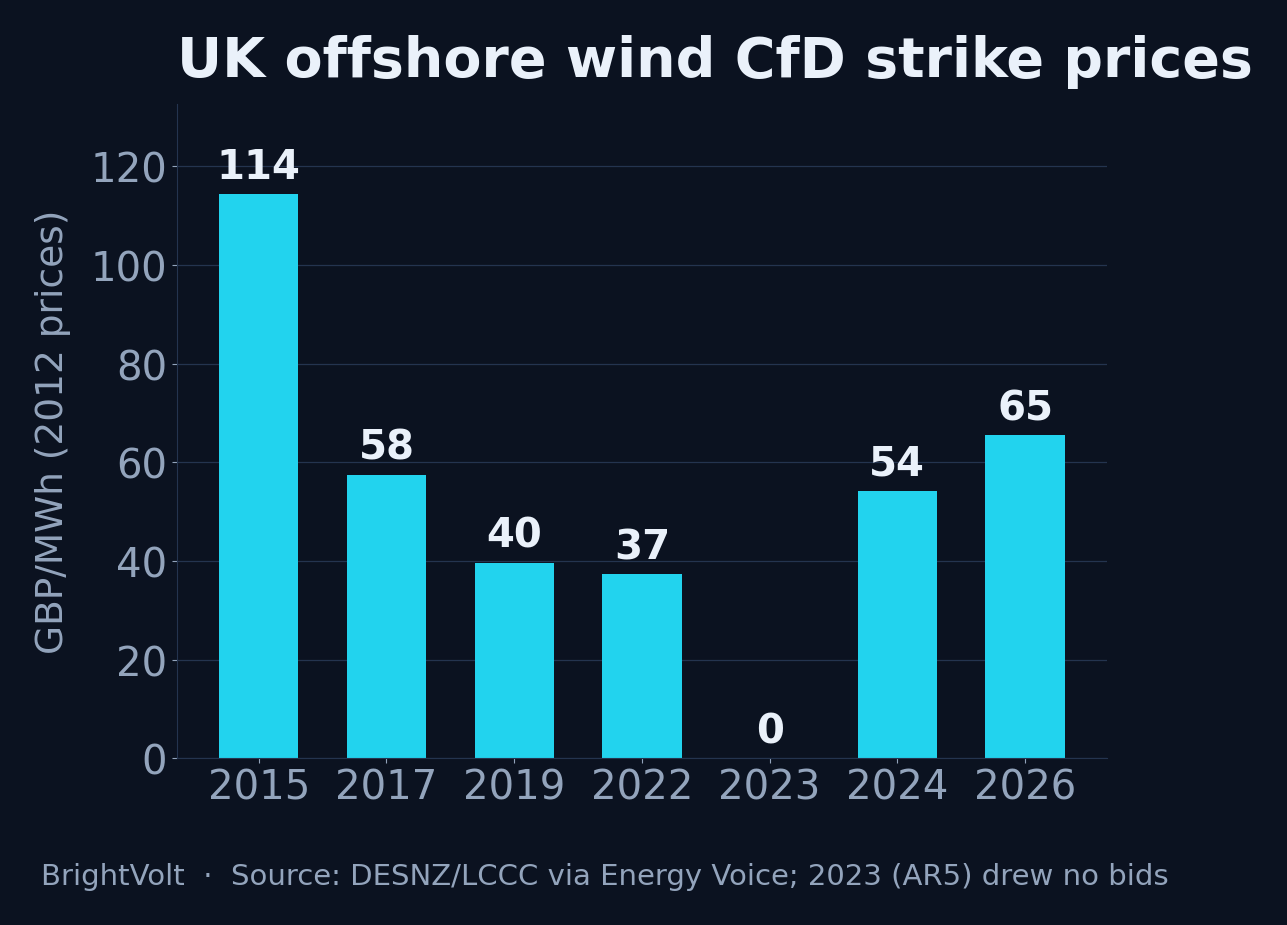
The strike-price history tells the story better than any argument. Britain’s rounds drove offshore wind from around £114/MWh in 2015 (in constant 2012 prices) down to a £37.35 floor in 2022 — a genuine and dramatic collapse in cost. Then the 2023 round demanded the impossible, got nothing, and the government had to raise the ceiling and lengthen contracts from 15 to 20 years to bring bidders back. The January 2026 AR7 auction then cleared a record 8.4 GW at £65.45 (2012 prices), higher than the 2022 low but competitive and, crucially, real. A CfD only works inside a price band wide enough to cover the developer’s actual costs. Set it below that band and the auction is a formality.
CfDs versus the alternatives
Every clean-power support scheme is a way of splitting price risk between the developer and the public, and they split it differently.
| Model | Revenue certainty | Price risk sits with | Pays back above strike? |
|---|---|---|---|
| Merchant (no contract) | None | Developer | N/A |
| Feed-in tariff | High | Public | No |
| Two-sided CfD | High | Public | Yes |
| Negative bidding | None on price | Developer | No |
A merchant project takes the full wholesale price and all the risk, which is why so little gets built on that basis. A feed-in tariff removes the risk but keeps overpaying when prices are high. Negative or dynamic bidding, the model that had developers paying billions upfront for the seabed, leaves the price risk with the developer and reappears as a higher cost of capital — the opposite of what a CfD is for. The two-sided CfD sits alone in transferring price risk to the public while also clawing back the upside, and that combination is why the EU’s electricity-market reform now points to it as the default for public support of new low-carbon generation, and why it already underwrites Hinkley Point C, Britain’s first new nuclear plant in a generation.
The number to watch is not the strike price on its own — a low one means nothing if the auction draws no bids, as 2023 proved. Watch the strike price against the developer’s real costs, and watch which direction the money actually flows once the farms are running. For most of the last five years, it flowed back.
Photo by John Lines on Pexels · Photo by Ola Noland on Pexels