
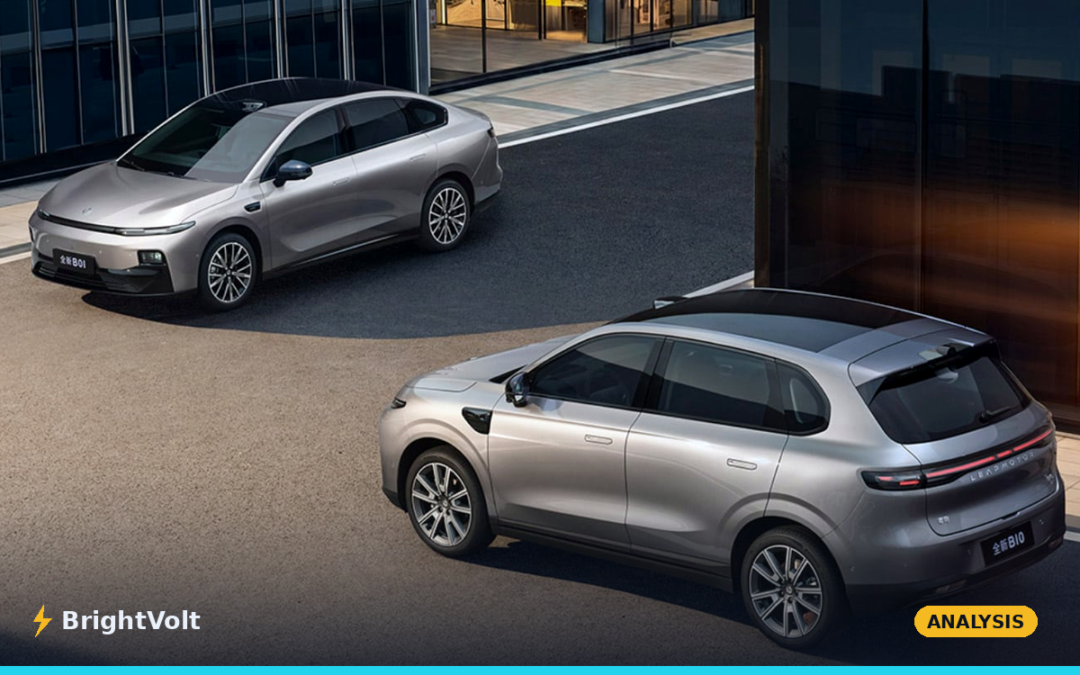
Leapmotor’s refreshed B01 saloon and B10 SUV went on sale in China on 16 July from ¥95,800 and ¥99,800 — about $14,100 and $14,700. The long-range versions carry an 800-volt silicon-carbide platform, peak at 210 kW on DC, and claim 670 km and 610 km on the CLTC cycle from a 69.7 kWh lithium iron phosphate pack. The most expensive car in either range is ¥125,800, or roughly $18,600.
Eight hundred volts used to be a badge for cars costing four times that.
What is actually in the car
| B01 saloon | B10 SUV | |
|---|---|---|
| Price | ¥95,800–119,800 (~$14,100–17,600) | ¥99,800–125,800 (~$14,700–18,600) |
| Battery | 60.8 or 69.7 kWh LFP | 60.8 or 69.7 kWh LFP |
| Range, CLTC | 590 or 670 km | 540 or 610 km |
| Power | 132 / 180 / 185 kW | 132 / 180 / 185 kW |
| 0–100 km/h | 6.1 s | 9.6 / 6.6 / 6.4 s |
| DC charge, 30–80% | 16 min | 16 min |
| Peak DC | 210 kW | 210 kW |
| Length | 4,770 mm | 4,515 mm |
| Drag coefficient | 0.197 (claimed) | — |
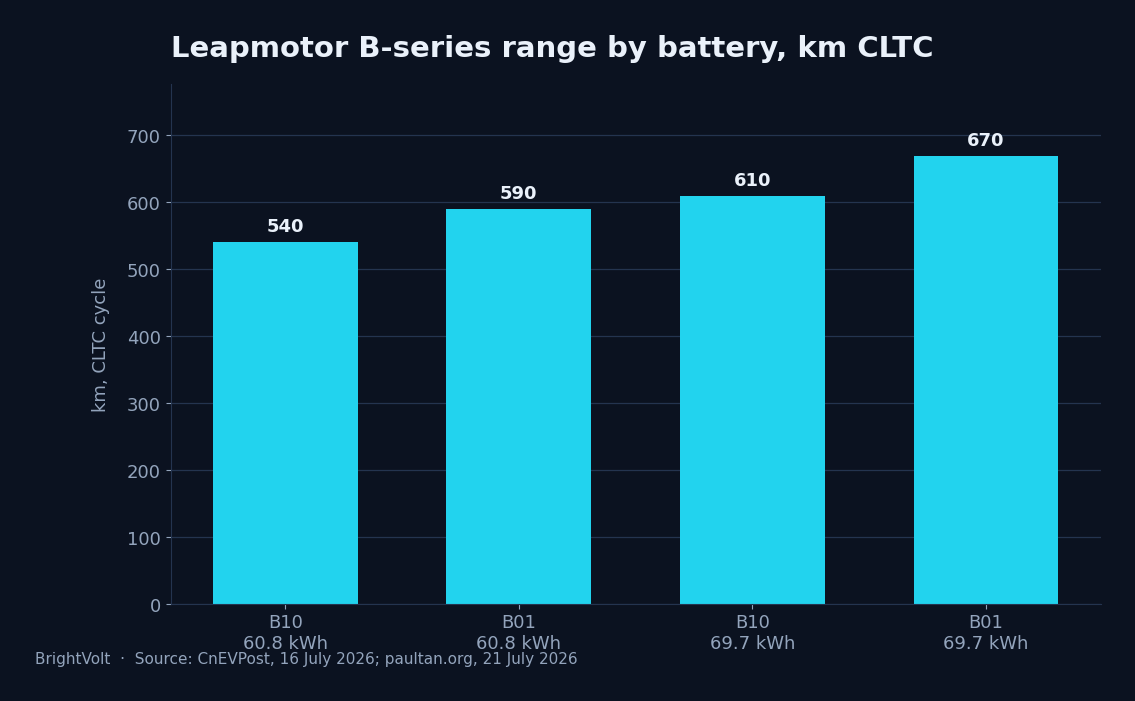
The efficiency figure is the one that deserves attention. Six hundred and seventy kilometres from 69.7 kWh is 10.4 kWh per 100 km on CLTC, which is genuinely low for a 4.77-metre saloon, and it is consistent with the 0.197 drag coefficient Leapmotor has claimed for the B01 since the Shanghai show in April 2025. If that Cd is real it puts the car among the slipperiest in production at any price — and the two claims corroborate each other, which is more than most manufacturer numbers manage.
The charging claim also survives a sanity check, which is not always true either. Moving 50% of a 69.7 kWh pack in 16 minutes needs about 131 kW sustained. A 210 kW peak makes that arithmetic work comfortably.
Which trims get the 800 volts, exactly
Here the coverage does not agree, and the disagreement is worth stating rather than resolving by picking a side.
CnEVPost attaches the 800V silicon-carbide platform specifically to “the 670-kilometer B01 and 610-kilometer B10” — the long-range cars. paultan.org’s trim breakdown reads the same way, putting the 132 kW entry car on 400V.
Chinese-market coverage says otherwise. Securities Times describes both cars as carrying the full-domain 800V silicon-carbide platform across the range, and Sina’s launch piece is explicit that the entry version already gets it. CarNewsChina describes a full-stack 800V platform without qualification.
No outlet in either language has published a complete five-variant price and specification table, which is why this is still open two weeks after launch. For a buyer it is the single most consequential question about the car, and for anyone writing about the price of 800V it decides whether the story is “$14,100” or “$17,600” — a 25% difference in the headline.
Why it matters outside China
Leapmotor delivered 93,376 vehicles in June 2026, up about 95% year on year, against a target of one million for the full year. The B-series is the volume engine for that target, and Stellantis — which holds just under 19% of the company and runs its international distribution — has the B10 lined up for export.
An 800V car claiming 610 km CLTC at under $19,000 arriving in Europe is a different object from the same car sold in Hangzhou. Apply the usual correction and 610 km CLTC is about 450 km WLTP, and 670 km is roughly 490 to 500 — paultan runs that conversion and lands in the same place, a 26% haircut that matches what other Chinese launches are showing this month. Even discounted, it is a European family car’s range at a Chinese city car’s price.
The equipment tells the same story. Two of the five variants in each range carry LiDAR, 27 sensors and a Qualcomm 8650 driving computer. Those are not the ¥95,800 cars — but they are somewhere below ¥125,800, which is roughly what a mid-spec European hatchback costs without any of it.
Leapmotor senior vice-president Cao Li was blunt about the lead this gives: “Even if competitors start to chase Leapmotor today, they might not catch up until next year.” That is a datable, falsifiable boast, and it is worth quoting precisely because it can be checked against what appears at this price point over the next twelve months.
What would settle it
A full variant table, first. Until Leapmotor publishes one — or a European price list forces the issue — the actual floor price for 800V in this segment is unknown, and every figure in circulation, including ours, carries that caveat.
Then an independent charging test reported over a 10–80% window rather than 30–80%, which would show whether the 210 kW peak holds up across the curve or spikes briefly and tapers. And a verified drag coefficient, because 0.197 remains a manufacturer claim rather than an independently measured figure, and the efficiency story rests on it.
Pre-orders opened on 8 July with a ¥99 deposit — about $15. Whatever demand figure Leapmotor eventually announces, that is what it will be measuring, and it is not much of a commitment.
Image: Leapmotor