
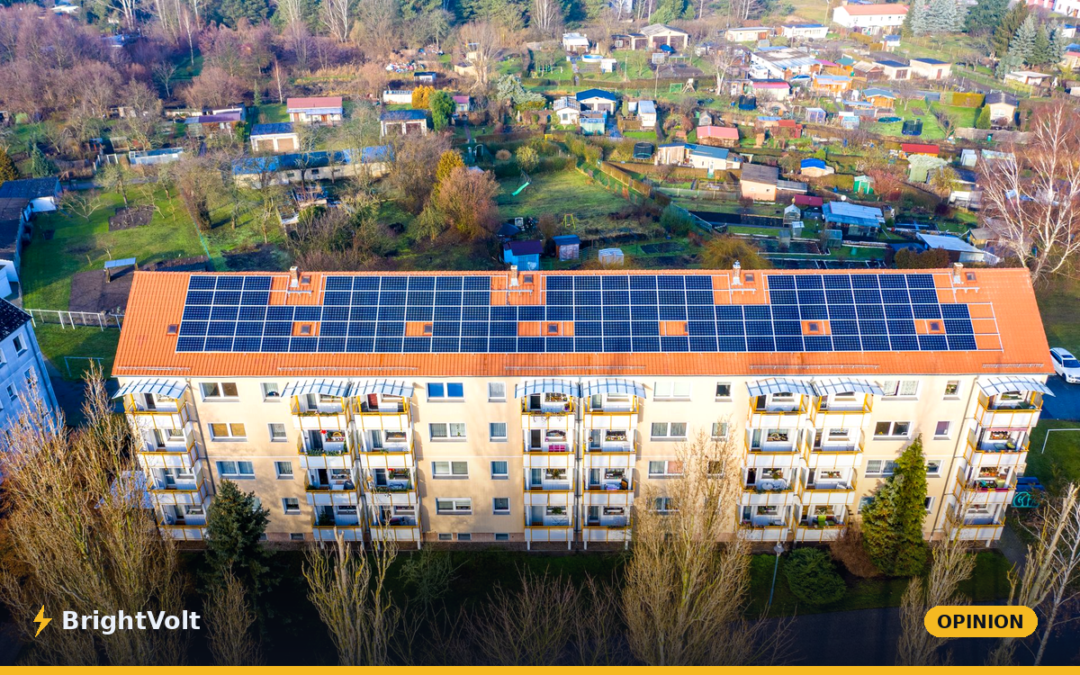
Germany has 1.31 million balcony-solar systems plugged into apartment sockets; the United States has almost none. The usual story is that America banned the things. It didn’t, quite — Utah legalised plug-in solar in May 2025 — and for most of the following year you still could not legally buy one. California’s new law, signed on 30 September, is being written up as the moment the German revolution finally crosses the Atlantic. It isn’t. The law was never the part that was broken.
Utah already proved the law was not the problem
A balcony-solar system is the cheapest, simplest form of solar there is: a panel or two, a small inverter, and a plug that goes into an ordinary wall socket. No roof, no installer, no utility contract. That last part is exactly what makes it legally awkward in the United States, because plugging a generator into a household circuit puts a power source and the loads it feeds on the same branch wiring — the arrangement the National Electrical Code was written to be suspicious of.
Utah went first anyway. Its HB 340 took effect on 7 May 2025, allowing portable systems up to 1,200 watts to feed a standard 120-volt outlet with no interconnection application, no utility approval and no fees. It passed the legislature unanimously, which tells you the politics were never the hard part either.
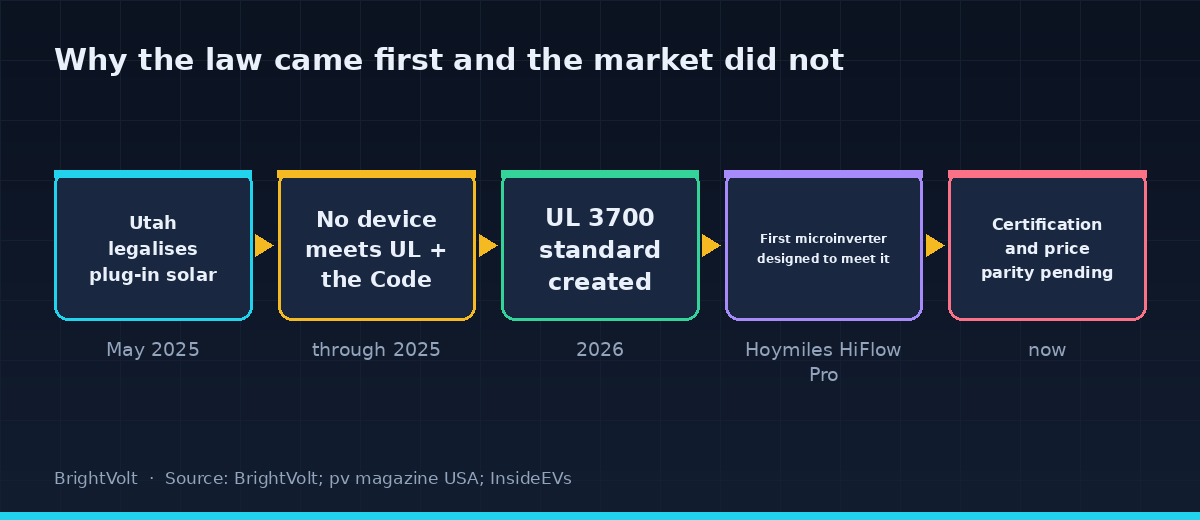
Then the hard part showed up. At the time the law passed, by the reporting around it, no device on sale met both UL safety listing and the Code at once. The state made balcony solar legal and the market offered nothing a cautious buyer could legally and safely install. A right to plug in is worth very little when the thing you would plug in does not exist.
What Germany actually did differently
Germany did not win on enthusiasm. It won on a standard and a form.
The numbers are not close. As of mid-April 2026 the German grid regulator’s registry held 1,311,919 balcony systems totalling about 1.34 gigawatts, with 435,344 of them — some 538 megawatts — added in 2025 alone. Annual installed capacity has risen more than tenfold since 2022. These are not hobbyists: four-panel kits averaging over 1,800 watts of modules are now the single most common configuration.
Three things built that. An inverter ceiling of 800 watts, raised from 600 in 2024, generous enough to be worth buying. A module allowance of 2,000 watts-peak behind it, so the panels can overproduce into a cloudy-day average. And a registration that is one online form in a national register, with the old requirement to notify your grid operator abolished. A kit to match starts around €350. The German buyer faces a clear wattage number, a single national rulebook and a device on the shelf at a price that pays itself back inside a few years.
| Germany | United States | |
|---|---|---|
| Installed base | ~1.31 million units, 1.34 GW | A few thousand at most |
| Inverter limit | 800 W | 1,200 W (Utah, California) |
| Module limit | 2,000 Wp | Not specified |
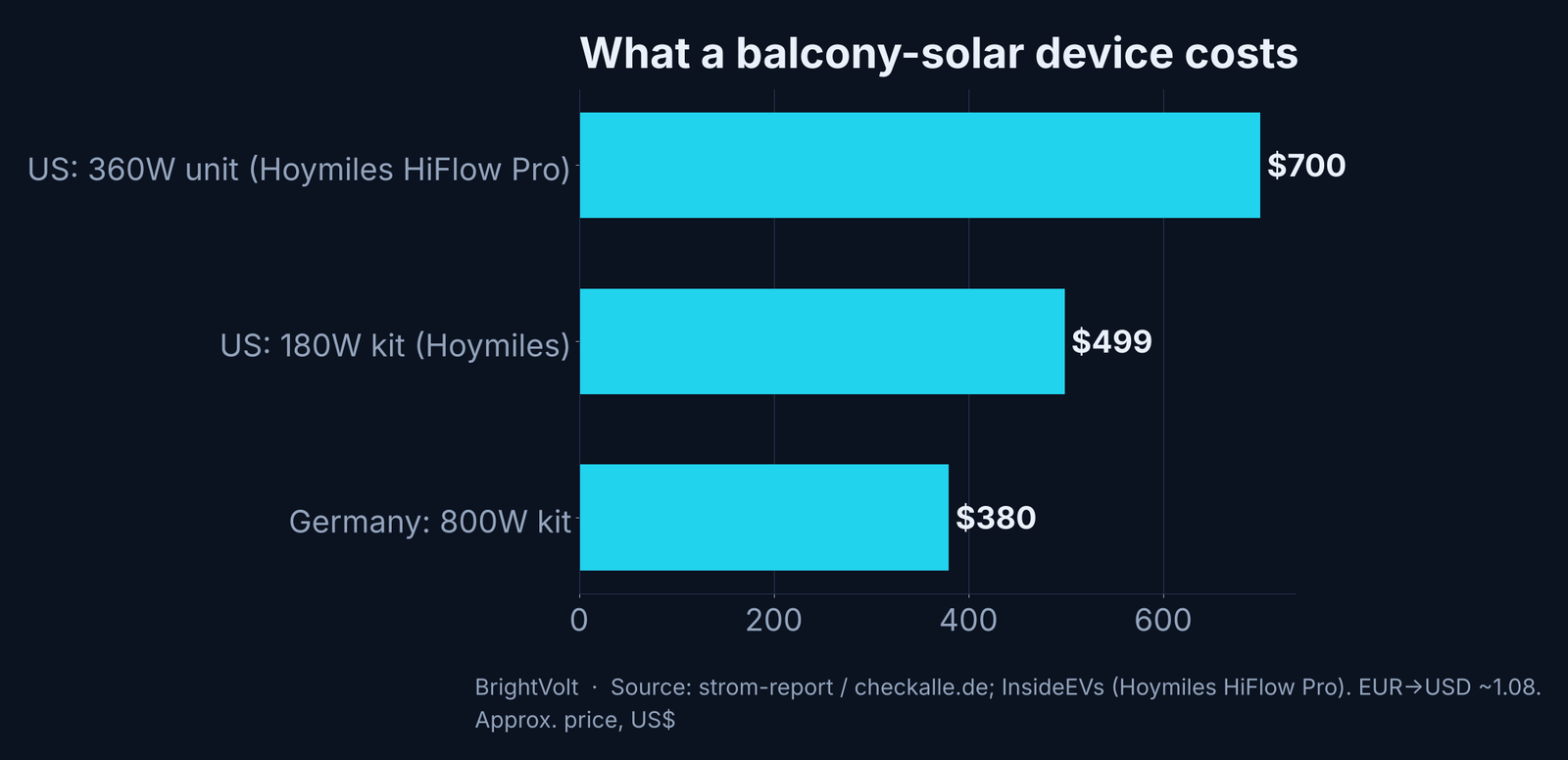
| Entry price | From ~€350 (~$380) | $499–700 for a single device |
| Registration | One national online form | Patchwork; no federal path |
| Safety standard | VDE, long established | UL 3700, new in 2026 |
The American figure in every row that matters is either smaller or newer. That is the gap a signing ceremony does not close.
The standard arrived in 2026, not the law
The genuinely new development this year is not Sacramento. It is a line of test engineering. UL 3700, North America’s first safety standard written specifically for plug-in solar, now exists, and the first microinverter built against it — the Hoymiles HiFlow Pro — has reached the US market. That is the missing piece Utah’s buyers did not have.
Read the fine print, though. The flagship device is described as “designed to meet” UL 3700, not yet certified to it. It sells as a 360-watt unit at $700, or a 180-watt panel-and-inverter kit at $499, and reaches the 1,200-watt legal ceiling only by running four units in parallel. So the American entrant arrives at roughly $700 for 360 watts while the German kit delivers 800 watts of inverter for about €380. The United States is paying more, for fewer watts, against a standard its best product has not finished clearing.
That sequence is the whole argument. The law in Utah came first and sat idle. The standard came a year later and is still settling. The product followed the standard, not the statute. California did not unlock the market; it joined a queue of states — the tenth to legalise plug-in solar, by pv magazine’s count, with 35 weighing bills in 2026 — that is still waiting on the hardware to grow up.
The obvious objection
The fair counter is that everything has now lined up at once. The law, in ten states. The standard, UL 3700. The first compliant-by-design hardware. And California — roughly 14 million rental units, about 40% of households — is the largest potential balcony-solar market in the country. Germany took years to assemble a fraction of that alignment. Why would the US not now follow the same curve, only faster?
Because the two things Germany got right are the two the US still lacks, and they are the two that actually move volume. Price is the first. A German household risks about €350 on a kit that needs no electrician; an American one is quoted $499 to $700 for a device producing half the power, from a market still too thin for the discounting that scale brings. Friction is the second. Germany offers one national form; the US offers ten different state regimes, no federal standard for the plug itself, and — in Utah’s case — no access to net metering, so the daytime surplus a renter cannot use is simply given away. California’s own rules sunset in 2030 unless extended. A market asked to form around a device that costs more, produces less and may be deregulated again in four years is not the German market with an American accent. It is a harder proposition.
This matters beyond the novelty, because balcony solar is the only solar most renters can own. The rooftop debate — net metering, leases, who keeps the tax credit — has always been a conversation among homeowners. A plug-in panel is the first version of the technology that a tenant in a flat can buy, carry to the next apartment, and run without a landlord’s signature. The same distributional fault line BrightVolt traced through Britain’s electrification divide runs here too: the households most exposed to high bills are the ones a $700 device and a patchwork of state rules keep out.
What would change our mind
This read turns on one claim: that regulation is no longer the binding constraint, and price and friction are. It is easy to falsify. Watch for a fully UL-3700-certified kit — not merely designed to the standard — reaching big-box retail under about $400 for a usable 600-to-800-watt system, alongside a registration path a renter can complete in one sitting across more than one state. If that appears and American uptake still crawls, then the barrier was never the hardware or the paperwork; it is something cultural or structural about US housing, and the German comparison was always a mirage.
But if the device, the price and the form arrive together — as they did in Germany — then the installs will follow within a couple of years, and the 2026 round of state laws will read in hindsight as the moment the groundwork was laid rather than the moment the market opened. The signatures were the easy part. They always were. The test is whether anyone can sell a Californian renter an 800-watt kit for the price a Berliner already pays, and that race has barely started.
Photo by Solarimo GmbH on Pexels · Photo by Jan van der Wolf on Pexels · Photo by Kindel Media on Pexels