
An e-bike battery is sold on three numbers: voltage (V), amp-hours (Ah) and watt-hours (Wh). Multiply the first two to get the third — a 48-volt, 14-amp-hour pack holds 672 watt-hours — and watt-hours is the one that predicts how far you will ride. The number that decides whether the pack catches fire is not printed on the label at all.
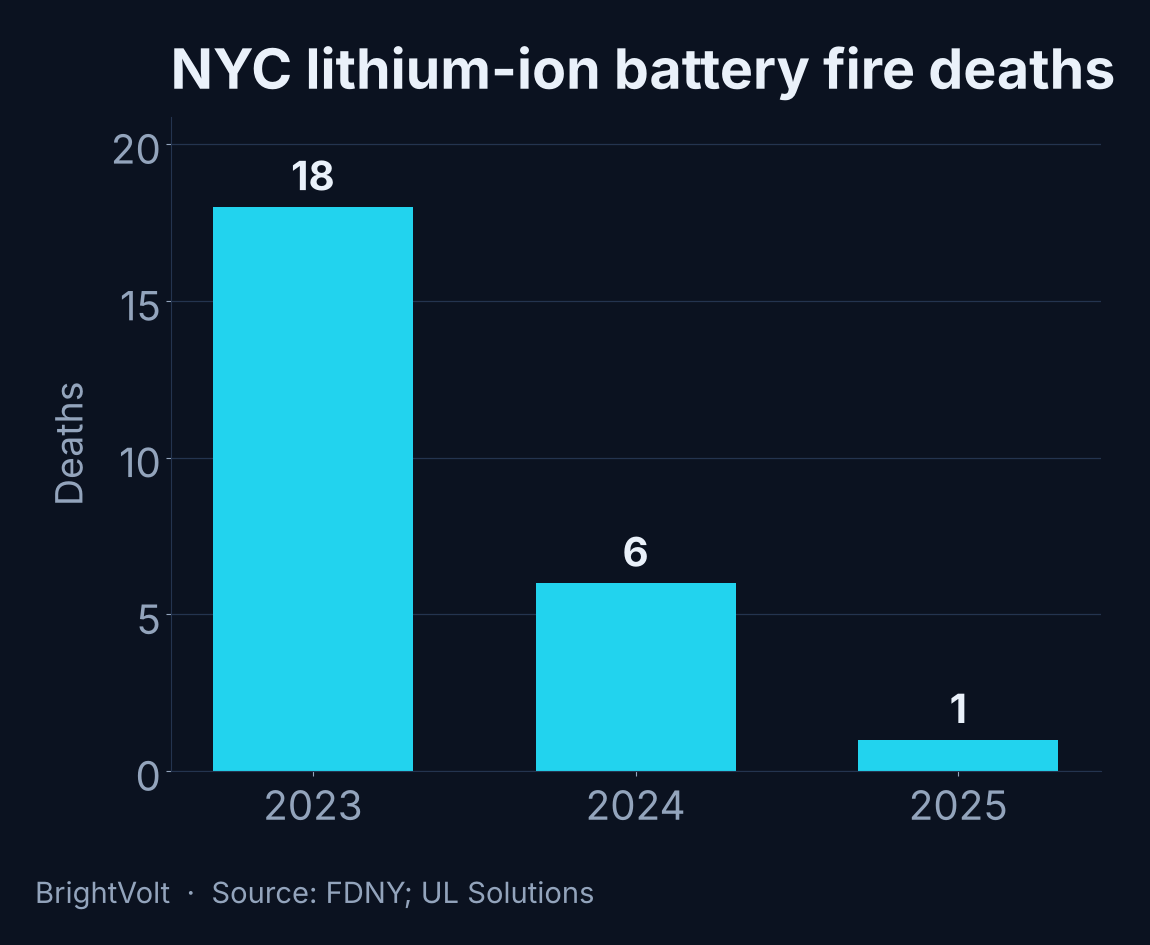
That gap matters more than any spec. In New York City, lithium-ion battery fires killed 18 people in 2023 and one in 2025. The fires themselves barely fell. What changed was which batteries were allowed on sale — and that is a story the spec sheet tells only if you know what it leaves out.
The three numbers, and which one to trust
Voltage is electrical pressure. Most e-bikes run at 36 V, 48 V or 52 V, and higher voltage lets the motor deliver more power for the same current, which is why faster bikes tend to run 48 V or above. Amp-hours measure charge — how much current the pack can supply for how long. Neither is much use alone, because a battery’s actual energy is the two multiplied together: volts times amp-hours equals watt-hours.
Watt-hours is the honest number, and the one to compare across bikes. A “20 Ah battery” sounds bigger than a “14 Ah battery”, but a 36 V 20 Ah pack (720 Wh) and a 48 V 14 Ah pack (672 Wh) hold almost the same energy and will go almost the same distance. As a rough guide a typical pedal-assist e-bike uses around 15 to 25 Wh per mile, so 672 Wh buys roughly 30 to 45 miles depending on rider, terrain and how hard the throttle works. Any range claim that does not resolve to watt-hours divided by a sensible Wh-per-mile figure is marketing.
| Spec | What it means | Why it matters |
|---|---|---|
| Voltage (V) | Electrical pressure | Higher V allows more power; sets motor compatibility |
| Amp-hours (Ah) | Charge capacity | Only comparable at the same voltage |
| Watt-hours (Wh) | Total energy = V × Ah | The real range number — compare this across bikes |
| Cell type | 18650 or 21700 cylindrical cells | Decides pack size, weight and quality headroom |
| Certification | UL 2849 / UL 2271 mark | Whether the pack was abuse-tested at all |
What the label hides: the cells
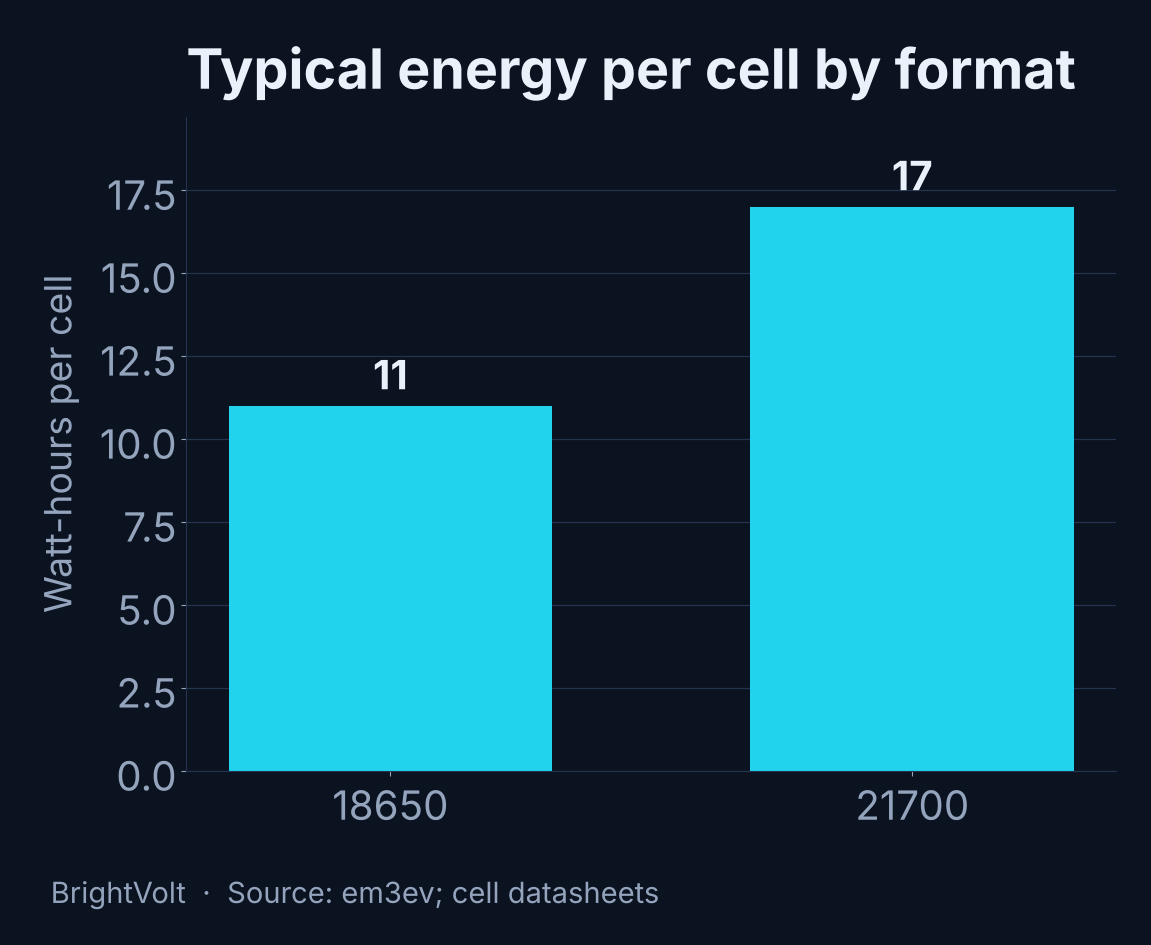
Open any pack and you find dozens of cylindrical cells wired in series and parallel. They come in two common sizes: the older 18650 (18 mm by 65 mm, about 2.5 to 3.5 Ah each) and the larger 21700 (21 mm by 70 mm, about 4.0 to 5.0 Ah). A 21700 holds more energy per cell, so a pack built from them hits a given watt-hour target with fewer cells, fewer welds and less to go wrong.
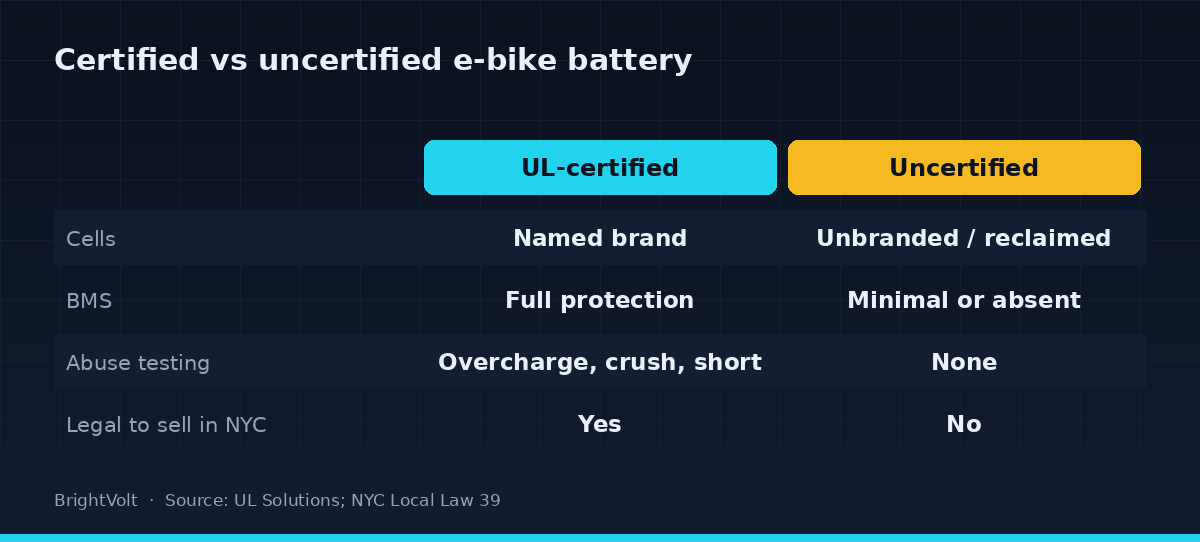
Size is on the spec sheet. Pedigree is not. The same 672 Wh can be assembled from name-brand cells — Samsung, LG, Panasonic, Molicel — or from unbranded, reclaimed or “grade B” cells pulled from salvage and relabelled. They read identically on the box. They do not behave identically when overcharged, punctured or left on a hot windowsill. The cheapest way to hit a watt-hour number is to use the cheapest cells, and the cheapest cells are exactly the ones with inconsistent internal resistance and no real safety margin.
The two things that decide whether it burns
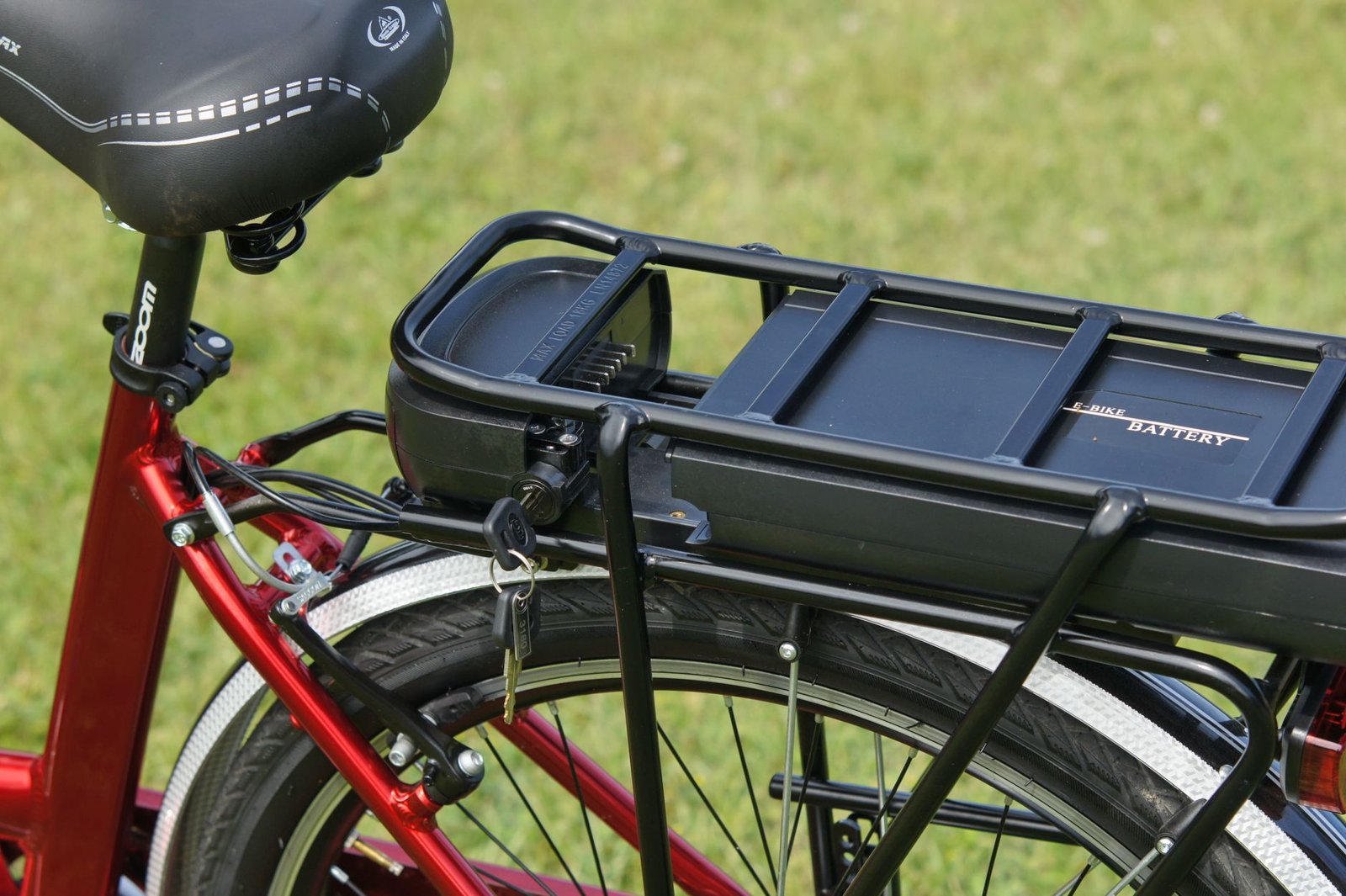
A good pack has a battery management system — a small circuit board that balances the cells, and cuts the pack off when any one of them is overcharged, over-discharged, too hot, or shorted. A single cell going into thermal runaway is survivable if the BMS isolates it and the pack is built to stop the fire spreading cell to cell. In a cheap pack the BMS is the first thing cut to price, and there is nothing between one bad cell and all the others.
Certification is how you tell the difference without opening the case. Three UL standards cover this equipment: UL 2849 for the e-bike’s whole electrical system, UL 2271 for the battery itself, and UL 2272 for e-scooters and similar personal devices. A certified pack has been deliberately abused — overcharged, short-circuited, crushed, heated — and shown not to propagate a fire. An uncertified pack has been tested by whoever buys it.
Why the fire numbers moved the way they did
The New York data is the clearest natural experiment anywhere. Lithium-ion fires in the city ran at 268 in 2023 and 277 in 2024 — essentially flat. Deaths over the same period fell from 18 to 6, and then to a single death in 2025. The fires did not stop. The fatal ones did.
That split is the whole argument for reading the spec properly. The catastrophic fires were concentrated in uncertified packs, often reclaimed cells with a token BMS, that go from one failed cell to a jet of flame with no warning. Removing those from sale does not prevent every fire, but it strips out the ones that kill. New York’s Local Law 39, in force since 2023, bans the sale, lease or rental of e-mobility devices that are not UL-certified. The FDNY credits the drop to education, inspections and a task force that ran 585 shop checks in 2024; UL Solutions credits the certification mandate. Both are describing the same thing from two ends: the deadliest packs were pulled off the street.
What to actually check before you buy
Read the watt-hours for range and ignore the headline distance claim. Look for a named cell manufacturer, not just a size. Confirm there is a real BMS, and confirm a UL 2849 or UL 2271 mark you can verify rather than a sticker that merely says “CE” or “meets UL standards”. And treat price as information: if a replacement pack costs half what the bike maker charges for the same watt-hours, the saving came out of the cells and the BMS — the two components that are not on the label and that decide whether the thing on your hallway floor is a battery or a hazard.
The open question is durability. The New York fall happened with a mostly new certified fleet; cells degrade with age and charge cycles, and even a good pack fails eventually. Whether the one-death year holds as that fleet ages, and whether other cities copy the certification-in-law approach, is what the next few years will show. For now the lesson reads cleanly off the statistics: the number that keeps you alive is the one the cheap packs leave off.
Photo by Erik Mclean on Pexels · Photo by alex on Pexels