
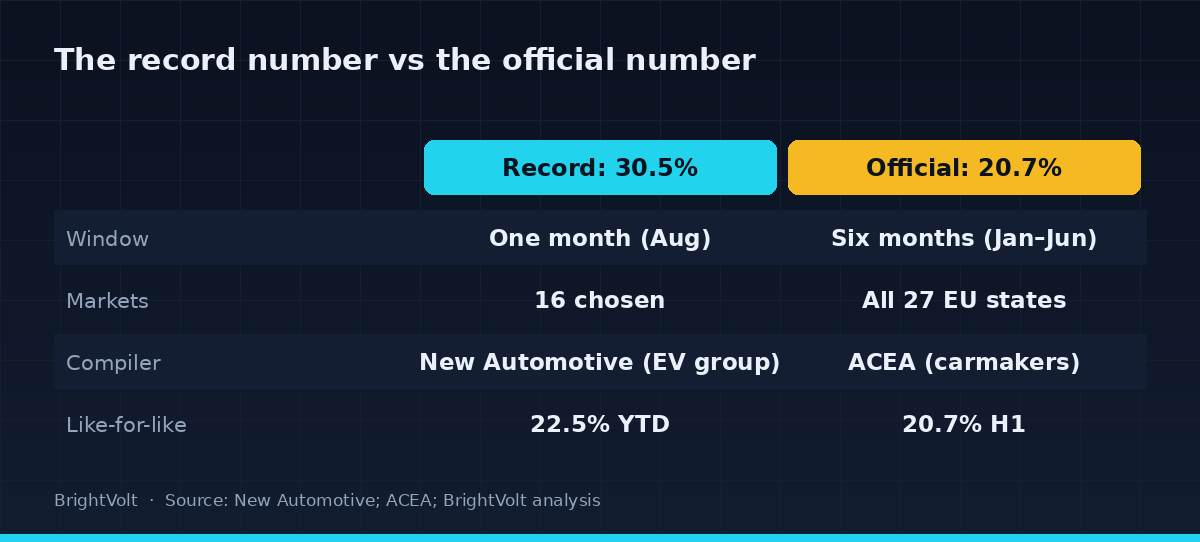
Europe’s electric-car share hit a record 30.5% in August, and the number travelled around the world in a day. It is real, and it is misleading. The figure covers one month, in sixteen hand-picked markets, compiled by an electric-vehicle industry group. The official EU-wide number for the year so far is 20.7%.
Both figures are correct. The gap between them — nearly ten percentage points, all of it method rather than measurement — is the story, and it is a more useful one than the headline. Europe’s switch to electric cars is real and accelerating. It is also being reported at the top of its range, in a way that all but guarantees a “slowdown” story the moment the calendar turns.
Where the 30.5% number came from
The record belongs to a specific dataset. New Automotive and the trade group E-Mobility Europe count battery-electric registrations across sixteen key European markets — a group that covers roughly 90% of the continent’s sales but leans on the countries where EVs already do best. Just under 203,000 electric cars were registered across those markets in August, up 54% on the same month in 2025. As a share of that month’s registrations, that came to 30.5%.
Read the next line of the same release and the shine comes off. The identical dataset puts the year-to-date figure at 22.5%. So even the group publishing the record number has Europe running at about 22% for 2026 as a whole; the 30.5% is the single best month lifted out of a slower average. August is the quietest sales month of the European year — factories on shutdown, dealerships thin, retail buyers on holiday — and a share is a fraction. Shrink the denominator and the percentage climbs without a single extra car being sold.
None of that made it into the headlines. RTE, TechTimes and a dozen others ran “record 30.5%, outpaces all forecasts.” One month, one dataset, one caveat dropped.
What the official figures say
Set the record beside the numbers kept by people with no reason to inflate them. The European Automobile Manufacturers’ Association — the carmakers’ own body, counting all 27 EU states — put battery-electric share at 20.7% for the first half of 2026. That is up sharply from 15.6% a year earlier, on 1.22 million cars: a real jump, not a plateau. Separately, JATO Dynamics measured Europe-wide August share at 22%, with petrol still the largest single fuel at 53% of the market.
Three credible bodies, one continent, one stretch of 2026: 20.7%, 22%, 30.5%. That spread is not error. It is the difference between counting all of the EU over six months and counting a favourable subset over the best four weeks.
| Figure | Period | Geography | Source | What it counts |
|---|---|---|---|---|
| 30.5% | August 2026 | 16 key markets (~90% of sales) | New Automotive / E-Mobility Europe | BEV share of new car registrations |
| 22.5% | Jan–Aug 2026 | Same 16 markets | New Automotive | BEV share, year to date |
| 22% | August 2026 | Europe | JATO Dynamics | BEV share of new car registrations |
| 20.7% | Jan–Jun 2026 | EU (27 states) | ACEA | BEV share of new car registrations |
| 17.4% | Full-year 2025 | EU (27 states) | ACEA | BEV share of new car registrations |
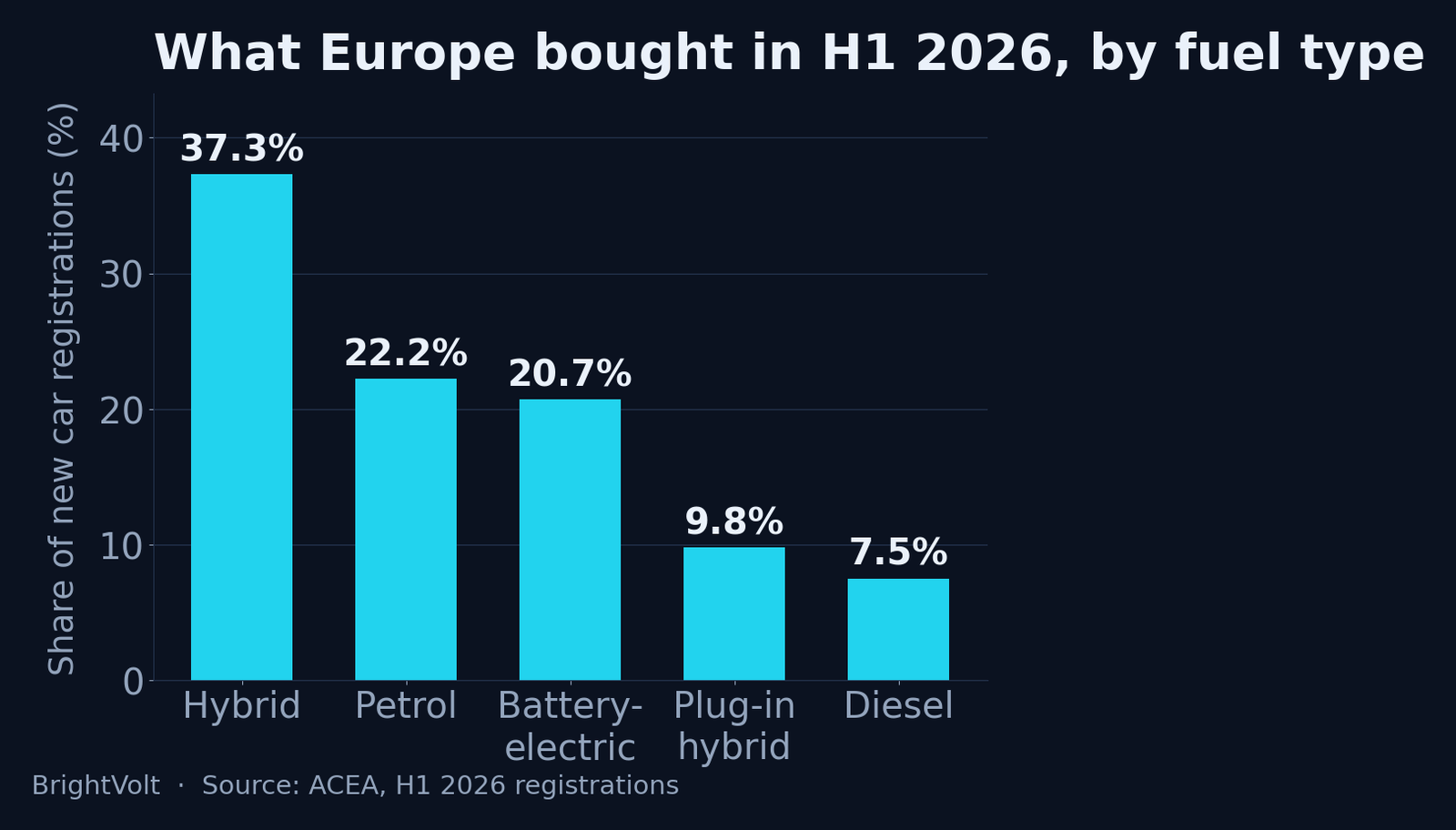
There is a second number in the ACEA table worth more than the record. The largest single category in Europe this year is not the battery-electric car at all. It is the plain hybrid, at 37.3% — cars that plug into nothing. Petrol has slid to 22.2% and diesel to 7.5%, and the hybrid has absorbed most of what they lost. The honest one-line summary of Europe in 2026 is that it is going electric via the hybrid at least as fast as via the battery, and the pure-EV line, while climbing, is not yet the market’s centre of gravity — the same pattern the US hybrid surge showed earlier this year.
Which forecast did it actually beat?
“Outpaced all forecasts” is doing heavy lifting. The forecasts in question held that European battery-electric share would struggle to clear 20% for the full year; Transport & Environment had pencilled in about 23% and Rho Motion about 21%. Those are annual, EU-wide numbers.
Now line them up against annual, EU-wide reality: ACEA’s 20.7% for the first half, New Automotive’s own 22.5% year-to-date. The forecasts were met, and perhaps nudged. They were not smashed. The only way to get “beat all forecasts” is to compare a peak month against a full-year projection — a category error dressed as a milestone. A basketball player who scores forty in one game has not “beaten his season average of eighteen.” He has had a good night.
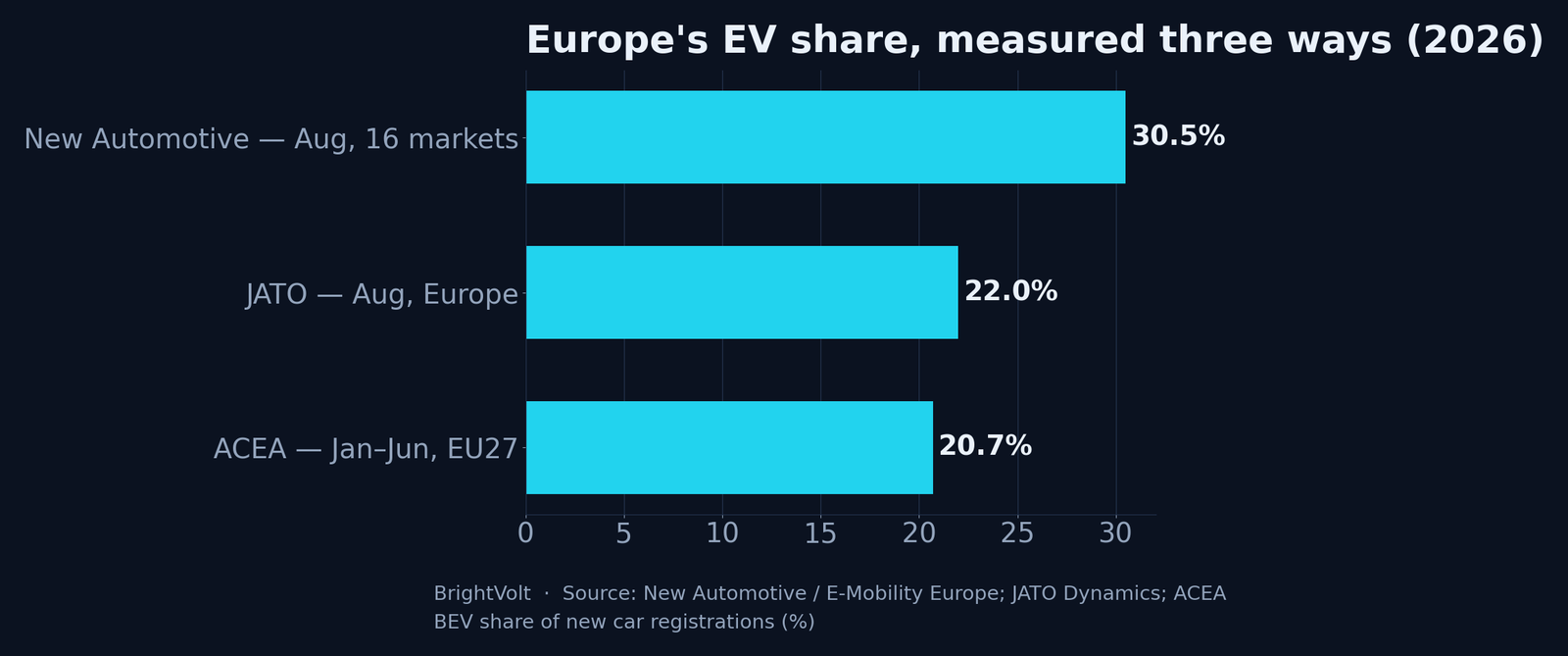
The disagreement is entirely legible once the two methods are laid side by side. It is not that one body is honest and the other is not — both figures are accurately computed. It is that only one of them is the number to quote when the question is “how electric is Europe.”
Why a ten-point gap is worth caring about
Because the quoted number becomes the baseline, and the wrong baseline sets up the wrong disappointment. When “Europe is at 30%” is what sticks, the autumn and winter months — with their higher total volumes and their share back down where the annual average lives — will read as a collapse. The cumulative figure will finish somewhere around 21–23%, exactly on the forecasts, and the same outlets that ran the record will run “EV demand stalls.” Neither the surge nor the stall will be real. Both will be artefacts of which month you photographed.
There is a policy reading too. A good deal of this share is being pushed rather than pulled. The EU’s fleet-average CO2 standard fines a carmaker €95 for every gram per kilometre it overshoots, across every car it sells, which gives manufacturers a powerful reason to move electric metal whatever the showroom mood. A share propped up by a compliance deadline behaves differently from one driven by demand — it can jump when a maker needs to hit a target and sag once it has, and it is unusually sensitive to Brussels softening the rules, which Brussels has already begun to do. Reading the 30.5% as pure consumer enthusiasm misdiagnoses the engine.

What to watch, and what would prove this wrong
Watch ACEA’s December release, not next month’s peak. The cumulative, EU-wide, full-year figure is the one that cannot be gamed by choosing a good month. Our read is that it lands around 21–23% — a genuine record, a genuine acceleration on 2025’s 17.4%, and nowhere near 30%.
Here is the number that would refute it: if EU-wide battery-electric share for full-year 2026 comes in at the high twenties or above, then August was a leading indicator rather than an outlier, the annual pace really has stepped up a gear, and this piece called it too cautiously. That is the figure to hold us to.
Until it prints, treat the record for what it is. European EV adoption is climbing fast and that deserves to be said plainly. It is also being narrated at its high-water mark, and a sector that keeps quoting its best month is a sector that keeps scheduling its own bad news.
Photo by Reinhard Bruckner on Pexels · Photo by abdo alshreef on Pexels