
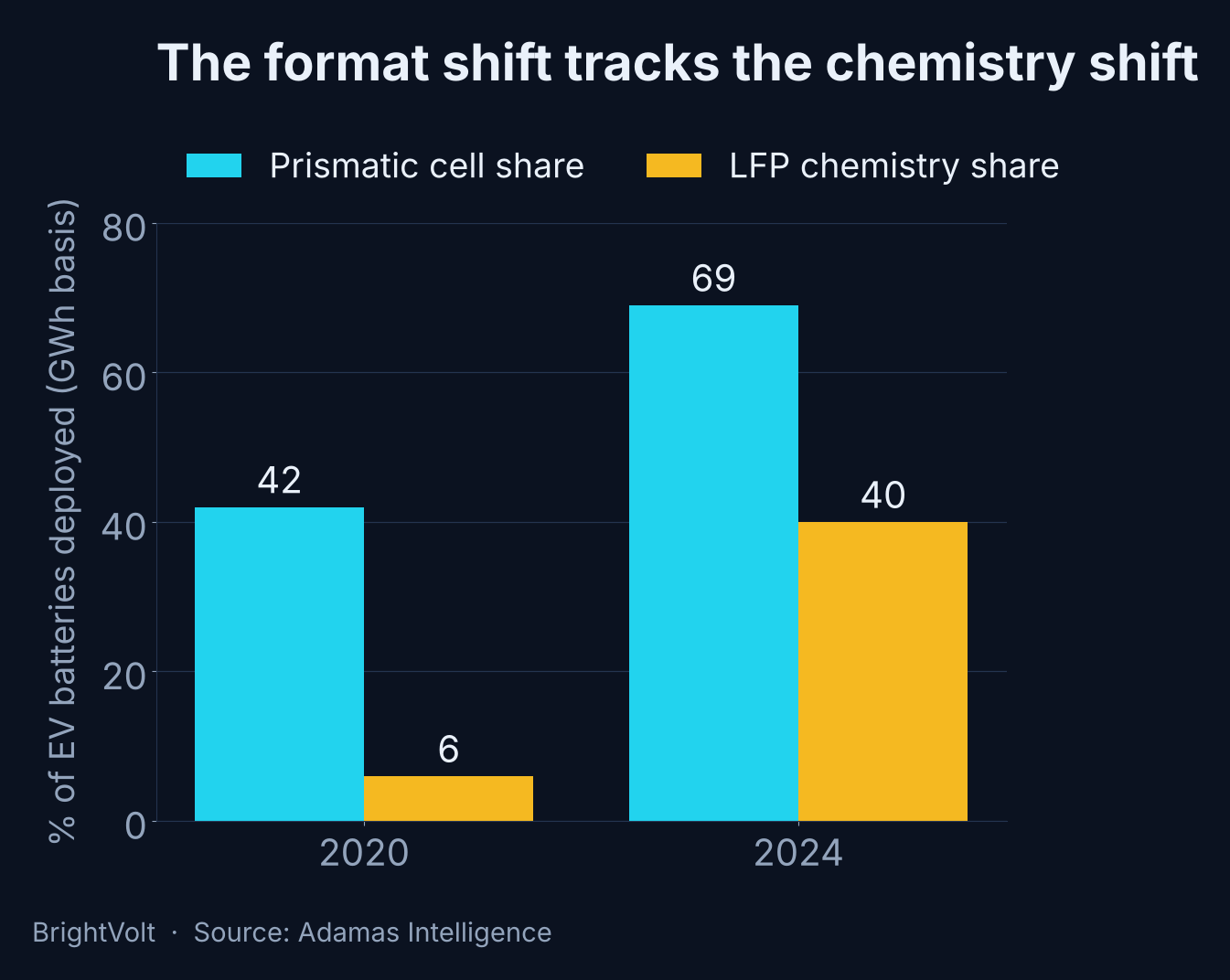
Almost every lithium battery takes one of three shapes: a cylindrical metal tube, a flat laminated pouch, or a rigid rectangular can called a prismatic cell. The choice is not cosmetic. It decides how tightly the cells pack into a battery, how they are cooled, how they fail, and what they cost to build. And one shape has quietly won: in 2024, prismatic cells made up 69% of the EV batteries deployed worldwide, up from 42% four years earlier.
The shift is not a fashion. It tracks a change in chemistry, and understanding why the box beat the tube and the envelope explains most of what has happened inside EV batteries since 2020.
The three formats, and how each is built
A lithium cell is the same sandwich in every format — a cathode coat, an anode coat, and a separator soaked in electrolyte — differing only in how that sandwich is folded and housed.
A cylindrical cell is wound into a spiral, a “jelly roll,” and sealed inside a rigid metal can. The format is named by size: an 18650 is 18 mm across and 65 mm tall, a 21700 is 21 by 70, and Tesla’s 4680 is 46 by 80. The can makes the cell mechanically self-contained — it needs no external support — which is why cylindrical cells are the cheapest format to mass-produce and the easiest to make consistently.
A prismatic cell stacks or flat-winds the same layers inside a hard aluminium case, usually a flat rectangular block. There is little cross-industry standardisation beyond a few automotive sizes, so a prismatic cell is often designed for one pack. BYD’s Blade cell is a prismatic taken to an extreme: long and thin, so the cell itself can act as a structural beam in the pack.
A pouch cell puts the stack in a sealed foil-laminate envelope with no rigid case at all. That makes it the lightest format and the most flexible in shape — but the envelope cannot hold the cell’s forces on its own, so a pouch needs the pack to clamp it under controlled pressure for its whole life.

Why prismatic cells took over
The prismatic surge is recent and steep. Adamas Intelligence put prismatic at 42% of EV batteries deployed in 2020 and 69% in 2024 — a 39% jump in deployed capacity in the last year of that run alone, to 596.9 GWh, while cylindrical volumes fell 2% and pouch grew just 4%.
What drove it was chemistry, not the shape for its own sake. Over the same four years, lithium iron phosphate rose from 6% of the market to 40%. LFP is cheap, safe and long-lived, but it stores less energy per kilogram at the cell level than the nickel-rich chemistries it displaced. The way to claw that back is to waste less space between the cells — to win at the pack level what the cell gives up — and that favours a flat, rigid, stackable block over a tube that leaves gaps. The BYD Blade is the clearest proof: a prismatic LFP cell long enough to span the pack and stiff enough to carry load, so the structure and the battery are the same object. This is the cell-to-pack logic the whole industry has chased, and prismatic is the format it rewards.
What each shape trades
No format is best at everything; each buys one virtue with another. The sharpest contest is between the two formats actually growing — prismatic and cylindrical — because those are the ones a carmaker now chooses between.
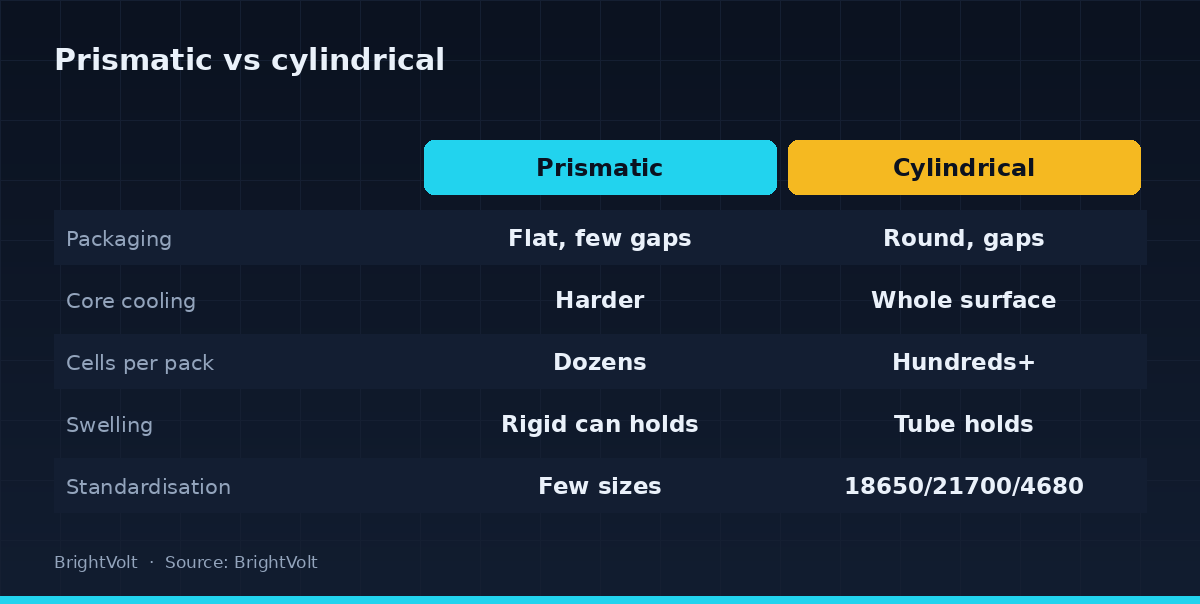
Cooling is the line that bites hardest. A cylindrical cell sheds heat through its whole curved surface and is robust enough that one cell failing need not take its neighbours with it. A prismatic cell is harder to cool at the centre — part of why LFP, which runs cooler and shrugs off abuse better than nickel chemistries, made the prismatic trade easier to accept. A pouch runs coolest per cell but is the fussiest to hold: a tired pouch swells, which is why pouch packs carry compression hardware a cylindrical pack never needs.
A rough map of who builds what, and from which chemistry:
| Format | How it is built | Common chemistry | Where you find it |
|---|---|---|---|
| Cylindrical | Wound roll in a sealed metal tube | Nickel-rich (NMC/NCA) | Tesla, Panasonic, parts of LG |
| Prismatic | Flat stack in a rigid aluminium can | LFP and NMC | CATL, BYD, Samsung SDI, Gotion |
| Pouch | Flat stack in a foil-laminate envelope | NMC, some LFP | SK On, Envision AESC, parts of LG |
The cylindrical comeback and the 4680
The tube is not finished. Tesla spent a decade enlarging it — 18650, then 21700, now the 4680 — on a simple arithmetic. A 4680 holds roughly seven times the volume of an 18650 and around 108 Wh of energy against the smaller cell’s 12.6, so a pack needs far fewer cells, far fewer welds and far less wiring to reach the same capacity. A tabless internal design cuts the resistance that a bigger cell would otherwise add, and the cell can be glued into a structural pack much as a prismatic can.
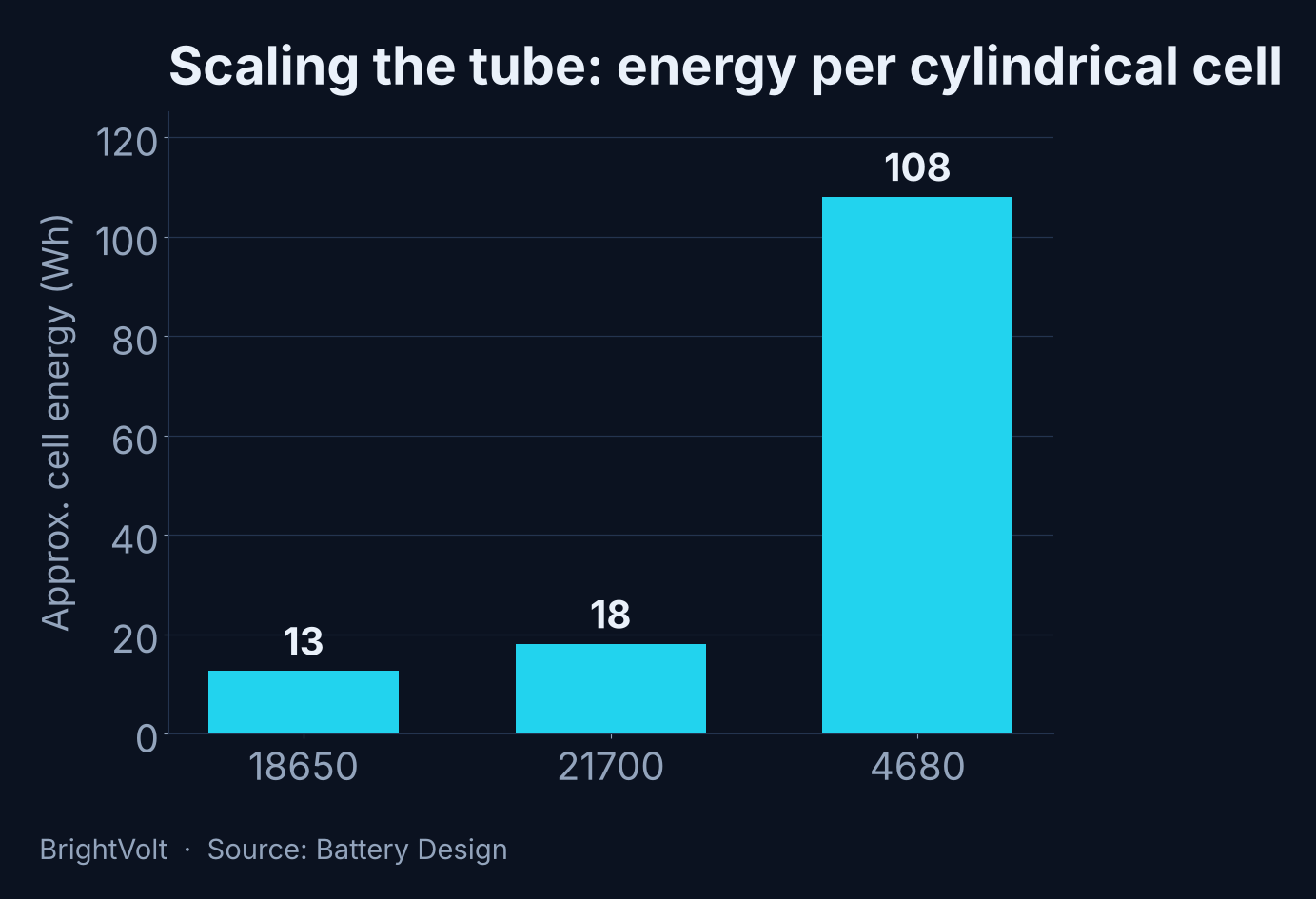
So the large cylinder survives in a prismatic world for the same reason the small one did: it is self-contained, standardisable and cheap to make well, and scaling it up recovers much of the packing penalty that shrank cylindrical’s share. The format war is not tube versus box so much as “how big a cell, and how much of the pack’s job can the cell itself do.”
What to watch
Format follows chemistry and pack architecture, not the other way round. As long as the density gains come at the pack level — cell-to-pack, structural packs, blade-style cells — prismatic and large-format cylindrical will keep winning, and pouch will recede toward the niches where grams and shape matter most, such as premium performance cars and aerospace.
The thing that could reverse it is already in the labs. Solid-state cells often need firm, even pressure across the electrode stack to cycle without forming voids — exactly what a clamped pouch provides and a rigid can does not. If solid-state reaches volume, the pouch may return not because it is lighter but because the chemistry demands the squeeze. Watch which format the first mass-produced solid-state packs choose; it will say more about where cells are heading than any single energy-density number.
Photo by Hilary Halliwell on Pexels · Photo by Looking For Feferences on Pexels