
Lithium manganese iron phosphate — LMFP — is lithium iron phosphate with manganese swapped in for some of the iron. That one substitution raises the cell’s working voltage from about 3.2 volts to roughly 3.7, and with it the energy density: manufacturers quote around 200 to 240 watt-hours per kilogram against LFP’s 160 to 190. The price is a little conductivity and a little cycle life. In 2026 it is the chemistry quietly doing the mid-market’s volume, and almost nobody outside the industry can say what it is.
What manganese actually adds
Plain LFP stores and releases lithium by shuttling it in and out of an iron-phosphate lattice, and it does so at a stubbornly flat 3.2 volts. Iron is cheap, abundant and hard to set on fire, which is why LFP took over the cheap end of the market. Its weakness is energy density: that low voltage caps how much energy a kilogram of cell can hold.
Manganese fixes part of that. Substitute manganese for a share of the iron — commercial cells run anywhere from roughly a third to two-thirds manganese — and the metal’s redox reaction sits higher up the voltage scale, around 4.1 volts against iron’s 3.4. Blend the two and the cell’s nominal voltage lands near 3.7. Since the energy in a cell is voltage multiplied by capacity, lifting the voltage while keeping the capacity roughly intact buys more watt-hours from the same mass. Gotion’s Astroinno LMFP cell is rated at 240 Wh/kg, with a pack the company says is good for up to 1,000 km of range; CATL’s manganese-based M3P cell sits a little lower. Both are firmly above where LFP tops out.
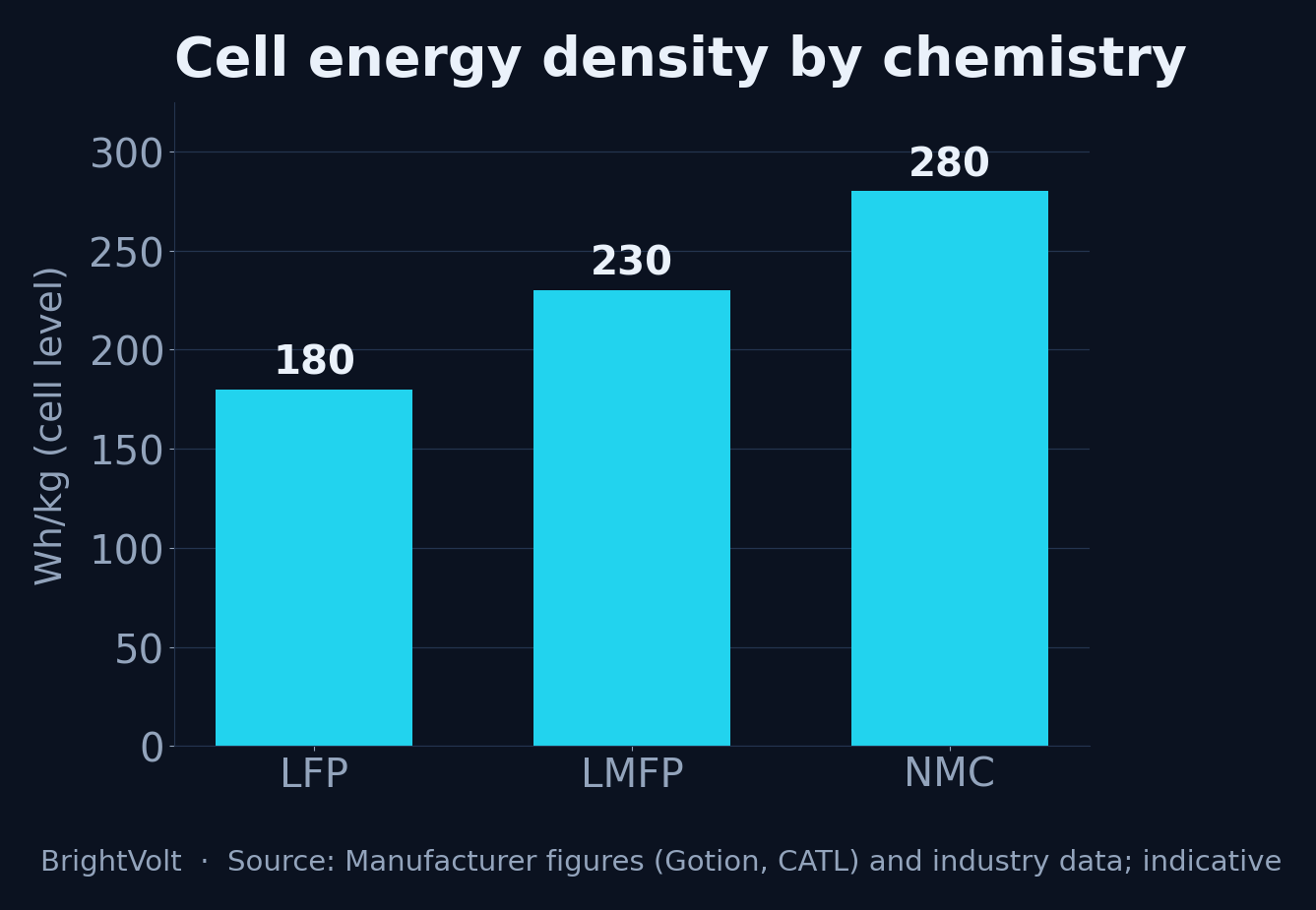
The gain is real but bounded. LMFP does not reach nickel-based cells, and the headline figures are manufacturers’ own, measured on their best cells rather than audited across a production run. Treat 200–240 Wh/kg as the promise, not the floor.
What it costs you
Manganese-rich phosphate is a worse conductor than plain LFP — of both electrons and lithium ions — which is the reason LMFP took years to move from lab to line rather than arriving the moment someone thought of it. Cells only work at useful charging speeds once the cathode is carbon-coated and engineered down to nanoscale particles to shorten the distance lithium has to travel. That processing is most of why an LMFP cell costs a little more than an LFP one.
Then there is the discharge curve. LFP is famously flat, which is good for squeezing energy out at a steady voltage and bad for guessing how full the battery is — the voltage barely moves until the pack is nearly empty. LMFP replaces that single plateau with two, one for the iron and one for the manganese, with a step between them. The step actually helps a battery-management system read the state of charge in the middle of the range, but the two-plateau shape complicates the calibration, and getting it wrong shows up as a range readout that jumps. Cycle life, finally, tends to come in below pure LFP’s, because manganese can dissolve slowly into the electrolyte over many cycles. None of these is a dealbreaker. All of them are the reason LMFP is a considered trade rather than a free lunch.
Where LMFP sits between LFP and NMC
The clearest way to place LMFP is between the two chemistries everyone already knows. LFP is the cheap, safe, long-cycling workhorse that gives up energy density. Nickel-based NMC is the dense, expensive option that carries range in premium cars and gives up some safety and cost, and leans on nickel and cobalt supply chains. LMFP threads the gap: most of LFP’s cost and thermal stability, part of NMC’s density, and — importantly — no nickel or cobalt at all.
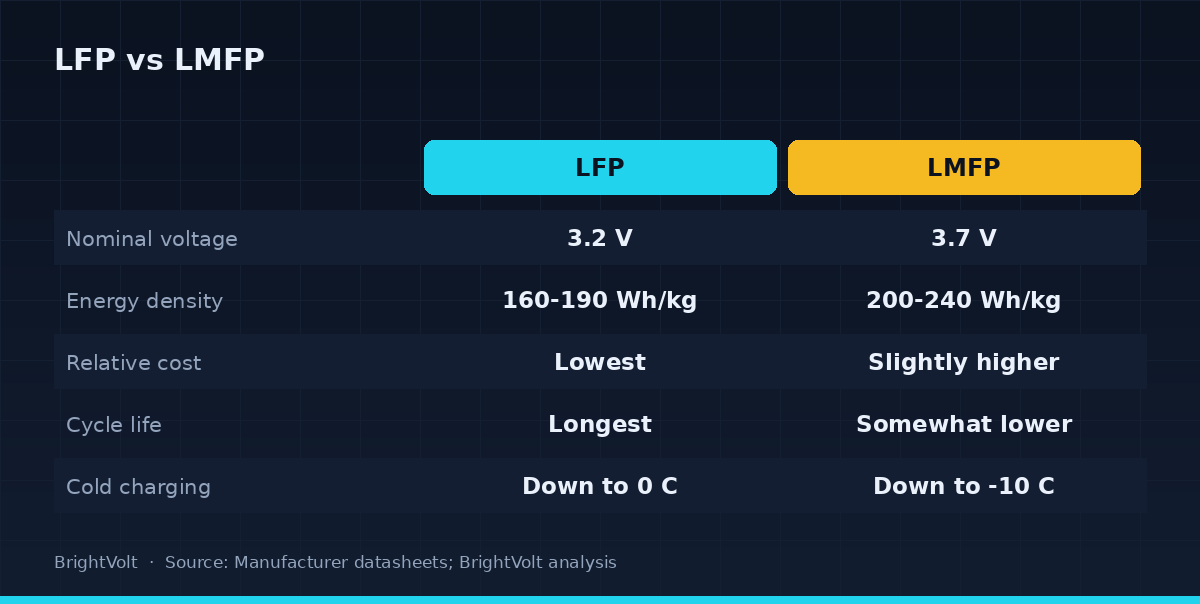
Cold weather is the one place LMFP quietly beats its parent. The higher voltage leaves more headroom before a cell hits the limits that force charging to slow or stop in the cold; on one manufacturer’s paired cells, the LMFP version accepted charge down to around −10°C where the LFP cell was capped at 0. For a mid-range car sold into a northern winter, that is not a rounding error — it is the difference between charging in the cold and waiting for the pack to warm.
Why 2026 is LMFP’s moment
The reason LMFP matters now is that it lands exactly where the volume is. The mid-range electric car and the home or grid battery are the two biggest markets, and both were served by LFP that was cheap and safe but a touch short on range or on energy per cubic metre. LMFP adds roughly 15 to 20% more energy on the same low-cost, hard-to-ignite backbone, which is why CATL, Gotion and BYD have all pushed manganese-blended phosphate into their flagship mid-tier packs rather than treating it as a science project. It is the upgrade that does not require a new supply chain.
It is also being squeezed from both sides, which is what makes the next few years interesting rather than settled. From below, sodium-ion is coming for the cheapest, coldest, most cost-sensitive applications with materials even more abundant than iron. From above, high-nickel cells and, eventually, solid-state chemistries keep pushing the density ceiling that LMFP cannot reach. LMFP wins the middle for as long as the middle is where the money is — and in 2026, it is.
What to watch
LMFP is an optimisation, not a revolution, and it should be read as one. The number that decides its future is not energy density, which is already good enough for the job; it is whether the cycle-life and conductivity penalties keep shrinking as cathode engineering improves, work that is actively under way in the literature. If they close, LMFP eats more of LFP’s territory. If they stall, LFP holds the floor and LMFP stays a premium-LFP niche.
The practical test for a reader is simpler. When a spec sheet says “LMFP”, ask how much manganese is actually in the cell and what it cost in cycle life, because “manganese-blended” covers everything from a genuine manganese-majority cathode to a token few percent added for the marketing. The chemistry is honest. The label is not always.
Photo by Looking For Feferences on Pexels · Photo by Heru Dharma on Pexels