
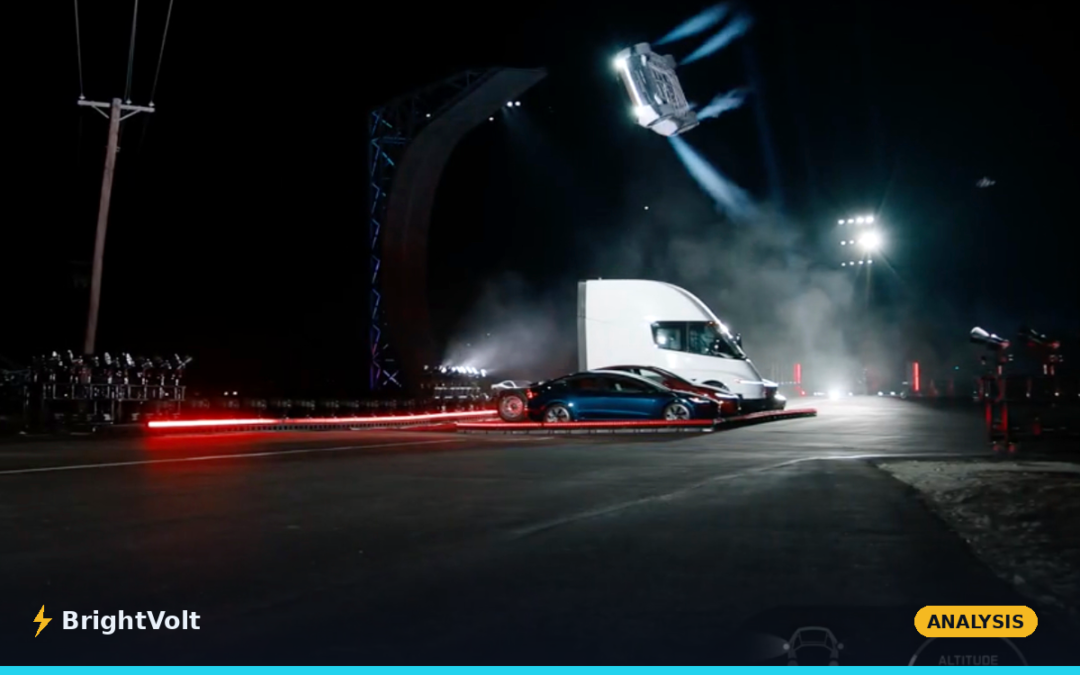
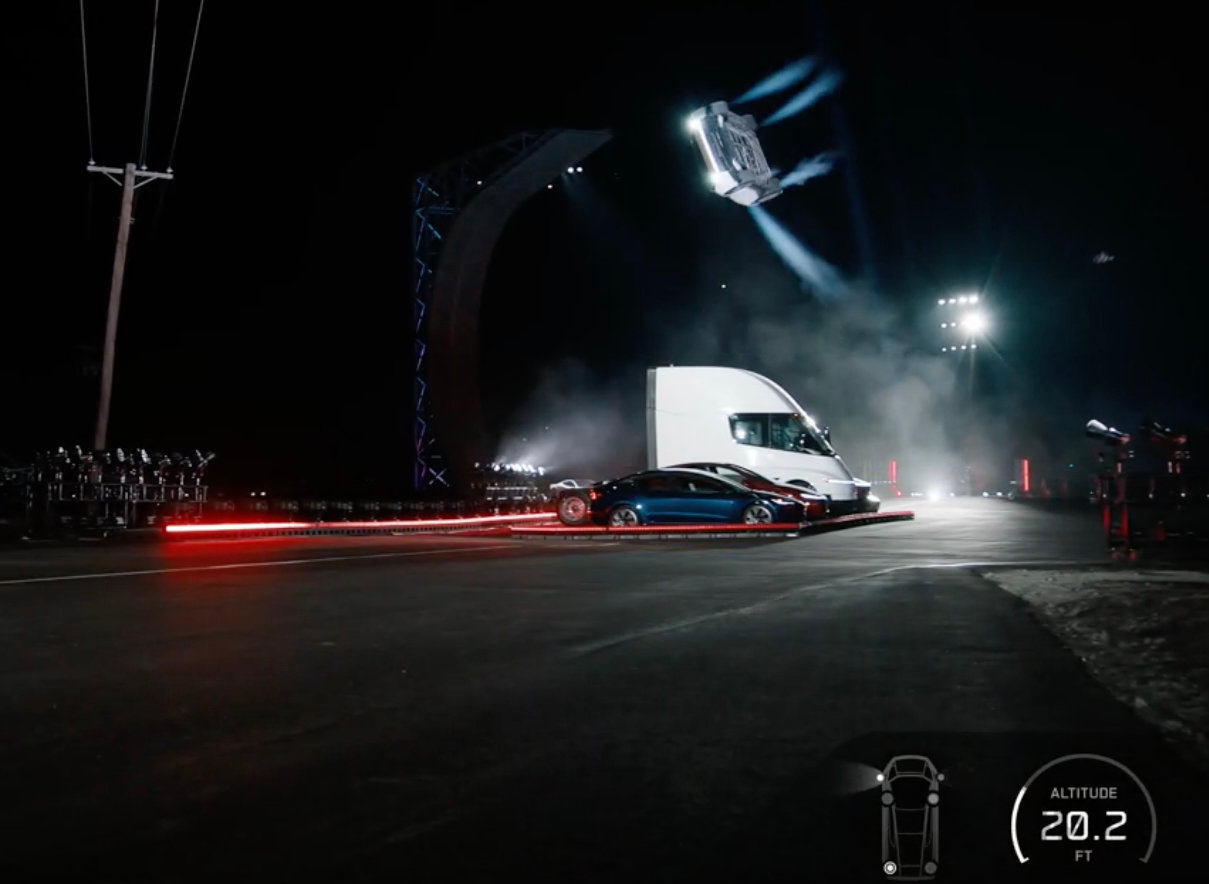
Tesla’s new Roadster can, according to Tesla, hop over a moving Cybertruck, spin in mid-air and drive upside down along a ceiling-style ramp. It also promises to hit 60 mph in about a second. The unveiling on 15 October, outside Waco, Texas, was built to be shared, and it was. But strip away the stunts and ask the question this site cares about, which is what the car actually tells us about electric vehicles, and the honest answer is: less than the footage suggests, and some of it points the wrong way.
The thing worth noticing is not the flying. It is that the range claim has been cut in half.
What Tesla actually claimed
The second-generation Roadster comes in three trims. Per TechCrunch’s report from the event, Performance is a road-ready two-seater with active aerodynamics, Thrust is a race-ready two-seater with rear-mounted thrusters, and Rocket is a single-seater with ten cold-gas thrusters, billed as “air ready” and available by invitation only. Tesla says every trim has a top speed above 230 mph and about 300 miles of range. Production is targeted for 2028. No base price was given; reservations are $50,000 for Performance and $250,000 for Thrust.
The thrusters are not electric. Engineering chief Lars Moravy said they run off 600 litres of compressed air, which can be refilled, and Tesla says the pressure vessels fill every usable void in the car. That is a SpaceX-derived system bolted onto an electric car. It adds hover and hop tricks, and Tesla ties its fastest acceleration claims to the thruster trims, but it does nothing for the part of the car that runs on a battery.
The number that went backwards
When Tesla first showed the Roadster in 2017, it promised roughly 600 miles of range. Electrek notes that the 2026 version promises “over 300 miles”, and that the battery size was not disclosed at all. Electrek’s inference is that the pack is smaller and that more of the performance now comes from fans and thrusters rather than stored electrical energy. That is an inference, not a Tesla statement, but it is consistent with what was and was not said on stage.
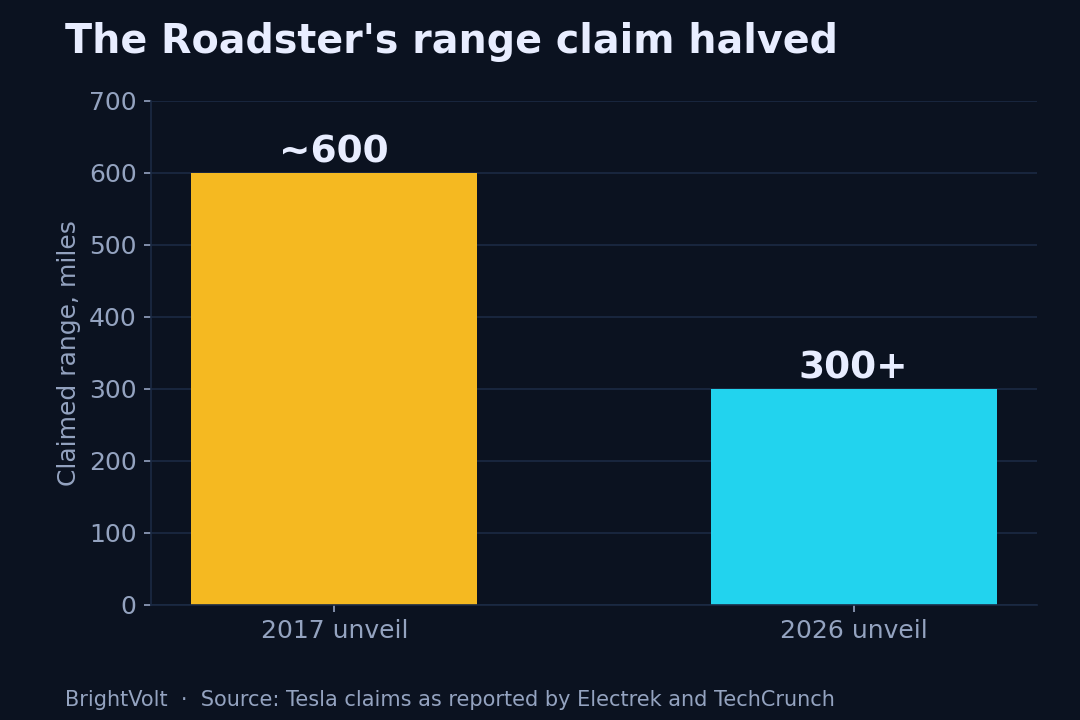
Range matters here because it is the cleanest way to compare EVs across a decade. A 300-mile claim in 2026 is ordinary, and BrightVolt’s own look at the Denza Z9S’s record range figure showed how much any headline number depends on the test cycle. Tesla did not say which cycle its 300 miles uses. A halved range claim on a car that is meant to demonstrate the state of the art is not what an engineering lead would choose to advertise.
What was shown, and what was not
The acceleration claims are where the footage and the paperwork part ways. Tesla’s own posts put the three trims at under 1.6 seconds, under 0.9 seconds and under 0.59 seconds to 60 mph, in that order. On stage, Musk quoted one second, and a later demonstration was claimed at 0.81 seconds.
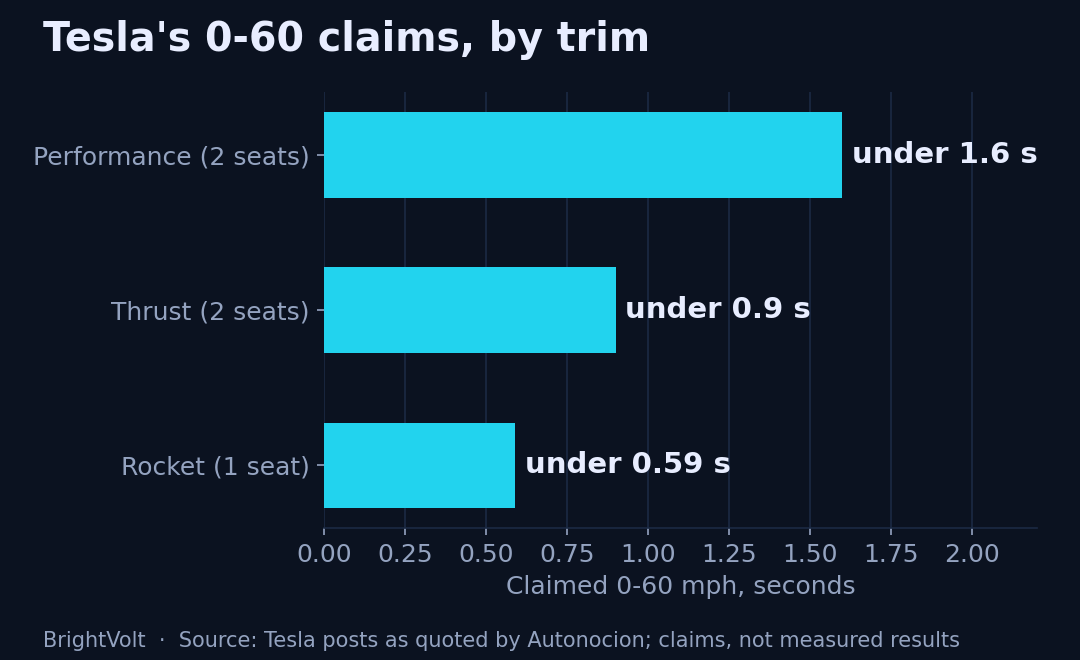
Those are claims about a car that does not exist in production form yet, and the evidence offered for them is thin in specific ways. Electrek points out that nobody was inside the car during the demonstrations and that frame-by-frame video shows the thrusters firing before the car moves, which raises the question of how the rollout was timed. Autonocion’s recap goes further and argues that the flight footage appears to have been pre-recorded rather than shown live, and that the timed run took place in a dark area behind the stage rather than in front of the audience. That is one outlet’s reading, and TechCrunch’s report does not say either way. The honest position is that the live-versus-recorded question is open.
| Claim | What Tesla offered | Status |
|---|---|---|
| 0-60 mph under 1 second | Recorded run at 1.0 s; later 0.81 s claimed | Method and rollout unspecified |
| Range over 300 miles | Stated for all trims | Battery size and test cycle not given |
| Top speed over 230 mph | Stated for all trims | No demonstration |
| Flying and hovering | Footage of hops, spins and an inverted ramp | Live or recorded not confirmed |
| Price | Reservation deposits only | No base price given |
| Production | Targeted for 2028 | Eleven years after the first unveil |
Why a compressed-air car still belongs on an EV site
It is tempting to dismiss the whole thing as a stunt, and as a product it may well be one: Musk himself said the car does not move the needle on revenue. But there are two reasons to take it seriously as a technology story rather than a sideshow.
The first is the energy accounting. Cold-gas thrusters do not burn anything. They release air that something has compressed, and compressing air takes electricity, with substantial losses along the way. Every hop is paid for by the grid or the battery first, at a poor conversion rate. A hover trick is a very expensive way to spend a kilowatt-hour, and Tesla has not said how many jumps one refill delivers. Electrek raises the same practical questions about tank capacity, refill time and what a gas plume does to a road surface.
The second is that the useful parts of the package may be the unglamorous ones. The inverted-ramp demonstration relies on a multi-mode fan-and-skirt suction system, which Electrek says is described in a Tesla patent. Electrek also notes that Tesla’s displayed downforce figure looks high for a car of this weight and treats it with caution, but if even part of it holds up, suction downforce is a genuine lever for a fast electric car, quite apart from the flying.
What to watch
The claim here is narrow and testable: the Roadster’s range and battery size will be the numbers that decide whether this is an engineering step forward or a marketing exercise. If Tesla discloses a pack size and a test cycle that support a competitive range, the stunts become a sideshow to a credible car. If it keeps both private until 2028, the range figure will quietly stay as the only number that went backwards.
Watch for three disclosures before any deposit turns into a delivery: the battery capacity, the test cycle behind the 300 miles, and an independent timed 0-60 run with the car in front of an audience and a person inside it. Until then, the Roadster is a very well-edited promise.
Image: Tesla · Image: Tesla