
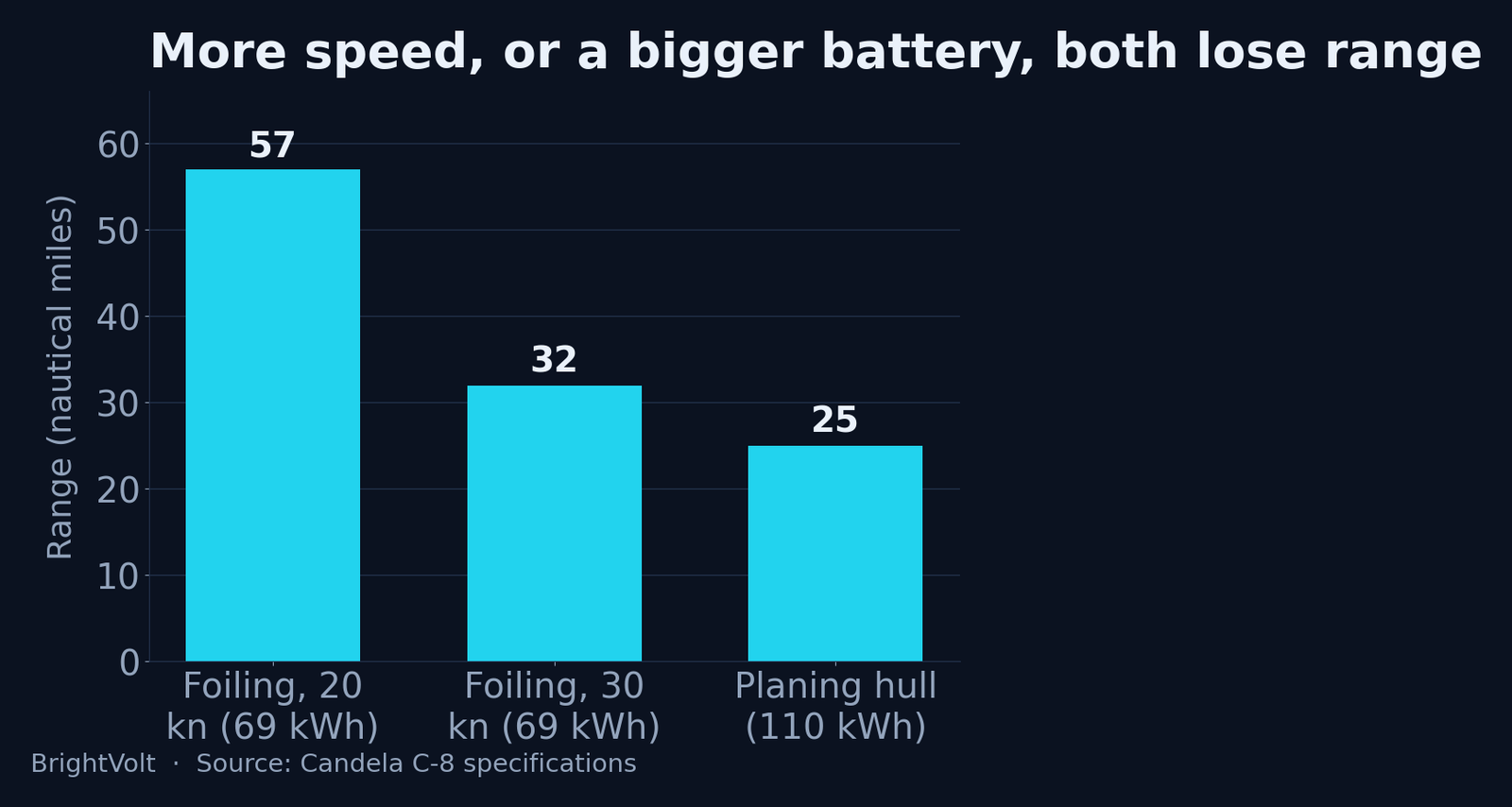
A Candela C-8 electric hydrofoil carries a 69 kWh battery and covers 57 nautical miles at 20 knots. A conventional electric boat with a 110 kWh pack — 60% more battery — manages 20 to 30. The bigger battery loses. The reason is not the cells or the motor. It is a wave the faster boat is forced to build and drag along behind it, and the physics that governs that wave is called wave-making resistance. On a petrol boat it hides behind a big fuel tank. On an electric one, there is nowhere for it to hide.
Understanding it is the difference between believing electric boats are simply waiting for better batteries and seeing why the successful ones look nothing like the boats they replace.
The hole a boat digs for itself
A ship moving through water pushes a wave up at the bow and drops into a trough, then throws up a second wave at the stern. At low speed these waves are small and cheap. As the boat speeds up, the waves grow and lengthen, and here is the trap: the length of that bow wave is tied to the boat’s speed, and once the wave gets as long as the boat itself, the hull is effectively sitting in a hole of its own making — perched on its bow and stern crests with a trough amidships.
Going any faster means climbing up the back of your own bow wave. That is where resistance stops rising gently and starts rising ferociously. Naval architects put a number on it. The speed where the wave length matches the waterline is “hull speed,” roughly 1.34 times the square root of the waterline length in feet, giving a speed in knots. A 25-foot waterline hits hull speed around 6.7 knots. Below it, a displacement hull is one of the most efficient vehicles ever built. At it, the hull is climbing its own wave and the water is charging exponentially for every extra knot.
Why the wall is so much steeper than a car’s
Every vehicle fights drag that grows with speed. What makes water special is how fast it grows near hull speed, and the fact that there is no coasting to recover any of it.
Aerodynamic drag on a car rises with the square of speed — double the speed, quadruple the drag. Wave-making resistance behaves worse than that as a hull approaches its limit, and because the power a motor must deliver is drag multiplied by speed again, the power demand climbs steeply enough that boaters use a rough rule of thumb: power required rises with roughly the cube of speed. Doubling a displacement boat’s speed near its hull-speed limit can ask for something on the order of eight times the power. A car cruising at 30 mph and then 60 mph pays a real but survivable aerodynamic penalty. A hull crossing its hull speed pays a wall.
Two things then compound it on the water that a road never imposes. A car coasts, and a modern electric one regenerates braking energy; a boat does neither — lift off the throttle and the water simply stops you, energy gone into wake. And a boat’s range reserve is a safety margin, not a convenience: you cannot run a battery to zero three miles offshore the way you empty one in a car park. So the usable fraction of a boat’s stored energy is smaller to begin with, and the speed penalty on top is savage.
This is why the diesel-versus-battery energy-density gap, the figure everyone reaches for first, is the least of the electric boat’s problems. Diesel’s effective energy density beats a lithium pack by something like twenty to one, which sounds insurmountable. But a petrol boat drags the same wall of water uphill; it just carries enough fuel that the owner never has to think about it. Take the fuel tank away and replace it with a battery a fraction of the energy, and the wave-making wall goes from an abstraction to the single fact that decides whether the boat is useful.
Planing and foiling: the two ways out
If climbing the wave is the wall, the escape is to stop being a displacement hull at all — to get the boat’s weight off the water it is pushing. There are two ways to do it, and they define almost every fast boat on the water.
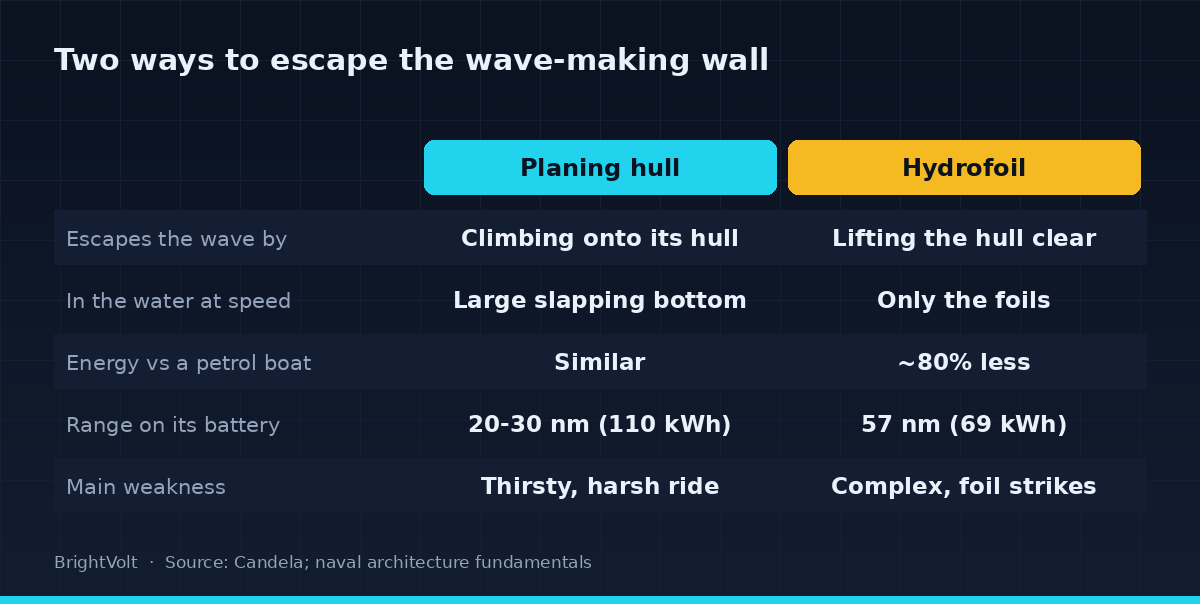
Planing is brute force. Enough power, and a flat-bottomed hull climbs up onto its own bow wave and skims across the surface rather than plowing through it, its weight now carried by hydrodynamic lift on the hull bottom. It works — every speedboat planes — but getting over the hump takes a burst of power, and once up, a large slapping area of hull is still in the water. It is fast and thirsty, and the ride in any chop is punishing.
Foiling is the elegant answer. Mount underwater wings beneath the hull, and above a takeoff speed those foils generate enough lift to raise the entire hull clear of the surface. With only the thin foils and their struts left in the water, both wave-making and the hull’s wetted drag largely disappear. That is the trick behind the Candela’s numbers: it uses about 80% less energy than a comparable petrol planing boat at cruise, which is exactly how a 69 kWh battery outranges a 110 kWh one. The cost is complexity — active control systems keeping the boat balanced on its foils, and foils that do not enjoy meeting a submerged log.
What it means for anyone reading an electric-boat spec
The practical upshot is a rule you can apply to any electric-boat claim. Range and speed are quoted together for a reason, and the relationship between them is not linear — it is closer to that cube. A boat advertised at “57 nautical miles” at a gentle cruise may do a third of that flat out, and the gap between the two numbers tells you how hard the hull is fighting the wave. A displacement electric ferry on a fixed harbour route, held below hull speed, is a genuinely easy engineering problem and several already run. A fast electric leisure boat is a hard one, and the ones that work solve it by foiling, not by waiting for a bigger battery.
So when the battery in an electric boat seems too small for the range promised, or suspiciously generous, look at the hull before you doubt the cells. The question is not how much energy it carries. It is how much of a wave it has to build to move — and whether it has found a way to stop building one at all.
Photo by Zhanzat Mamytova on Pexels · Photo by Bayram Çalık on Pexels