
A 100-hour battery stores electricity for more than four days at a stretch and hands back only 35 to 50% of what you put in. That sounds broken. It is the entire point. The long-duration batteries now being built — Form Energy’s iron-air cells, Noon Energy’s carbon-oxygen ones — deliberately trade away the efficiency lithium prizes, and in return they store energy for roughly a tenth of lithium’s cost per kilowatt-hour. Understanding why that is a good trade, not a bad one, means understanding what these batteries are actually for.
What “long-duration” actually means
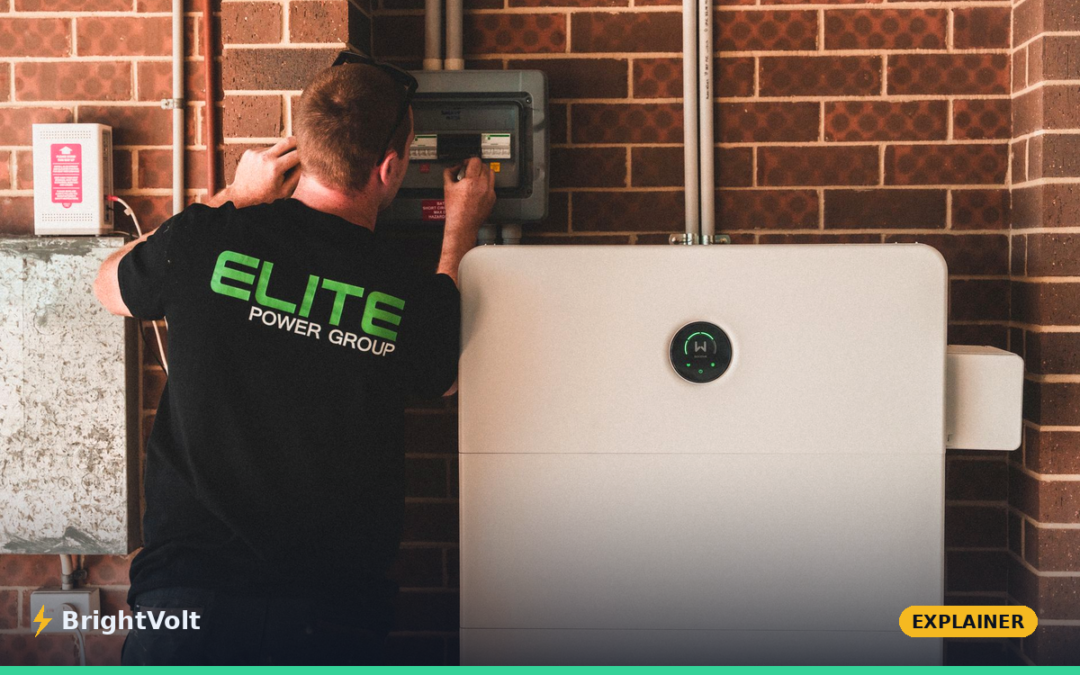
A grid battery is really two numbers: how much power it can deliver at once, in kilowatts, and how long it can keep delivering, which together give its energy in kilowatt-hours. The distinction between the two is the whole subject. Almost every lithium battery on the grid today is a four-hour battery: it is built to soak up a few hours of cheap midday solar and pour it back across the evening peak, then do the same thing again tomorrow. It cycles once a day, hundreds of times a year.
That is the wrong tool for a different problem. A grid running mostly on wind and solar does not only have a daily rhythm; it has a windless, cloudy week in winter when generation collapses for days. Bridging that gap needs a battery that can discharge not for four hours but for a hundred, and that will sit mostly idle waiting for the rare stretch when it is needed. Round-trip losses barely matter for a battery that cycles a few dozen times a year. What matters is the cost of building all that energy capacity in the first place. Lithium, optimised for daily cycling, is the most expensive possible way to buy four days of storage.
How an iron-air battery works: reversible rust
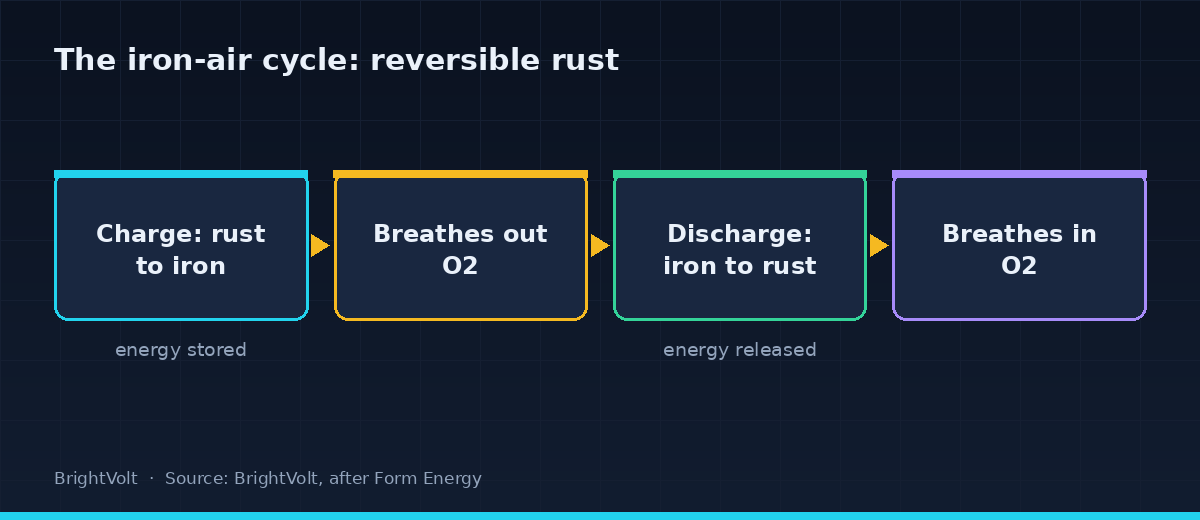
Form Energy’s cell is the strangest and the cheapest, because it runs on the most abundant industrial metal there is. It stores energy by rusting iron and releases it by un-rusting it.
On discharge, the battery breathes in oxygen from the air, which reacts with iron metal to form rust — iron oxide — and that reaction releases electrons, which is the current you draw. To charge, you push current the other way: it converts the rust back to metallic iron and breathes the oxygen back out. Reversible rusting, run in a tank of water-based electrolyte, with iron and air as the consumables. There is no lithium, no cobalt, no nickel — just iron, water and air, which is why Form can target a cost of $15 to $20 per kilowatt-hour, against lithium’s figure many times higher.
The price of that abundance is efficiency. Reversible rusting is a slow, lossy chemistry: Form’s round-trip efficiency sits around 35 to 40%, so more than half the energy is lost as heat over a full cycle. It is also slow to deliver power. Form’s first commercial systems, contracted with Xcel Energy for sites in Pueblo, Colorado and Becker, Minnesota, each provide 10 megawatts of power but store a full gigawatt-hour — a power-to-energy ratio that would be absurd for a car and is exactly right for a multi-day grid reserve. The company’s plant in Weirton, West Virginia was built to make these cells at scale.
How a carbon-oxygen battery works
Noon Energy takes a different route to the same goal, and lands on better efficiency. Its cell borrows from solid-oxide fuel cells and redox-flow batteries: on charging, surplus renewable electricity converts a carbon-based storage medium and releases oxygen to the air; on discharge, the carbon and oxygen recombine into carbon dioxide, and that reaction generates the power. The carbon and the CO2 stay inside the sealed system, cycling back and forth.
Because it is a higher-temperature electrochemical process rather than slow corrosion, Noon claims a round-trip efficiency of 60 to 80% — much closer to lithium — while still targeting under $20 per kilowatt-hour and durations as long as 200 hours. A third company, Ore Energy, is pursuing the same iron-air chemistry as Form, quoting around $18.50 per kilowatt-hour and a similar 40 to 50% efficiency. The field is not one bet; it is several, aimed at the same gap.
Why poor efficiency is the right trade
Put the technologies side by side and the logic of the trade becomes obvious.
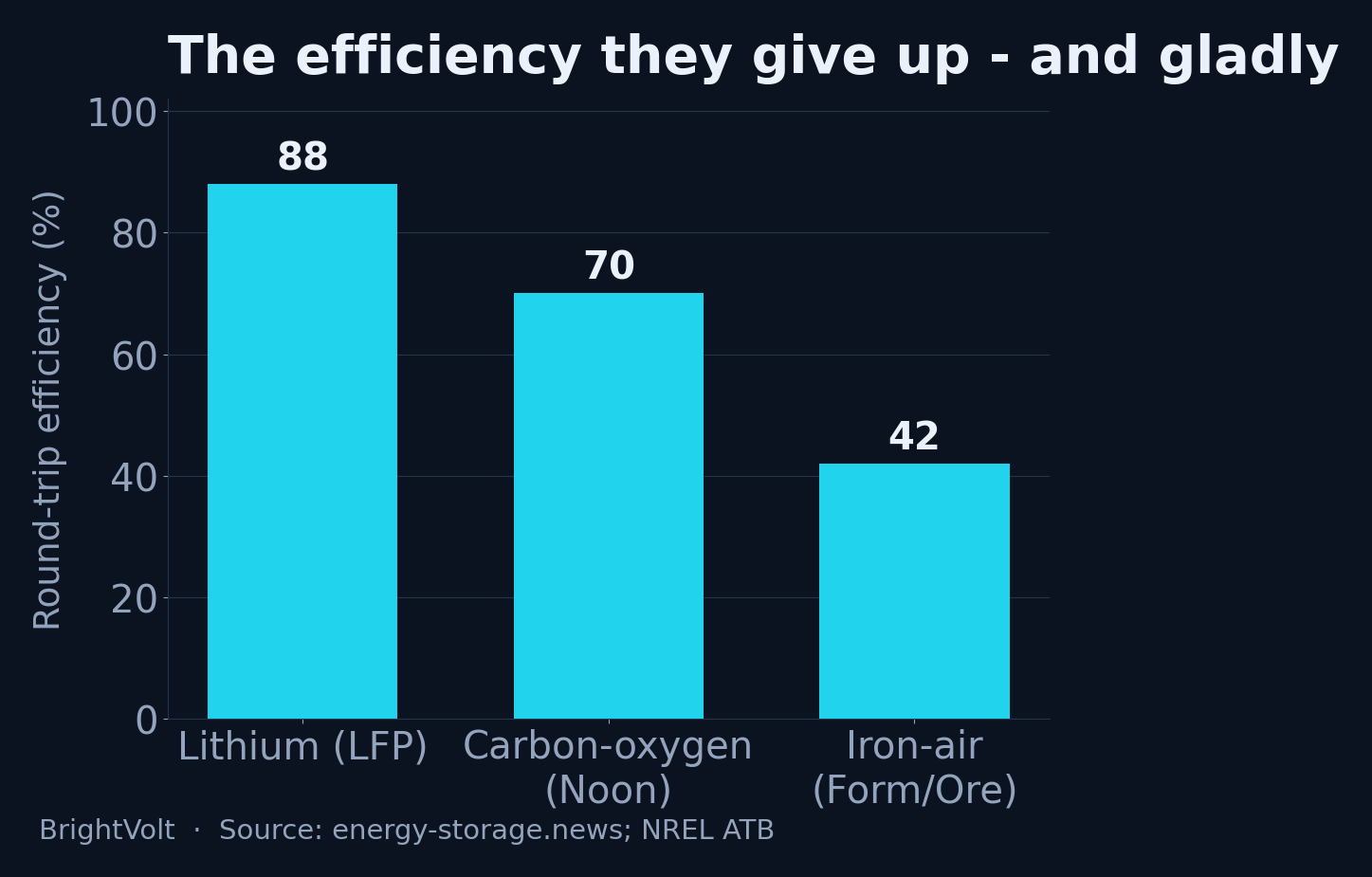
| Technology | Round-trip efficiency | Typical duration | Energy-cost target | Suited to |
|---|---|---|---|---|
| Lithium (LFP) | ~85–90% | ~4 hours | high per kWh | daily cycling |
| Carbon-oxygen (Noon) | 60–80% | up to 200 hours | <$20/kWh | multi-day gaps |
| Iron-air (Form, Ore) | 35–50% | ~100 hours | $15–20/kWh | multi-day to seasonal |
Efficiency only compounds when you cycle often. A lithium battery cycling 350 times a year loses a few per cent each time, and those losses add up to real money, so 90% efficiency is worth paying for. A 100-hour battery that fires perhaps twenty times a year, to cover the storms and the still weeks, throws away half its energy on each of those twenty cycles — and it barely matters, because the number that dominates its economics is the upfront capital cost of the energy capacity, not the throughput losses. When the input is surplus wind and solar that would otherwise be curtailed and wasted anyway, losing half of it to buy four days of firm backup is a bargain. You are not paying for the electricity that goes in. You are paying for the ability to have it come out four days later.
This is why comparing these cells to lithium on efficiency, the way the headlines do, measures the wrong thing. They are not competing with lithium. They are competing with the alternative for multi-day firmness — a gas peaker kept on standby, or overbuilding wind and solar by a huge margin — and against those, a cheap, lossy, long-lasting tank of rusting iron looks very good indeed.
What to watch
The threshold to keep in mind is roughly a day. Below about a day of storage, lithium’s high efficiency and falling price make it hard to beat, and none of these chemistries will displace it. Above a day — and especially at the multi-day durations a wind-and-solar grid actually strains against — the economics flip, and the question stops being efficiency and becomes cost per kilowatt-hour of capacity, which is the game iron-air and carbon-oxygen were built to win.
The open question is not whether the chemistry works; the demonstrations exist. It is whether these systems get built fast enough, and whether power markets learn to pay for multi-day firmness at all, since most were designed to reward four-hour arbitrage and nothing longer. The tell will be in the deployment numbers over the next few years: gigawatt-hours contracted, not gigawatts. A technology that measures its output in days is one to judge on how much energy it can hold, not how fast it can dump it.
Photo by Elite Power Group on Pexels · Photo by Heru Dharma on Pexels · Photo by Kindel Media on Pexels