
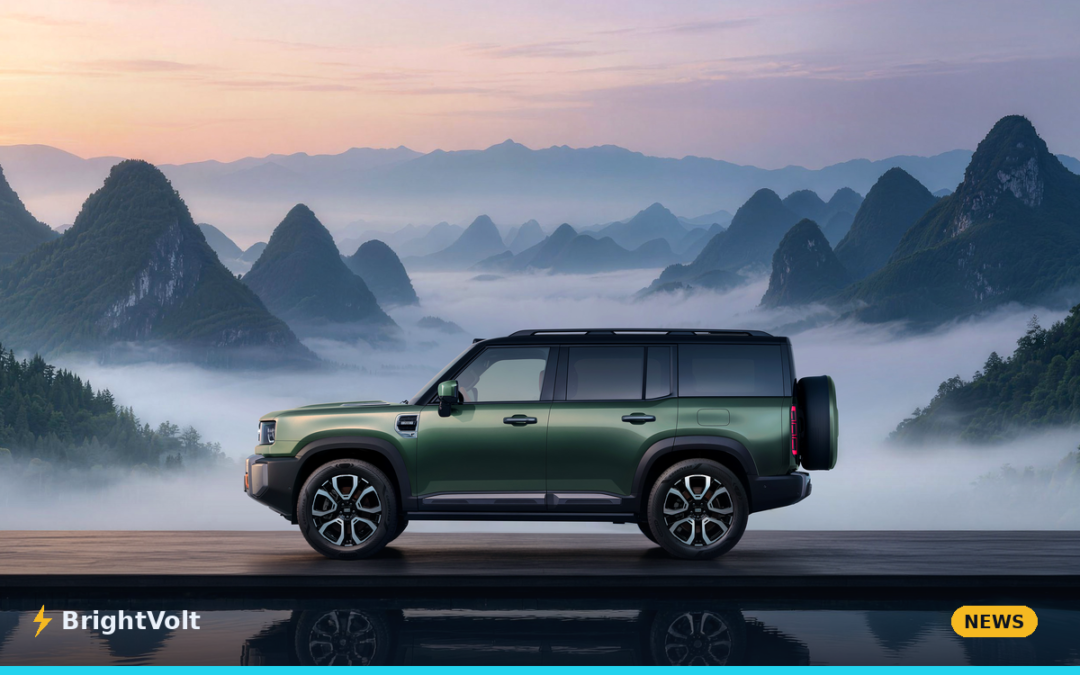
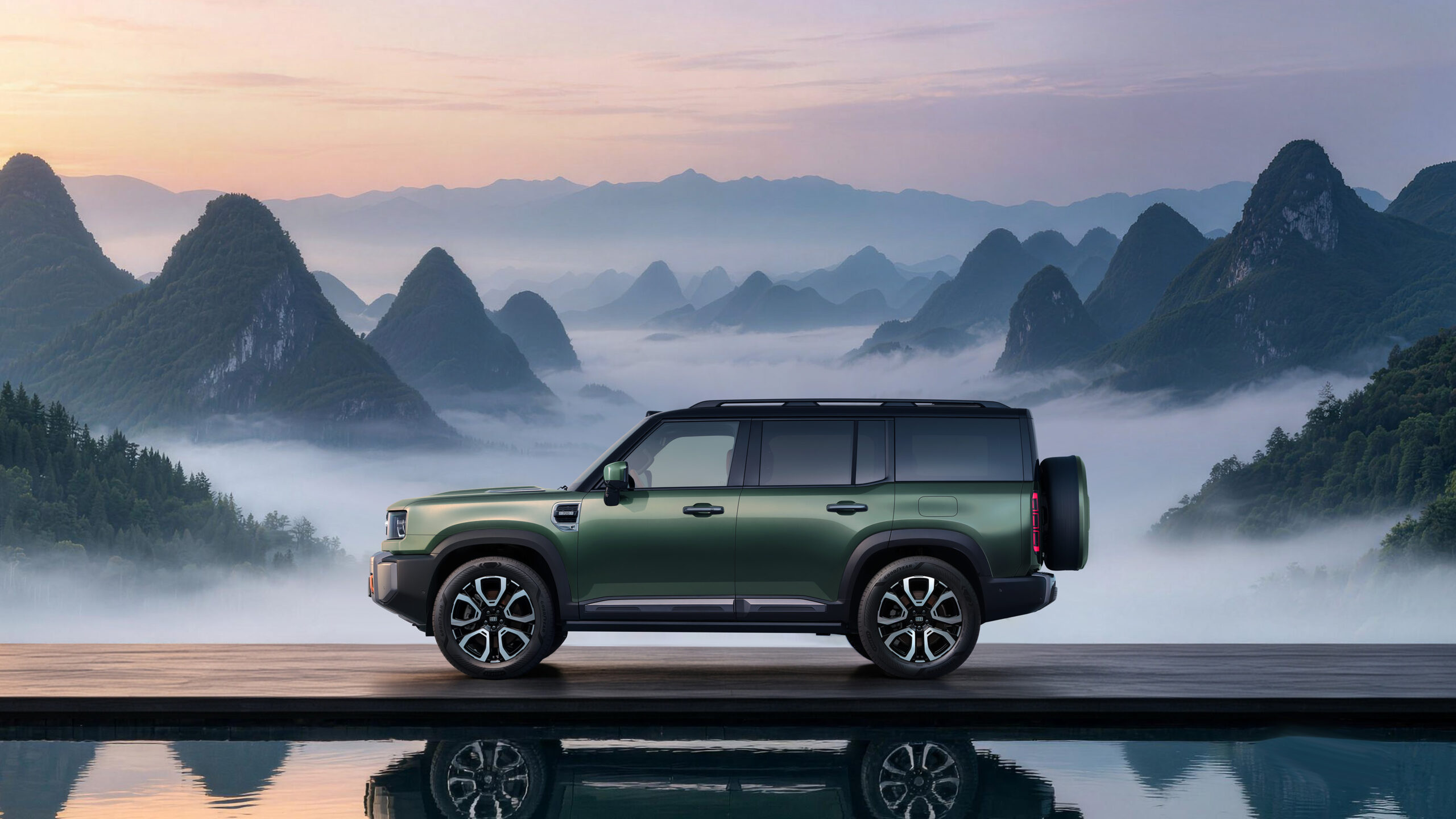
Geely showed the Galaxy Cruiser 700 in China in the last week of July, and in Milan on 26 July: a boxy plug-in hybrid off-roader with 830 kW, or 1,113 horsepower, from a petrol engine and three electric motors. That power figure is real and it is remarkable for the money it is likely to ask.
The other number in every headline is 165 to 185 km of electric range, which the English coverage has been converting to 100–115 miles. That conversion is arithmetically correct and practically misleading, because the figure is CLTC.
What was actually launched
The specification is now firm, because the car has been through China’s regulatory filing process rather than only through a press release.
| Combined output | 830 kW (1,113 hp / 1,128 ps) |
| Layout | Petrol engine plus three motors, two on the rear axle |
| Battery | 47.14 kWh LFP, CATL |
| Length / wheelbase | 5,085 mm / 2,900 mm |
| Ground clearance | 233 mm |
| Wading depth | 800 mm (claimed) |
| Price | Not announced |
The MIIT filing published on 10 July lists two engines: a 1.5-litre turbo (BHE15-CFZ) at 115 kW with a 200 km/h top speed, and a 2.0-litre turbo (BHE20-EFZ) at 155 kW at 220 km/h. Several outlets are printing 120 kW and 160 kW. The filing is the document that matters, and it says 115 and 155.
The same filing gives kerb weights of 2,405–2,605 kg for the 1.5T cars and up to 2,805 kg for the 2.0T. Hold on to that, because Geely’s own marketing quotes 392 ps per tonne, and 1,128 ps at 392 ps/t implies a 2,880 kg car — heavier than anything in the filing. The likeliest explanation is that the power-to-weight claim is measured against a gross or as-tested weight rather than kerb, but Geely has not said, and the arithmetic is ours rather than anyone’s official position.
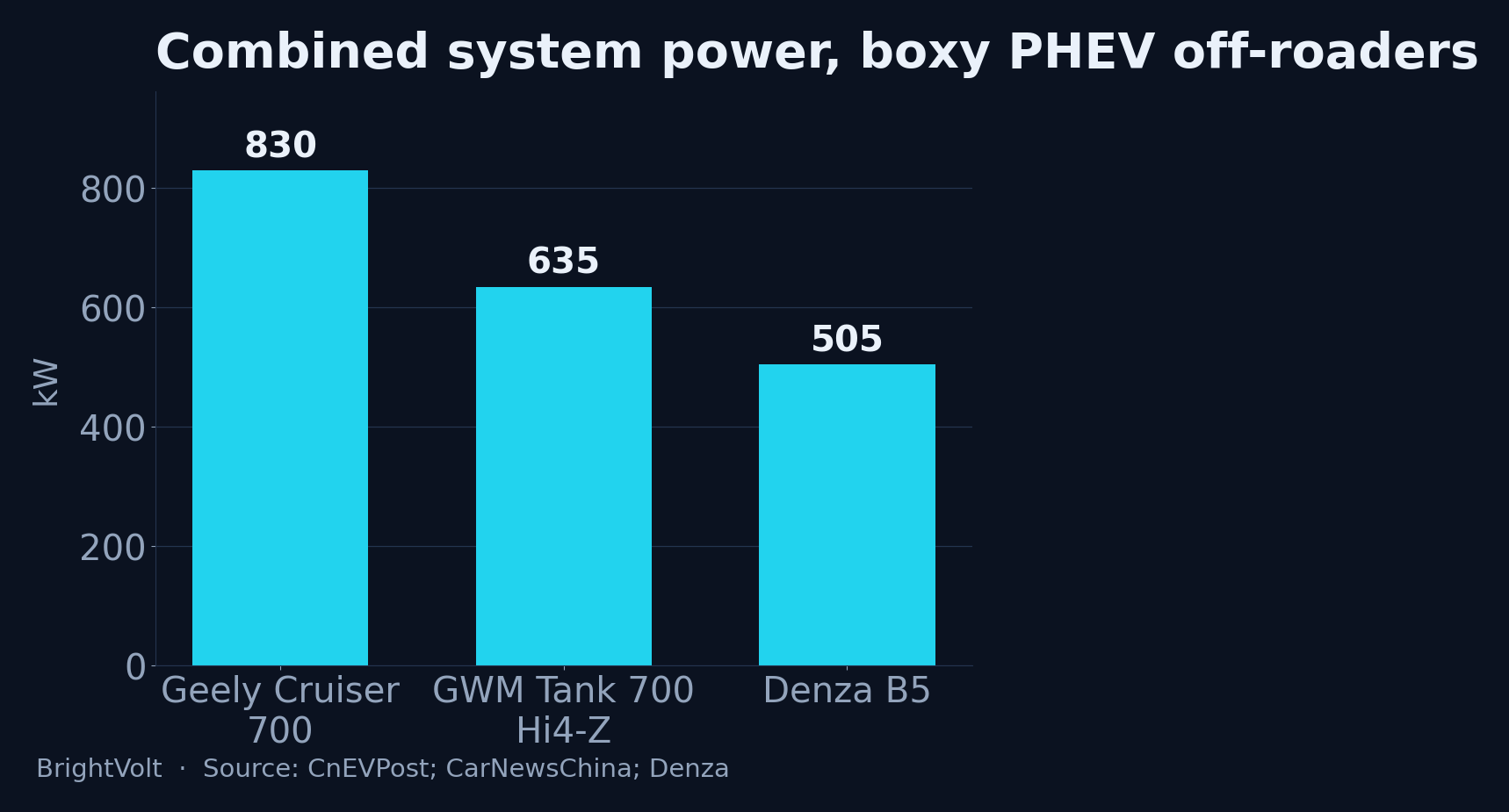
Against the obvious comparisons it is genuinely the most powerful of the three. GWM’s Tank 700 Hi4-Z, launched in April at 428,000 yuan, makes 635 kW. The Denza B5 makes 505 kW in Chinese specification and 400 kW in the Australian and New Zealand versions — itself a reminder that a Chinese number and an export number are rarely the same number.

The range figure needs translating
CLTC is the China Light-duty Vehicle Test Cycle, and as we set out in our guide to range cycles, it is the most generous of the three major procedures — roughly 35% above EPA for the same vehicle, which means converting the other way calls for a haircut of about 26%.
Chinese coverage lists three variants at 165 km, 170 km and 185 km CLTC. Apply our own published adjustment and the picture changes:
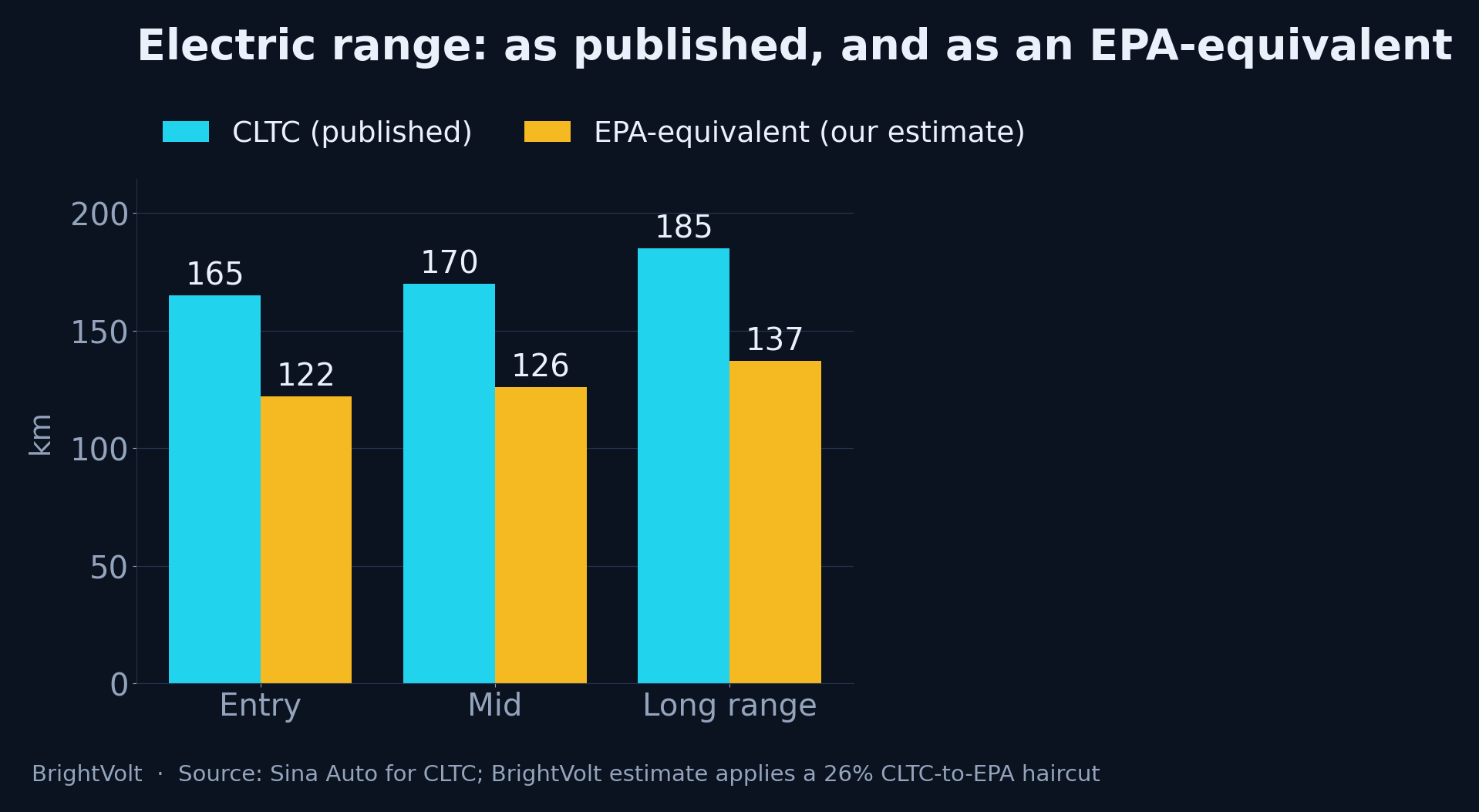
The 115 miles in the headlines becomes about 85 miles on the basis a British or American buyer would recognise, and the entry car’s 103 miles becomes about 76. That is still a useful electric-only range for a two-and-a-half-tonne off-roader, and it is not what the number appears to promise.
There is a second reason to be careful with the range claim. At 185 km from 47.14 kWh, the Cruiser 700 implies 3.92 km per kWh. The Tank 700 Hi4-Z, a similarly sized and similarly heavy body-on-frame off-roader, implies 3.22 km/kWh from its 59.05 kWh pack — but GWM quotes WLTC, which is the harder test. Adjust for the cycle and the efficiency gap between the two narrows to something close to nothing. The comparison that looks like a Geely win is mostly a comparison of test procedures.
Britain gets it in 2028
This is the part most worth knowing if you are reading from the UK, and it is buried in most of the coverage.
Geely has confirmed Britain as an export market — a company executive told Carwow in June, “We will definitely launch the car in the UK,” and the product roadmap has the Cruiser 700 heading the Geely UK line-up. The date on that roadmap is 2028. The Chinese launch is this year.
Two years is long enough for the specification, the battery supplier and the price to change entirely, and long enough for the Defender, the Tank 300 and Denza’s B-series to answer it. Treat the current numbers as a statement of intent for the Chinese market rather than a preview of a British showroom.
On price, nothing is confirmed anywhere. The “around 300,000 yuan” circulating in English coverage traces back to Chinese media speculation, and the outlet carrying it says plainly that Geely has not released a final price. For scale, the Tank 700 it is aiming at spans 428,000 to 508,000 yuan.
What we could not establish
Individual motor outputs are not in the filing, so the 830 kW combined figure cannot be decomposed. Neither is the split between engine and motors under load, which is what determines whether 1,113 hp is available for more than a few seconds. The battery is described as CATL, but the filing names three cell suppliers — CATL, Jiangsu Times and Zhongzhou Times — with final assembly by Zhejiang Shanjui, so “a CATL pack” is a simplification.
And there is no independent test of anything: no measured 0–100, no measured electric range, no verified wading depth. Every figure above is a manufacturer claim or a regulatory filing.
What to watch
The Chinese price, which is the only thing that will tell you whether this is a Tank 700 rival or something aimed considerably lower. Whether the 2.0T car reaches the UK at all, given that a 155 kW petrol engine in a 2.8-tonne PHEV faces a very different tax treatment here than in China. And whether Geely publishes a WLTP range figure when it certifies for Europe — that number, unlike this one, will be directly comparable to a Defender’s.
Image: Geely