
Lithium plating is what goes wrong inside a battery when it is charged too fast or too cold. Instead of tucking into the graphite anode the way they are supposed to, lithium ions arrive faster than the graphite can absorb them and settle on its surface as a film of metallic lithium. That metal is mostly lost for good — it strips real capacity from the cell — and in the worst case it grows into spikes that short the battery from the inside. It is the single biggest reason fast charging comes with a temperature limit.
Almost every explanation of it online is written for people who already build batteries: ScienceDirect papers, a PNAS study, vendor application notes. This is the plain-English version, and the one the rest of BrightVolt’s charging coverage keeps pointing at.
What lithium plating actually is
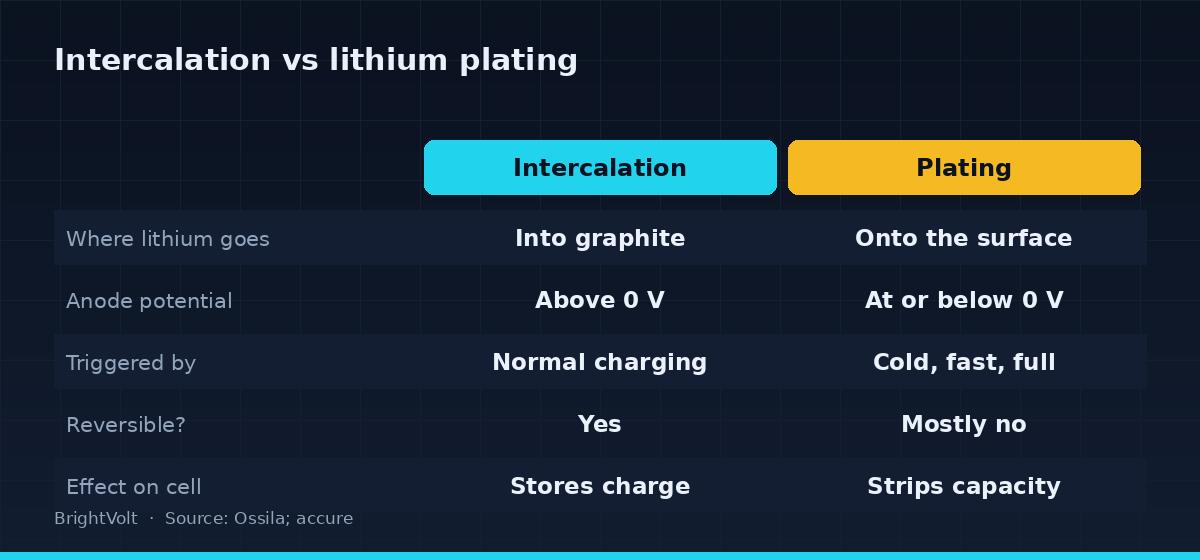
A working lithium-ion cell charges by intercalation: lithium ions leave the cathode, cross the electrolyte, and slot into the layered structure of the graphite anode like cards sliding between the pages of a book. The graphite does this at a voltage very close to that of lithium metal itself — the anode sits only about a tenth of a volt above the potential at which lithium would rather be a solid than an ion. That thin margin is the whole problem.
Plating happens when the anode’s local potential is pushed down to or below zero volts versus a lithium reference (0 V vs Li/Li⁺). At that point deposition becomes more favourable than intercalation, and the arriving lithium reduces to metal on the graphite surface instead of entering it. Nothing exotic has to happen for the anode to cross that line. It is a tenth of a volt away during normal charging, and three ordinary conditions push it over.
Why cold and fast charging cause it
Three levers move the anode toward the plating threshold, and real-world plating is almost always a combination of them.
Cold. Lithium ions have to diffuse through the graphite once they arrive, and that solid-state diffusion slows sharply as temperature drops. The ions pile up at the surface faster than they can spread inward, the surface saturates, and the excess plates. This is why cars in winter are the classic case: manufacturers generally treat roughly 5–45°C as the safe charging window and 10–30°C as the comfortable one, and why a cold pack will refuse a full-speed charge until it warms.
Speed. A high charging current is simply a high rate of lithium delivery — a high C-rate. Push ions at the anode faster than intercalation can take them up and, again, the surplus has nowhere to go but onto the surface. The faster the charge, the closer the anode runs to the plating line.
Fullness. As the graphite fills toward 100% state of charge there is less room left to accept ions, so its potential naturally drifts downward. A cell that plates happily at 20% may plate readily at 80%. High speed and high state of charge are a bad combination, which is exactly why the last stretch of a fast charge is the slowest.
There is a nastier version, too. Plating does not need the average anode potential to go negative — a cold spot inside a large pack is enough. Research on underpotential plating shows temperature differences across a cell can drive lithium onto the colder regions while the cell as a whole looks fine, which is part of why detecting it from the outside is so hard.
Where the lost capacity goes
Not all plated lithium is gone. Some of it re-dissolves and intercalates when the cell rests after charging — reversible plating, which shows up in the lab as a small “stripping” plateau on the voltage curve during relaxation. The rest is the damage.
Metallic lithium is extremely reactive. Some of what plates immediately reacts with the electrolyte and thickens the solid-electrolyte interphase, the passivating skin on the anode. Some becomes physically disconnected from the electrode — “dead lithium” — electrically stranded and useless. Both outcomes consume the cell’s finite lithium inventory, and that inventory is what capacity is. Every plating event permanently removes a little of the material the battery uses to store charge.
This is why plating shows up as accelerated ageing rather than a single failure. A cell repeatedly fast-charged in the cold loses capacity gradually, then hits what battery engineers call the knee — the point where the loss rate suddenly steepens and the cell heads toward end of life much faster than its early curve suggested. The internal resistance climbs too, which quietly caps how much power the pack can deliver.
From plating to a fire
The safety story is the reason plating gets attention out of proportion to its everyday frequency. Metallic lithium does not deposit as a smooth layer. It tends to grow needle-like structures — dendrites — and given enough plating cycles a dendrite can grow far enough to pierce the separator between anode and cathode. That is an internal short circuit: a direct path that dumps the cell’s energy as heat in one place, which is one of the ways a lithium-ion cell tips into thermal runaway and, occasionally, fire.
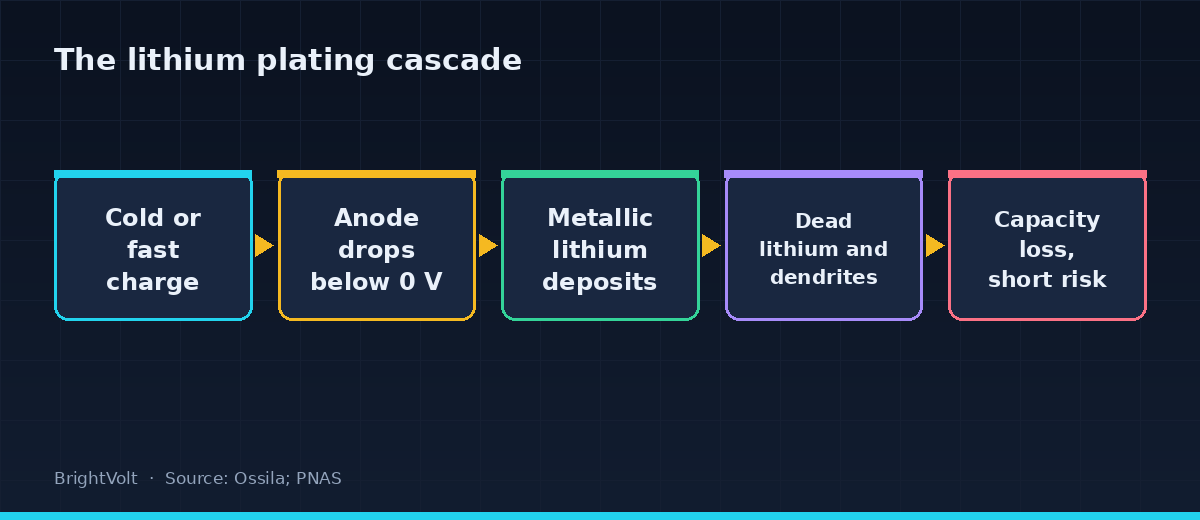
The chain is worth keeping straight because most fast charges never get near the end of it. Cold-plus-fast charging pushes the anode below zero volts; lithium plates; most of it becomes dead lithium and lost capacity; a small fraction builds dendrites; and only after enough of that does a short become likely. Good battery design is aimed at breaking the chain at the first link, not the last.
How EVs are engineered around it
This is where the abstract chemistry turns into features drivers actually notice. A modern battery management system watches voltage, current and temperature and tapers the charging current as state of charge and temperature move toward the danger zone — voltage remains the most reliable real-time signal a BMS has for catching plating conditions as they form. That taper is not the charger being weak. It is the pack staying above zero volts on the anode. It is also most of the reason a 350 kW charger never delivers 350 kW for more than a few minutes.
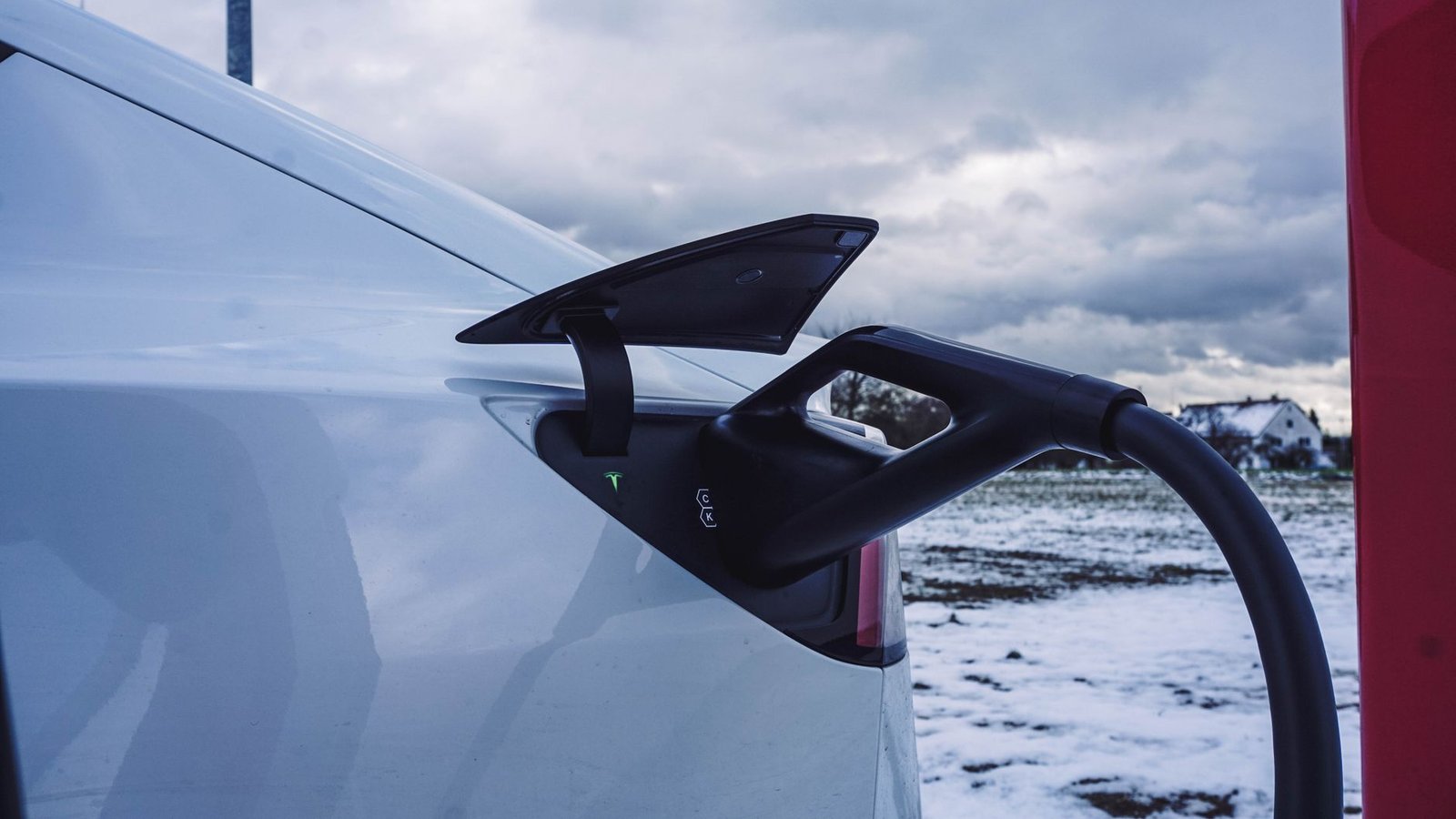
The other visible feature is preconditioning. When a car heats its own battery on the way to a fast charger — often triggered automatically once you set the charger as a navigation destination — it is warming the pack out of the plating-prone cold range so it can accept a high current safely on arrival. Cell design does the rest: fast-charge-oriented graphite, thinner electrodes and silicon additives all widen the margin before the anode potential hits the plating line, which is how each generation of cell charges faster than the last without simply plating more.
What shifts the picture next is chemistry that does not rely on graphite at all. Silicon-dominant anodes and, further out, the sodium-ion cells already moving into cold-climate storage change where — and whether — this limit sits. But for the graphite lithium-ion battery in almost every EV on the road today, the rule is fixed by physics: charge it cold and fast and full at your own risk, and let the car warm and taper when it insists. The pause is the battery protecting the thing you paid the most for.
Photo by Castorly Stock on Pexels · Photo by Ayyeee Ayyeee on Pexels · Photo by Maik Poblocki on Pexels