
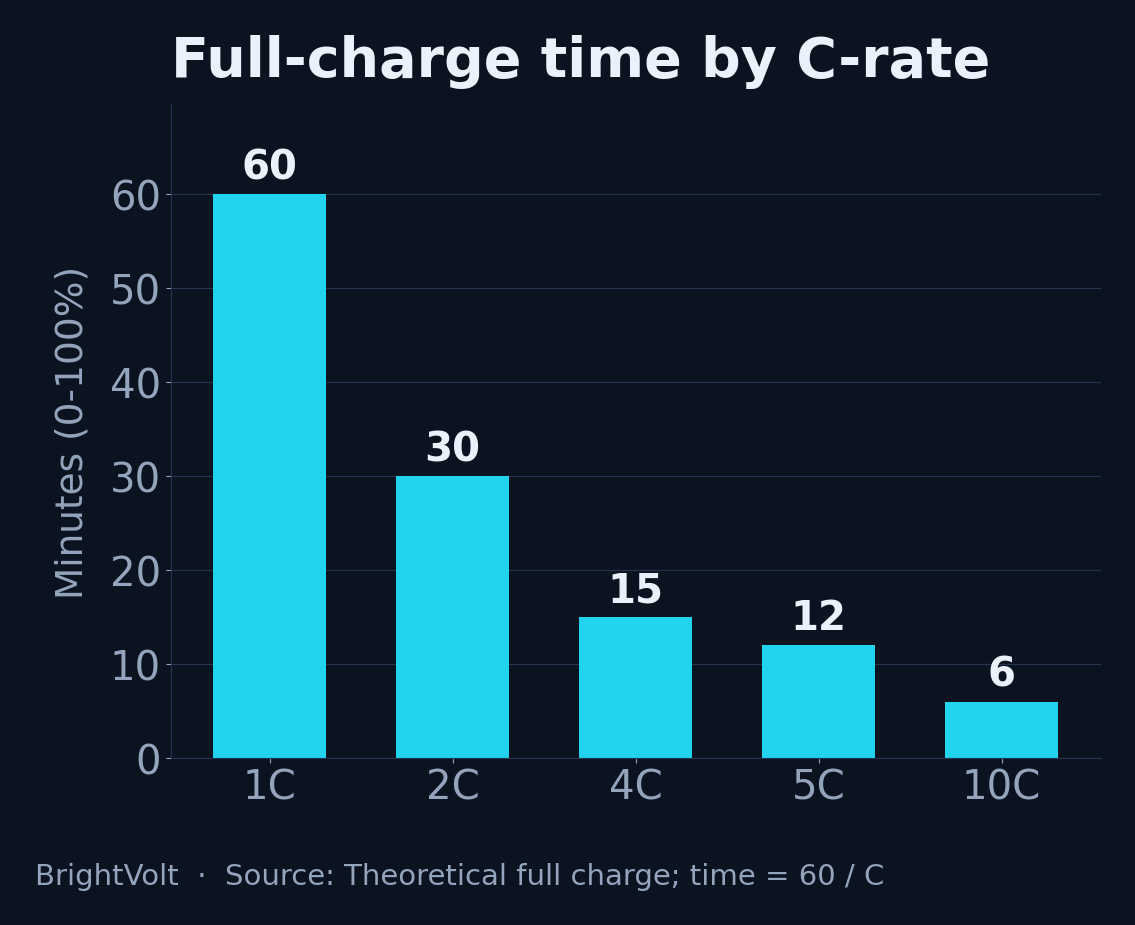
A battery’s C-rate is how fast it charges or discharges relative to its own capacity: at 1C it fills in an hour, at 4C in fifteen minutes, at 10C in six. That last figure is not hypothetical. In March 2025 BYD’s Super e-Platform hit 10C — 1,000 kW, 1,000 volts, 1,000 amps, adding 400 km of range in five minutes. The catch is that no car holds its peak C-rate for more than a moment, which is why the number on the spec sheet and the minutes on the charger almost never agree.
C-rate is the single most useful number for understanding EV charging, and it is the one carmakers are quietly racing on. It also travels badly: the same “10C” that sounds like a full charge in six minutes describes, in practice, a curve that spends most of its time far below the peak. Here is what the number means, and what it does not.
What does C-rate actually measure?
C-rate is charge or discharge current expressed as a multiple of the battery’s capacity. A pack rated at 60 kWh charged at 1C draws 60 kW and fills in one hour. At 2C it draws 120 kW and takes thirty minutes. At 5C, 300 kW and twelve minutes. The arithmetic is simply time = 1 ÷ C hours, so the rate and the charging time are two ways of saying the same thing.
That is why C-rate is more honest than a raw kilowatt figure. A 250 kW charging session sounds fast, but into a 50 kWh pack it is 5C and brutal on the cells, while into a 120 kWh pack it is barely 2C and gentle. The power figure alone tells you nothing about the stress on the battery; the C-rate tells you everything. It is capacity-relative by design.
The same logic runs in reverse on discharge. A pack that can deliver 10C on discharge can dump its entire energy in six minutes — which is what a performance EV needs for a launch, and what a grid battery providing frequency response needs for a fast injection. Charge and discharge C-rates are not always symmetric, but the unit is the same.
Why is the spec-sheet C-rate a peak, not an average?
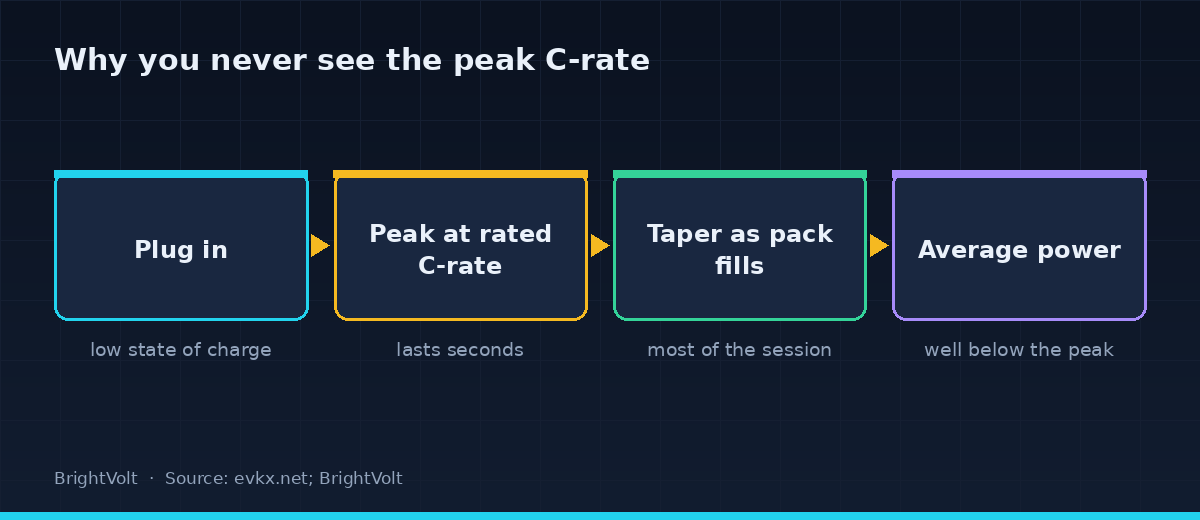
Because a lithium cell cannot accept its maximum current across the whole state of charge. Charging fast is easy when the battery is nearly empty and hard as it fills: push too much current into a full cell and lithium plates onto the anode instead of intercalating, which permanently kills capacity and, in the worst case, starts a fire. So the charger holds a high current only briefly, then tapers it down as the pack fills. The headline C-rate is the height of the spike, not the area under the curve.
This is why manufacturers quote a window, not a full charge. CATL’s second-generation Shenxing cell is rated for a peak in the region of 12C but describes itself in use as “5 to 70% in five minutes” — the honest metric, because 70 to 100% is where the taper bites hardest and the minutes pile up. The same physics is why a 350 kW charger never actually delivers 350 kW for more than a slice of the session. C-rate sets the ceiling. Tapering sets the average, and the average is what you wait through.
How fast are the fastest packs, really?
Fast enough that the cell is no longer the bottleneck — the charger and the grid connection are. The table below lines up the current front-runners against a typical Western 800-volt car. The peak C-rates are manufacturer claims; the real-world times are the quoted charging windows, which already bake in the taper.
| Pack / platform | Peak C-rate | Quoted fast-charge | Peak power |
|---|---|---|---|
| Typical 800V EV (2025) | ~3C | 10–80% in ~18 min | ~270 kW |
| CATL Shenxing, 1st gen (2023) | 4C | 400 km added in 10 min | ~ |
| CATL Shenxing, 2nd gen (2026) | ~12C peak | 5–70% in 5 min | ~ |
| BYD Super e-Platform (2025) | 10C | 400 km added in 5 min | 1,000 kW |

Two things stand out. The leaders are Chinese, and they are running LFP — lithium iron phosphate, long treated as the cheap-and-safe chemistry you accepted slower charging to get. BYD and CATL have pushed LFP past 10C, which was supposed to be the preserve of exotic cells. And the peak has run ahead of the infrastructure: a 10C pull on a large pack asks for a megawatt, and there are very few chargers in the world, and fewer grid connections, that can source a megawatt to a single car. The cell is ready before the forecourt is.
What does a high C-rate cost?
Heat, mainly, and the engineering to manage it. Ramming a megawatt into a pack in five minutes generates enormous waste heat, so a 10C car needs aggressive liquid cooling, thicker busbars, a 1,000-volt architecture to keep the current survivable, and silicon-carbide power electronics rated well above the working voltage. All of that is weight and cost that a 2C car does not carry. There is a durability tax too: sustained high-C cycling ages a cell faster than gentle charging, which is why CATL markets a durable 5C cell for longevity separately from its headline peak — the number you can hit once is not the number you can hit every day for a decade.
Then there is the grid. A single 10C car mid-charge is a megawatt of demand appearing and vanishing in minutes; a forecourt of them is a small industrial load with a violent duty cycle, and that is a substation-and-buffer-battery problem long before it is a cell problem. This is the quiet reason the C-rate race matters beyond bragging rights: it moves the constraint off the battery and onto everything around it.
So read the C-rate as a ceiling, not a promise. It tells you how hard a pack can be pushed, which is genuinely useful — a 5C car will out-charge a 2C car at every state of charge. What it will not tell you is how long you actually stand at the charger, because that is decided by the taper, the plug’s amp limit and whether the grid behind it can feed the cable. The cells have nearly won their half of the argument. The chargers have not.
Photo by Reinhard Bruckner on Pexels · Photo by Looking For Feferences on Pexels