
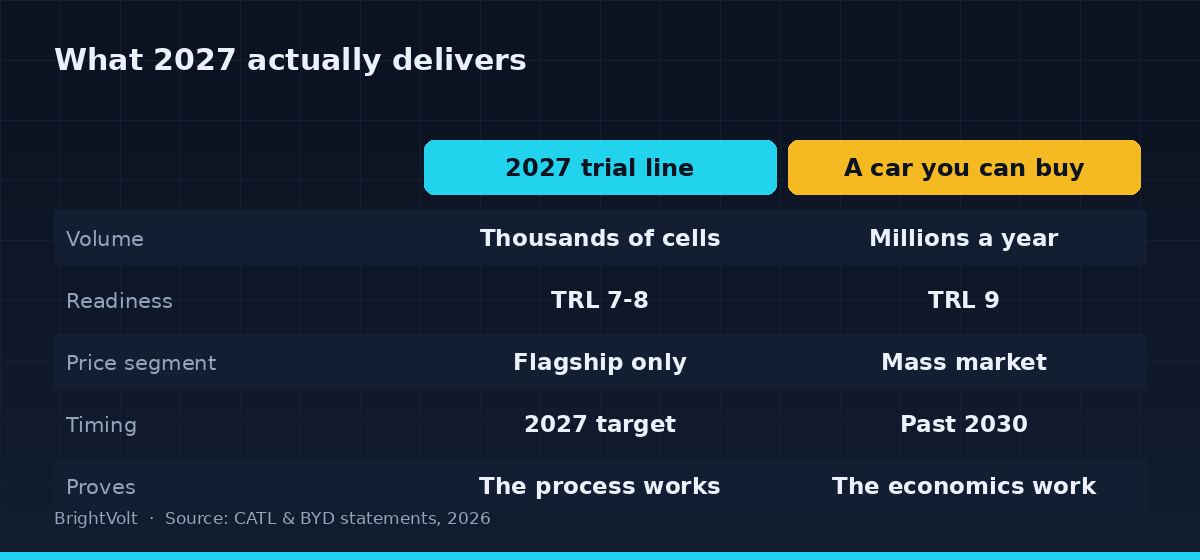
Solid-state batteries are not arriving in 2027. What arrives in 2027, if the schedules hold, is a trial production line — a few thousand cells built to prove the process works, not a battery you can buy in a car. CATL and BYD, which between them make most of the world’s EV batteries, both now target that date. Both also say the mass-market product is past 2030.
The headlines have collapsed the two into one. “Solid-state by 2027” is the consensus shorthand now, repeated by outlets that would struggle to say what actually happens on the line that year. So it is worth being precise, because the gap between a pilot line and a showroom is where most battery revolutions have quietly gone to die.
What actually happens on the line in 2027
A proof of concept, at small volume, at laboratory-adjacent readiness. CATL rates its own all-solid-state technology at level 4 on the nine-point technology-readiness scale — validated in the lab, not yet built at scale. Its stated goal for 2027 is TRL 7 to 8: a system prototype demonstrated in a real environment. That is real progress, and it is still two rungs short of TRL 9, the level at which you actually sell the thing.
BYD’s 2027 target is the same shape. It is trial production, backed by six solid-state patents granted at the end of July covering a dual-electrolyte cathode of solid halide and sulfide. Patents and pilot lines are exactly what you expect from a company two to three years out. They are not what you see from one about to ship.
A trial line is to a product what a wedding rehearsal is to a marriage — necessary, encouraging, and not the thing itself.
Why the biggest battery makers are the ones telling you to wait
Here is the tell. The loudest “solid-state is imminent” copy tends to come from the players with the least manufacturing to lose — startups raising rounds, carmakers with no cell plants of their own. The caution comes from CATL and BYD, the two firms that would actually have to build these at industrial scale, and who therefore know precisely what standing up a new gigafactory line costs.
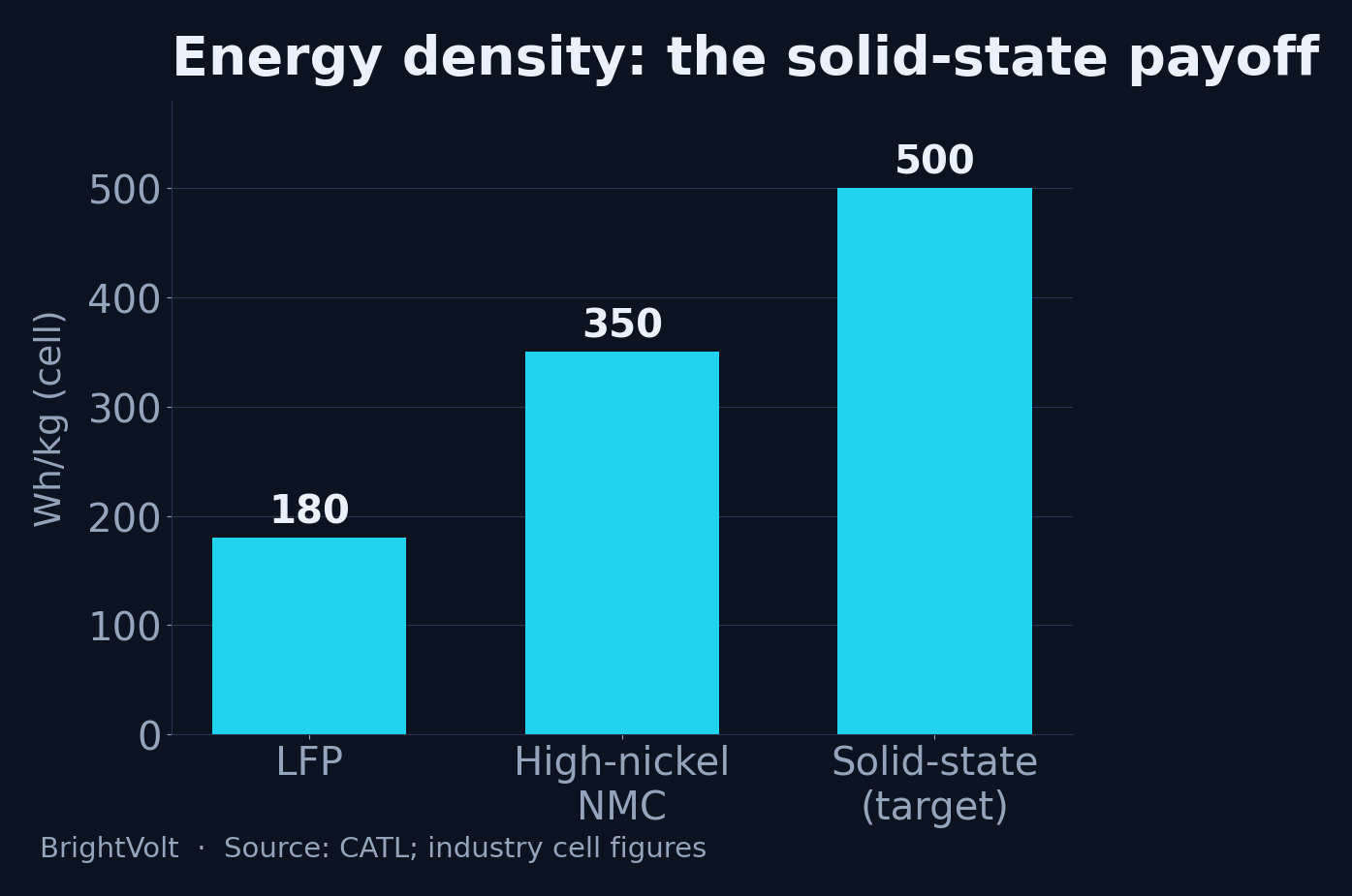
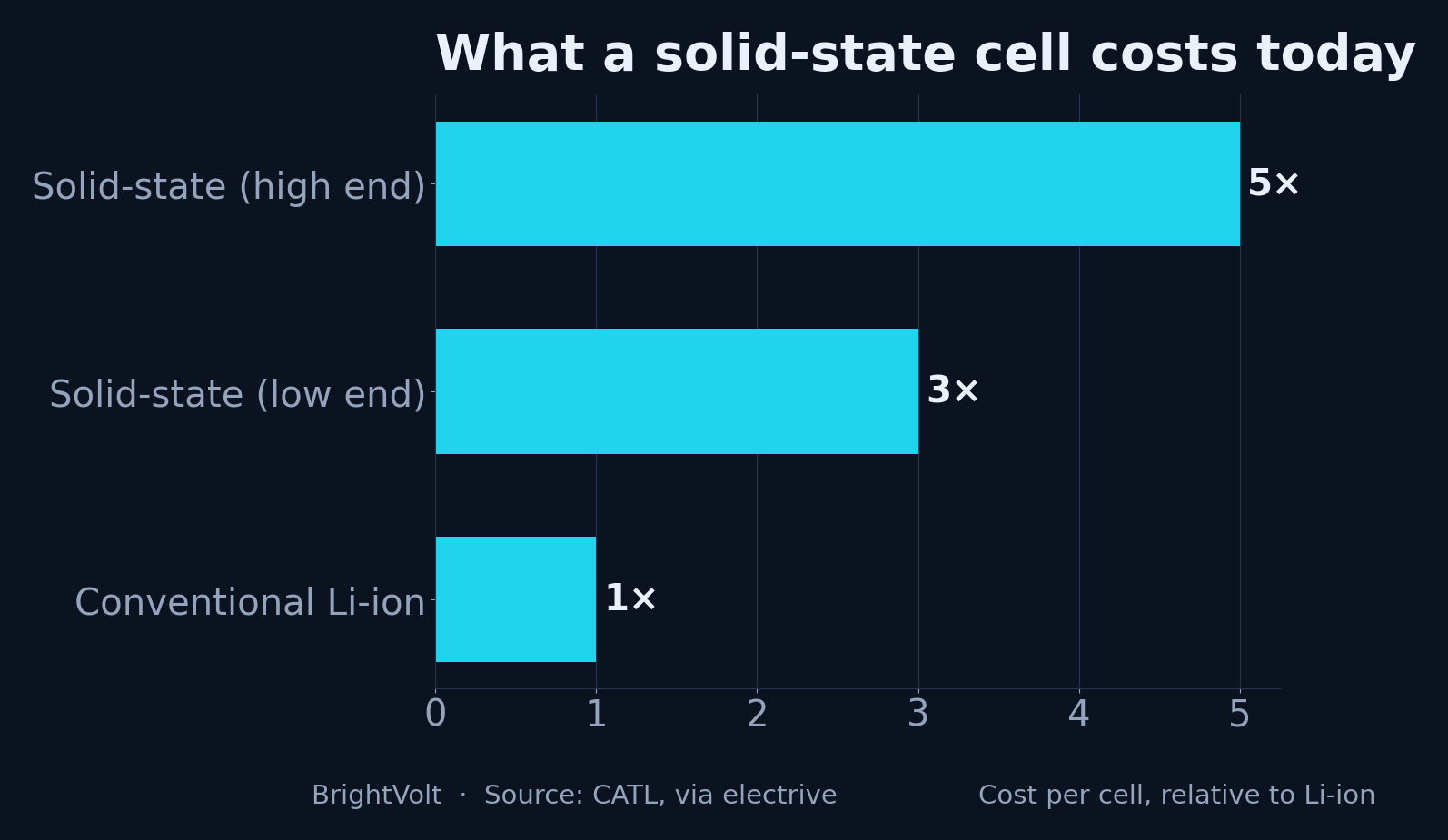
CATL’s chairman Robin Zeng has said mass commercialisation before 2030 is unlikely, and that the first cells will only make sense in cars priced above ¥250,000 — about $37,000 — because of what they cost. And they cost a great deal: sulphide-based solid-state cells run three to five times the price of conventional lithium-ion today. The payoff is genuine. CATL’s pilot cells reach around 500 Wh/kg against roughly 350 for the best liquid-electrolyte cells, a 40% jump in the energy carried per kilogram.
But nobody drops a cell that costs 3-5x into a mass-market car. You put it in a flagship, sell a few thousand, and learn. That is what 2027 is for. It is the year the leaders find out what the line can do, not the year the technology reaches a driveway.
The roadmap everyone quotes, read honestly
Every major player has a solid-state date, and almost none of them is a car on a lot at a price an ordinary buyer pays.
| Maker | Headline milestone | What it actually is | Mass market |
|---|---|---|---|
| CATL | 2027 | Trial line, TRL 7–8 | “Unlikely before 2030” |
| BYD | 2027 | Trial production | Late decade |
| Toyota | 2027–2028 | First BEV, low volume | Premium first |
| Samsung SDI | 2027 | 900 Wh/L, pilot since 2023 | “Late 2020s” |
| QuantumScape | 2025–2026 | Sample cells, pilot line | Via PowerCo, later |
Read down the last column and the schedule says the same thing five times. Pilots and prototypes cluster around 2027; volume and affordability sit at the far end of the decade. Toyota’s 2027–2028 target is the most concrete of the set, and even Toyota frames the first units as low-volume and premium, paired with a 1,000 km range figure that belongs to a halo car, not a Corolla. Samsung SDI’s 900 Wh/L pilot line has been running since 2023 and still points at “the late 2020s.” QuantumScape is shipping samples, not selling packs.
The strongest case that this read is too gloomy
Battery timelines have been beaten before, from the wrong direction. Sodium-ion went from curiosity to shipping product faster than most 2023 forecasts allowed, and LFP energy density climbed years ahead of where the old consensus put it. Pilot lines have a way of quietly becoming production lines once the process locks. BYD’s patent flow and QuantumScape’s sample flow are exactly the leading indicators you would want to see two years before scale. Take that case seriously: the people betting on an early solid-state car are not fools, and the technology is moving.
It still does not deliver a mass-market solid-state car in 2027, for one stubborn reason. Sodium-ion and LFP scaled fast because they reused the existing liquid-electrolyte manufacturing base — the same coating, winding and filling lines, retuned. Solid-state does not get that gift. It needs new processes for handling brittle ceramic and sulphide electrolytes, tighter dry-room discipline, and quality control invented largely from scratch. That is the manufacturing problem CATL calls the unsolved one, even as it describes the underlying science as “largely resolved.” Chemistry you can rush in a lab. A gigafactory yield curve you cannot.
What would change our mind
A specific, watchable thing: a solid-state EV on sale to ordinary buyers, below roughly $40,000, before 2029 — or any single maker shipping more than 100,000 solid-state-equipped vehicles in a year before then. Either would mean the cost and manufacturing curves bent faster than CATL’s own chairman expects, and this piece was too cautious. Watch the price tag and the volume, not the press release. The announcements have promised 2027 for years while the in-service dates kept sliding right.
Until one of those lands, the accurate description of 2027 is the deflating one. It is the year the industry finds out whether it can build these at all — a rehearsal, watched closely, by the people who will have to perform. The solid-state battery is coming. It is just not coming to a dealership near you the year the headlines say it will.
Photo by Looking For Feferences on Pexels · Photo by Artem Podrez on Pexels