
The derailleur has survived every attempt to replace it for a hundred years, and it has survived for a good reason: a bent piece of aluminium hanging off the back of a bike is lighter, cheaper and more efficient than anything else that changes gear. Hub gears lost on efficiency. Gearboxes lost on weight and price. The derailleur won on the numbers every time.
Two drive systems shown at Eurobike 2026 — the Avinox MG Concept and the Gobao X1 and X1P — take a different route. They do not try to beat the derailleur at its own game. They put the gearbox inside the motor, and they use electricity rather than cogs to change ratio. On an e-bike, that changes which numbers matter.
What a derailleur is actually good at
Two things, and they are worth naming before anything replaces them.
The first is efficiency. Careful measurements by Kyle and Berto put chain-and-derailleur drivetrains at 87 to 97%, against 86 to 95% for internal gear hubs; Rohloff’s own testing at higher rider power puts both its Speedhub and a 24-speed derailleur at 95 to 98.5%. The spread depends heavily on how hard you are pedalling, but the ordering is consistent: a straight chain running over sprockets is very hard to beat.
The second is range for the money. A modern 12-speed cassette gives a 520% spread between highest and lowest gear — the ratio between the easiest hill you can spin up and the fastest descent you can pedal — for a few hundred grams and not much money.
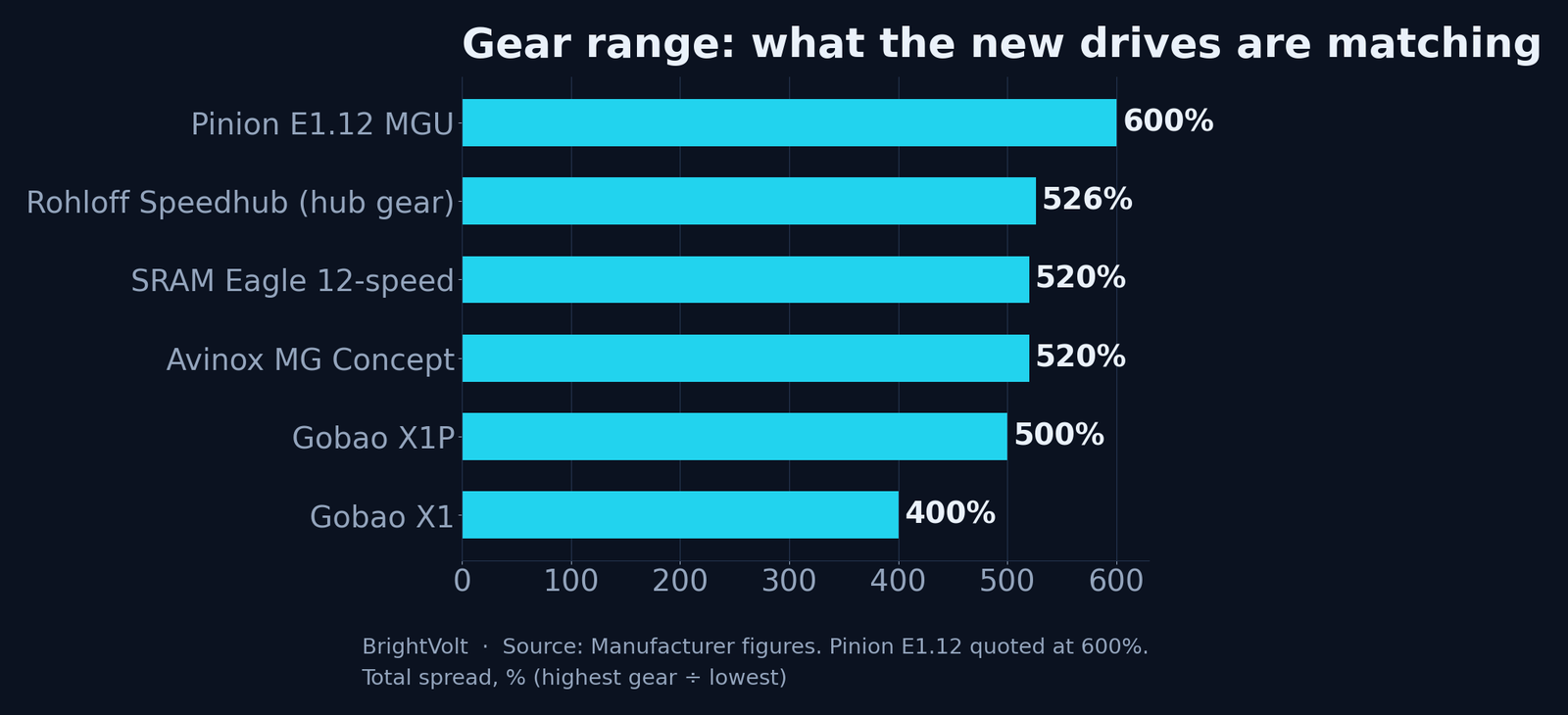
Both new drives target exactly that figure. Avinox quotes 520%, matching SRAM Eagle. Gobao’s X1P quotes 500%. Neither is claiming to give you more gear than you already have; they are claiming to give you the same gear with nothing hanging off the frame.
Two ways to put the gearbox inside the motor
There are now two quite different architectures under the same “motor-gearbox unit” heading, and conflating them is the main confusion in the coverage.
The stepped gearbox. Pinion’s E1.12 MGU is the established version: a conventional 3×4 cog gearbox sitting in the same housing as the motor. Real gears, real ratios, real engagement, just relocated from the rear wheel to the bottom bracket. It works, it has been on sale for years, and it has not broken through — BIKE magazine attributes that to noise, jerky shifts, weight and, above all, bikes costing north of €7,000.
The power-split eCVT. This is what Gobao and, apparently, Avinox are doing, and it is not a gearbox in the ordinary sense at all. The unit contains two electric motors and a fixed planetary gearset. Your legs drive one input; the two motors act on the others. By varying how much each motor holds back or drives forward, the effective ratio between your pedals and the rear wheel can be set to any value in the range — continuously, with nothing engaging or disengaging.
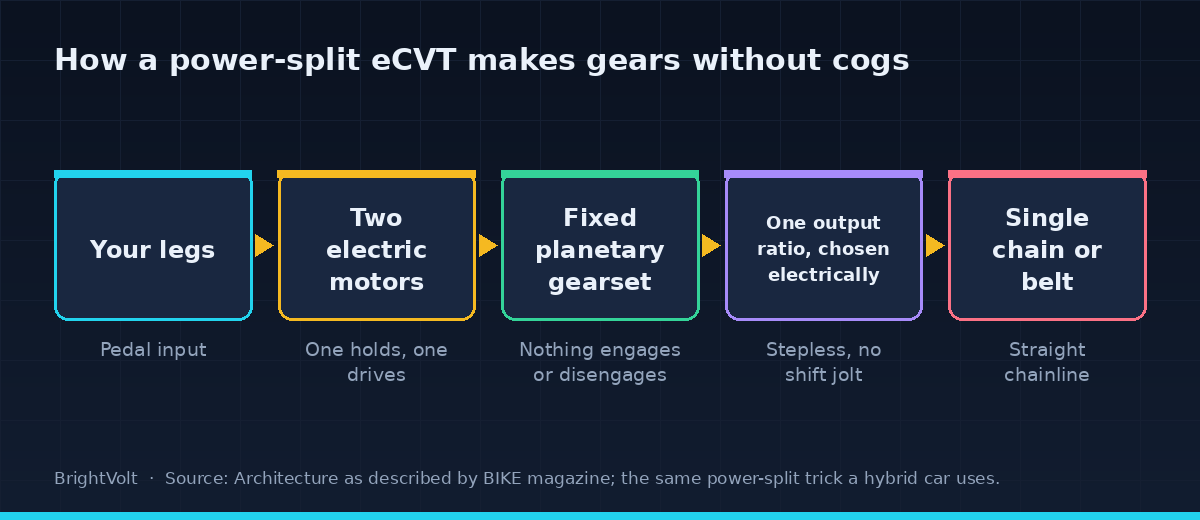
If that sounds familiar, it should. It is the same trick a hybrid car uses to avoid having a gearbox: a planetary set with an engine on one input and motor-generators on the others, where the “gear ratio” is a consequence of how the electrical machines are loaded. Gobao and Avinox have taken the Prius transmission, shrunk it, and put your legs where the petrol engine goes.
That also explains why the word CVT is doing something unusual here. A mechanical CVT — the belt-and-cone kind — is a wear item and a known efficiency problem. There is no such belt in this. The continuity comes from software.
Why this only makes sense on an e-bike
Here is the part that decides whether any of it matters, and it is arithmetic rather than opinion.
Nobody has published an efficiency figure for either eCVT drive. Assume, pessimistically, that it lands at the bottom of the measured transmission band rather than the top. On an unassisted bike that would be a serious problem: every percentage point comes directly out of your legs, and you have perhaps 200 watts to give.
On an e-bike it comes out of the battery instead, and a battery is a quantity you can put a number on. Take a bike using 10 Wh per kilometre at the crank and a 750 Wh pack.
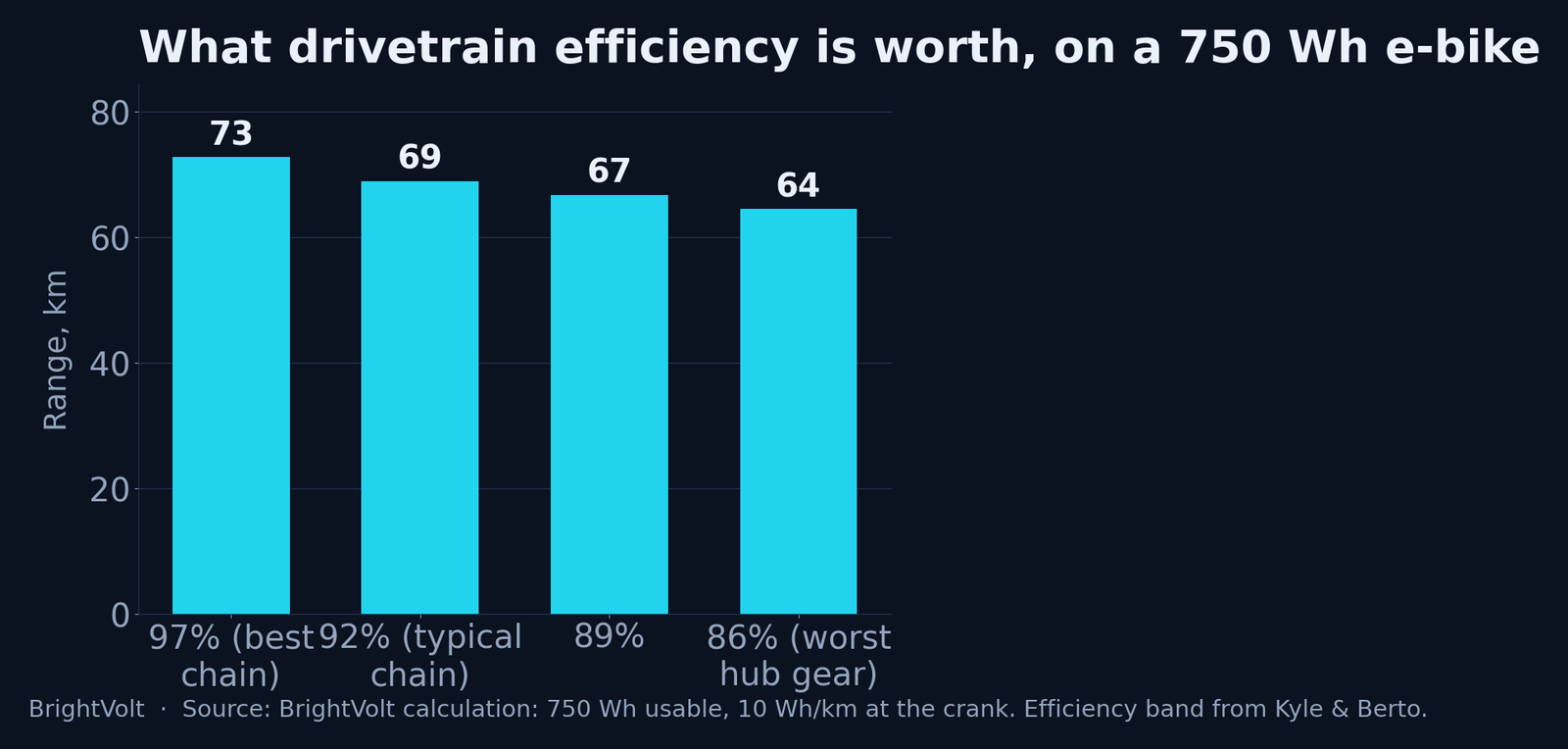
The whole spread between a best-case chain and a worst-case hub gear is about eight kilometres on a seventy-kilometre ride. That is not nothing. It is also roughly what you would lose to a headwind, and considerably less than you would lose by choosing the 500 Wh battery instead of the 750 Wh one.
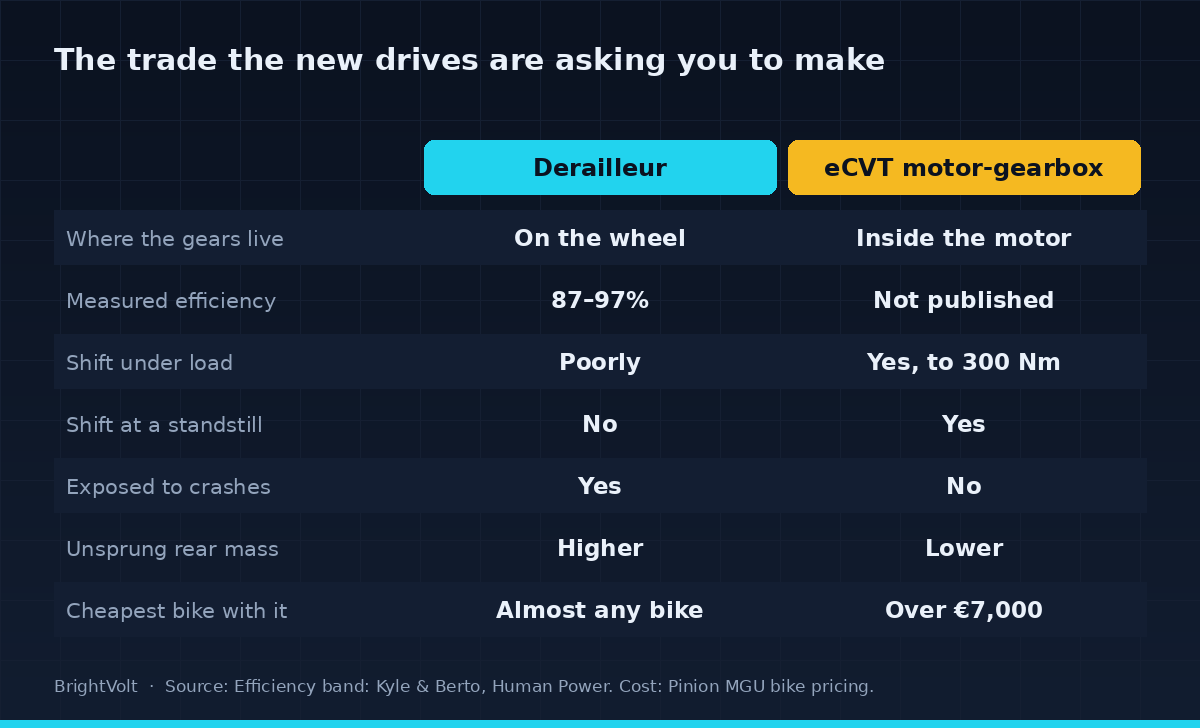
That is the trade the new drives are making, and on an e-bike it is a defensible one: spend a few points of efficiency, and in exchange delete the derailleur, the cassette, the shifter, the cable and the hanger.
What you get for the efficiency
The gains are mostly the ones a derailleur structurally cannot offer.
Shifting under load is the big one. A derailleur has to lift a chain sideways off one sprocket and onto another while that chain is under tension, which is why every cyclist learns to ease off before changing gear. Avinox claims shifts in under 0.1 seconds at up to 300 Nm of input torque. You can also shift while stationary — the thing you always want at a red light on a hill and never have.
Then there is what is no longer there. No derailleur means nothing to bend in a crash, nothing to catch on a rock, no hanger to replace. A single straight chainline means a belt becomes practical, and a belt does not need lubricating. Gobao ships with a Gates belt for exactly this reason. Moving mass off the rear wheel and into the frame’s centre also reduces unsprung weight, which is a real suspension benefit on a mountain bike rather than a marketing one.
The catches nobody is selling
Three, and only one of them is about efficiency.
You cannot fully disconnect. Because the ratio is set electrically, the motors are part of the transmission rather than an add-on to it. BIKE’s analysis notes that complete decoupling is not possible: above the assistance cut-off the machines keep turning and the system still needs battery. A conventional e-bike with a flat battery is a heavy bicycle. What one of these is with a flat battery has not been demonstrated in public, and it is the single question a buyer should ask first.
The ride is a software product. With no fixed ratios, what the bike feels like is entirely a function of how well the control algorithm reads your cadence and the gradient. BIKE describes the experience as tending to lack directness. That is a criticism you cannot design out with better hardware.
Heat and price are unproven. A unit passing 1,500 watts through a compact sealed housing has to get rid of the losses somewhere, and neither company has published thermal data. And Pinion’s history is the cautionary one: the engineering was never really the obstacle, the €7,000 bike was.
What to watch
Three numbers, none of which either company has released.
An efficiency figure, measured, ideally by someone independent. Until one exists, the range arithmetic above is a guess with a plausible range rather than a fact.
A complete unit weight for Avinox, which has published a gear range but not a mass. Gobao has: 3.85 kg, which is close to what a conventional motor plus cassette, derailleur, shifter and cable weighs together — the claim that this costs nothing in weight is testable, and Gobao has made it testable.
A bike price under €5,000. That is the number that decides whether this is the end of the derailleur or the second time a good idea gets priced into a niche.
Photo by Elsa Puga on Pexels