
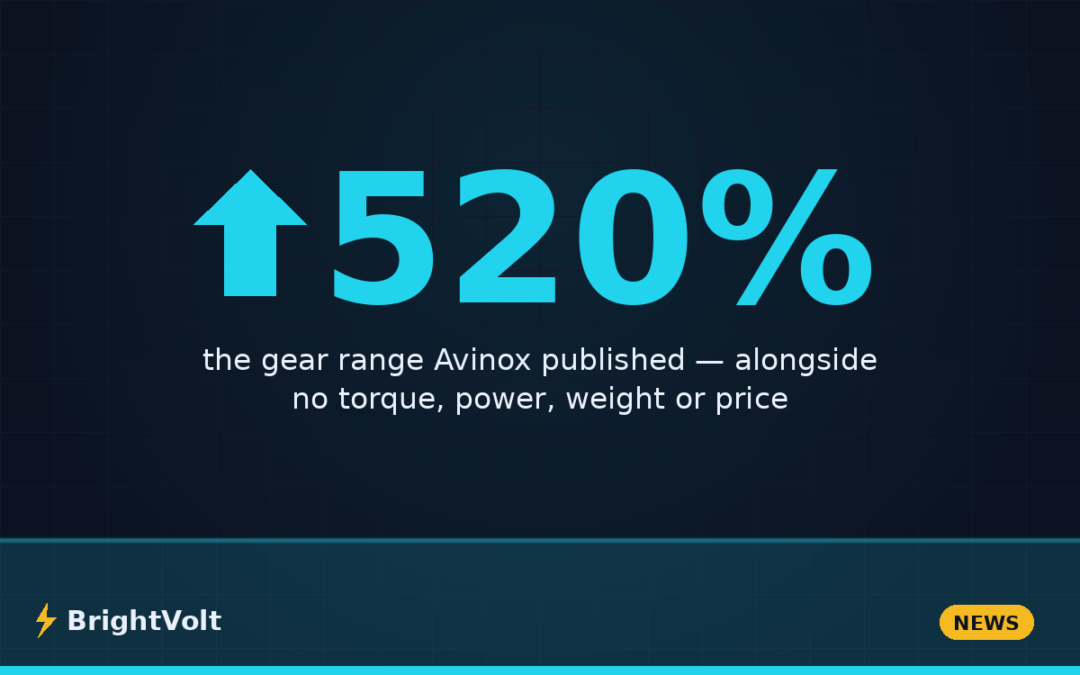
Avinox brought a motor with a gearbox inside it to Eurobike 2026 and told the world almost nothing about it. No torque figure. No power figure. No weight. No price. No date beyond a confirmation that it will not be sold in 2026.
What it did publish is a gear range — 520%, matching SRAM’s 12-speed Eagle — a shift time of under 0.1 seconds, and the claim that it will change gear under up to 300 Nm of input torque or at a complete standstill. For a company backed by DJI and already fitted to bikes from Canyon, Commencal, Forbidden and Mondraker, that is a strange combination of things to say and not say.
What was actually shown
The MG Concept is a single unit containing the motor and the gearing, driving a straight chainline with no cassette and no derailleur. The gear steps are configurable in software rather than fixed by hardware: Bikerumor reports that the same unit could be set up as a four-speed or a thirteen-speed, with an automatic mode on top.
The details Avinox chose to volunteer are revealing. Components run in an oil bath. There are no internal belts that could wear out — a pointed remark, given that belt-and-pulley CVTs are the technology everyone assumes is inside. The unit runs at 45 dB, the same as the existing M2 and M2S motors. It has a mechanical locking mechanism that immobilises the bike without battery power, an electrically assisted reverse, and a rider weight rating above 150 kg. Avinox also claims it can recover energy on descents.
Every one of those is a durability or feature claim. Not one is a performance number.
The numbers that are missing, and what they would tell you
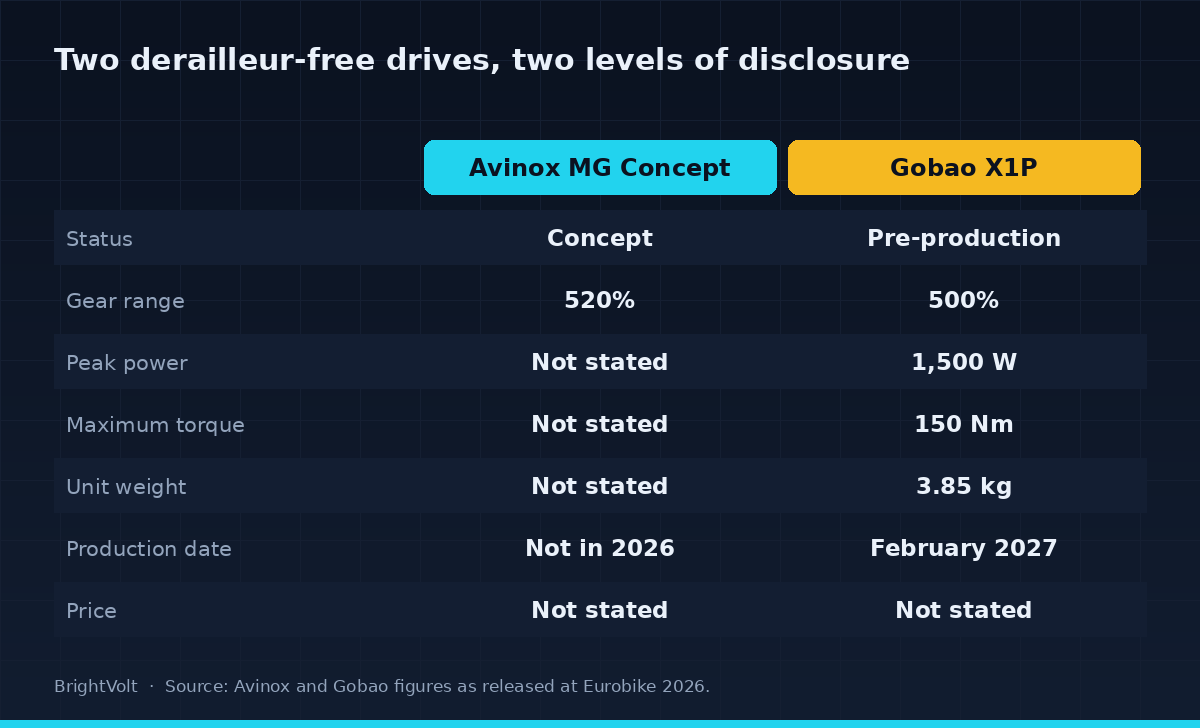
The contrast with Gobao — which showed a comparable eCVT drive at the same show and published its full specification sheet — is the story here.
Torque and power. Some outlets have attached 150 Nm and 1,500 W to the MG, the same figures Gobao quotes. Avinox has not confirmed them, and Bikerumor is explicit that the wattage and torque were not disclosed. Treat those numbers as inference from the 45 dB comparison with the existing M2S, not as a specification. We are not going to print them as one.
Weight. This is the number that matters most and the one most conspicuously absent. The entire case for a motor-gearbox unit is that deleting the cassette, derailleur, shifter and cable pays for the gearing you added. Gobao says its unit is 3.85 kg and invites you to check the arithmetic. Avinox has not, and a gearbox is not a light thing to add to a motor.
Efficiency. Nobody publishes this — not Avinox, not Gobao, not Pinion. It is the single figure that decides how much battery range the architecture costs, and its universal absence across the category is conspicuous.
Concept, or a product being staged?
Avinox is unambiguous that this is a concept on a stand, not in 2026. That framing deserves a little scepticism in both directions.
Against it: Avinox is not a startup fishing for attention. It arrived in the e-bike market with DJI’s motor engineering behind it, moved to more than 60 OEM brands, and filled a Eurobike booth with 19 partner brands’ bikes. A company at that stage does not usually build a running gearbox prototype as a talking point.
For it: showing a concept with a headline gear range and no performance figures is exactly what you do when you want to freeze buyers who are about to commit to a competitor’s platform, and the competitor here — Gobao — has a February 2027 production date and a price expectation in the mid-$3,000s for complete bikes.
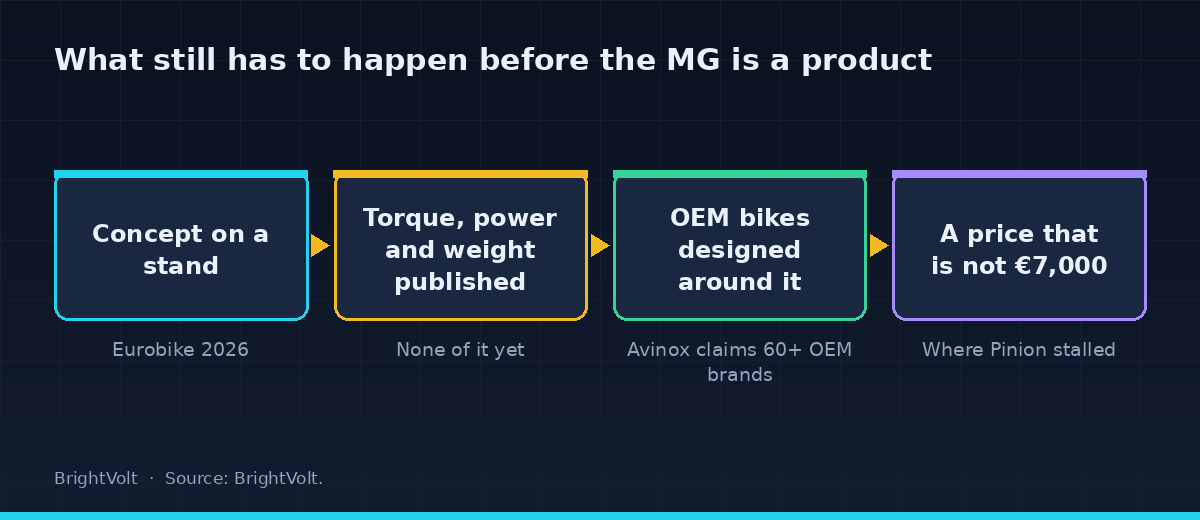
The honest read is that both things can be true. The hardware is probably real. The timing of the reveal is probably tactical.
Why this is harder than it looks
The precedent is not encouraging, and Avinox will know it better than anyone. Pinion has been selling a motor-gearbox unit, the E1.12, for years. It works. It never broke through, and BIKE magazine’s assessment is that noise, jerky shifts and weight all contributed — but that price was decisive, with bikes landing above €7,000.
That is the wall. Deleting a derailleur is an engineering problem, and several companies have now solved it. Deleting a derailleur at a price a mainstream buyer will pay is a manufacturing-scale problem, and it is the one nobody has solved. If DJI’s contribution to Avinox turns out to be volume manufacturing rather than motor design, that would matter far more than the 520%.
What to watch
A weight and a torque figure, in that order. The moment Avinox publishes a complete unit mass, the whole proposition becomes checkable — either the gearbox pays for itself against the parts it replaces, or it does not, and everyone can do that sum in a line.
Then the first OEM bike designed around it. Avinox’s leverage is its 60-plus brand relationships; a motor-gearbox only becomes real when a frame is built for it rather than around it. And finally the price of that bike, because on the evidence of the last decade that is the only number that has ever decided this question.