
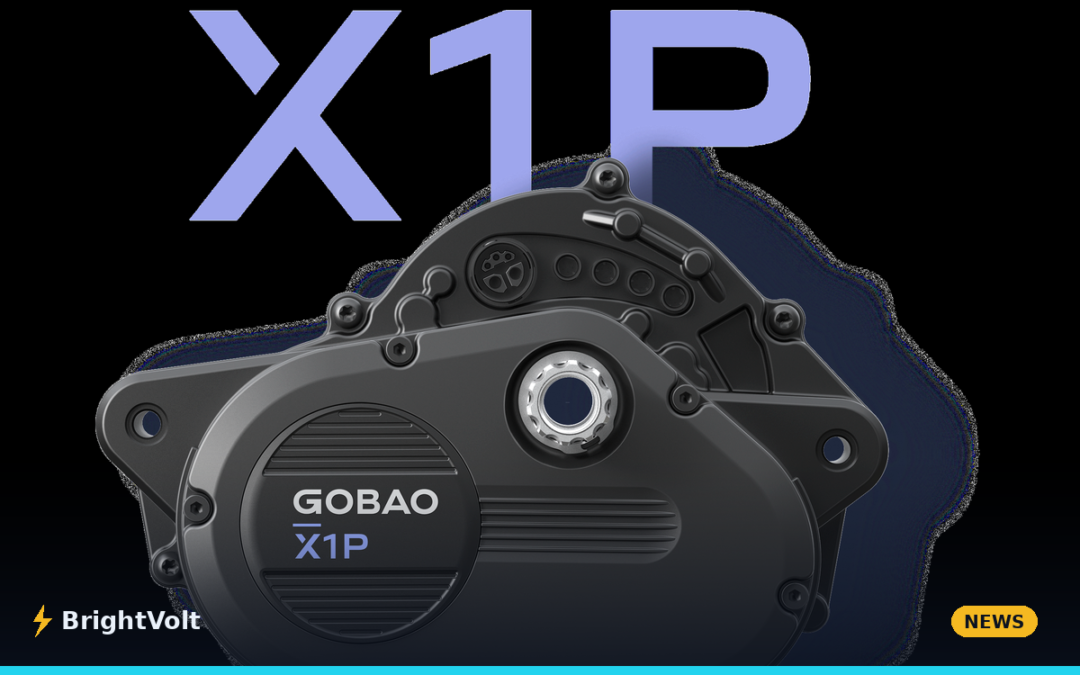
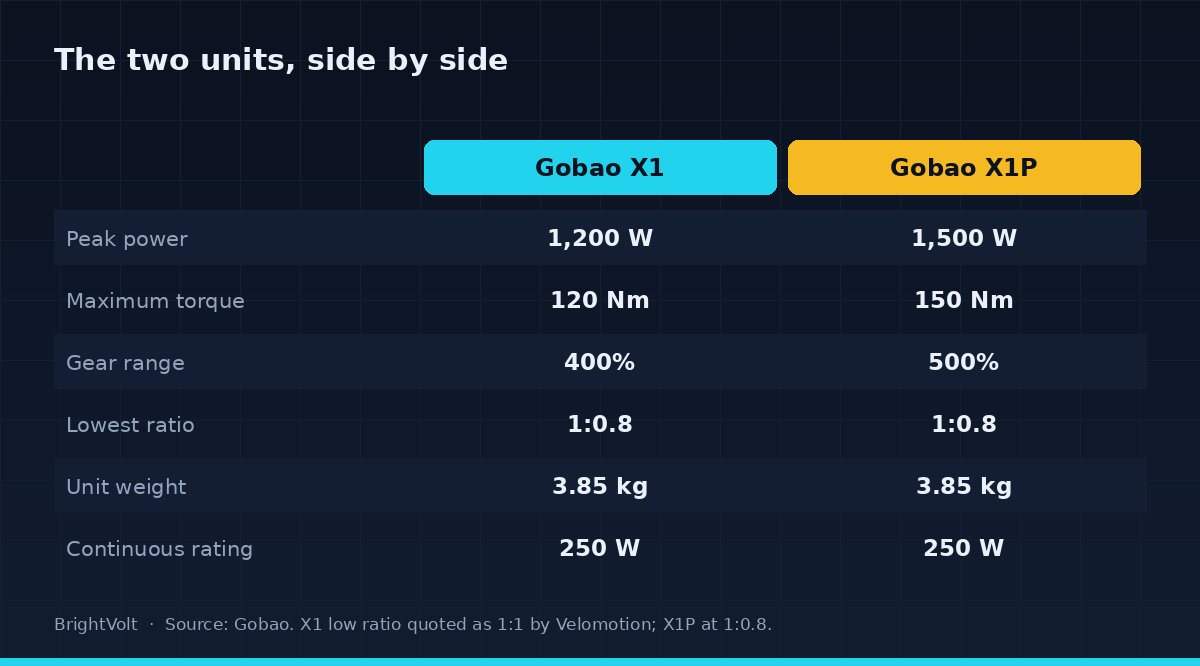
Gobao brought a drive unit to Eurobike 2026 that deletes the derailleur, and — unusually for this category — brought the whole specification sheet with it. The X1P makes a claimed 150 Nm and 1,500 W peak from a 3.85 kg unit with a stepless 500% gear range, and it is scheduled for mass production in February 2027.
The specification is the story, because two of its numbers do not sit comfortably together and a third is a genuinely striking piece of arithmetic.
What the two units are
The X1 and X1P are the same 3.85 kg package at two power levels. Both are electronically controlled continuously variable transmissions built into the motor: no cassette, no derailleur, and a Gates belt rather than a chain.
There are no gears to select. Software watches cadence, torque, speed and gradient and sets the ratio continuously to hold whatever pedalling rhythm you have chosen, with a manual mode available for people who would rather decide themselves. How that works — two electric motors and a planetary gearset, borrowed wholesale from hybrid cars — is worth understanding before judging the claims, because it is not a gearbox in the ordinary sense.
Gobao is not a name most European riders know, but it is not new: it already supplies motors to Aventon and Hepha.
The 250 W that is also 1,500 W
The first oddity is the pair of power figures on the same unit.
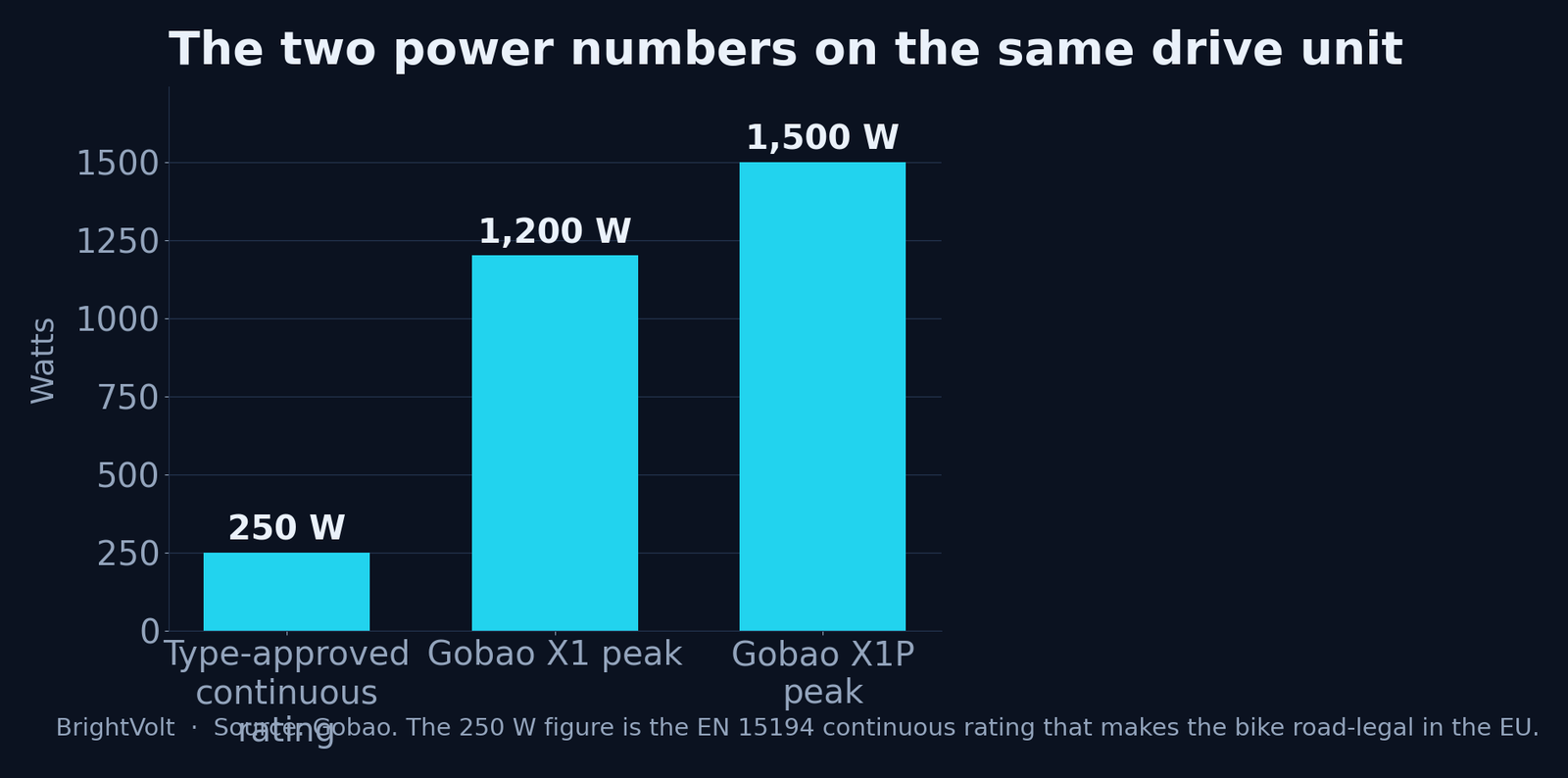
Both units are type-approved at 250 W. Both peak at six times that. This is not a contradiction and it is not a loophole — the EU’s 250 W limit is a continuous rating, the power a motor can sustain indefinitely without overheating, and a motor that can hold 250 W all day can deliver far more for the seconds a steep pitch actually lasts. Every mid-drive on the European market does this. Gobao is simply quoting both ends where many manufacturers quote whichever suits the audience.
What is worth flagging is what six times means thermally. A sealed 3.85 kg housing containing two motors and a planetary set has to shed the losses from 1,500 watts somewhere, and Gobao has published no thermal data at all. Heat management is the most common failure mode for compact high-power drives, and it is exactly what a specification sheet cannot tell you.
Charging that would embarrass most cars
The second number is the charger. Gobao quotes 1.5 kW at 52 V and 30 A, taking its packs to 80% in 24 to 32 minutes.
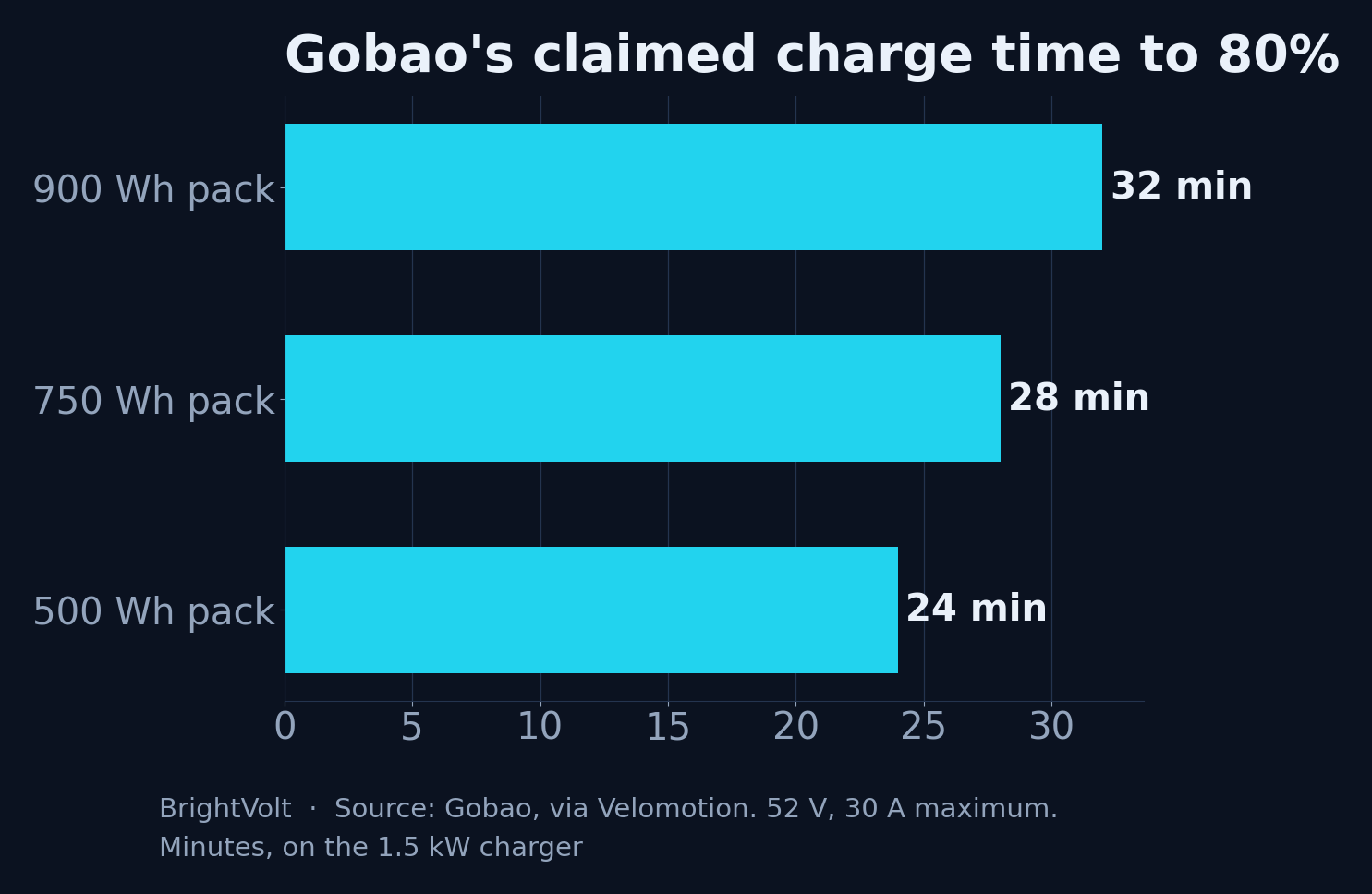
Put that in the units the rest of the industry uses. Charging a 900 Wh pack at 1.5 kW is roughly 1.7C, and the arithmetic checks out against Gobao’s own claim: 80% of a pack at 1.7C takes about 29 minutes, which is what it quotes. The same C-rate on a 75 kWh car battery would mean sustaining 125 kW — a rate most electric cars cannot hold across that window. A typical e-bike charger delivers 150 to 250 watts and takes four hours or more; Gobao is proposing roughly an order of magnitude more.
That is credible for a small pack, because the thermal problem scales with size and a 3.7 kg pack has an easy time getting rid of heat that a 500 kg one does not. But the charger itself is 1.2 kg and the size of a hardback book, and 30 A at 52 V is a serious piece of equipment to leave in a hallway.
The spec that does not add up
Here is the number worth pausing on. Gobao lists three packs:
| Pack | Capacity | Mass | Energy density |
|---|---|---|---|
| BT500ES | 500 Wh | 2.6 kg | 192 Wh/kg |
| BT750FS | 750 Wh | 3.6 kg | 208 Wh/kg |
| BT900FS | 900 Wh | 3.7 kg | 243 Wh/kg |
Look at the last two rows. Going from 750 Wh to 900 Wh — an extra 150 Wh — costs 100 grams.
There is no cell on the market that stores 150 Wh in 100 g. That would be 1,500 Wh/kg, roughly five times the best lithium-ion cells in production and comfortably past the theoretical limit of the chemistry. So one of three things is true: the 900 Wh pack uses substantially better cells and a much lighter enclosure than its sibling, one of the two masses is a typographical error, or the capacities are quoted on different bases. Gobao has not said which.
None of that makes 243 Wh/kg impossible on its own — it is a plausible figure for a well-packed e-bike battery, and it would still beat most car packs. It makes the set of three figures internally inconsistent, which is the kind of thing worth catching before it is repeated as fact for the next eighteen months.
Where the weight claim can be checked
The 3.85 kg unit mass is the honest, testable centre of Gobao’s pitch, and it deserves credit for being published.
A conventional set-up replaces it with a mid-drive motor of roughly 2.7 to 2.9 kg, plus a 12-speed cassette at around 450 g, a rear derailleur at about 300 g, and a shifter, cable and hanger for another 150 g or so. That lands somewhere near 3.6 to 3.8 kg. In other words Gobao’s drive is close to weight-neutral against the parts it replaces — which is precisely the claim, and precisely the claim that Avinox has not yet made checkable, because it has not published a mass at all.
What to watch
A production bike, first: Gobao has shown the drive but no complete bicycle built around it, and February 2027 is not far away for a component with no announced host frame.
Then a price. New Atlas expects bikes from around $3,750, which if it holds would put this well under the €7,000 territory where Pinion’s motor-gearbox stalled — and price, not engineering, has been the thing that killed every previous attempt to retire the derailleur.
And finally an efficiency figure, from anyone. Gobao has published more than its competitors on almost every axis and still not that one. Until someone does, the range cost of going derailleur-free remains an estimate rather than a measurement.
Image: Gobao