
A Porsche Taycan Turbo S carries its energy at about 148 watt-hours per kilogram of battery pack. A Tesla Model 3 manages 171. The e-bike battery Gobao plans to sell in 2027 claims 243.
The bicycle wins, and not narrowly. It is not because the bicycle has better cells — it almost certainly has the same commodity cylindrical cells a car uses, bought from the same suppliers. It wins because of everything a car pack has to be that a bicycle pack does not.
Cells are not packs
Energy density gets quoted at two levels and they are routinely confused. Cell density is what the chemistry achieves: the best mass-produced lithium-ion cells sit somewhere around 250 to 300 Wh/kg today. Pack density is what arrives in the vehicle after you have added everything needed to keep those cells safe, cool, monitored and attached to the machine.
The gap between the two is the engineering. And it is large: a car pack typically delivers little more than half to two-thirds of its cells’ density once assembled.
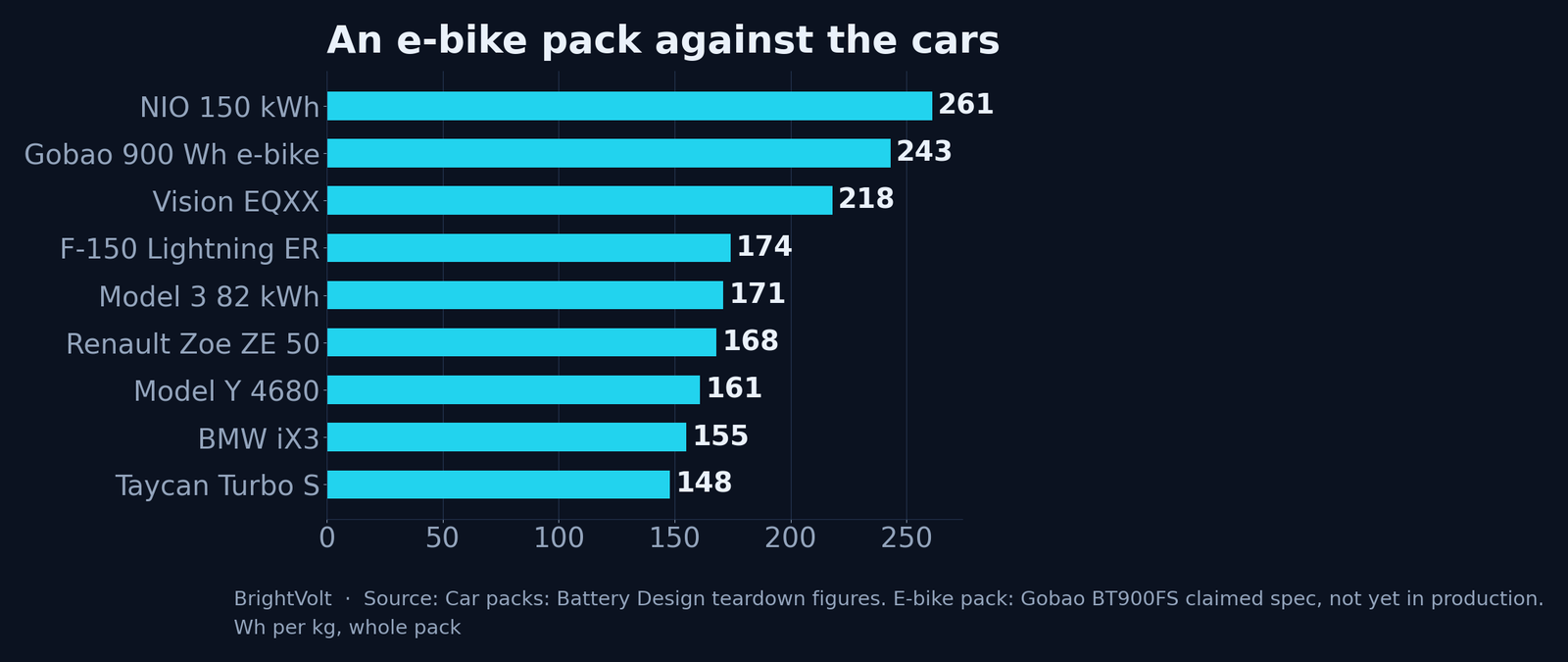
The cars in that chart are real, measured packs from teardowns rather than press releases. Only NIO’s 150 kWh semi-solid pack — an expensive, low-volume halo product — beats the e-bike figure, and Mercedes’ Vision EQXX is a concept car built specifically to break this record.
What the car is carrying that the bicycle is not
Four things, roughly in order of how much mass they cost.
Structure. A modern EV pack is not a box bolted to the floor; it is part of the floor. It carries crash loads, resists side-pole intrusion, stiffens the body shell, and has to survive being hit by road debris at motorway speed for fifteen years. That is a large amount of steel and aluminium in the mass budget. An e-bike pack needs to survive being dropped on a driveway.
Cooling. Cars need liquid thermal management: cold plates under every module, a pump, a radiator loop and several kilograms of glycol. An e-bike pack is small enough that its own surface area does the job, and Gobao’s 1.5 kW charging works precisely because a 3.7 kg pack can shed heat a 500 kg one cannot.
Fire containment. Thousands of cells in series and parallel means thermal propagation is a design problem with regulatory teeth — barriers between cells, venting paths, and materials chosen to slow a runaway long enough for occupants to get out. A pack with tens of cells needs far less of this.
Monitoring. A car BMS supervises hundreds of cell groups with the wiring harness to match. A bicycle BMS supervises a handful.
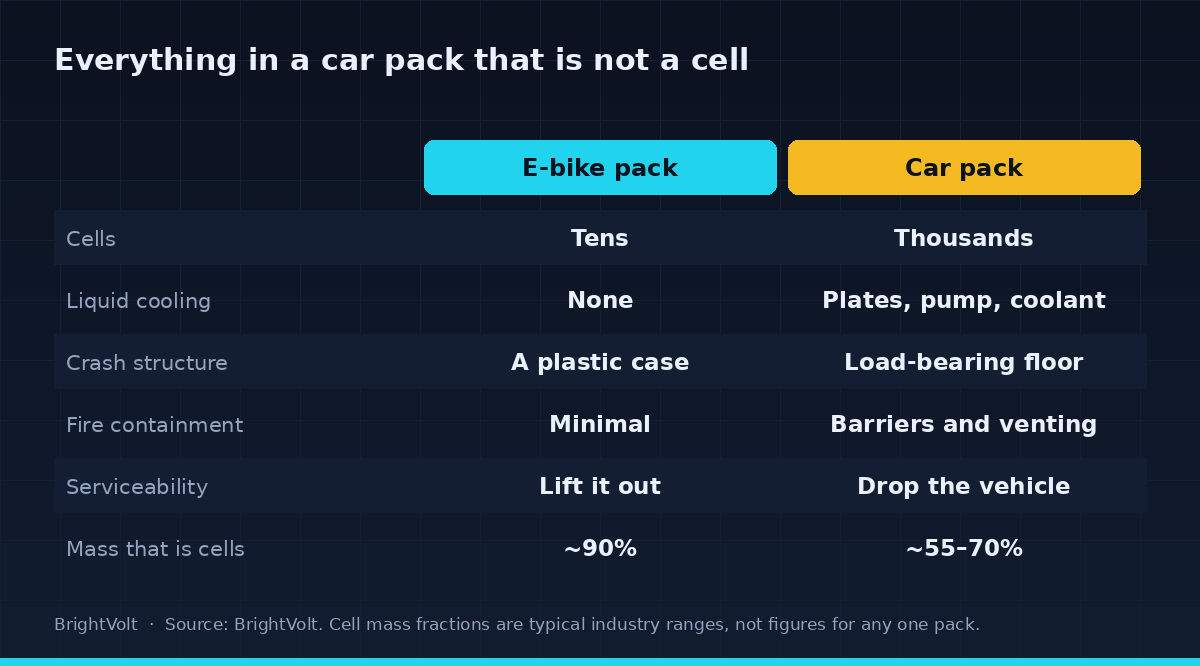
Add those up and the picture inverts intuition: the e-bike pack is denser not because it is more advanced, but because it is allowed to be simpler.
The uncomfortable corollary
This is where the comparison earns its keep, because the obvious conclusion — that e-bike batteries have room to run — is the wrong one.
If an e-bike pack is already delivering around 90% of its cells’ energy density, then there is almost no pack-level overhead left to remove. Every future gain has to come from the cells themselves, which improve at a few percent a year and are shared with every other application competing for them.
Car packs are in the opposite position. They are carrying 30 to 45% overhead, and that overhead is engineerable: cell-to-pack and cell-to-body designs delete module casings and make the pack lid structural, which is how CATL and BYD have been closing the gap without changing chemistry at all. The car has headroom the bicycle has spent.
So the ranking in that chart is not stable. It is a snapshot of an industry that has not yet finished removing its own packaging, taken against one that finished years ago.
One figure worth not trusting yet
The 243 Wh/kg number carries a caveat, and it is Gobao’s own specification sheet that raises it.
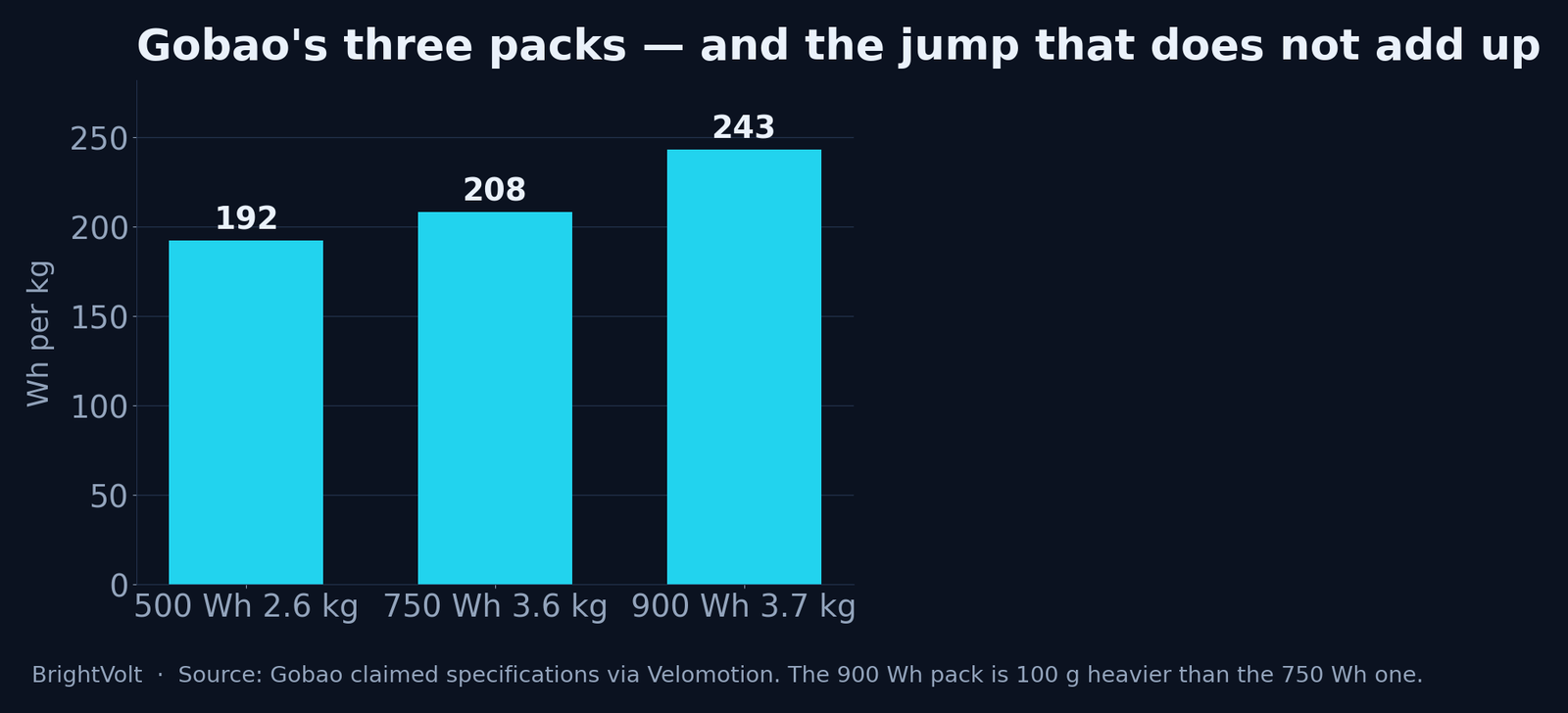
The same document lists a 750 Wh pack at 3.6 kg and a 900 Wh pack at 3.7 kg. That is 150 extra watt-hours for 100 extra grams — a marginal density of 1,500 Wh/kg, which is not merely better than current cells but past what the chemistry allows. Either the top pack uses different cells and a lighter case, or one of those figures is wrong.
Treat 243 Wh/kg as a claim that is plausible in isolation and unverified in context. Even at the 208 Wh/kg of the mid-size pack, which is internally consistent, the e-bike still beats every mainstream car in the chart.
Why this matters beyond trivia
Two practical consequences.
For anyone comparing batteries, it is a reminder that a cell specification tells you very little about a finished product. The number that decides how far a vehicle goes is the pack number, and the distance between the two is a design decision, not a chemistry one.
For e-bikes specifically, it sets expectations. A rider hoping that batteries will get dramatically lighter in the next few years is hoping for something the pack engineering cannot deliver, because it has already been delivered. The next meaningful jump in e-bike range comes from cells — or from using less energy per kilometre, which is the argument for caring how efficient the drivetrain is in the first place.
Photo by Looking For Feferences on Pexels