
A grid-following inverter can only push power into a grid that already exists. A grid-forming inverter can build the grid — set its voltage and frequency itself, the way a spinning generator does. That one distinction decides whether solar panels and batteries can actually run a power system or can only ride on one that coal and gas are still holding up. For most of the last decade it was a research question. In 2026 it became a procurement requirement.
Nearly every inverter ever connected to the grid has been grid-following. The reason it matters that this is changing is that the machines the grid was built around — the spinning turbines in coal, gas, hydro and nuclear plants — are retiring, and they were doing a second job nobody was paying them for.
What a grid-following inverter actually does
A grid-following inverter is a current source that takes its orders from the grid. It uses a circuit called a phase-locked loop to read the grid’s voltage and frequency, locks onto that reference, and injects power in step with it. Almost all the rooftop solar, utility solar farms and first-generation batteries in the world work this way. It is cheap, well understood, and completely dependent on something else already setting the tune. Pull the reference away — a fault, a blackout, an islanded corner of the network — and a grid-following inverter has nothing to synchronise to, so it trips off. It cannot start a dead grid, and it cannot, on its own, hold a live one steady.
That dependence was invisible while synchronous generators were everywhere. A coal or gas turbine is a multi-tonne mass spinning at grid frequency, and its physical inertia resists sudden change: when demand jumps or a plant trips, all that spinning steel gives up a little rotational energy and slows fractionally, buying the system a few seconds before frequency falls too far. It also dumps a large surge of current into a fault, which is what lets protection relays detect the fault and clear it. Grid-following inverters do neither. They were passengers on a bus that synchronous machines were driving.
What “grid-forming” adds
A grid-forming inverter is a voltage source. Instead of following an external reference, its control software creates one — it sets its own internal voltage and frequency and holds them, emulating a spinning generator closely enough that the standards now call it a virtual synchronous machine. That change of role is what lets it do the jobs a grid-following inverter cannot.
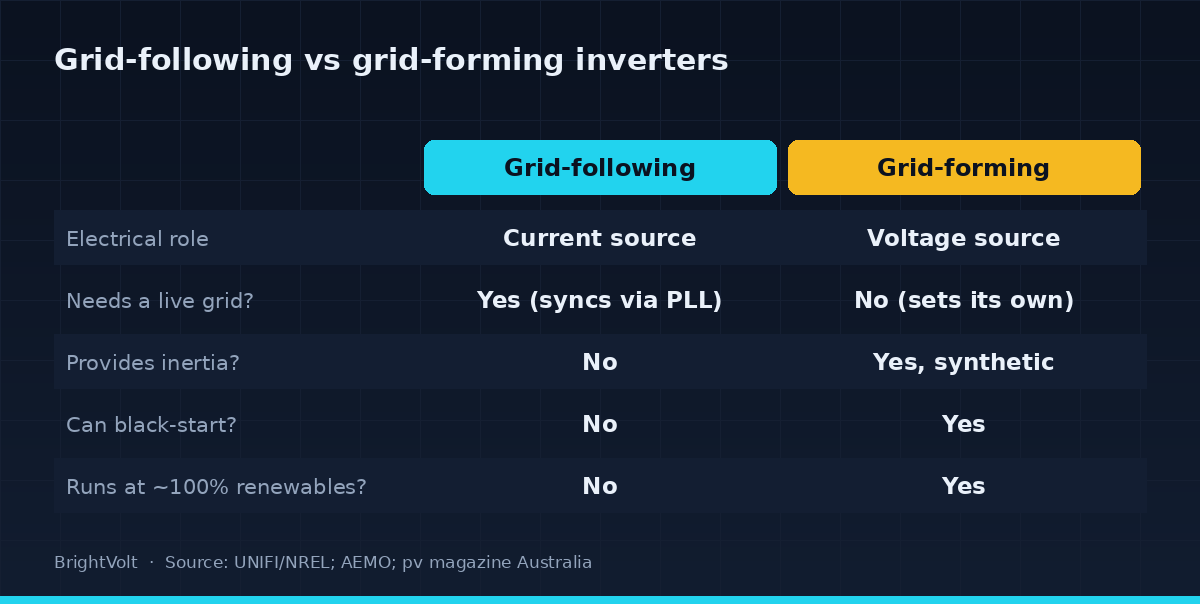
Four capabilities come with being the voltage source rather than a follower. It provides synthetic inertia — a controllable, near-instant burst of active power that mimics the physics of a spinning mass, arresting a frequency drop in milliseconds. It contributes system strength, the fault current that keeps voltage stable and lets protection work, though today’s inverters still deliver less fault current than a synchronous machine, which is the main gap left to close. It can black-start, acting as the first voltage source that re-energises a collapsed network stage by stage. And it can run in island mode, holding voltage and frequency for a microgrid with no main grid behind it at all — the oldest and most proven of the four.
The threshold this is racing is concrete. A 2012 UK study found that once non-synchronous generation exceeded roughly 65% of the generation actually running, the transmission system could no longer be secured against some credible faults. That is not a distant limit any more. South Australia already runs for stretches on close to 100% inverter-based power, which is only possible because grid-forming batteries are supplying the strength the retired gas plants used to.
Why 2026 is the tipping point
Two things changed at once: the technology stopped being a premium, and the grid stopped being able to do without it.
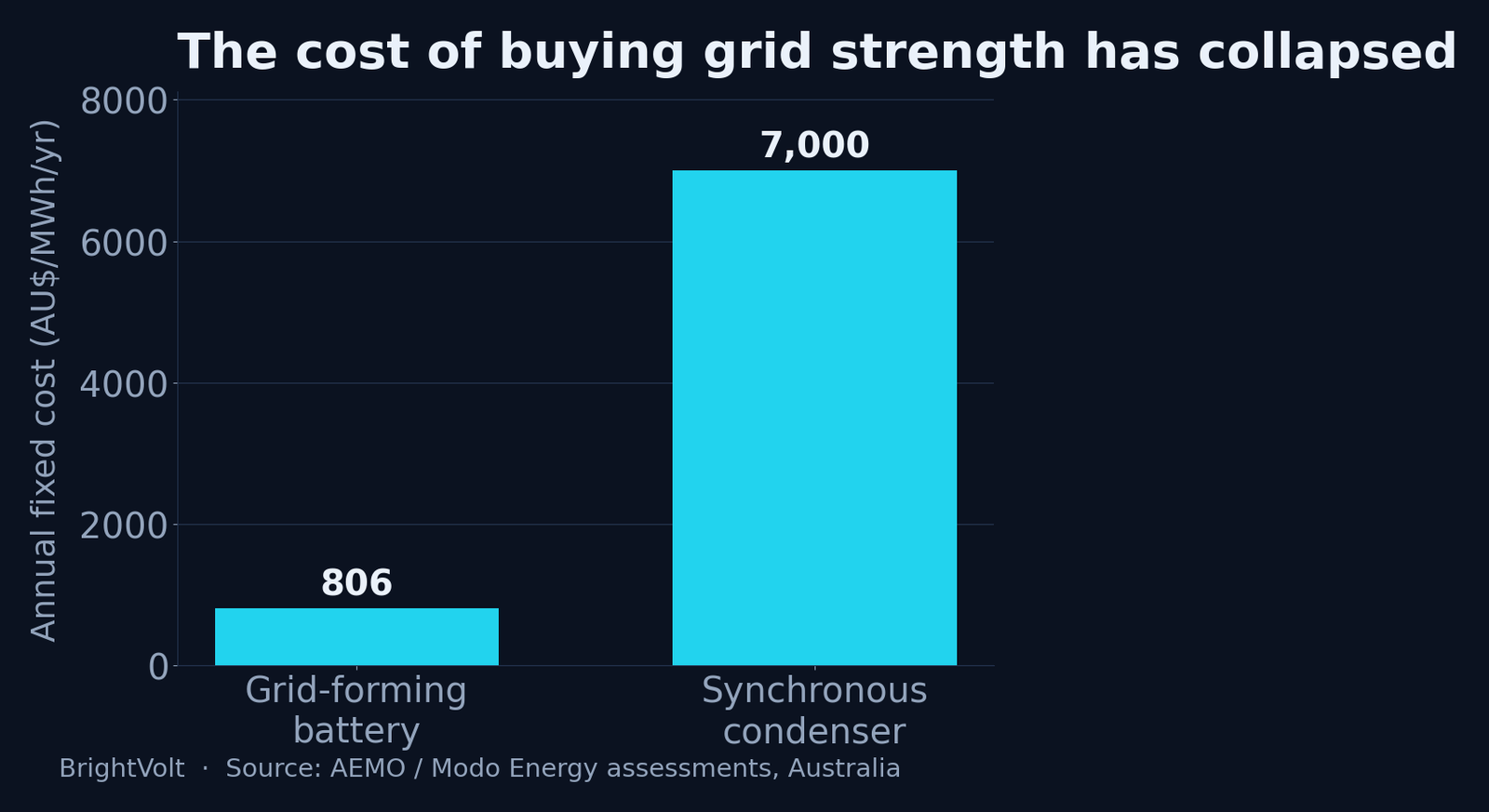
On cost, the analysts at Modo Energy now put the price of building a grid-forming battery as virtually identical to a grid-following one at installation. The hardware is nearly the same silicon; the difference is in the control software and the design effort, not the bill of materials. Set against the alternative for buying system strength — a new synchronous condenser, a spinning machine that generates no energy and exists only to lend inertia — the economics are lopsided. Grid-forming batteries came in at an annual fixed cost of AU$0 to AU$806 per MWh in Australian assessments, against roughly AU$7,000 for a new syncon. When the feature is nearly free and does a job you now have to pay someone for anyway, it stops being a feature and becomes the default specification.
The deployment numbers have followed. In Australia’s National Electricity Market, ten grid-forming battery sites are already operating with a combined 1,070 MW of output, and the pipeline behind them runs to 94 projects. Tesla alone expects 4.5 GW of grid-forming batteries running across the country by the end of 2026, and plans to double it. In Scotland, the Blackhillock battery came online providing 370 megawatt-seconds of synthetic inertia and 116 MVA of short-circuit strength from a single site.
| Project | Size | Role |
|---|---|---|
| Blackhillock (Scotland) | 200 MW / 400 MWh | 370 MW·s synthetic inertia, 116 MVA fault level |
| Hornsdale (South Australia) | 150 MW / 194 MWh | Retrofitted to Tesla “virtual machine mode” for inertia |
| Dalrymple (South Australia) | 30 MW / 8 MWh | Islands a wind farm on its own — early proof of island mode |
| Western Downs (Queensland) | 540 MW / 1,080 MWh | Grid-forming system strength in a coal-heavy region |
What it does not fix, and what to watch
Grid-forming is not a full swap for spinning steel yet. The honest limit, and the one grid operators keep flagging, is fault current: an inverter’s power electronics can only push so much current for so long before they must protect themselves, so a network leaning entirely on grid-forming inverters still has weaker fault behaviour than one with synchronous machines in it. That is why Australia’s operator is pairing battery build-out with synchronous condensers at the hardest points, such as the 1,680 MW Gladstone coal exit due in 2029, rather than assuming batteries alone will carry it.
The distinction to carry away is simple. A grid-following inverter is a guest at the grid’s party; a grid-forming one can host it. As the synchronous generators that hosted for a century switch off, someone has to take the role, and for the first time the cheapest candidate to do it is a battery that also happens to store energy. Whether that is enough on its own is the open question — and it is the same one running through the debate over how much inertia a modern grid really needs, and through every plan to store energy for longer than four hours.
Photo by Daryana Vasson on Pexels · Photo by Robert So on Pexels