
On 1 September China started taxing the lithium battery. A 2% consumption tax now sits on every lithium-ion cell made or sold in the country, and it rises to 4% next September. Sodium-ion and solid-state cells pay nothing until 2029. Most of the coverage filed this under “China trims EV support,” alongside the shrinking purchase-tax break. That reading misses the part that matters. For the first time, Beijing has taxed one battery chemistry and deliberately zero-rated its replacement — and the gap between them is the whole story.
What actually changed on 1 September
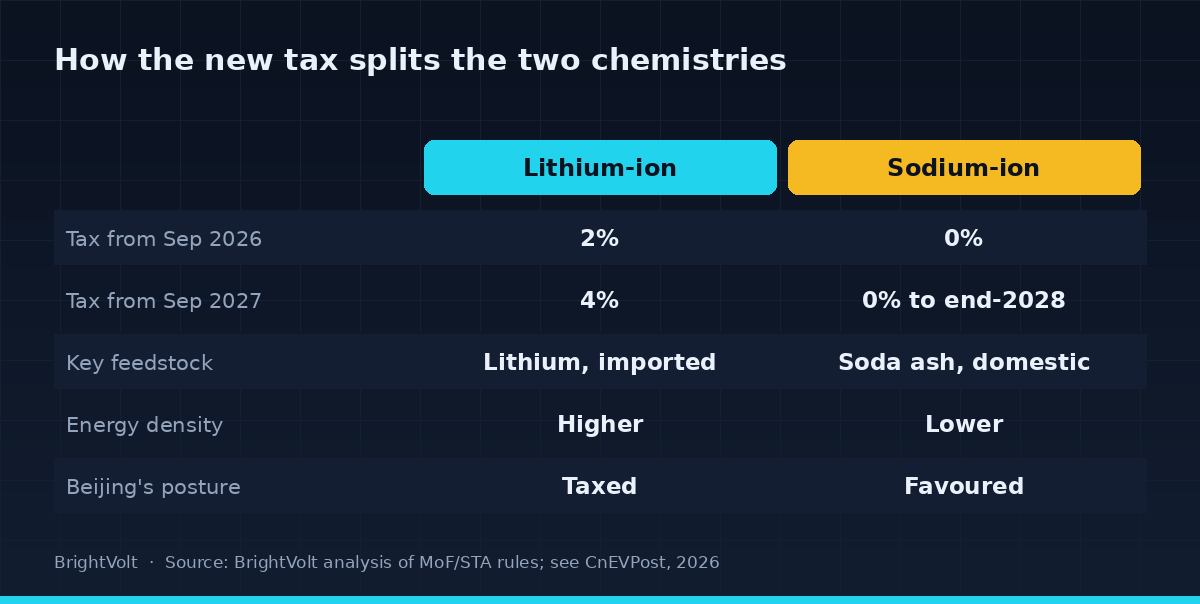
The Ministry of Finance and the State Taxation Administration ended an eleven-year holiday. Since 2015, lithium batteries made for clean energy and electric cars had been exempt from the 4% consumption tax that applied to batteries in general. That exemption is now being withdrawn on a schedule: 2% from 1 September 2026, 4% from 1 September 2027. Nickel-metal-hydride and vanadium flow batteries are swept in at the same rates. Solar cells get parallel treatment a year later — 2% from April 2027, 4% from April 2028.
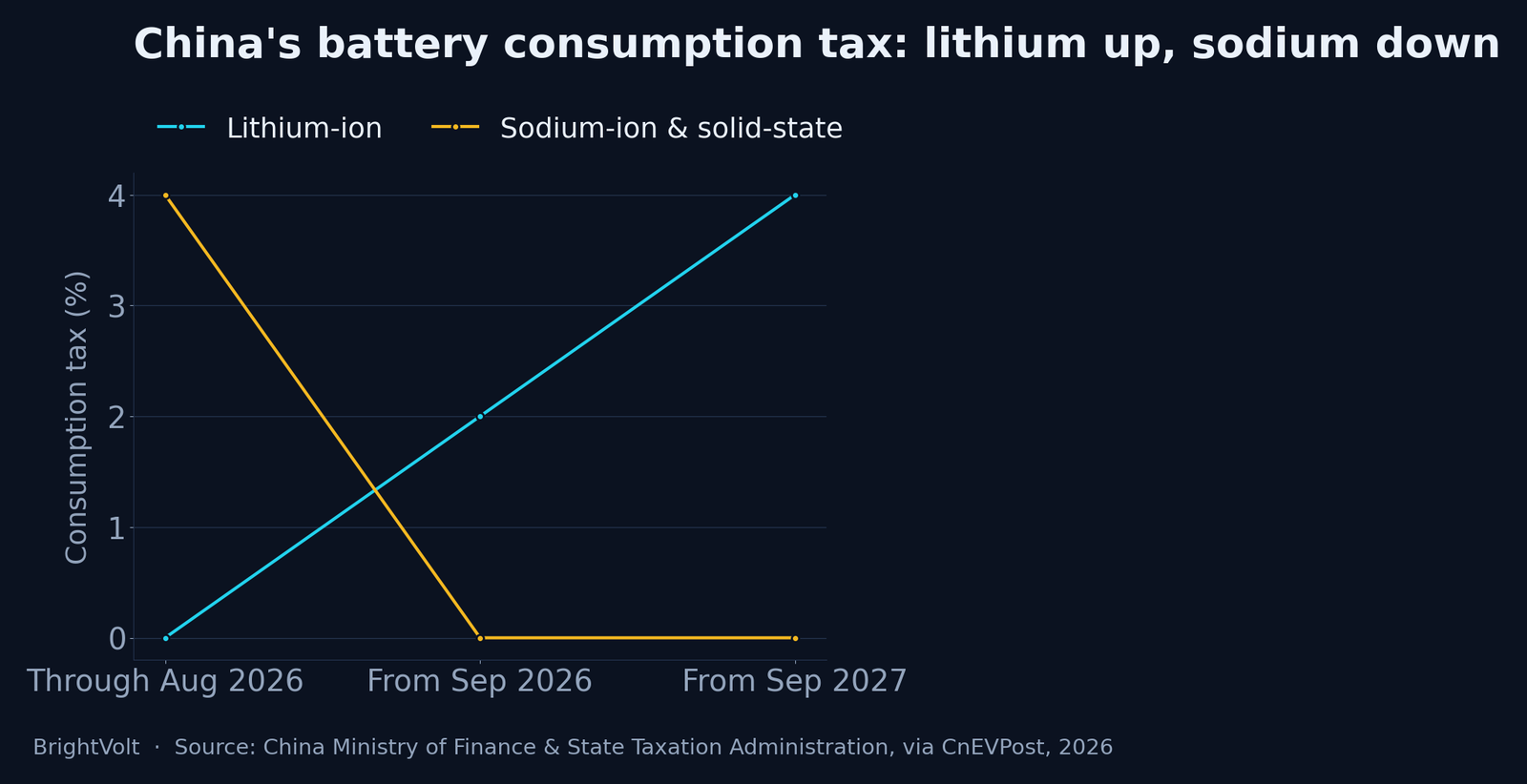
Here is the asymmetry the “subsidy cut” framing hides. Sodium-ion and solid-state cells were not on the 2015 exemption list, because in 2015 they barely existed, so they had nominally been sitting at the standard 4% all along. The new rules do not just raise lithium’s tax. They cut sodium-ion’s, solid-state’s and hydrogen fuel cells’ to zero through the end of 2028. Lithium climbs from nothing to 4%; its rivals fall from 4% to nothing. The two lines cross this month.
The scope is wider than cars, which is the second thing the EV framing gets wrong. The tax lands on batteries for grid storage as much as for vehicles, and on the solar cells feeding them. This is an energy-industry tax wearing an EV headline.
Two percent is the point, not the problem
Taken at face value, the numbers are trivial. At today’s cell prices — roughly 0.35 to 0.40 yuan per watt-hour — a 2% levy adds about 0.007 to 0.008 yuan per watt-hour, a cost increase of well under 2%. On a 60 kWh car pack that is around 438 yuan, about $62, doubling to roughly $125 when the rate steps up. Nobody defers a car purchase over $62.
So read it as what it is: a lever, not a levy. Beijing has spent two years trying to end the ruinous price war — neijuan, the involution — that has driven battery and solar makers into thin or negative margins. The consumption tax is the fiscal edge of that campaign, arriving alongside mandatory energy-efficiency standards issued in July. The stated aim is to “reduce overcapacity, promote advanced technologies, and favor more competitive, higher-efficiency producers.” A 2% cost that a giant shrugs off is a 2% cost that a marginal producer, already selling below cost to hold share, cannot.
That is the design. CATL reported first-half profit up 42% year on year; it can absorb the tax or pass it down the chain without blinking. A tier-three cell maker in Jiangsu running at a loss to keep its lines busy cannot. That squeeze is the backdrop: CATL now lists LFP cells online at about $63 a kilowatt-hour, a public reference price that turned the cell into a commodity and left the weakest producers nowhere to hide. The tax does not need to be large to work, because it is aimed at the difference between the strong and the weak, not at the average.
Why sodium, and why now
The exemption is where policy stops being macroeconomic and starts picking a technology. Sodium-ion’s problem has never been whether it works — it is that it costs more per usable kilowatt-hour than mature lithium iron phosphate, because the cells are lower in energy density and the supply chain is young. A relative price advantage is exactly what a young chemistry needs to cross into volume, and a tax that raises the incumbent’s cost while zero-rating the challenger manufactures one out of thin air.
There is a strategic logic underneath the industrial one. Sodium is drawn from soda ash, which China has in abundance and does not import; lithium still ties the country to mined and refined supply it would rather not depend on. A battery chemistry that runs on a domestic, effectively unlimited feedstock is worth more to Beijing than one that runs on a commodity it competes for. Solid-state, exempt on the same schedule, is the other bet — the energy-density prize the whole industry is chasing. The tax code now says, in the plainest language a government has, which two technologies the state wants built.
The quality reckoning underneath
The tax did not arrive in a vacuum. Days after it took effect, at the World Power Battery Conference in Yibin, CATL chairman Robin Zeng told the room that the industry’s own success was becoming its problem. Chinese firms now hold more than 70% of the global battery market and power some 30 million vehicles. And more than 600 new models launched in China this year, roughly three a day. Zeng’s warning was that shortening validation to keep that pace had already produced “batch failures” in some battery products — that quality is designed and manufactured in, not tested in after the fact. EVE Energy’s Liu Jincheng, at the same event, called for the industry’s “collective reflection.”
When the man who makes more cells than anyone alive stands up to say the race to launch is outrunning the checks on the thing that can burn the car down, that is not modesty. It is the same diagnosis the tax is written from, delivered from the other side. The price war compressed margins until validation itself became a cost to trim, and a battery validated in a hurry is a battery that occasionally fails in a batch. Beijing is attacking that from the fiscal side; the industry’s own leaders are naming it from the engineering side. Both arrows point at the same target — the era of the cheap, disposable, race-to-the-bottom lithium cell — and both landed in the same week.
What would change the read
The claim here is falsifiable, and worth stating as such. If sodium-ion’s share of new Chinese storage and entry-level EV deployment does not visibly accelerate against lithium’s over the next two years, the exemption was a gesture rather than a lever, and this read is wrong. If Beijing quietly softens the 4% step next September — the way it has softened deadlines before — the consolidation nerve failed and the tax was theatre. Watch those two numbers.
The steelman for the opposite view is real: 2% is a rounding error, sodium remains more expensive even untaxed, and a chemistry does not win on a tax break. All true, and none of it survives contact with how thin the margins already are. In a market where CATL and BYD fight over single points of share and half the industry sells below cost, the state does not need to move the price much. It needs to move it in a direction, and hold it there while a favoured technology scales into the gap. That is what an exemption running to 2028 does. The tax is small. The instruction is not.
Photo by Hilary Halliwell on Pexels · Photo by Heru Dharma on Pexels · Photo by Keegan Checks on Pexels