
EVgo will preview a 750kW public fast charger in 2027, and it says the machine can refill “the fastest-charging EVs currently sold in the US in around 10 minutes.” The fastest-charging EV currently sold in the US peaks at 600 kilowatts, for a minute or two near the bottom of its battery, and the next car down manages 400. So the most revealing number in the announcement is not 750. It is the gap between 750 and anything a driver can actually plug in.
That gap is the story of public charging in 2026. The kilowatt figure on the marquee has come unhooked from the kilowatts a car will accept, and the industry keeps advertising the marquee.
The 750 no car can take
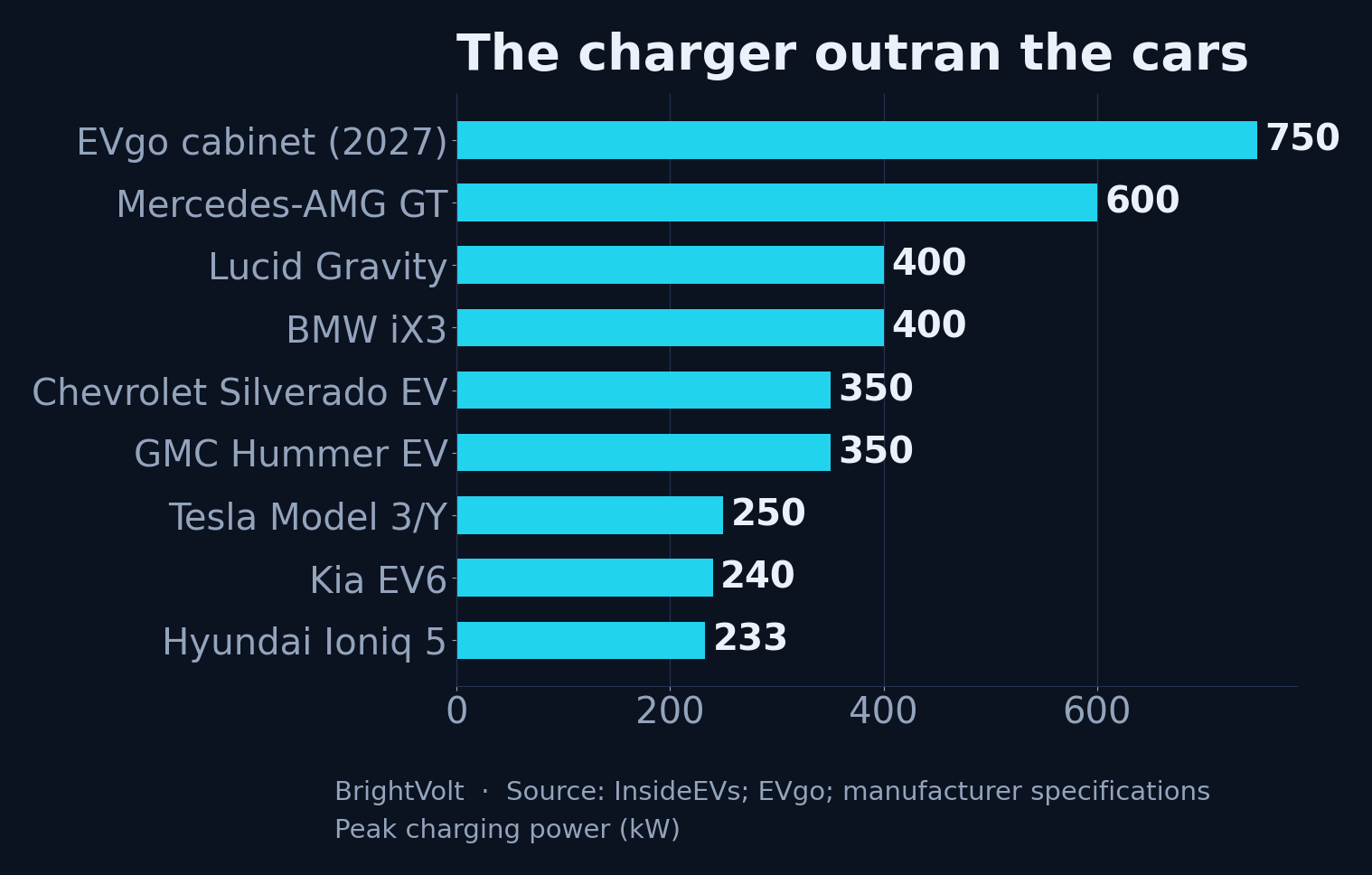
Set the headline against the cars. The single fastest-charging EV on sale in America is the 2027 Mercedes-AMG GT 4-Door, which touches 600 kW — and it holds that peak for a sliver of the session before the curve falls away. After it, the field drops off a cliff.
| Vehicle (US market) | Peak charging power | 10–80% time |
|---|---|---|
| Mercedes-AMG GT 4-Door | 600 kW | ~11 min |
| BMW iX3 | 400 kW | ~21 min |
| Lucid Gravity | 400 kW | ~23 min |
| GMC Hummer EV | 350 kW | — |
| Chevrolet Silverado EV | 350 kW | — |
| Tesla Model 3/Y | 250 kW | — |
| Kia EV6 | 240 kW | ~17 min |
| Hyundai Ioniq 5 | 233 kW | ~18 min |
Peak charging power by model, manufacturer specifications as compiled by InsideEVs.
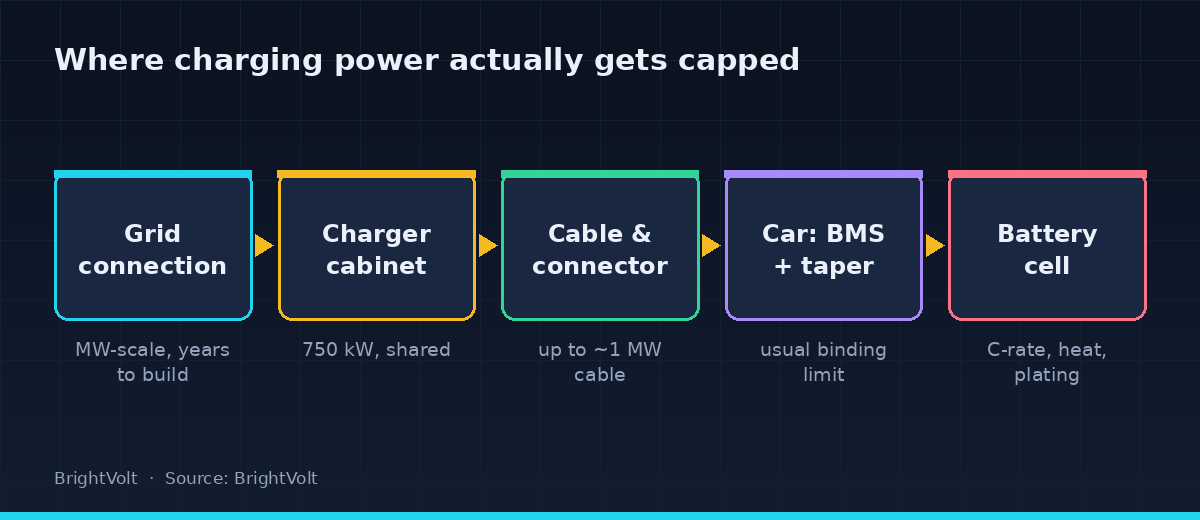
One car in the American market reaches 600 kW. Most of the cars people actually own top out between 230 and 350, and they reach even that for a few minutes at a low state of charge. A 750 kW cabinet does not make a 233 kW Ioniq 5 charge at 750 kW any more than a petrol pump rated for a tanker fills a hatchback faster. The car’s onboard limit — set by its pack voltage, its cooling, and how hard its chemistry can be pushed without plating lithium onto the anode — is the binding number, and it lives in the car, not the cabinet.
Peak kilowatts are the wrong number anyway
Even for the car that can take 600 kW, the peak is close to meaningless, because no battery holds its peak. Charging speed follows a taper: it is high for the first stretch, then drops steadily as the pack fills, to protect the cells from heat and degradation. An EV that hits 250 kW at 10% might be down to 60 kW by 80%, and crawls the rest of the way. This is why every honest charging figure is quoted as a 10-to-80% time, not a headline wattage. The 10–80% time is the number that decides how long you stand in the forecourt. The peak is the number that decides how good the brochure looks.
EVgo half-admits this. Its own release says the average charge rate on its network is up “nearly 20% in the last two years” — a real, useful improvement, and an order of magnitude smaller than the jump from today’s cabinets to 750 kW. The company that is previewing 750 is telling you, in the same paragraph, that the number that moved for actual drivers was the average, and it moved by a fifth.
The real advance is buried in the press release
Read the EVgo announcement for what it is engineering rather than what it is marketing, and the interesting phrase is not “750 kW.” It is “dynamic power sharing.” The system, co-developed with Delta Electronics, pools its total power and allocates it across stalls on demand, so that — in EVgo’s words — “every stall is the right one.” A driver no longer has to hunt for the 350 kW post because a car that can only take 150 will be handed 150 and the rest goes to the next vehicle.
That is the improvement that matters, and it is the opposite of a peak-kilowatt story. It is a utilisation story. A shared-cabinet architecture that keeps every stall busy at whatever rate each car can take does more for throughput — cars served per hour, the metric a site host actually earns on — than a single 750 kW stall that spends its life feeding cars 200 kW because that is all they will accept. The 750 kW is the ceiling one exotic car might graze. The power sharing is what fills the station.
The bottleneck moved behind the cabinet
Here is the honest steelman for the big number. China already sells cars that can use it: BYD’s Super e-Platform runs at 1,000 volts and claims 1,000 kW charging, and BYD is rolling out 1,360 kW liquid-cooled “flash” chargers at scale. Heavy trucks, on the Megawatt Charging System, will genuinely draw north of a megawatt. Build for 750 now and you are ready for the 800-volt-plus cars and the trucks that are coming. Future-proofing is a real argument.
It runs into a wall behind the charger. A single 750 kW stall, never mind a hub of them, needs a grid connection to match, and mid-voltage connections of that size are the part of a charging project that takes years and utility queues, not months and a purchase order. BYD’s own market has found the megawatt dream “impressive in theory, challenging in practice”: the chargers exist, but siting them where the grid can feed them, and paying the demand charges when they all fire at once, is the hard part. This is why the most credible high-power sites now pair the cabinet with on-site battery buffering — because the wire, not the plug, is what actually limits how much energy a forecourt can pour into cars on a busy afternoon. The constraint climbed out of the cell, past the connector, and settled on the transformer at the edge of the lot.
What would change our read
The falsifiable version of this is precise. If, within a couple of years, cars on sale in the US routinely accept high power as a sustained rate rather than a two-minute peak — say 400 kW held from 20% to 70%, not just kissed at 12% — and if charging hubs are actually being provisioned with grid connections sized for every stall firing at once, then 750 kW stops being a marquee number and starts being a spec drivers feel. Both are measurable, and neither is true today.
Until they are, treat the kilowatt on the pylon the way you would treat the top speed on a family SUV: real, engineered, and almost never the number that matters. The advance worth applauding in EVgo’s announcement is the one it undersold — the cabinet that gives every car exactly what it can take. The number it led with is the one nobody can use.
Photo by Giant Asparagus on Pexels · Photo by Giant Asparagus on Pexels · Photo by Giant Asparagus on Pexels