
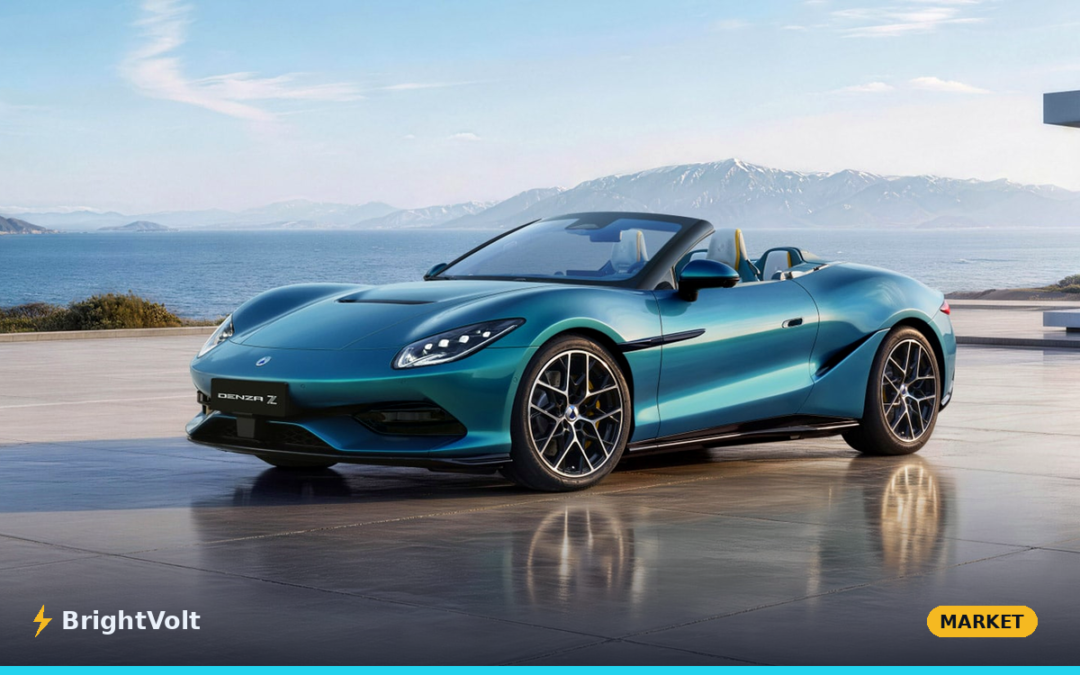
BYD’s Denza Z made its global debut at Goodwood on 9 July, four days before it went on pre-sale in China. The Coupe costs ¥680,000 at home and £142,900 in Britain — about $100,800 against $189,800 at the end of July, an 88% premium. That gap is the most interesting thing about the launch, and it is not quite what it first appears.
The car, briefly
Tri-motor all-wheel drive producing 1,180 kW — 1,582 hp — with steer-by-wire, rear motors spinning to 30,000 rpm, and a claimed 1.96-second sprint to 100 km/h in the Racing variant. The Coupe takes 2.25 seconds and tops out at 300 km/h; only the Racing reaches the 350 km/h figure that has attached itself to the car generally. The Coupe and Spider ride on DiSus-M magnetorheological dampers, while the Racing swaps to mechanical racing springs.
It weighs 2,230 kg, which is worth holding in mind next to those numbers.
The battery is a second-generation lithium iron phosphate Blade pack. LFP in a supercar is an unusual choice — cheaper and thermally safer, weaker on power density and cold performance than the nickel chemistries its rivals use.
The premium is real, but the cars are not identical
Here is the wrinkle that most coverage has missed. The China-market Denza Z carries a 102 kWh pack. The export car carries 76 kWh.
So “88% more for the same car” is not quite right: British buyers pay nearly double for a car with a quarter less battery. That makes the pricing decision more aggressive rather than less, and it explains the range figures — 409 km WLTP for the Coupe, 399 for the Spider, 380 for the Racing, all from the smaller export pack.
It also resolves a contradiction that has been sitting in the coverage since launch. CarNewsChina published roughly 600 km on 9 July and 409 km on 13 July, both labelled WLTP, four days apart. The likeliest explanation is not a mislabelled test cycle but the two packs being conflated: 600 km from 102 kWh is about 17 kWh per 100 km, entirely ordinary for a car of this mass, while 409 km from 76 kWh is 18.6. Both figures are plausible. They simply describe different cars.
| China | United Kingdom | |
|---|---|---|
| Coupe | ¥680,000 (~$100,800) | £142,900 (~$189,800) |
| Spider | ¥780,000 | £159,900 |
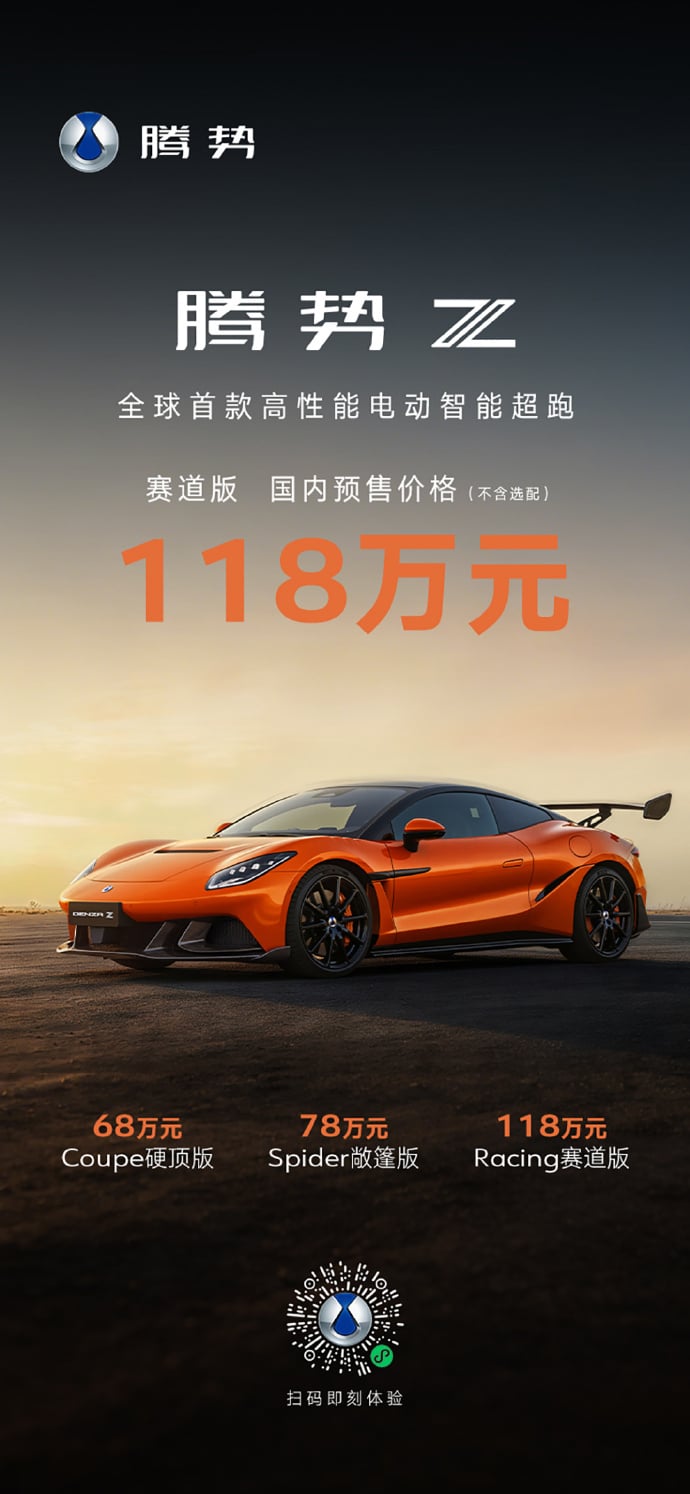
| Racing | ¥1,180,000 (~$174,900) | £172,900 |
| Battery | 102 kWh | 76 kWh |
| Range | not published | 409 km WLTP (Coupe) |
| Pre-sale opened | 13 July 2026 | 9 July 2026 (debut) |
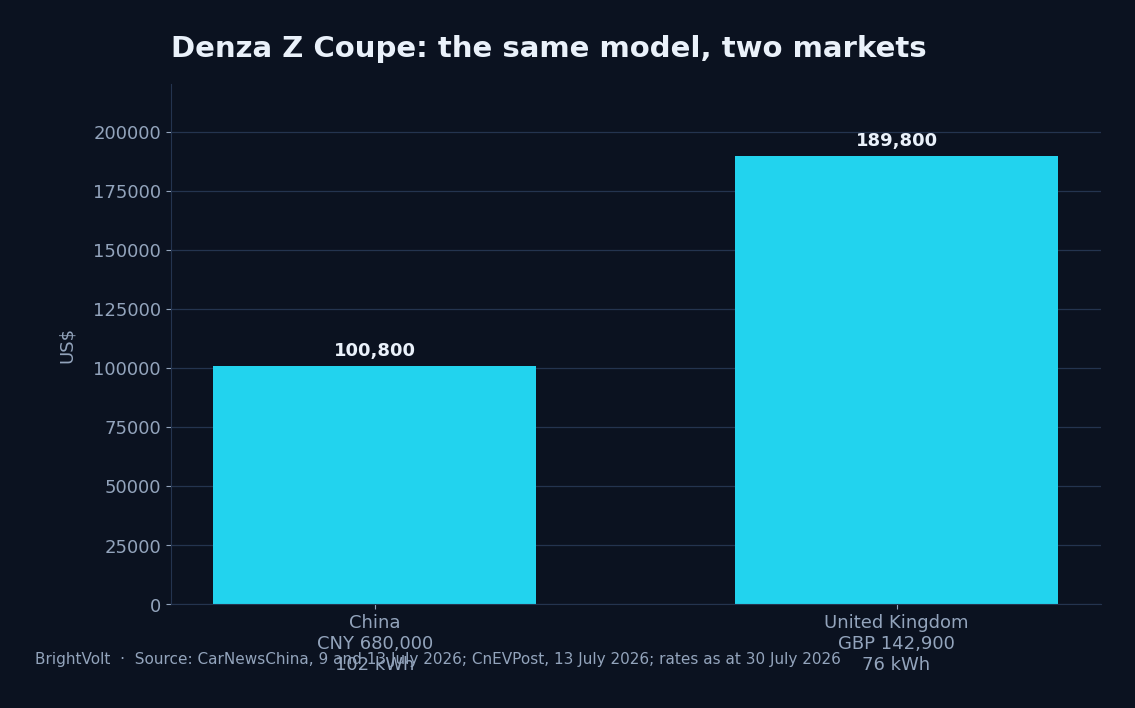
Note what happens further up the range. The Racing costs ¥1,180,000 in China and £172,900 in Britain — a premium of about 28%, not 88%. BYD has not applied a uniform export markup. It has compressed its British range into a narrow band between £142,900 and £172,900 while the Chinese range spans a factor of 1.7, which is a deliberate act of positioning rather than a cost pass-through.
Why launch in Britain first
Because the price anchor sets the brand, and BYD wants that anchor set where the comparison set is expensive.
At £142,900 the Denza Z is priced against Porsche. At ¥680,000 it sits ¥150,100 above a Xiaomi SU7 Ultra — a saloon making about 1,526 hp for ¥529,900. Sell in China first and the global write-up is “Chinese supercar undercuts everything.” Debut at Goodwood and the story is a 1,582 hp coupé landing in Porsche’s bracket, with the Chinese price as a footnote that flatters rather than defines.
This inverts how Chinese manufacturers exported a decade ago, when the pitch was the same product for less money. The premium brands have worked out that cheapness is a positioning trap above the mass market, and that the sequence of launches is itself a pricing decision.
The five-minute charge has nowhere to happen yet
BYD quotes 10–70% in five minutes and 10–97% in nine, on its own flash-charging hardware.
That condition is load-bearing. Outside a BYD megawatt-class station the figure is unreachable, and the network barely exists outside China. BYD set a target in April of 6,000 overseas flash chargers between March 2026 and March 2027 — 3,000 in Europe, 2,000 in the Americas, 1,000 in Asia-Pacific — and restated it at Goodwood. Four of those twelve months have already elapsed.
Any British buyer reading a five-minute charging claim in 2026 is reading a number with no infrastructure behind it.
About those thousand orders
BYD reported more than 1,000 pre-orders in 24 hours globally. For a car starting at ¥680,000 that is genuinely notable, and it ran on five or six outlets within a day.
It was one announcement, not five sources. Neither CnEVPost nor CarNewsChina reports a deposit amount or a refund policy, and with the official launch not due until the fourth quarter there are months in which reservations can quietly lapse.
What to watch
Whether the British prices hold through the Q4 launch, or soften once orders are being counted rather than announced. Whether BYD publishes a China-market range figure that confirms the 102 kWh reading. And whether any meaningful share of those 6,000 chargers appears — because a Denza Z in Britain without them is a 2,230 kg car with a 76 kWh pack and an ordinary charging curve, sold at Porsche money.
Image: Denza