
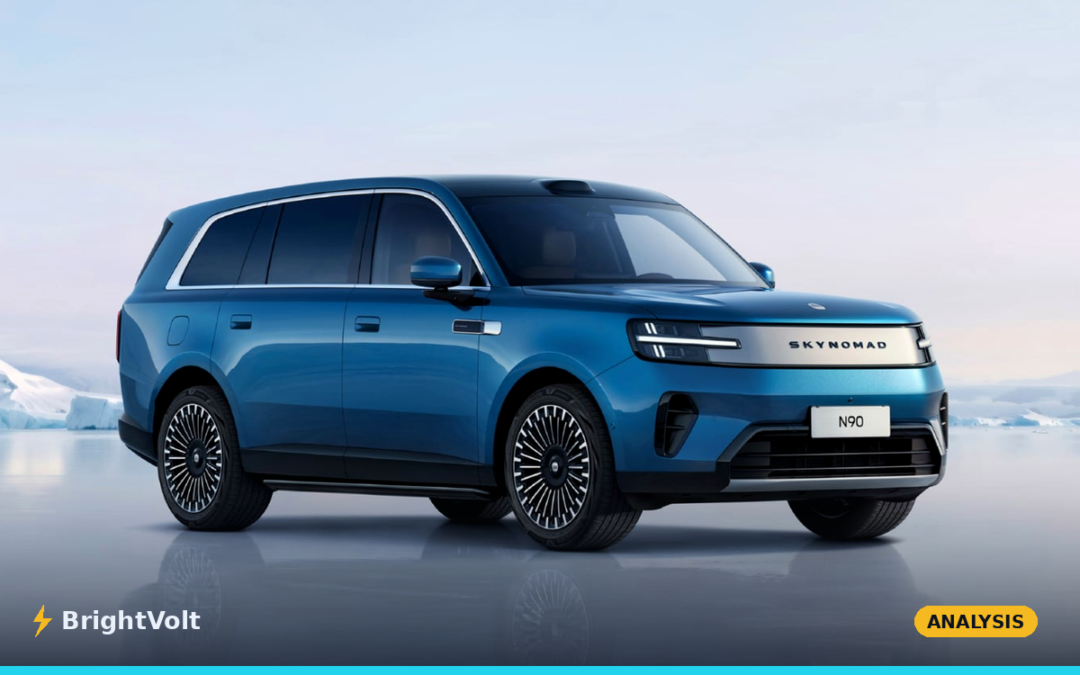
Xiaomi opened pre-sales of the SkyNomad on 30 July at ¥259,900 for the N70 Max and ¥299,900 for the N90 Max — about $38,400 and $44,200. Lei Jun claimed the N70 Max has the longest pure-electric range of any production extended-range vehicle in the world, at 505 km on the CLTC cycle. Two things about that sentence need correcting before the number means anything.
The SkyNomad is not a new Xiaomi brand. And it is not an electric car.
What it actually is
Xiaomi unveiled the name on 8 July in a way that read, to several outlets including Electrek and TechNode, as the launch of a second marque. Xiaomi corrected that the following day: SkyNomad is a series within Xiaomi Auto, sitting alongside the SU7 and YU7. The correction did not travel as far as the original.
The more consequential point is the powertrain. The SkyNomad is an extended-range electric vehicle — a battery and electric drive with a turbocharged 1.5-litre petrol engine on board acting purely as a generator. It has a fuel tank. The headline 1,705 km combined range for the N90 Max is a petrol-plus-electric figure, and its 6.26 L/100 km depleted-state consumption is a petrol figure. On a site that covers alternative energy, that distinction is the whole point: this is a hybrid with an unusually large battery, and it should be judged against hybrids.
| N70 Max | N90 Max | |
|---|---|---|
| Price | ¥259,900 (~$38,400) | ¥299,900 (~$44,200) |
| Battery | 52 kWh LFP or 76 kWh NMC | 76 kWh NMC |
| Electric range, CLTC | 505 km | 464 km |
| Power | 310 kW AWD | 310 kW AWD |
| Range extender | 1.5T, 112 kW | 1.5T, 112 kW |
| Length | 4,960 mm | 5,285 mm |
| Deliveries | September 2026 | September 2026 |
How the range record was won
Lei Jun’s launch slide compared the N70 Max against anonymised rivals carrying 63.3 to 80.3 kWh and managing 500 km or less. CarNewsChina identified the leading one as the Leapmotor D19, at 500 km CLTC from 80.3 kWh.
So Xiaomi’s record is 505 km against 500 km — a 1% margin — achieved with a pack 4.3 kWh smaller. That is a real efficiency advantage and a narrow one. The staging implied a generational leap; the arithmetic describes a rounding error with better packaging behind it.
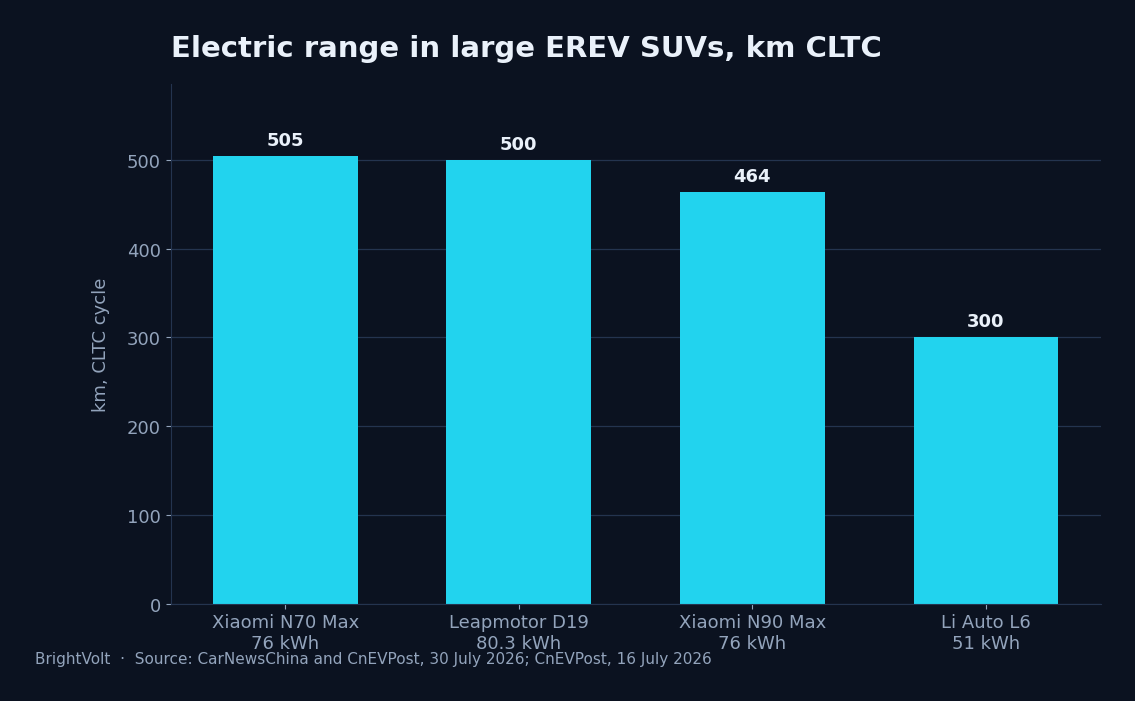
The genuinely notable number is not the range but the battery. Seventy-six kilowatt-hours in a car with a petrol engine is larger than the entire pack in most pure electric cars sold in Europe, and 25 kWh larger than the 51 kWh in Li Auto’s L6. Xiaomi is brute-forcing the position that an extended-range car can be driven as an electric one almost all the time, and paying for it in mass and cost rather than winning it on consumption.
The number Xiaomi did not put on a slide
Charging. Xiaomi quotes 20–80% in 18 minutes.
Li Auto’s revamped L6, launched on 16 July, quotes 20–80% in 12 minutes — six minutes faster, from a company Xiaomi is directly attacking, with a smaller battery. Note also that both figures use a 20–80% window rather than the more common 10–80%, which flatters them by skipping the slowest portion of the curve. Neither is comparable to a rival quoting the wider window.
CnEVPost reports the platform as 800V. No other outlet we could find reports it either way, and none publishes a peak charging figure in kilowatts. Treat the architecture as unconfirmed.
CLTC is the friendliest of the major test cycles, and the gap to WLTP and EPA is wide enough that the headline needs a mental discount before it can be compared with anything sold outside China.
The pricing is the actual news
The N70 Max at ¥259,900 sits ¥10,100 above the new-generation Li Auto L6 at ¥249,800 — a car relaunched two weeks earlier and the single most important product in Li Auto’s range. The N90 Max at ¥299,900 undercuts the Tesla Model Y L, which launched at ¥339,000 last August, by ¥39,100.
Xiaomi has not entered the extended-range segment. It has parked on top of the incumbent’s flagship during its relaunch window, with more battery and a lower charging speed, and dared buyers to compare spec sheets.
There is one more detail that says something about how commoditised this segment has become. The 1.5-litre turbo range extender is not Xiaomi’s. It comes from Harbin Dongan, the engine arm of Changan, reportedly at around $1,100 a unit — and Huawei’s extended-range vehicles use the same supplier. China’s two largest technology entrants into the car market are buying the same commodity generator and differentiating entirely on battery, software and interior.
What to watch
Order numbers, and how they are framed. None had been published as of 31 July. When they arrive, the deposit is ¥1,000 and refundable — roughly $148, which makes a reservation a statement of curiosity rather than a purchase. Xiaomi has a record of publicising large reservation counts that convert at materially lower rates, so the figure to wait for is September deliveries, not July reservations.
The other thing worth watching is whether Li Auto responds on price. It has the faster-charging car, the established service network and a two-week head start. What it does not have is 76 kWh, and if the market decides that an extended-range car should behave like an electric one nine days out of ten, that is the specification that will need answering.
Image: Xiaomi