
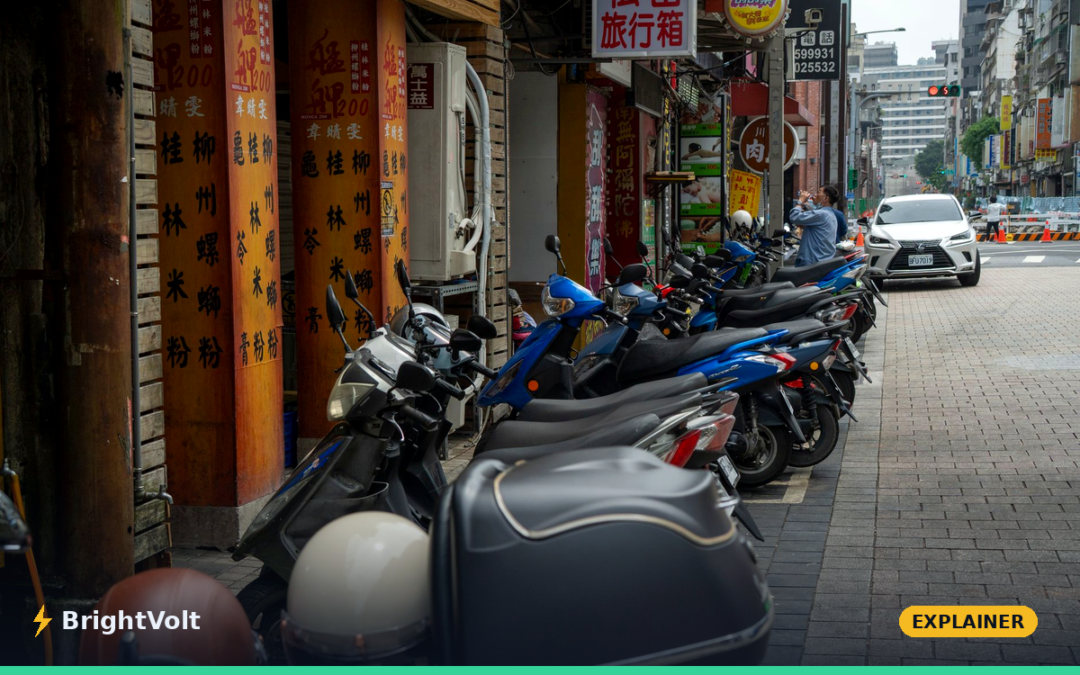
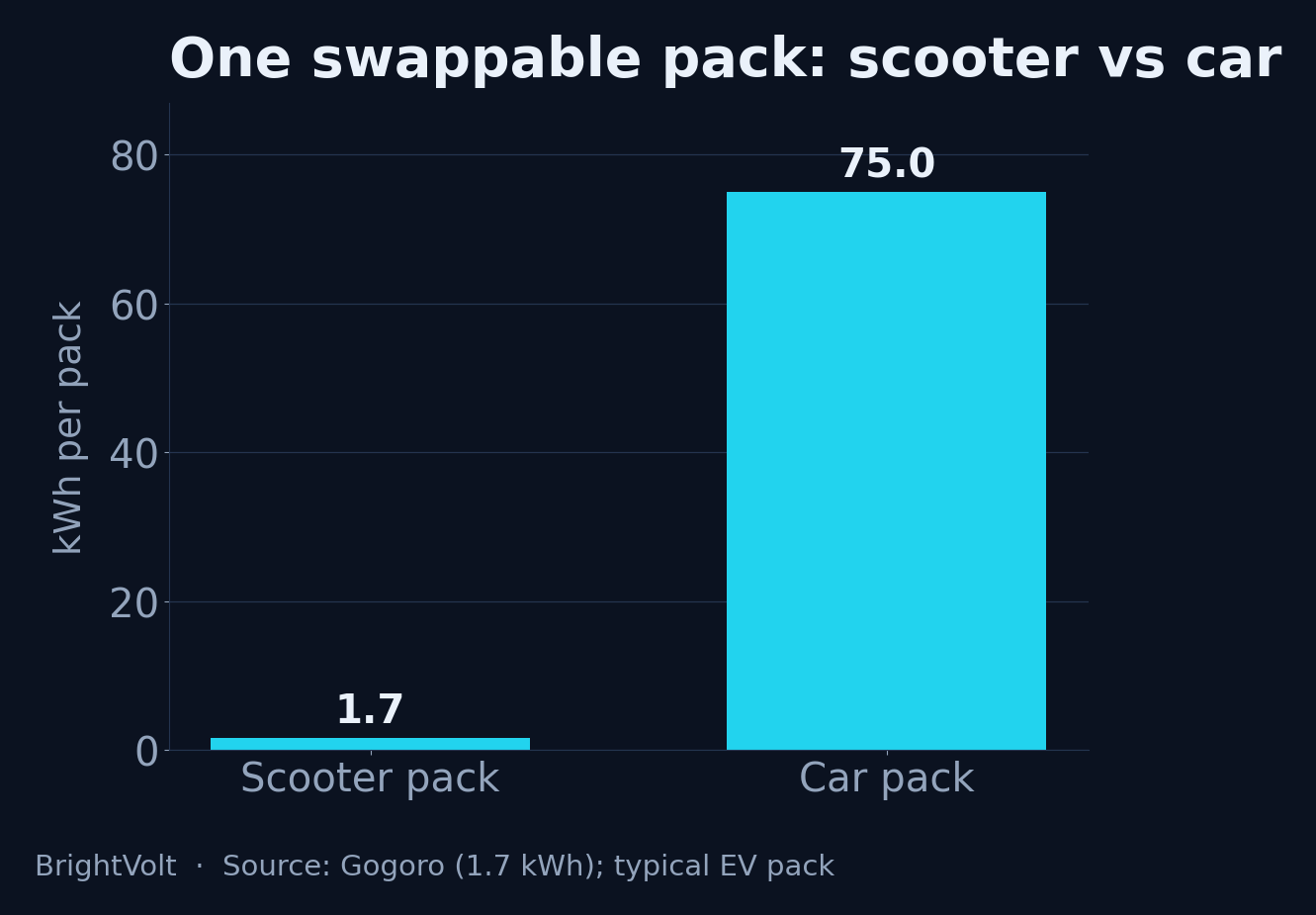
Battery swapping works. It just works for scooters, not cars. Gogoro swaps a 9 kg, 1.7 kWh scooter battery by hand in under six seconds and has done it more than 650 million times across Asia; a car pack holds forty times the energy and weighs half a tonne. That gap — arithmetic, not engineering — is why the idea scaled on two wheels and keeps stalling on four.
The debate about swapping cars has run for a decade, from Better Place’s 2013 bankruptcy to Nio’s stations today, and it usually gets framed as a technology question. It is really a size question. A swap network’s economics are set almost entirely by how big, heavy and expensive the thing being swapped is, and a scooter battery and a car battery are not the same problem wearing different badges.
How a scooter swap actually works
Pull up to a Gogoro station — a lit cabinet the size of a vending machine — lift the two depleted packs out of the scooter, push them into empty slots, and take two charged ones. The whole exchange is done by hand in seconds, with no cables, no app wait and no plug. The station keeps the batteries it holds topped up and thermally managed, checks each one’s health, and hands out the next good pack in the queue.
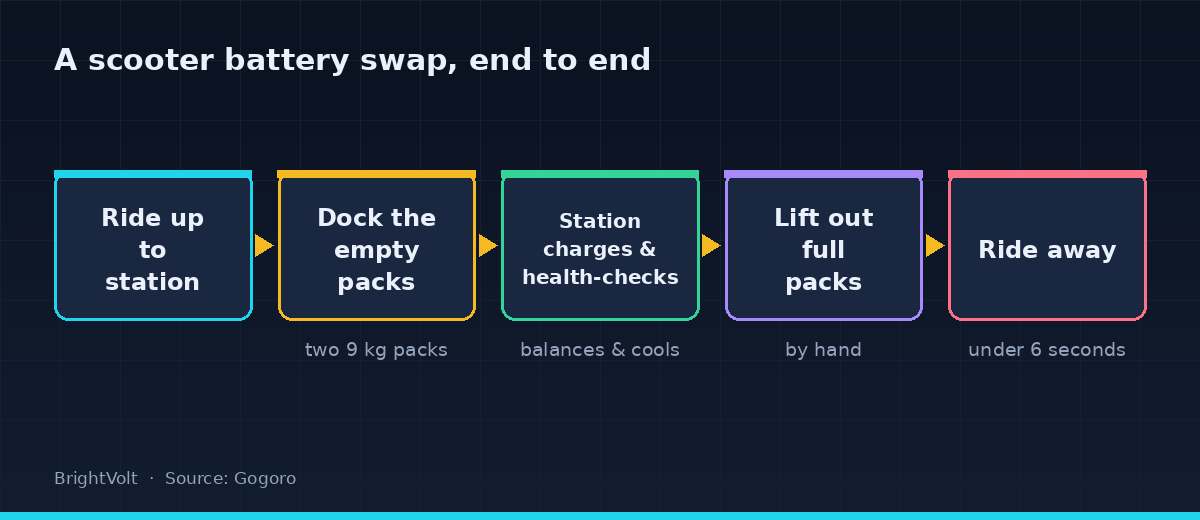
The numbers behind that simplicity are what make it scale. Each Gogoro pack holds about 1.7 kWh and, on the company’s own figures, weighs over 9 kg — light enough for anyone to lift, cheap enough to stock in quantity. Gogoro runs more than 13,000 swap stations across roughly 3,000 locations in eight markets, passed its 500,000th subscriber in 2022, and reports more than 650 million swaps worldwide, running over 400,000 a day in Taiwan alone. In India, Battery Smart has built the country’s largest swap network on the same logic, becoming the first there to hit 100 million swaps and now handling on the order of 100,000 swaps a day for e-rickshaws and delivery two-wheelers.
Why the arithmetic breaks at car scale
Now change one variable. A mainstream electric car carries a 60–80 kWh pack that weighs somewhere around 450 kg. Nothing about the swap concept changes — but every number that made it cheap gets worse at once.
No one lifts 450 kg by hand, so the station needs a robotic bay, a hydraulic lift and a reinforced floor instead of a wall of shelves. The battery is the most expensive part of the car, so every spare pack a station holds to serve a queue is thousands of dollars of inventory sitting idle — where a scooter station stocks tens of dollars per spare. And because a car swap moves so much energy at once, the depot needs a grid connection closer to a small substation than a wall socket. The pack got forty times bigger; the cost of the network built around it grew faster than that.
There is a subtler problem too. Scooter batteries are effectively standardised — a handful of pack formats serve dozens of scooter models across brands sharing one network. Cars are not. Every manufacturer’s pack is a different shape, capacity and mounting, structural to the chassis, and no carmaker wants to hand a rival’s vehicles free access to the network it paid to build. A swap station only works if the packs passing through it are interchangeable, and car packs are built to be anything but.
The one company making car swaps work
Nio is the exception that proves the rule, and it proves it by doing the opposite of what made scooters easy. Rather than share a standard, it built the entire stack itself — the car, the pack, the station and the subscription — as one closed system. That vertical integration is the only way the economics close: Nio owns every variable, so it can standardise its own packs and eat the station cost as a customer-acquisition expense.
Even done that way, it is a heavy lift. Nio operates around 3,790 swap stations and passed 100 million car swaps in mid-2026, with each exchange taking about three minutes — fast for a car, but thirty times the six seconds a scooter takes. It got there on years of losses and subsidy, and it only works inside Nio’s own walled garden. The wider industry’s answer is to force the standardisation cars naturally resist: CATL is now selling standardised swappable car packs that drivers can rent from around $50 a month, betting that a shared pack format is the missing piece. Whether rival carmakers ever agree to share one is the real question, and history is not encouraging.
| Network | Vehicle | Stations | Swaps | Per swap |
|---|---|---|---|---|
| Gogoro | Scooters | 13,000+ | 650M+ (to Jan 2025) | <6 sec |
| Battery Smart | E-rickshaws, 2-wheelers | not disclosed | 100M+ | seconds |
| Nio | Cars | ~3,790 | 100M (since 2018) | ~3 min |
Where swapping actually wins

The pattern under all of this is duty cycle. Swapping earns its keep where a vehicle cannot afford to sit idle and the pack is small enough to duplicate cheaply — a delivery rider whose downtime is lost income, an e-rickshaw driver renting a battery instead of buying a vehicle they could not otherwise afford. Small packs make the “own the vehicle, rent the energy” model possible, because the operator can stock enough spares to guarantee a charged one is always waiting. For a private car that sits parked 95% of the day and charges overnight, that guarantee is worth far less, and fast charging covers the occasional long trip without anyone building a robot bay.
So swapping is not a failed idea that cars will eventually redeem. It is a solved idea that found its natural home on two wheels and in commercial fleets, and struggles precisely where the pack is largest, priciest and least standard.
What it means
Watch the standardisation fight, not the technology. Scooter swapping already won; nothing about physics is holding car swapping back, only the size and cost of the pack and the unwillingness of carmakers to share one. If CATL’s rentable standard gains real cross-brand adoption, car swapping could widen beyond Nio’s garden. If it does not, the honest read is that swapping stays where the arithmetic favours it — millions of times a day, on a scooter, in under six seconds — while cars keep plugging in.
Photo by Chris Oberman on Pexels · Photo by Lan Yao on Pexels