
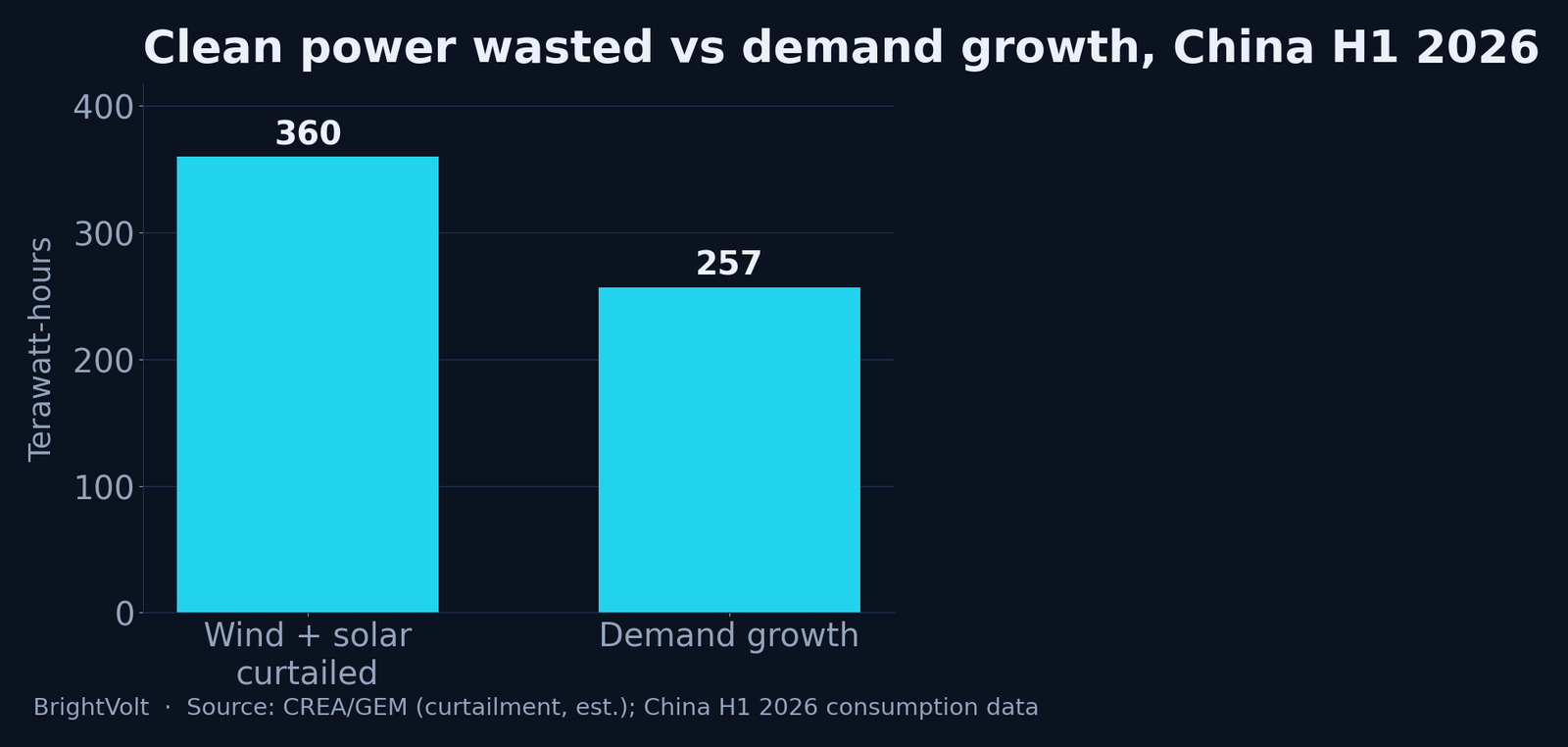
China threw away an estimated 360 terawatt-hours of wind and solar in the first half of 2026 — more clean electricity than the entire country’s power demand grew by, and up 49% on a year earlier. In the same six months it switched on 30 gigawatts of new coal. The waste is usually blamed on a grid that cannot keep up. The more uncomfortable reading is that China’s coal fleet is contracted to run whatever the sun and wind do, and the clean power is what gets spilled to make room.
The number that should not be possible
The 360 TWh figure comes from the half-year coal review by CREA and Global Energy Monitor, and it is an estimate rather than a meter reading. It deliberately counts curtailment the official monthly data leaves out — the solar clipped behind the meter and the wind never dispatched — which is why it dwarfs China’s headline curtailment rates of a few percent. Treat it as the analysts’ best guess at the true figure, not as an audited total.
Even discounted, the direction is unambiguous. Curtailment rose 49% year on year, and the wasted wind and solar exceeded the 257 TWh by which electricity consumption grew — a 5.3% rise on a first-half total of 5,099.9 TWh. Read that twice. A country that has installed more solar and wind than anyone in history spent the first half of 2026 unable, or unwilling, to use enough of it to have covered all of its own demand growth and let coal generation fall instead.
Coal generation did the opposite of falling. It rose 3.4%, reversing its 2025 decline. So the clean power was there, the demand for it was there, and the system chose coal anyway. A grid that genuinely could not physically move the electrons would not also be running more of the dirtiest source on the network.
Coal is contracted to run
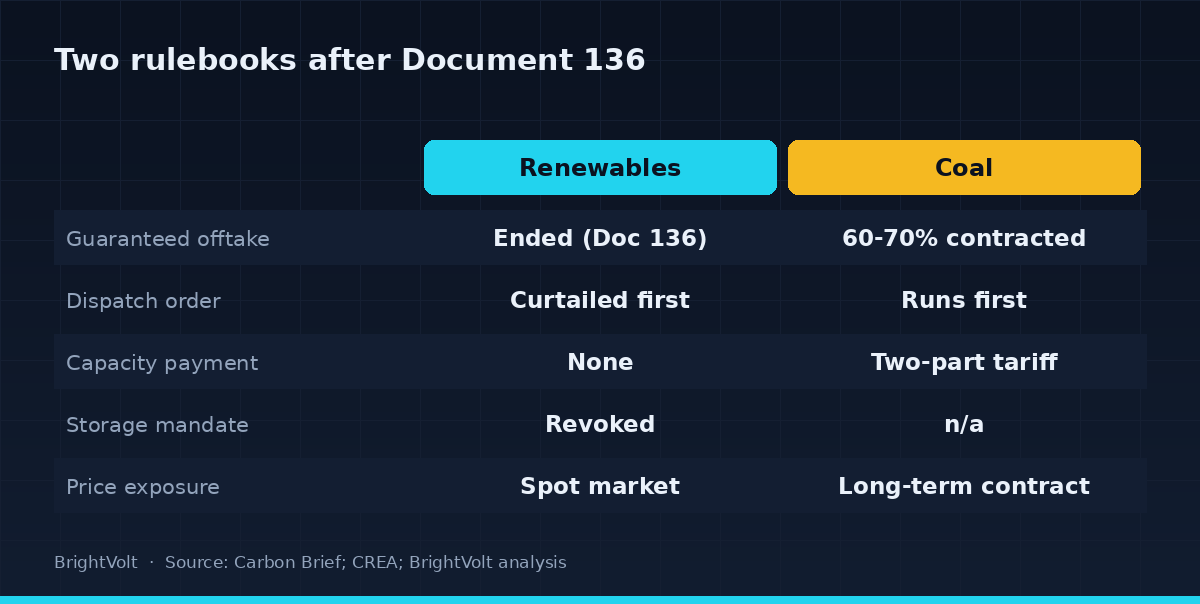
This is the part the grid-lag story leaves out. China’s coal generators sign long-term contracts covering 60 to 70% of the previous year’s delivered electricity, and since 2024 a two-part tariff pays them a separate capacity fee simply to stay available. That is guaranteed offtake plus a retainer. A plant with a contract to deliver a fixed block of power, and a payment for existing on top of it, does not sit idle when supply is long.
So picture the sunny, breezy afternoon when generation outruns demand and something has to give way. The grid does not spill the most expensive plant to run. It spills the plant without a contract — and that is the wind farm and the solar array, whose fuel is free and whose only claim on the wire is that they happen to be generating. The economics are backwards on purpose. The capacity factor of a coal unit that runs to honour a contract it barely needs is a policy artefact, not a market outcome.
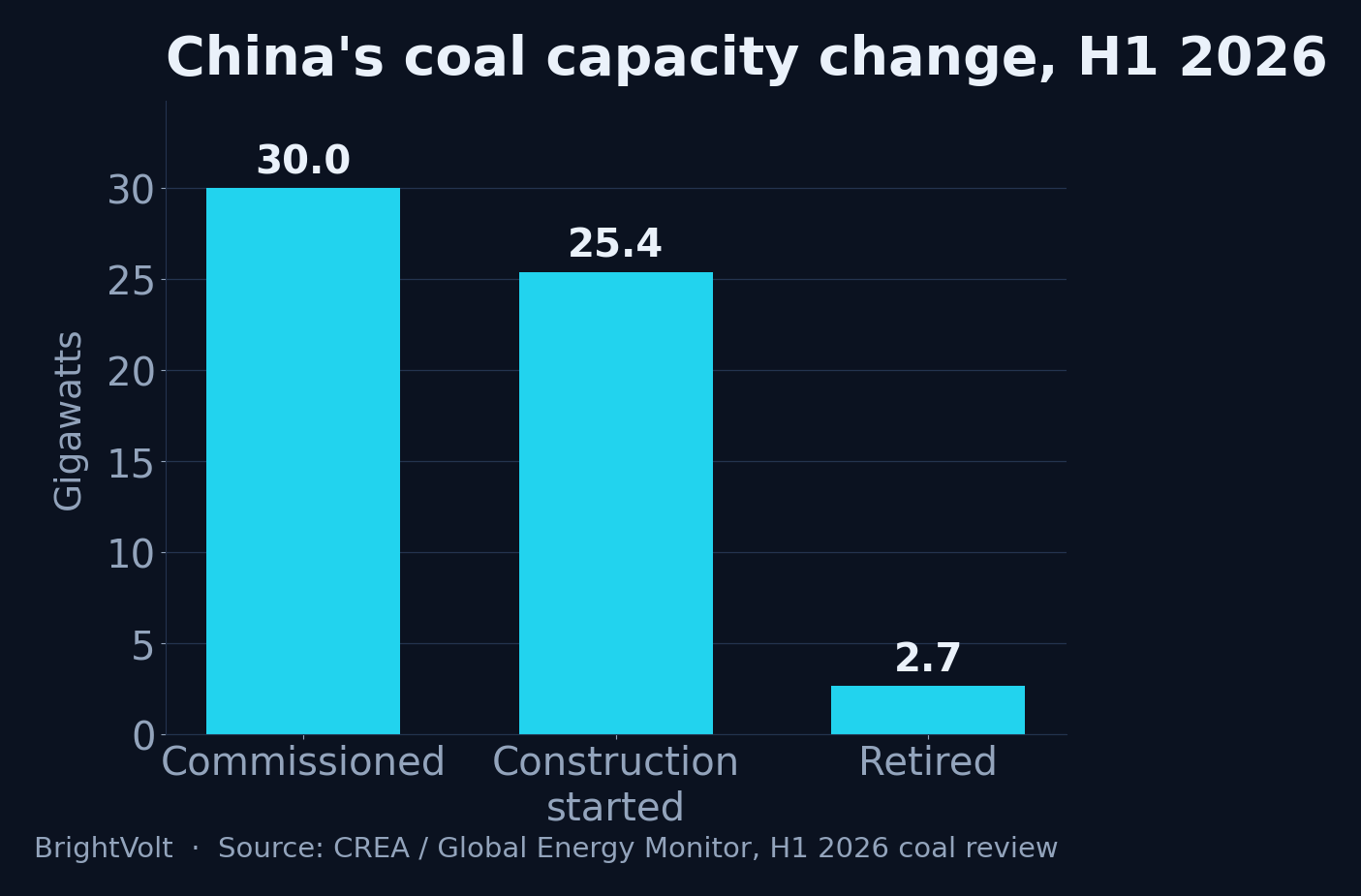
And the fleet keeps growing. In the first half alone China commissioned 30 GW of coal, started building another 25.4 GW, and retired just 2.7 — ten new gigawatts for every one closed, against a pipeline of 274 GW. Every one of those plants arrives with a contract attached. The more coal is built for “backup”, the more contracted must-run capacity there is to shove clean power off the grid the rest of the time.
Renewables got the market; coal kept the guarantee
The timing is the tell. In February 2025 China issued Document 136, and from June that year new wind and solar had to sell into the spot market. The old guaranteed full-purchase price at a coal benchmark was gone; the mandate that had forced developers to bolt storage onto every project was scrapped in the same reform. Renewables were handed price risk and dispatch risk in one document.
Coal’s guarantees were left untouched. One technology was told to compete on the merits; the other was told it would be paid whatever happened. Set the two rulebooks side by side and the curtailment stops looking like an accident of engineering and starts looking like the predictable output of the incentives.
None of this means the reform was pointless — pushing renewables into the market is how China eventually gets storage and demand response that actually respond to price. But sequencing matters, and China liberalised the clean side of the system while leaving the fossil side on a guaranteed contract. That is not a transition. That is a subsidy that changed which technology it protects at the worst possible moment.
The grid excuse, in its strongest form
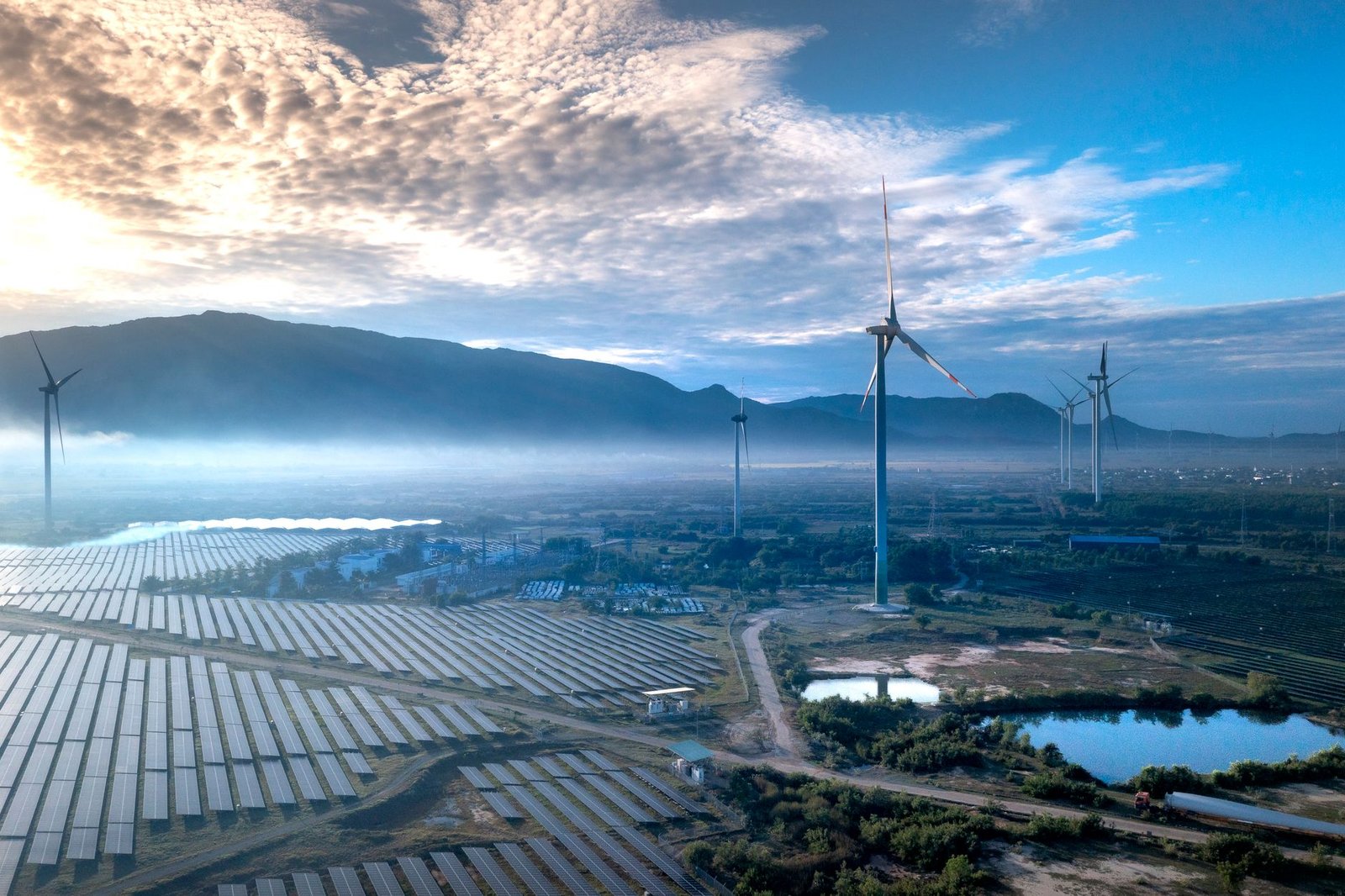
The grid constraint is real, and it deserves its best version rather than a straw one. China’s richest wind and solar sit in the north and west — Heilongjiang, Qinghai, Inner Mongolia — and the load sits on the coast, a thousand kilometres of transmission away. Provinces hoard their own generation and resist importing a neighbour’s. Wood Mackenzie expects curtailment above 5% to persist in seven provinces for wind and twenty-one for solar over the next decade. Some of the 360 TWh genuinely had nowhere to go.
But grant every gigawatt of that argument and the conclusion does not change, it sharpens. When the wires are full and something must be curtailed, the decision over which electron gets spilled is not made by physics. It is made by who holds a contract. Transmission takes years to build; a dispatch rule can be rewritten in a season. The reason the spilled electron is almost always the clean one is that the bottleneck is a rulebook, not a bottleneck of copper — and rulebooks are cheaper to fix than the excuse suggests.
What would change the read
The read is falsifiable, and the test arrives over the next year as the provinces finish implementing Document 136. If coal is genuinely exposed to the same market discipline now aimed at renewables — its capacity payments trimmed, its must-run contracts loosened, its output set by price rather than by guarantee — then coal generation should start to fall and curtailment should ease as spot prices do the sorting. That is the outcome the reform is meant to produce.
If instead coal keeps its contracts and its retainer while renewables absorb all the spot-price risk, then 2026’s 360 TWh is a floor, not a peak, and each new “backup” plant makes the next year’s waste larger. The day the read flips is the day China’s dispatch order stops protecting the most expensive thing to run. Until then, the country wasting the most clean power on earth is doing it with the lights on, on purpose.
Photo by K on Pexels · Photo by Quang Nguyen Vinh on Pexels