
Japan has roughly 170 gigawatts of grid-scale batteries waiting to connect to its power grid and under one gigawatt actually connected. The queue is larger than the country’s entire peak electricity demand, and more than 99 percent of it has never produced a watt. On October 1, the rules changed: a developer now has to prove it holds rights to the project site, or forfeit its place in line.
That is the clearest admission yet that the queue is not a pipeline. It is a filing cabinet, and Japan has started throwing out the folders with nothing in them.
How a battery queue grew bigger than peak demand
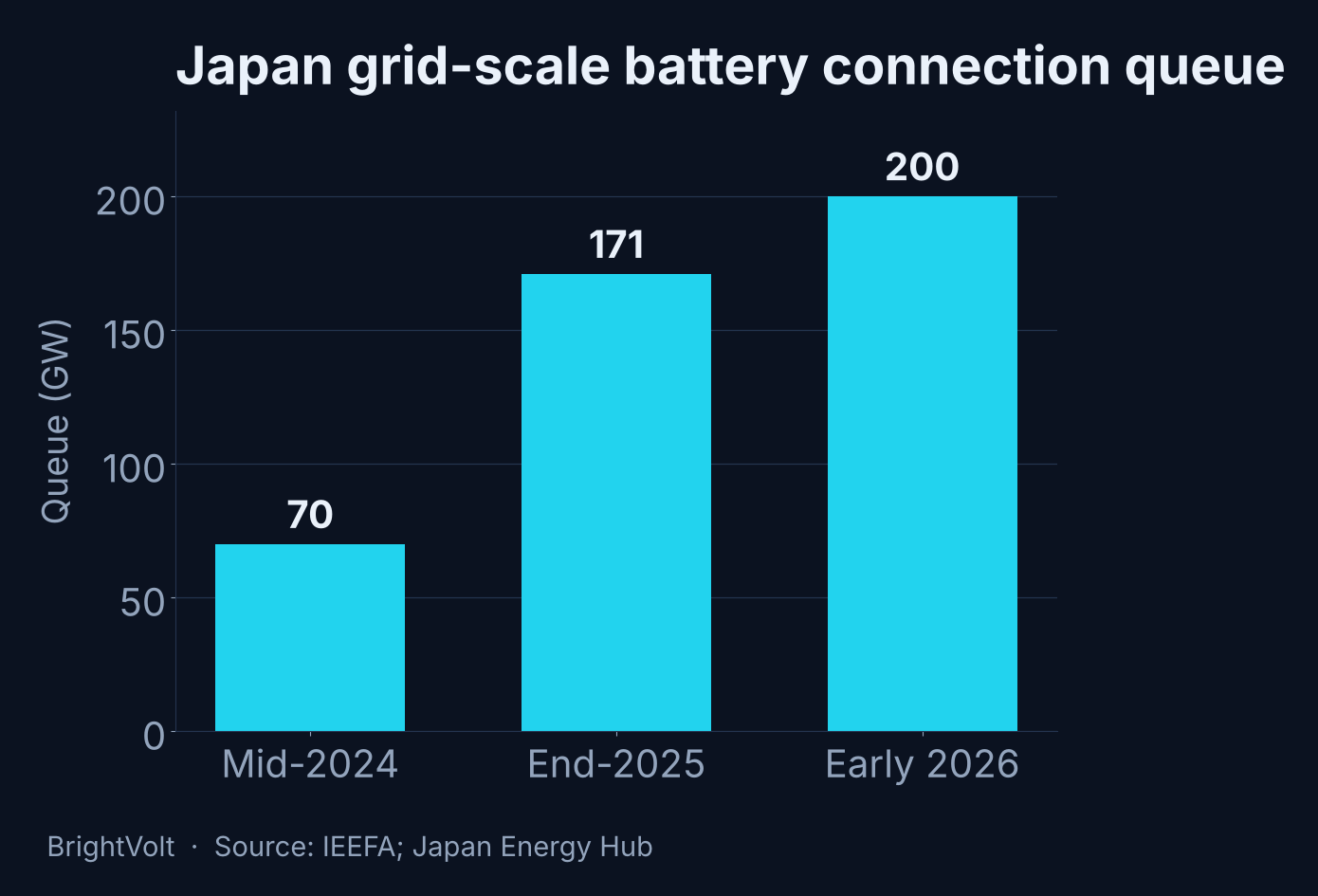
The growth is almost comic in its steepness. Grid-scale battery applications in Japan sat at about 70 GW in mid-2024 and reached 170.8 GW by the end of 2025, according to the Institute for Energy Economics and Financial Analysis. By the first quarter of 2026 the connection queue had passed 200 GW. Batteries now dominate it: they made up two-thirds of all grid-connection study applications in 2024 and around 83 percent in fiscal 2025. The Renewable Energy Institute counts 28,927 connection requests in FY2025 against 14,276 the year before, with 24,880 of them for batteries.
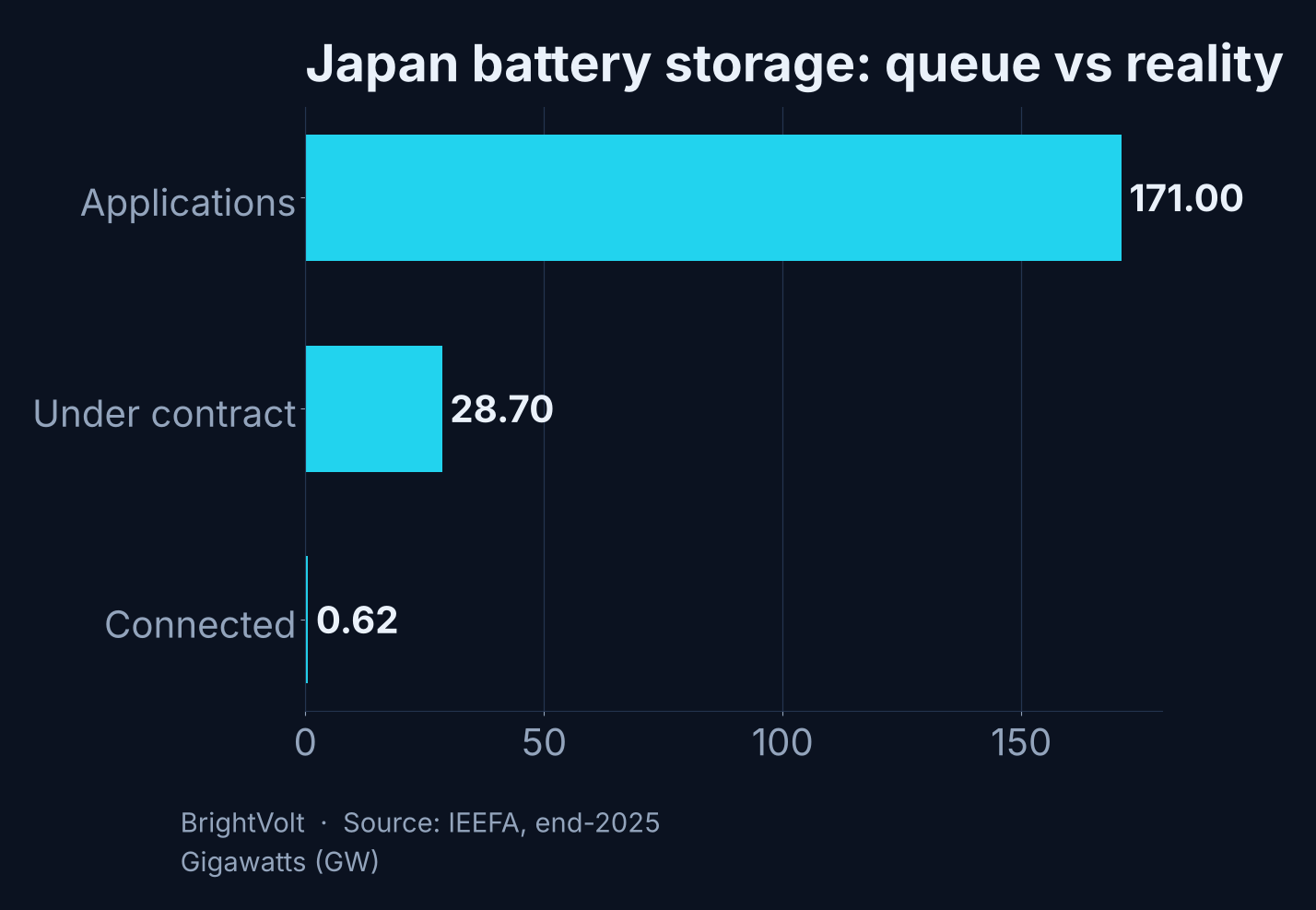
Set that against what exists. Japan’s grid-scale battery fleet is about 0.62 GW connected, up from 0.07 GW in early 2024. Roughly 28.7 GW is under contract — a signed connection agreement, not a built asset — which is about 17 percent of the applications. The connected fleet is about 0.36 percent of the queue.
Japan’s all-time peak electricity demand is in the region of 150 to 180 GW. The battery waiting list now rivals the entire grid’s busiest moment. No one believes 170 GW of batteries is about to appear; the question is why the paperwork says it might.
Why most of the queue is fiction
A queue fills with ghosts when joining it is cheap and leaving it is free. Japan’s was both. Connection studies ran first-come, first-served, the deposit was small, and nothing forced an applicant to show it had a site, financing or any intention of building. Under a “causer pays” rule the developer eventually carries the grid-upgrade cost — but only after the study, so the rational move was to file early, file often, and decide later which reservations were worth keeping.
Developers did exactly that. The Renewable Energy Institute notes that a single company submitted more than 100 requests in a short period. A connection reservation had become a free option on a scarce resource, and options get hoarded.
The tell is in how badly batteries convert compared with everything else on the same grid. IEEFA’s audit of Japan’s connection framework puts solar’s connected capacity at about 2.3 times its study-stage volume, onshore wind at a 14 percent conversion, offshore wind below 1 percent, and battery storage lowest of all at roughly 0.35 percent. Solar converts because solar gets built. Batteries, as a class, were filing applications faster than anyone was pouring foundations. A queue where 996 of every 1,000 megawatts never connects is not measuring supply. It is measuring speculation.
What October 1 actually changes
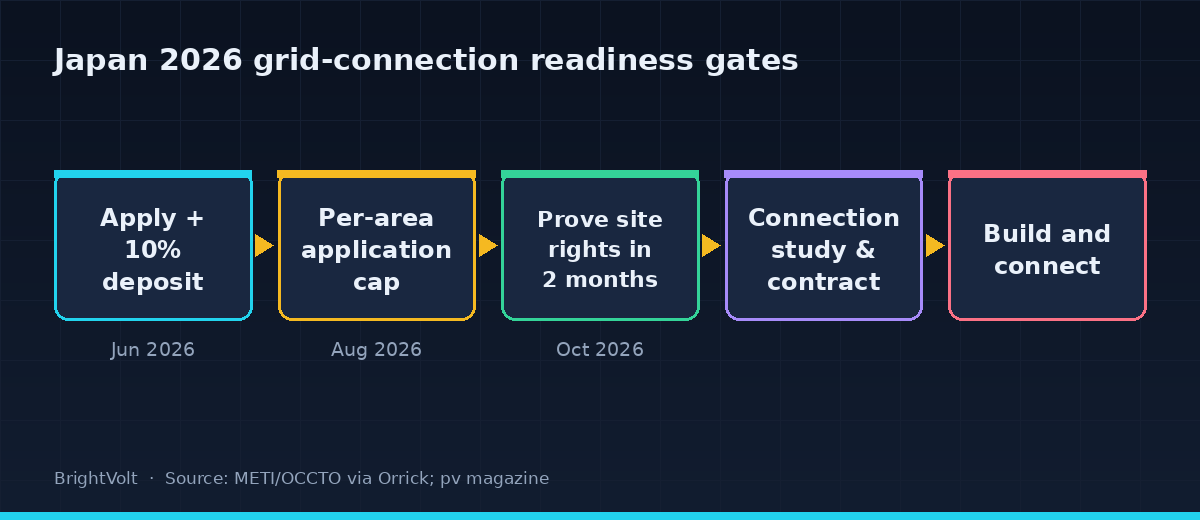
Japan’s answer is a readiness test, phased in across 2026 by the grid operators under guidance from the Ministry of Economy, Trade and Industry. Three filters, in sequence:
| Reform | In force | What it screens out |
|---|---|---|
| Deposit raised from 5% to 10% of estimated connection cost | June 2026 | Applications too thin to post real money |
| Cap on connection studies per company per grid area (5–11, by region) | August 2026 | Bulk filers flooding one operator |
| Proof of site-use rights, submitted within two months | October 2026 | Reservations with no land behind them |
The caps are deliberately regional, reflecting where the grid is tightest: Tokyo is capped at 11 studies per company, Kansai at 10, Hokuriku and Kyushu at 8, Tohoku at 6, and Hokkaido, Chubu, Chugoku and Shikoku at 5 each. The deposit doubling and the site-rights test do the same work from the other direction — they make an empty reservation expensive to hold and impossible to hold for long.
None of this is novel. It is the same diagnosis the United States reached with FERC Order 2023, which replaced first-come, first-served with cluster studies and financial readiness requirements after American queues swelled past 2,000 GW on the same incentives. The fix is always some version of the same sentence: stop treating a free reservation as if it were a commitment.
The bottleneck the cull can’t clear
Thinning the queue is necessary and it is not sufficient, because the hard constraint was never the length of the list. It is geography. Japan’s best wind and solar sit in Hokkaido, Tohoku and Kyushu; its demand sits in Tokyo and Kansai; and the transmission between them is thin. The queue reflects that distortion rather than causing it. Tohoku alone holds about 71 GW of study-stage applications, while Hokkaido — resource-rich and demand-poor — has the most connected battery capacity in the country, and that is still only 190 MW.
Clearing the ghosts lets the real projects be studied faster. It does not build a single kilometre of inter-regional line, and OCCTO’s grid master plan to strengthen those links runs on a timescale measured in years. Nor does it fix the revenue side: Japan’s long-term decarbonisation auctions have so far awarded 1.1 GW, then 1.3 GW, then 0.8 GW of storage across three rounds — real contracts, and a rounding error next to a 170 GW queue.
The number to watch is not the queue. It is connected capacity. If the cull works, the 0.62 GW fleet should start climbing steeply through 2027 as genuine projects stop waiting behind speculative ones. If the queue shrinks and connections stay flat, the hoarding was a symptom, not the disease — and the real answer was always wires and offtake contracts, which no readiness rule can conjure. Japan has correctly identified that most of its battery queue is fiction. Whether the non-fiction can actually be built is the test that starts now.
Photo by K on Pexels · Photo by K on Pexels