
South Korea is putting 8.4 trillion won — about $6 billion — into sodium-ion and solid-state batteries to “reclaim” a market it is losing. Read the targets against what China already ships and the plan looks less like a leap and more like a sprint to where the leader was standing a year ago. That is the problem with the bet: it is aimed at the past.
The money is real and the engineering is serious. But a battery roadmap is judged against a moving target, and on two of the three chemistries that matter, Korea has set out to catch a train that has already left the platform.
What Seoul actually committed
The Ministry of Trade, Industry and Energy announced the strategy at a Seoul summit on 22 September, flanked by executives from LG Energy Solution, Samsung SDI and SK On. The government puts in 400 billion won ($300 million) of R&D money over 2027–2031; the companies commit the other 8 trillion won through 2030. Production tax credits start in 2027, and a recycling framework is bolted on to match Europe’s incoming rules.
The technical targets are specific, which is what makes them testable. On sodium-ion — the cheap, abundant-material chemistry BrightVolt has explained before — Korea is aiming for 160 watt-hours per kilogram by 2027 and 220 Wh/kg “full commercialisation” by 2030. On solid-state, the plan is a prototype in 2027, a 400 Wh/kg cell developed by 2028, and mass production by 2030. Both are framed as the technologies that will lift Korean makers out of a corner. The corner is the interesting part.
The chemistry it is fleeing
Korea’s battery champions bet the last decade on high-nickel NCM cells — nickel-cobalt-manganese chemistry that buys energy density, and therefore range, at a price. That bet was right for a market that wanted 500-kilometre premium EVs. It aged badly the moment the market started wanting cheap ones.
Lithium iron phosphate is what the cheap ones use, and LFP now accounts for more than 55% of global EV batteries. China owns it. CATL and BYD built the LFP supply chain, the cell formats and the pack designs that made a $10,000 electric car possible, and Korean makers largely sat that generation out. The new strategy does not propose to win LFP back. It proposes to skip it — to leap past the chemistry Korea lost and land on the two it hopes are still open. That is a coherent instinct. It only works if the landing spots are actually empty.
The train that already left
They are not empty, and sodium is the clearest case. Korea wants 160 Wh/kg sodium cells by 2027. CATL’s Naxtra sodium-ion cell already reaches about 175 Wh/kg and enters mass production through Changan this year. Korea’s first-generation target for 2027 sits below the number a Chinese cell is putting in a car in 2026.
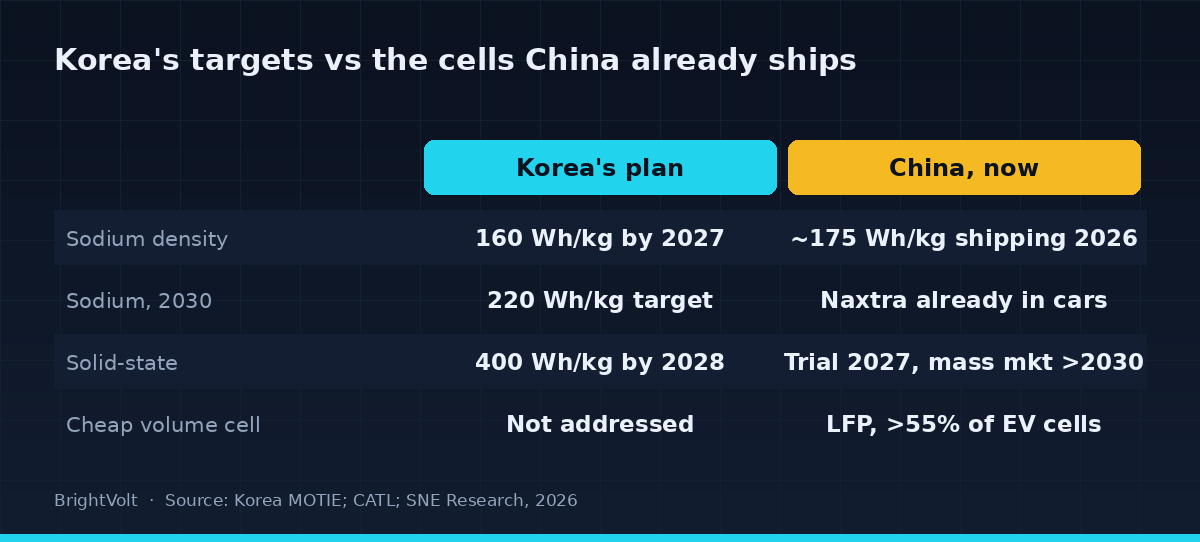
Solid-state is the softer target, because there nobody has arrived. But “nobody has arrived” is not the same as “the door is open for Korea.” The whole industry keeps pushing the solid-state date back: CATL rates its own all-solid-state work at technology-readiness level 4, and both it and BYD call 2027 a trial line and the mass-market cell “past 2030” — which is exactly where Korea’s own plan lands. Taiwan’s ProLogium is already building a mass-production line for a 381 Wh/kg cell. Korea’s 400 Wh/kg-by-2028 goal is competitive on paper, but so is everyone’s, and solid-state has never been short of competitive paper. It has been short of gigafactories.
The number that explains the panic
The strategy makes sense as a response to a chart. The three Korean makers held 31.7% of the global EV battery market in 2021. By 2024 that was 20.2%. In the first half of 2026 the trio’s combined share was about 15.4% — LG Energy Solution at 8.6%, SK On 3.1%, Samsung SDI the rest — against CATL alone at 39.9%. Korea’s three national champions, together, now hold less than half of what one Chinese company does.
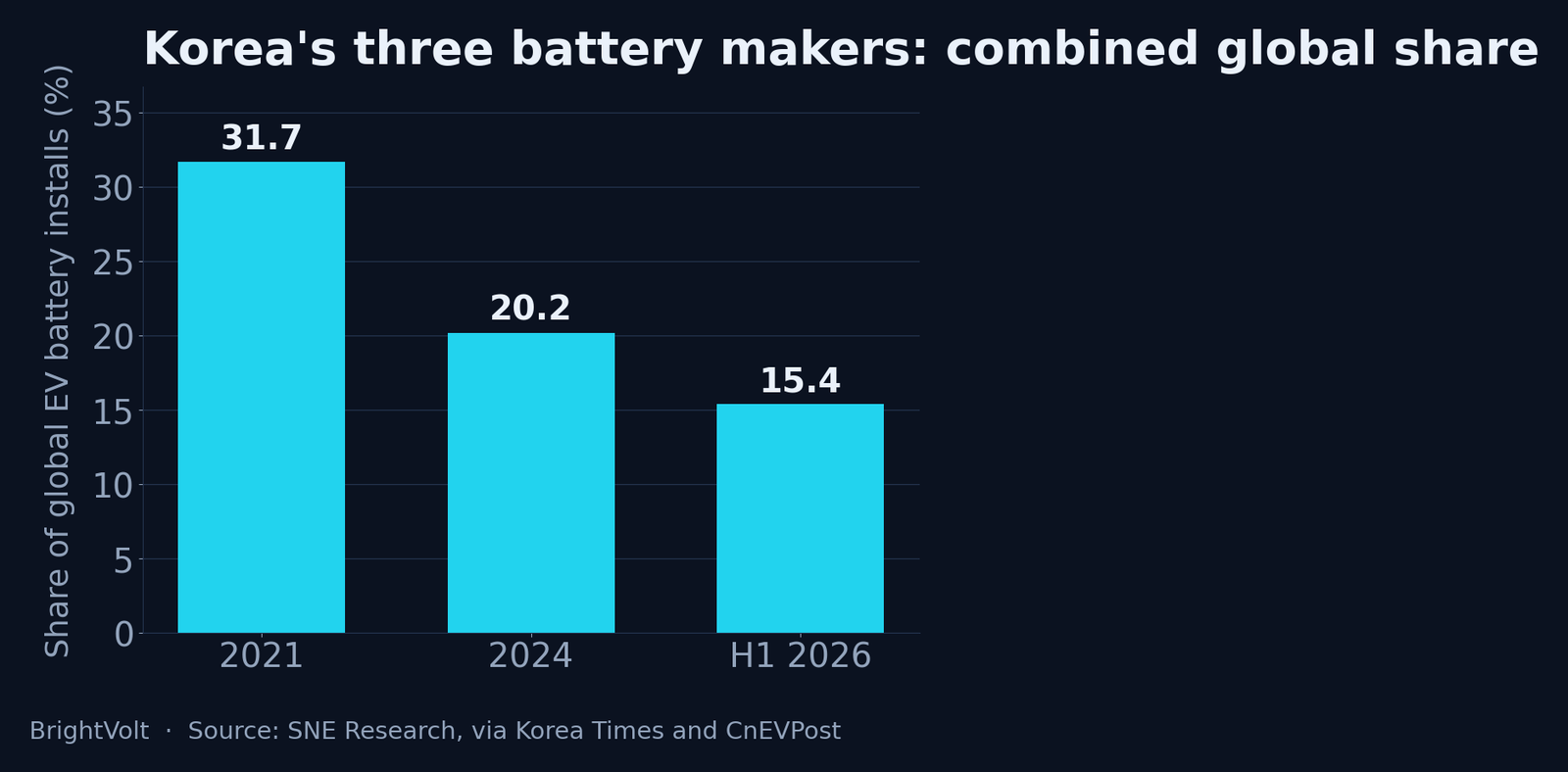
Halving your share in five years concentrates the mind, and a $6 billion counter-move is a rational thing for a government watching its flagship industry slide. The question is not whether Korea should respond. It is whether responding on China’s chosen ground — chemistry, at scale, on cost — plays to any strength Korea still has.
The strongest case for the bet, and why it falls short
The bet’s defenders have a real argument, and it is worth stating at full strength. Korea does not need to beat China on volume; it needs a defensible premium niche, and solid-state is the one chemistry where the incumbents’ LFP advantage counts for little, because it is a different manufacturing problem entirely. Korean firms hold deep solid-state patent portfolios and world-class NCM process knowledge that transfers. Sodium, on this reading, is a hedge — a cheap grid-storage and entry-EV play to keep a foot in the low-cost market while the real prize, solid-state, matures. Land a 400 Wh/kg cell first and the last decade’s losses look like a detour.
Two things make that case weaker than it sounds. First, patents and pilot cells are not the wall; the wall is the gigafactory line that turns a lab cell into a product at yield, and that is precisely the discipline China’s LFP dominance was built on and Korea’s NCM lead never tested at LFP’s cost points. The firm that industrialises solid-state fastest is more likely to be the one that has industrialised the most cells, full stop — and that is CATL and BYD, not Seoul. Second, the sodium “hedge” is already a losing hand: entering in 2027 at 160 Wh/kg, against a Chinese cell shipping at 175 in 2026 into a supply chain that also owns the anode material, is not a hedge. It is a late entry into a commodity, and commodities do not reward the latecomer.
Beijing, for its part, is not waiting to find out. It has taxed lithium cells and zero-rated sodium and solid-state through 2028 — using the tax code to pull its own industry toward exactly the chemistries Korea now hopes to claim. When the market leader subsidises the same technologies you are treating as your escape route, the escape route is a contested road, not an open one.
What would change the read
This read is falsifiable, and the test is a date and a number. If a Korean maker ships a solid-state cell at automotive scale — tens of thousands of units in real cars, not a pilot batch — meaningfully before CATL, BYD or ProLogium, then the patents-and-process argument was right and the $6 billion bought a genuine lead. Watch 2028 to 2030 for that, and watch whether Korea’s sodium cells launch at a density and cost that a Chinese buyer would actually choose over Naxtra.
If instead the solid-state prototype slips past 2030 like everyone else’s, and the sodium line opens years behind CATL at a higher price, then this strategy will read as what the market-share chart already suggests: a well-funded attempt to win the last war. The money is not wasted — process R&D compounds, and a domestic recycling base is worth having regardless. But “reclaim dominance” is the wrong verb for a plan whose most ambitious targets describe where the competition already is. The honest verb is catch up, and catching up is not the same as leading.
Photo by Heru Dharma on Pexels · Photo by Heru Dharma on Pexels