
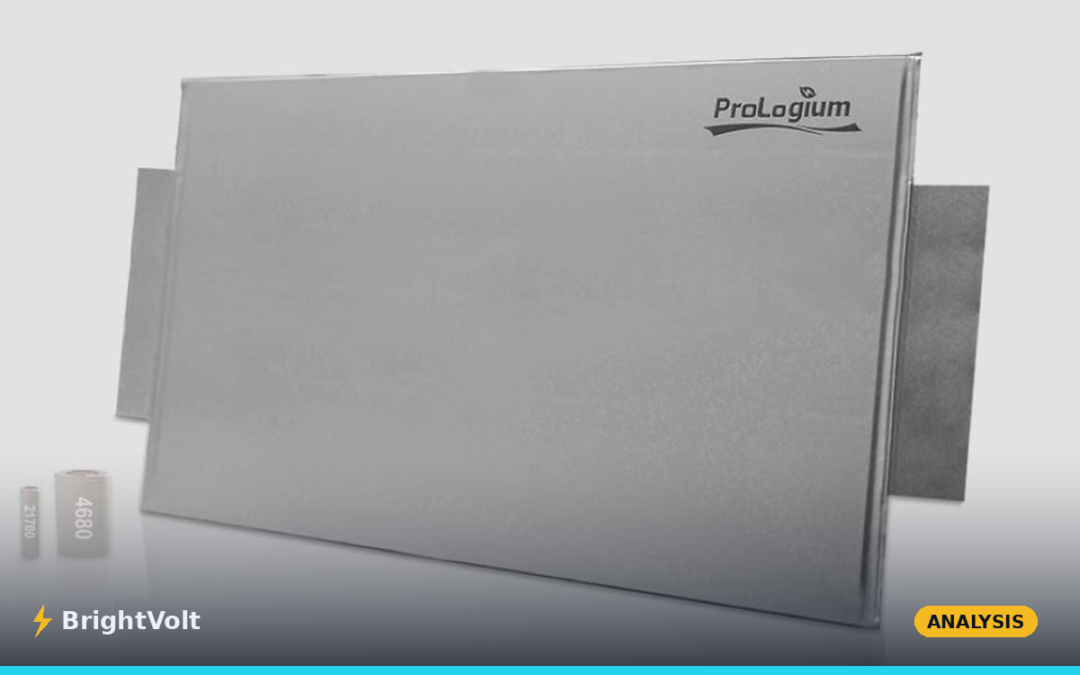
ProLogium says it has begun mass-producing an all-solid-state battery cell that stores 381 watt-hours per kilogram — denser than any lithium-ion cell sitting in a car today, and the first solid-state cell the company has put on a production line at that figure. It is a real milestone, verified by an outside lab. The catch is buried in the word “mass”.
What ProLogium actually switched on
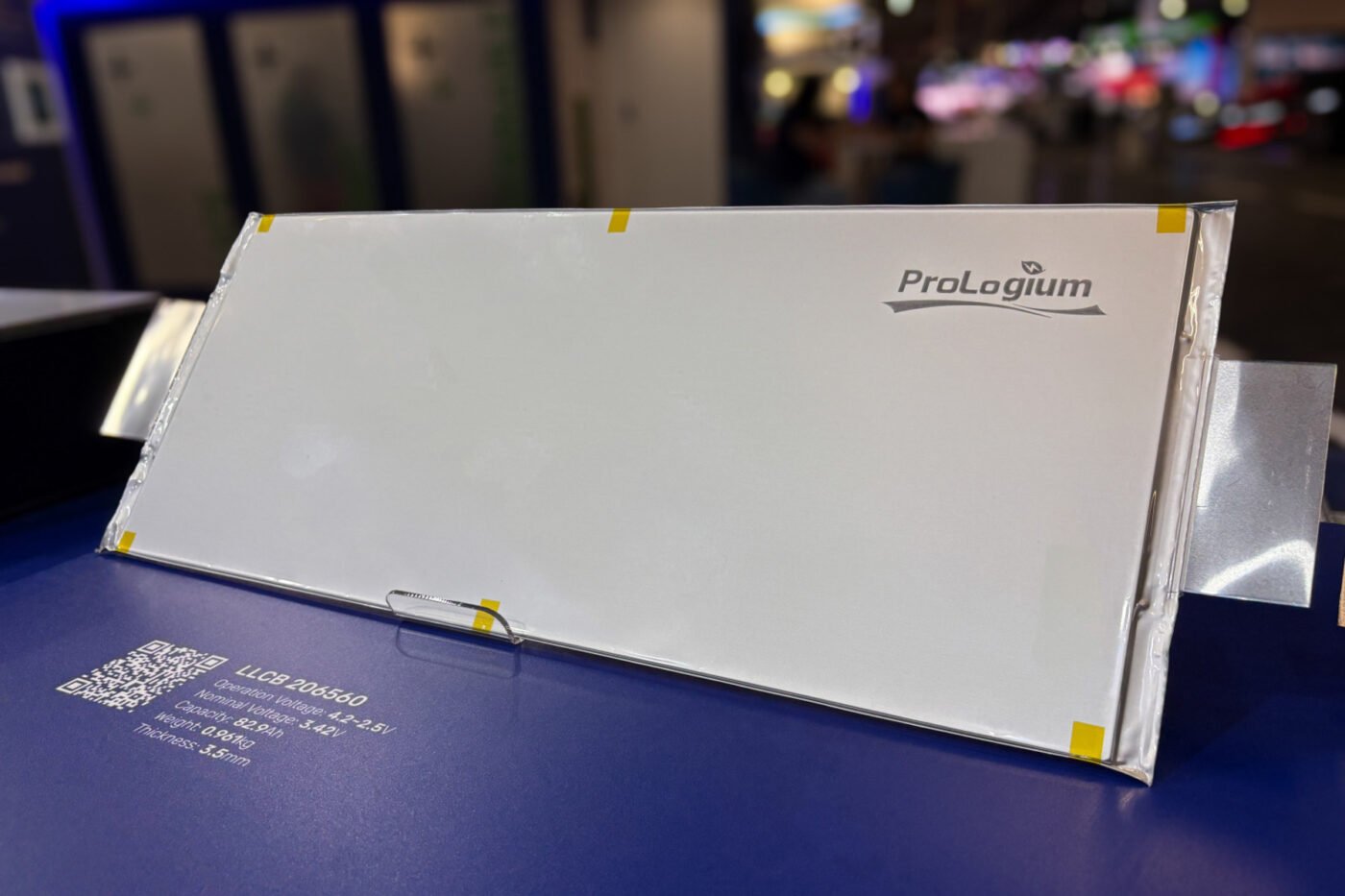
On 2 September the Taiwanese maker announced that its Gen 3.5 Lithium Ceramic Battery — an all-solid-state cell with a ceramic separator in place of the flammable liquid electrolyte in a normal lithium-ion cell — had entered mass production at a “giga-level” plant in Taiwan that has been running since 2024. The headline numbers, measured on a 185.4 amp-hour large-format cell, are 381 Wh/kg by weight and 903 Wh/L by volume, both certified by TÜV. A separate UL Solutions test lost less than 0.05% of the cell’s weight after six hours in a vacuum at 120°C, which is what earns it the “all-solid-state” label under China’s new GB/T 43568-2026 standard rather than the “semi-solid” hedge most rivals ship.
That distinction matters. The industry is littered with cells sold as solid-state that still carry a few percent of liquid or gel to make the interfaces work. A cell that holds together bone-dry at 120°C is the genuine article, and getting the genuine article off a production line at all is more than most of the field has managed.
381 Wh/kg, and why the number is the easy part
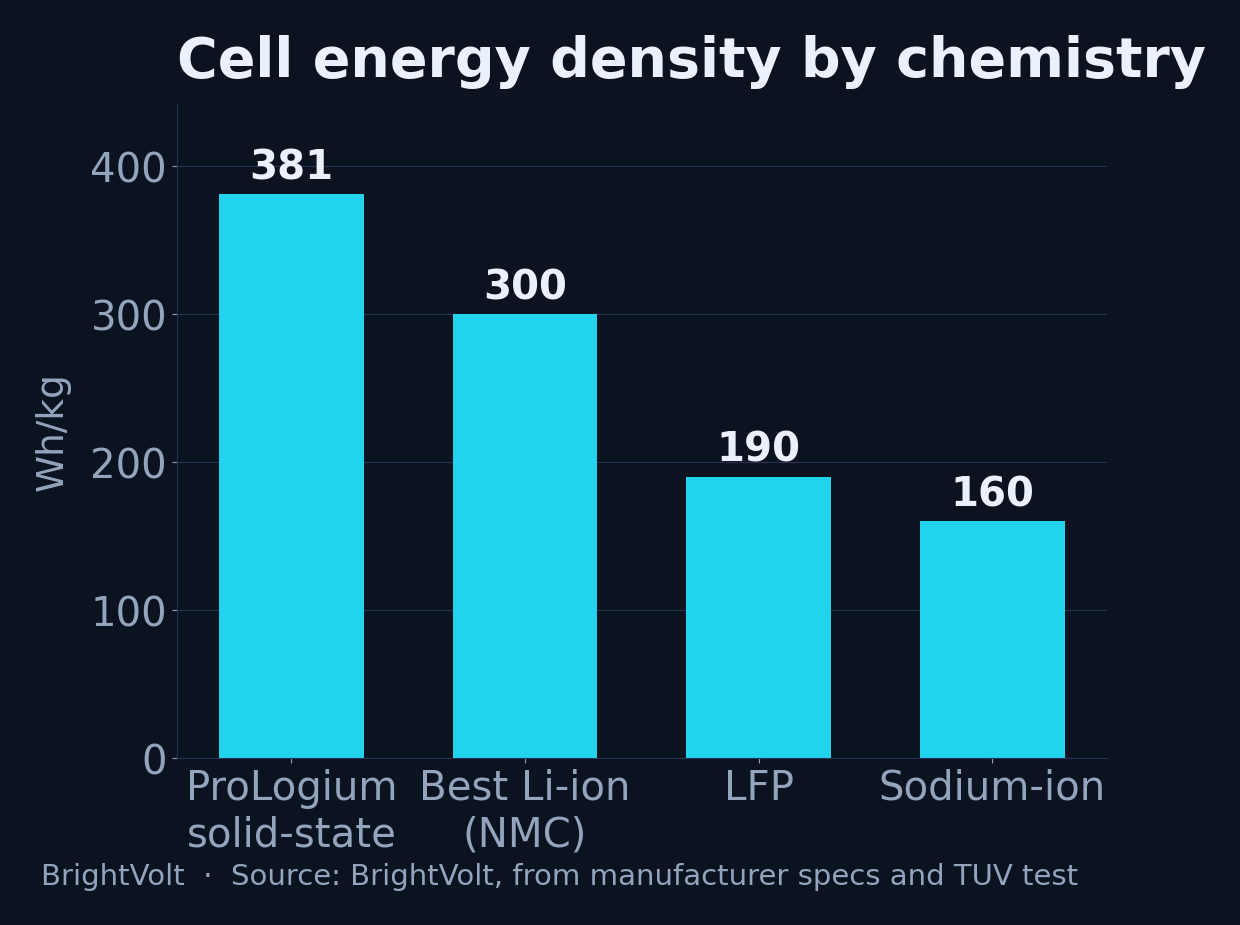
Density is where solid-state was always supposed to win, and this is a real jump. The best mass-produced nickel-based lithium-ion cells today sit around 300 Wh/kg; the cheap lithium iron phosphate cells doing the volume work in China are nearer 190; sodium-ion trades density for cost at roughly 160. At 381, ProLogium’s cell clears the best liquid cell by about a quarter, and it does it while removing the electrolyte that makes a punctured cell catch fire.
But energy density has never been the thing standing between solid-state and your car. Chemistry that works in a lab cell has existed for years. The wall is manufacturing: making the cell the same way ten million times, at a price a carmaker will pay, without the ceramic layer cracking or the yield collapsing. That is exactly the argument this site made when it looked at the 2027 solid-state timeline — the science is largely resolved, the gigafactory line is not. ProLogium clearing the line for one large cell format is progress against that wall. It is not the same as clearing it for the tens of gigawatt-hours a single EV model consumes.
Where the cells are going, and it isn’t cars
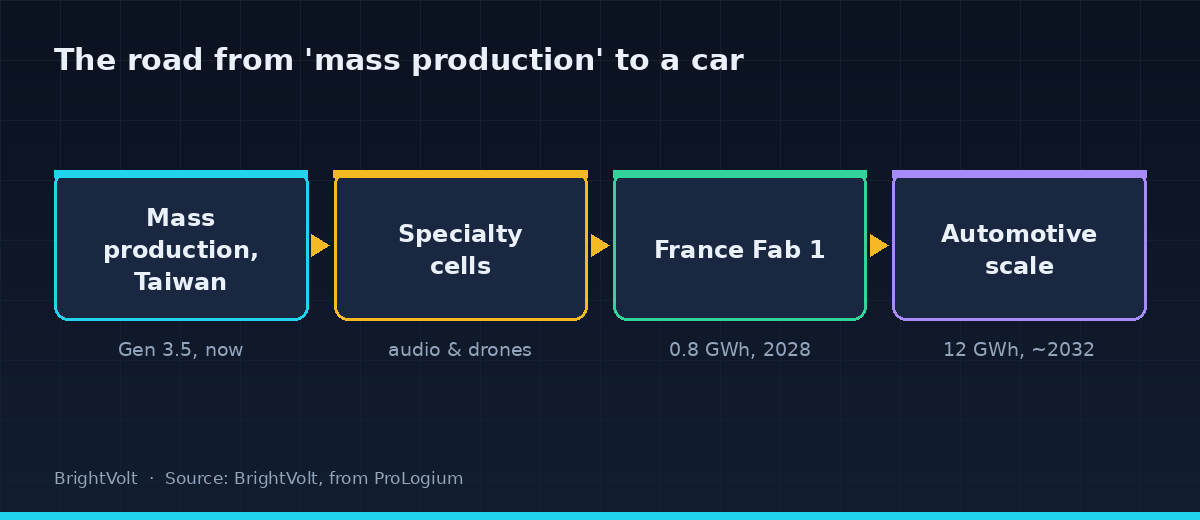
The clearest tell is the customer list. ProLogium says it has shipped more than 2.4 million cells since 2013 and delivered over 900,000 with 175-plus repeat orders — to a US car-audio company, a Japanese automaker that ranks top-three in North America, and the “unmanned systems” market, meaning drones. These are real, paying, repeat customers. They are also, every one of them, low-volume applications where a premium cell that is safe and light is worth paying for and nobody needs a million of them a week.
That is the honest scale of “mass production” here. Nine hundred thousand cells over a decade is a serious specialty business. It is a rounding error against automotive demand, where one gigafactory feeds a single model line and the counting is done in billions of cells.
The automotive-scale plant is a separate, later thing. ProLogium’s €5.2bn Dunkirk gigafactory in France — the one meant to feed European carmakers — only broke ground in February 2026, after the company slowed the original plan. Its first phase is scheduled to make 0.8 GWh in 2028, ramping toward 12 GWh around 2032, with 48 GWh a long-term maybe. The cells announced this month and the cells a car will use are years and one enormous factory apart.
The numbers ProLogium didn’t publish
A press release is written to be quoted, and this one has three holes where the decisive numbers should be.
There is no price. Solid-state’s problem has never been whether it can be built, but whether it can be built for anywhere near the roughly $60–80 per kilowatt-hour that a commoditised LFP cell now costs. A cell that is 25% denser and several times more expensive does not go into a mass-market car; it goes into a drone.
There is no cycle life — how many charges before the cell fades — which for a ceramic cell that mechanically stresses its own interfaces every cycle is precisely the figure a sceptic wants. And there is no charging time, despite a “high-power” claim.
| ProLogium Gen 3.5 | Today’s best Li-ion cell | |
|---|---|---|
| Energy density | 381 Wh/kg (TÜV) | ~300 Wh/kg |
| Electrolyte | Solid ceramic | Liquid |
| On a production line | Yes, specialty scale | Yes, billions of cells |
| Disclosed price | No | Yes, ~$60–80/kWh (LFP) |
| Disclosed cycle life | No | Yes |
One more caution worth stating plainly, because it applies to every solid-state story: the specifications here all trace to ProLogium and its test labs. The dozen outlets carrying the news are carrying one press release, not a dozen verifications. TÜV measured a cell ProLogium supplied; it did not audit the factory. None of that makes the claim false. It makes it a claim, from a company with a genuine product and a commercial reason to round up.
What to watch
The milestone is real and worth marking: someone is now building a true all-solid-state cell at automotive-grade density, at more than laboratory scale, and Chinese makers targeting 2027 trial production are behind it, not ahead. China thought the technology important enough to zero-rate solid-state in the battery tax that took effect the same week.
The thing that would move this from a specialty milestone to a car story is specific and nameable. Watch for a published price per kilowatt-hour, a cycle-life figure that survives an independent teardown, and an automaker putting the Gen 3.5 cell in a car it will actually sell with the range on the window sticker. Until one of those three lands, “mass production” means drones and car speakers — and solid-state stays what it has been since 2015: real, impressive, and always about three years out.
Image: ProLogium · Image: ProLogium