
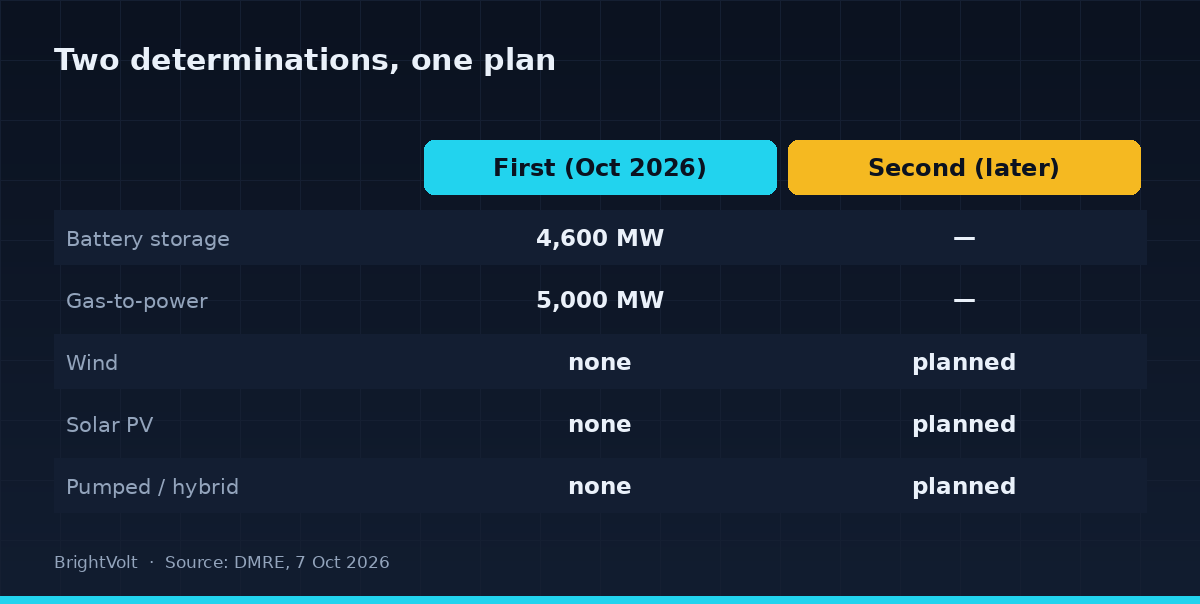
South Africa has told the market to build 4,600 MW of battery storage and 5,000 MW of new gas-fired power — and not one megawatt of new wind or solar. The Section 34 determination signed on 7 October 2026 by Electricity and Energy Minister Kgosientsho Ramokgopa procures 9,600 MW of capacity, all of it dispatchable, and defers the country’s much larger renewables pipeline to a later round.
The reasoning is the tell. A country that spent the better part of a decade in rolling blackouts is now, by its own account, throwing away clean power it cannot use. The problem flipped from too little electricity to too much at the wrong time, and the fix the government reached for is not more generation. It is somewhere to put the generation it already has.
What the determination actually orders
Two numbers, one of each kind. The determination allocates 4,600 MW of battery energy storage and 5,000 MW of gas-to-power, to be procured through the Independent Power Producer Office and open to all bidders, Eskom included. No energy figure accompanied the battery allocation — 4,600 MW could be a two-hour fleet or a four-hour one, and the duration decides what it can do — but the capacity is unambiguous, and so is what is missing. The minister was explicit that this round “will make no provision for new wind or solar capacity,” with a separate determination to follow for variable renewables, hybrid renewables-plus-storage, and longer-term pumped hydro.
Procurement will be written around the system operator’s needs: enforceable availability obligations, and dispatch tied to when the grid wants a battery to charge and when it wants it to discharge. This is capacity bought to be commanded, not energy bought to be sold.
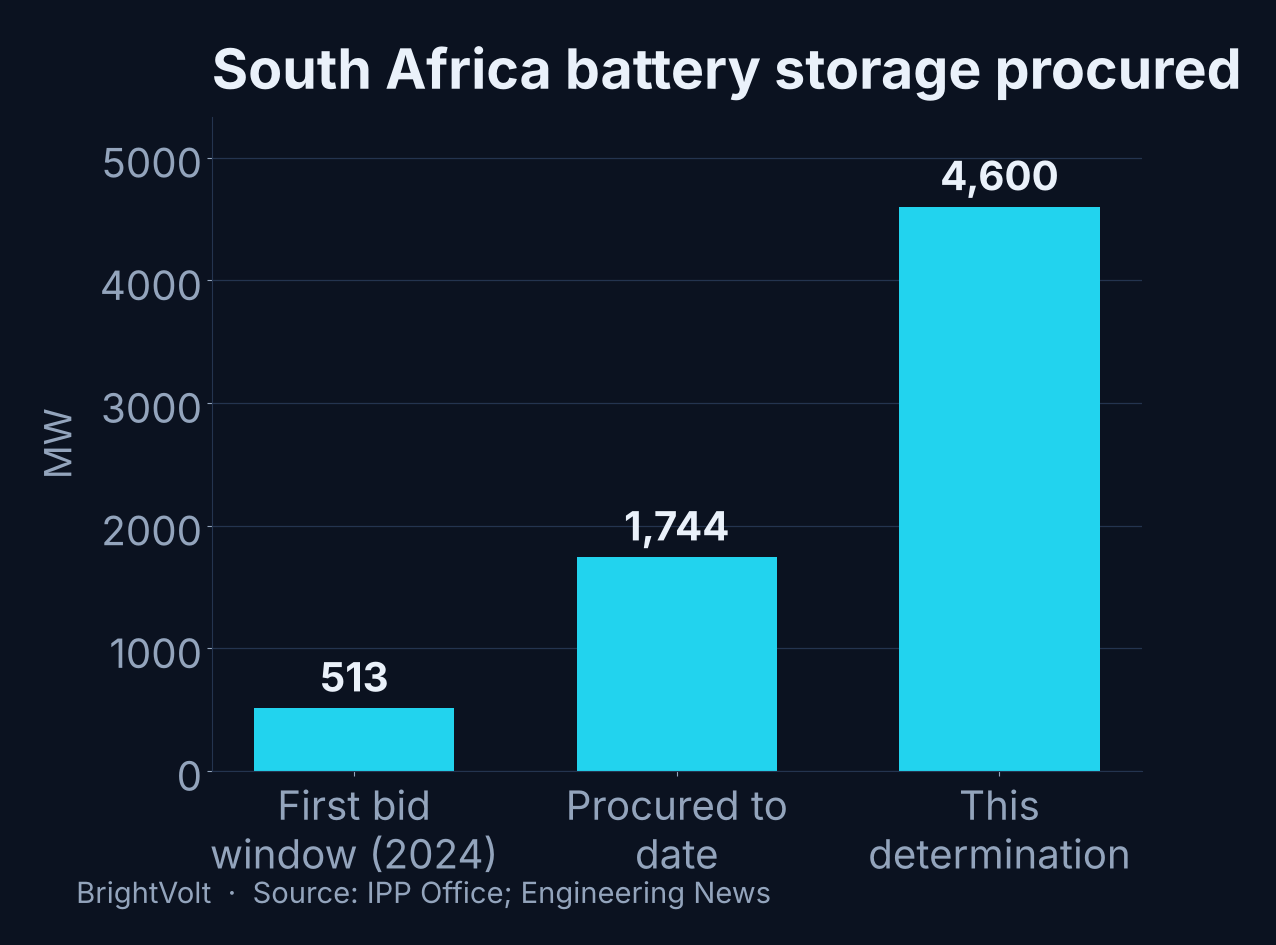
The scale is the jump. The first battery storage bid window procured five projects totalling 513 MW, which reached commercial close by June 2025 and drew R15.4-billion. Successive rounds lifted the running total to roughly 1,744 MW. This single determination orders nearly three times everything procured before it.
Set the determination against the plan it supposedly serves, and the shape of the decision becomes clear.
The plan is mostly renewables. The first order is none.
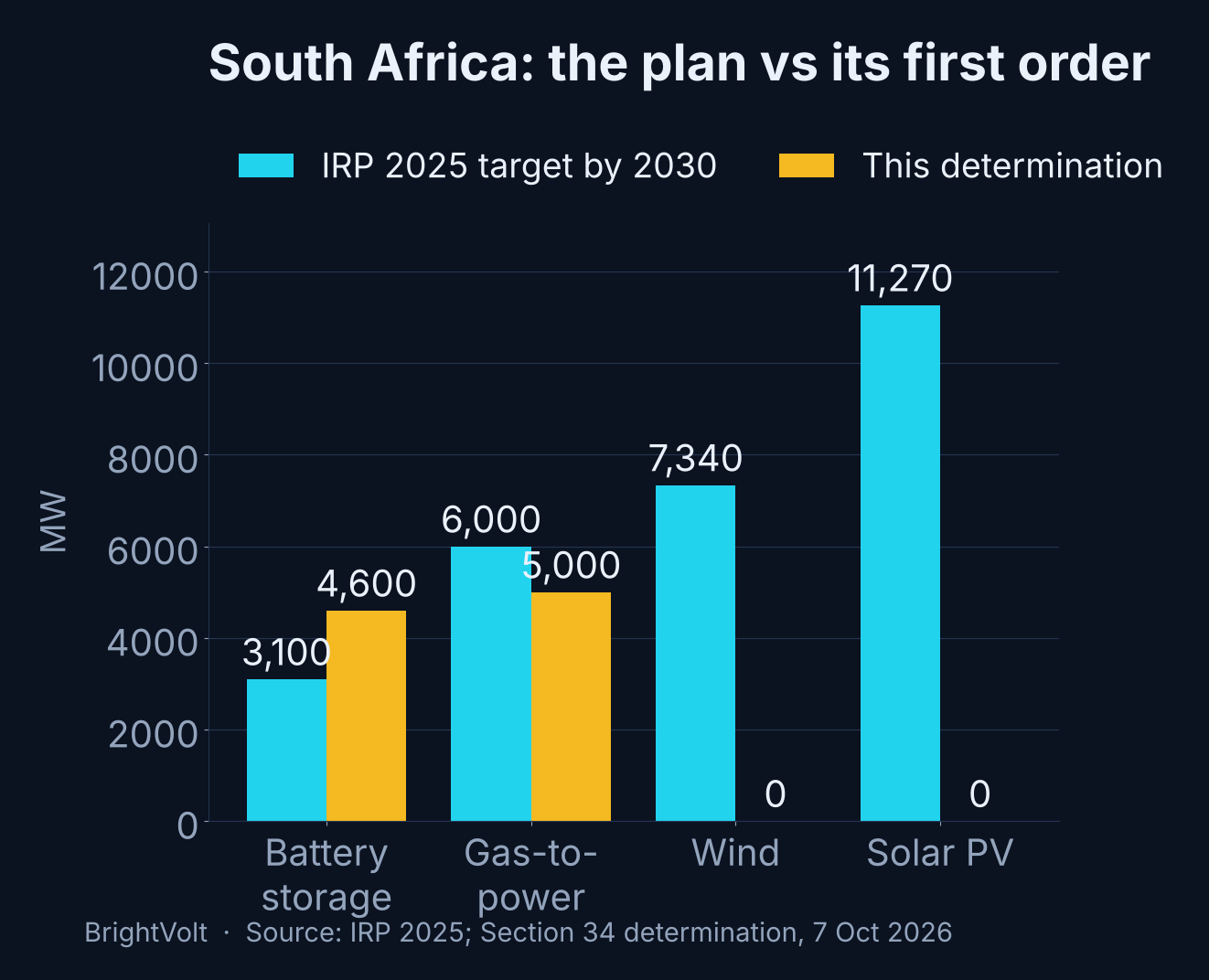
South Africa’s Integrated Resource Plan 2025, approved by cabinet in October 2025, is overwhelmingly a wind-and-solar document. It calls for 7,340 MW of new wind and 11,270 MW of new solar by 2030, against 3,100 MW of storage and 6,000 MW of gas over the same period. Out to 2039 the renewables share grows, not shrinks: 34 GW of wind and 25 GW of solar inside 105 GW of total new capacity.
The first procurement off that plan inverts it. It orders more battery storage than the entire 2030 storage target in a single determination, close to the full 2030 gas allocation, and zero of the 18,600 MW of wind and solar the plan wants this decade.
| Technology | IRP 2025 target by 2030 | This determination |
|---|---|---|
| Battery storage | 3,100 MW | 4,600 MW |
| Gas-to-power | 6,000 MW | 5,000 MW |
| Wind | 7,340 MW | 0 |
| Solar PV | 11,270 MW | 0 |
A plan that is three-quarters renewables has produced a first order that is entirely firming. That is not a contradiction the government is hiding — it is the point. The argument is that the grid cannot physically carry the renewables it already has, so buying more before the wires and the storage exist would be paying for power the network cannot move.
Why batteries first, when batteries make nothing
A battery is not a power station. It moves energy in time; it does not create it. Procuring 4,600 MW of storage while pausing the renewables that would charge it looks, at first glance, like buying a very large bucket before deciding whether to turn on the tap.
It is more deliberate than that, and the word the government keeps using is the reason: curtailment. South Africa is already spilling clean power because the network is congested or because supply briefly outruns demand. Storage absorbs that otherwise-wasted electricity and returns it into the evening ramp, when the sun has gone and demand peaks. On that logic the battery’s first job is not to firm new solar — it is to stop the existing fleet being thrown away, and to shave the evening peak the country still meets with its oldest, dirtiest coal.
The gas sits beside it for the same reason and a harder one. Batteries cover hours; they do not cover a windless, sunless week. Five gigawatts of gas-to-power is dispatchable insurance against the days storage cannot reach — the capacity a grid leaning on weather needs most and markets reward least. Whether that gas runs flat-out or sits idle as a peaker depends on contracts not yet written, and no capacity factor was disclosed. A 5 GW gas fleet run hard is a large new fossil commitment; the same fleet run a few hundred hours a year is cheap insurance. The determination does not say which it will be, and that ambiguity is doing a lot of work.
The honest read, and what would change it
Strip the clean-energy framing off the battery number and this is a grid-stability determination, not a decarbonisation one. The storage ordered now will largely time-shift the existing coal fleet and the new gas, plus mop up curtailment from renewables already built. It decarbonises nothing by itself. What it does is make room — clear the congestion, firm the peak, and stabilise a grid so that the next determination’s wind and solar have somewhere to go.
That is a defensible sequence, and it is also exactly what a government nervous about blackouts and indifferent to emissions would do. The two are indistinguishable until the renewables determination arrives.
 Developers already read the pause as a setback, and they are right to watch the calendar: a firming round with no renewables round close behind is not a bridge to a cleaner grid. It is just more gas with better public relations.
The number to watch is not the 4,600 MW. It is the date on the second determination. South Africa has done the unglamorous half first, and there is a real case for doing it in that order — the batteries and the gas are what let the renewables connect without breaking the grid. But a bucket is only worth buying if the tap is coming. If the wind-and-solar round lands in months, this was sequencing. If it slips to “later” and stays there, the country will have spent its procurement firepower on 5 GW of gas and a fleet of batteries with nothing clean to store.
Photo by Quang Nguyen Vinh on Pexels · Photo by K on Pexels