
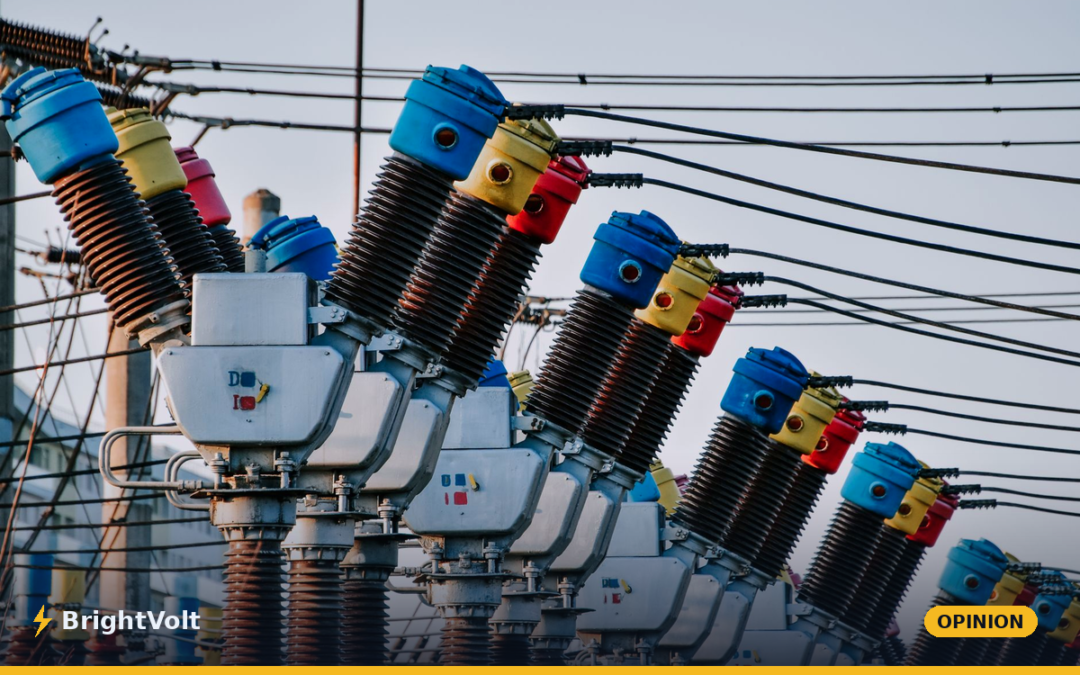
The machine deciding how fast the United States can electrify is not a solar panel, a gas turbine or a battery. It is the large power transformer — a hundred-year-old block of steel and copper the country imports 82% of, now on a two-to-four-year wait, whose core steel comes from a single plant in Pennsylvania. Every plan that races to add generation while treating this as a footnote is scheduling around a bottleneck it has not priced.
We have argued before that the grid, not the panel, is the binding constraint on a clean build-out. That piece was about the interconnection queue — the paperwork layer. This is the layer beneath it, where the paperwork finally turns into a physical object that has to be manufactured. And the object is running out.
The bottleneck is a transformer, not a turbine
Almost nothing reaches the grid without a transformer. A power plant steps its output up to transmission voltage through a generator step-up (GSU) unit; a substation steps it back down; the wire into a house ends at a distribution transformer. They are unglamorous, individually enormous, and largely invisible until you cannot get one — which, right now, you cannot.
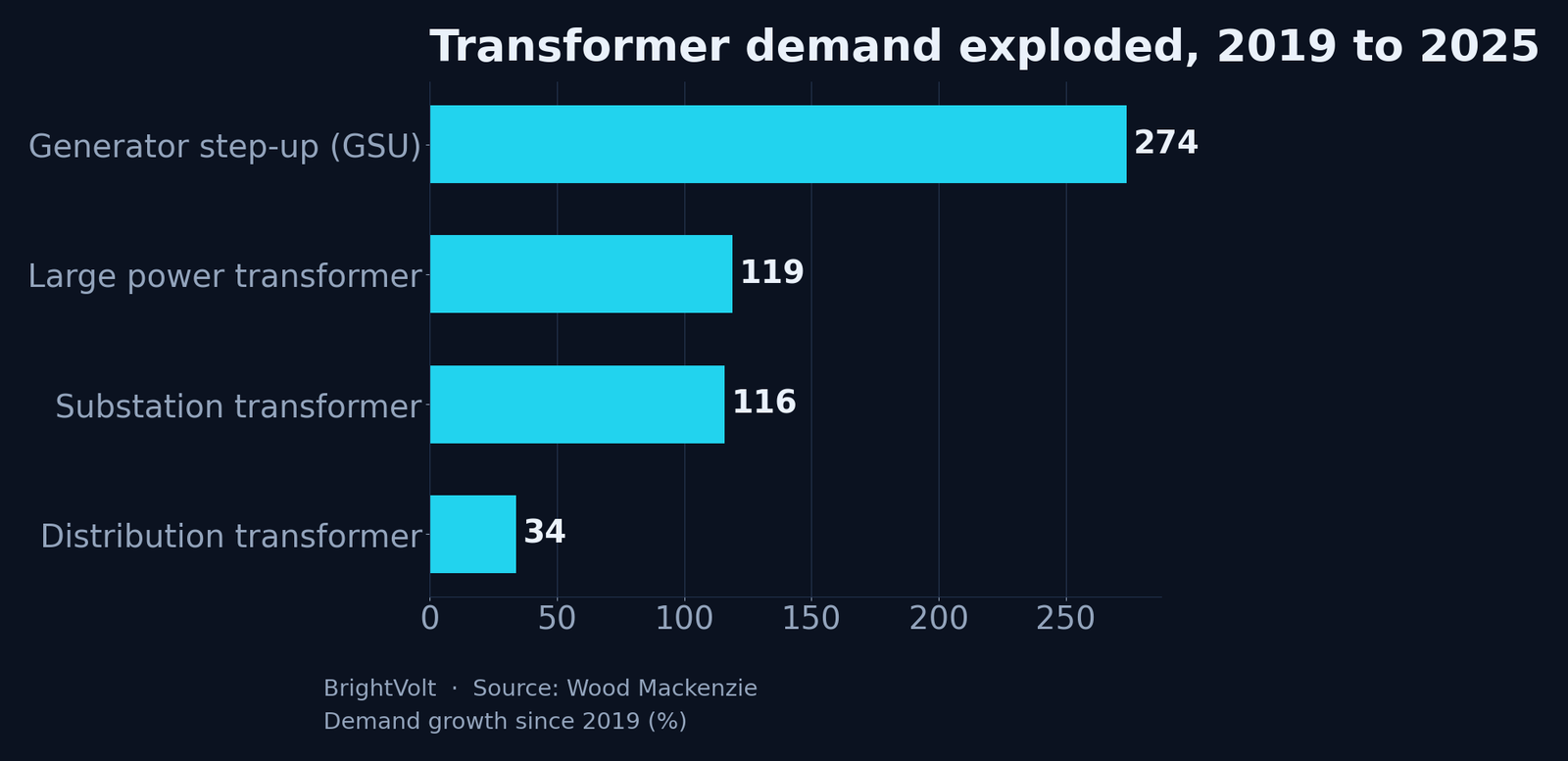
The demand curve tells the story. According to Wood Mackenzie, US demand for generator step-up transformers rose 274% between 2019 and 2025. Demand for large power transformers rose 119%, and for substation units 116%. This is what the AI-and-electrification boom actually looks like at the component level: not a debate about gas versus solar for data centres, but a queue for the same grey box regardless of what sits on either side of it.
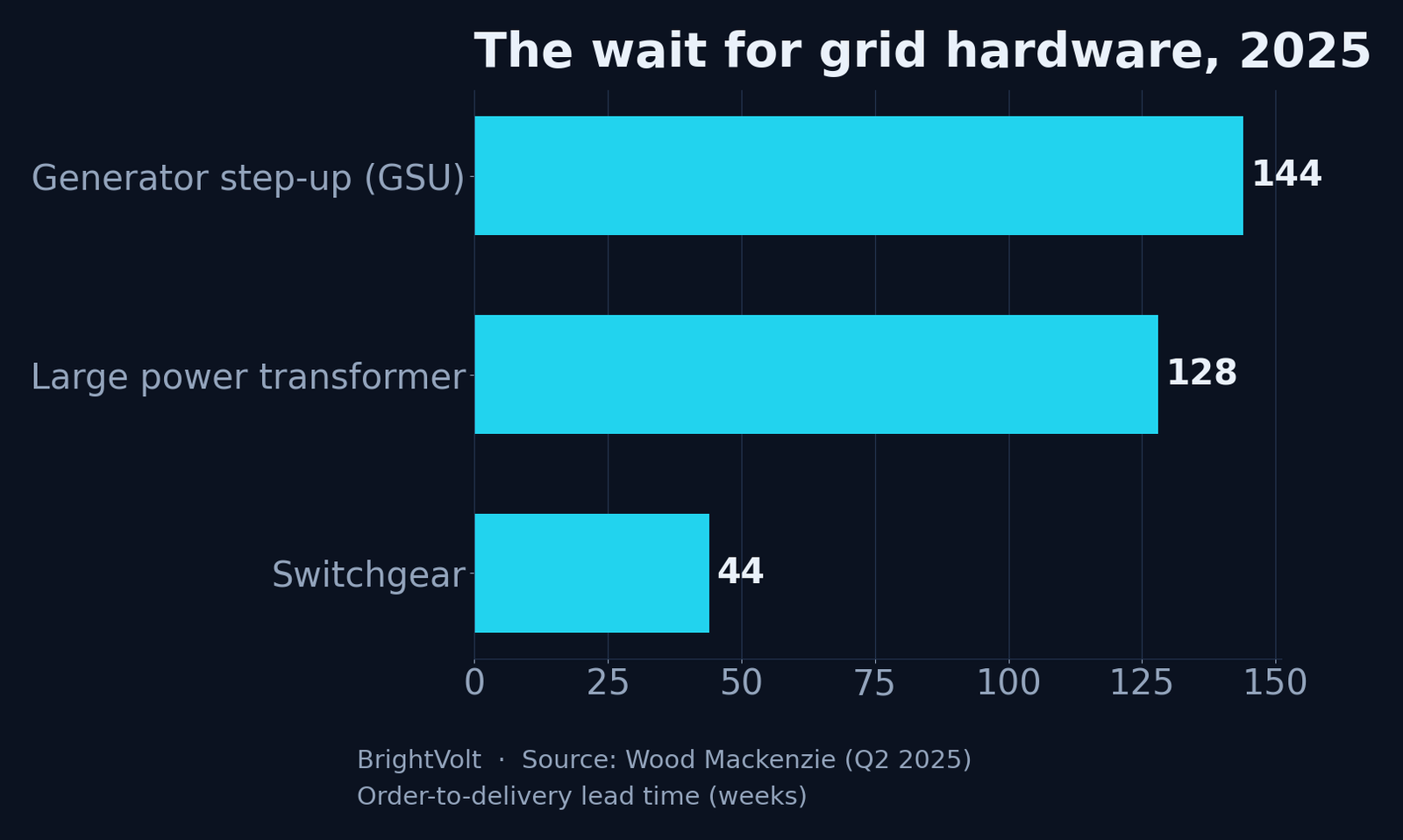
Supply did not follow. Lead times for a large power transformer reached about 128 weeks by mid-2025, and around 144 weeks — closer to three years — for a GSU. PwC puts the wait for the highest-capacity units at four years. Prices moved in step: large power transformers up roughly 77% since 2019, some distribution classes up as much as 95%. Wood Mackenzie estimated the 2025 market fell about 30% short of demand for power transformers.
| Equipment | Typical lead time, 2025 | Price vs 2019 | Demand vs 2019 |
|---|---|---|---|
| Generator step-up (GSU) | ~144 weeks | +45% | +274% |
| Large power transformer | ~128 weeks | +77% | +119% |
| Distribution transformer | shorter, ~30% short of demand | up to +95% | +34% |
A solar farm can be built in a year. If the transformer connecting it is quoted at three, the solar timeline is a fiction. The constraint has quietly moved from the thing everyone photographs to the thing nobody does.
Why a steel mill sets the ceiling
Here is the part that turns a supply squeeze into a structural problem. The magnetic core of every one of these transformers is made from grain-oriented electrical steel (GOES), a specialised alloy rolled so its crystal grains line up with the magnetic field to cut energy losses. It is difficult to make, and in the United States exactly one company makes it: Cleveland-Cliffs, at Butler Works, thirty miles north of Pittsburgh — roughly 250,000 tonnes a year from a single site. There is no domestic number two.
That would be a vulnerability even if the steel were world-class. It is not. Domestic GOES tops out around 920 mm wide while the market increasingly wants 1,000 mm and above, and in distribution transformers it loses up to 39% more energy than the grain-oriented steel Japan’s Nippon Steel and JFE produce, because US mills cannot run the groove-etching and annealing steps that make the best grades. So buyers import the better metal: US transformer-core imports grew more than fourfold, from $126 million in 2018 to $524 million in 2025, and GOES prices doubled between 2020 and 2024.
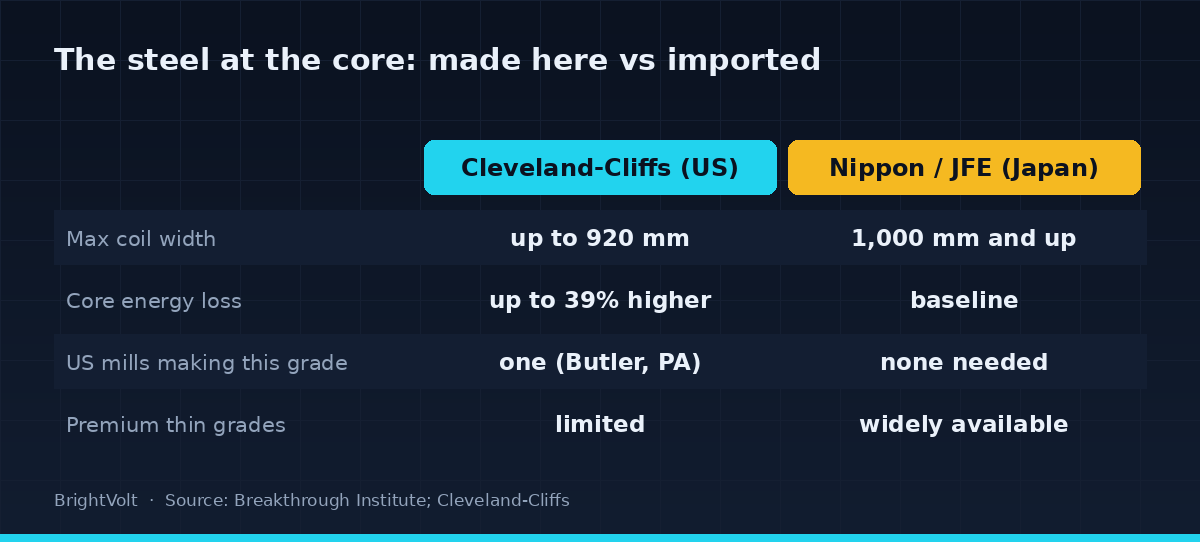
Read those two facts together and the picture is bleak in a specific way. The country imports 82% of its finished large transformers — a Department of Energy inventory found 617 of 754 units in the fleet were foreign-built — and the domestic industry that is supposed to replace them depends on a single mill making a grade the market has moved past. This is not a shortage you buy your way out of in a quarter. It is a supply chain with a chokepoint at both ends.
The strongest case that this is overblown
The serious rebuttal is worth stating in full, because parts of it are right. Patrick Tarver, a veteran of the transformer trade, argues there is no real shortage at all — that the two-year quotes come from “procurement blinders,” utilities bound by vendor-qualification rules and habit to a short list of incumbent suppliers, when standard substation units can be had in twelve to fourteen months from vendors they refuse to look at. And the market is responding: nearly $1.8 billion in North American capacity has been announced since 2023, led by Hitachi Energy’s billion-dollar Virginia plant, due to be the country’s largest by 2028.
Both points land, but neither reaches the core of the problem. Faster procurement genuinely helps for commodity distribution transformers — the ones that are, to a first approximation, catalogue items. It does far less for a bespoke 500 kV GSU that is semi-custom, tested for months, and expected to sit on a wire for forty years; there the qualification rigour is the job, not a bureaucratic tic. And the $1.8 billion of new plants is real but slow: a transformer factory that reaches production in 2028 does nothing for a data centre or a wind farm that needed its unit in 2026, and every one of those plants still winds its cores from the same constrained steel. Capacity arriving after the demand it was meant to serve is not a refutation of the bottleneck. It is the bottleneck.
What this should change
If the binding constraint is a manufactured object with a multi-year lead time, then the metric the industry loves — gigawatts installed per year — is measuring the wrong thing, again. A better one is order-to-energised time for the grid hardware, and it has been getting longer for most of a decade. Planning that does not put a transformer delivery date on the critical path is planning fiction.
It also reorders the policy list. Subsidising another generation record is cheap politics and does not touch the ceiling. Standardising transformer designs so utilities can pool orders, funding the right electrical steel rather than merely more of the wrong grade, and treating GOES capacity as the strategic asset it is would all do more for the 2030 grid than the next auction. The near-miss of the 2024 DOE efficiency rule — which at one point risked stranding domestic GOES in favour of a steel the US barely makes — is a warning about how easily this gets handled backwards.
We could be wrong, and here is the test. If lead times fall back toward twelve months and the import share drops below two-thirds as the announced plants ramp through 2027 and 2028 — without a fresh wave of data-centre demand swallowing the new capacity whole — then this was a transient shock and the market cleared it, as Tarver expects. If instead the queue of unbuilt clean capacity keeps growing while the transformers to connect it stay two years out, the constraint was never the panels or the politics. It was a grey box, and the steel inside it, that almost nobody was counting.
Photo by Diana ✨ on Pexels · Photo by Diana ✨ on Pexels