
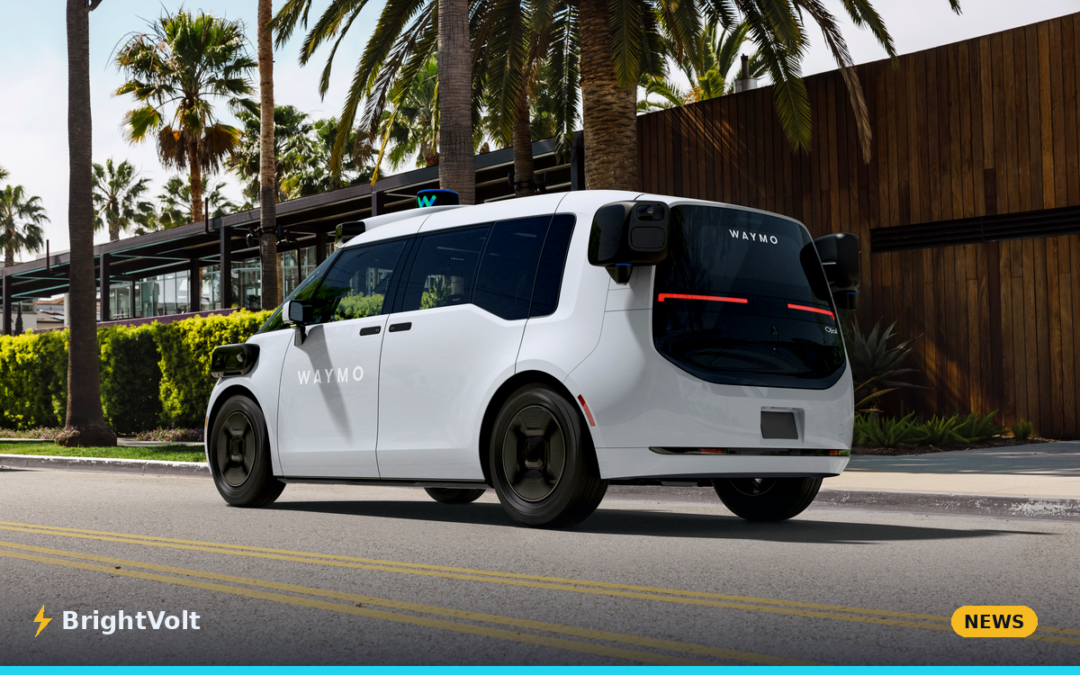
Americans cannot buy a Chinese electric car. Waymo has imported more than 3,200 of them. Alphabet’s robotaxi arm has brought over 3,200 Zeekr CM1e vehicles through the Port of Los Angeles, more than 2,600 of them this year, at a tariff rate that roughly doubles what each one costs. It keeps doing it at about 300 a month.
That looks irrational until you price the alternative. The tariff is not the obstacle in this story, and neither is the cost. The thing that actually ends this arrangement is a rule that has nothing to do with either.
What the tariff actually is
Two figures are circulating, and both are right about different things. The vehicle carries a 2.5% standard duty like any imported car, plus the 100% Section 301 rate applied to Chinese-built EVs. That is the 102.5% most outlets quote. Forbes puts it at 127.5%, adding a further 25% levy on strategic goods.
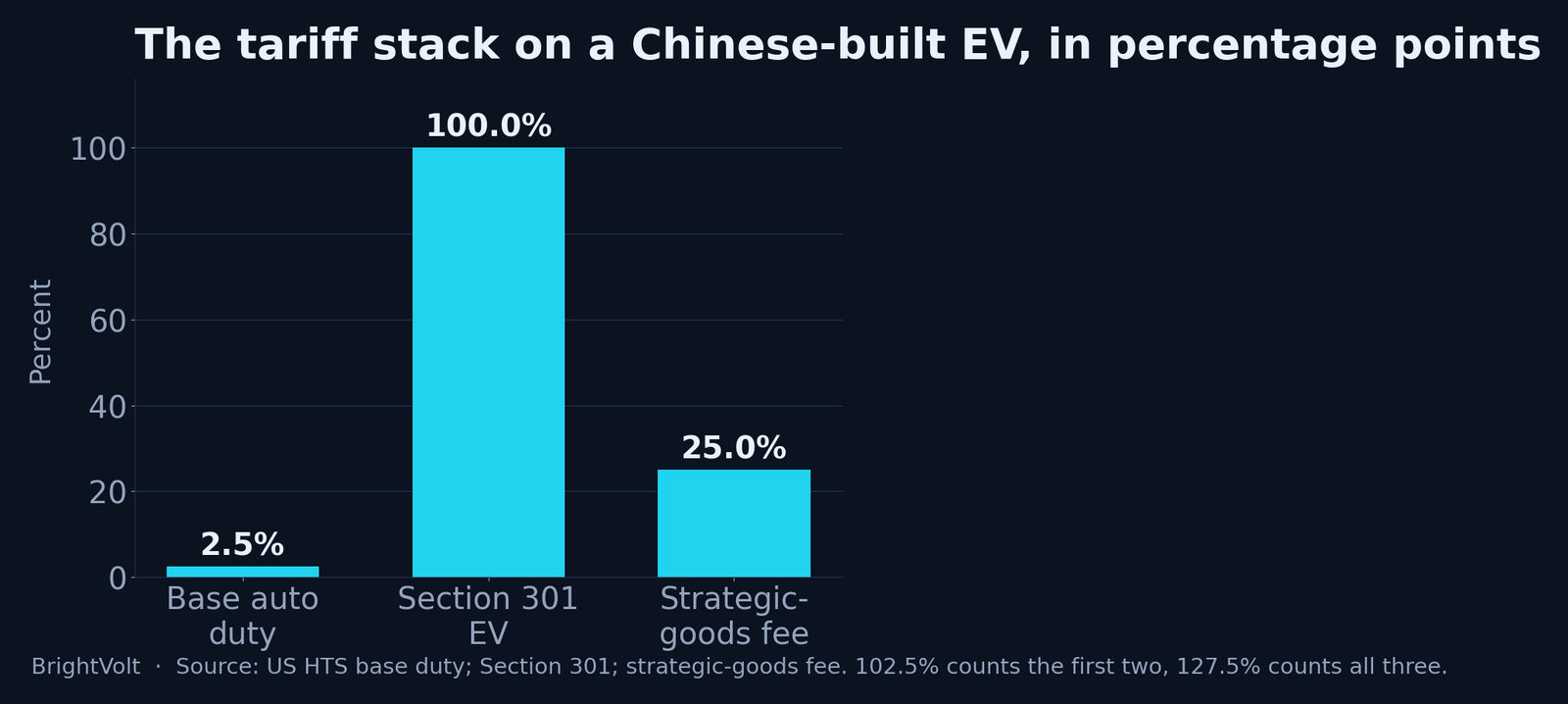
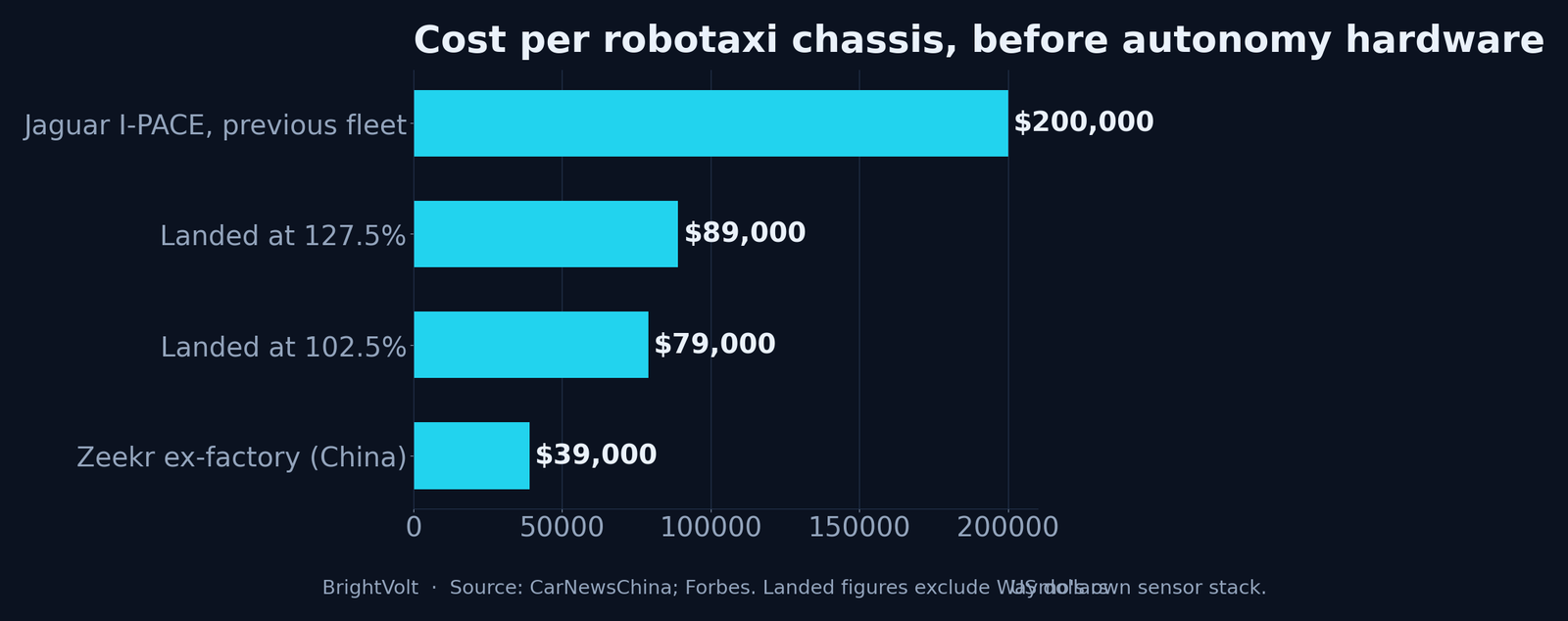
The arithmetic settles which is which. The CM1e leaves China at about $39,000. Multiply by 2.025 and you get $79,000; multiply by 2.275 and you get $89,000. Those are precisely the two landed figures being reported, so the disagreement is not about the car or the customs value — it is entirely about whether the strategic-goods layer applies on top. We cannot resolve that from public filings, so treat the landed cost as $79,000 to $89,000 and be suspicious of anyone quoting one number without the other.
Why Waymo pays it anyway
Because the vehicle it replaces cost more than twice as much. Waymo’s fifth-generation fleet ran on modified Jaguar I-PACEs at roughly $200,000 a unit. A Zeekr chassis at $89,000, plus a Waymo sensor and compute stack the company puts at $10,000 or more, lands somewhere near $100,000 — half the price, before counting the fact that the Zeekr was designed for this job and the Jaguar was adapted into it.
The CM1e — sold as the Ojai in Waymo livery — is a purpose-built robotaxi rather than a converted SUV: an 800V architecture, a 93 kWh pack, a single 200 kW rear motor, B-pillarless sliding doors and redundant drive-by-wire steering and braking. Redundancy is the part that matters. A car with no driver needs two of everything that can kill you, and retrofitting that into a production platform is harder than buying a platform built with it.
Nobody in North America makes this vehicle. That, not cost, is the honest answer to why a company under political scrutiny keeps importing from Geely.
How big this actually is
Scale explains why 3,200 vehicles is a strategic number rather than a curiosity. Waymo’s operating fleet stood at roughly 3,900 cars in July, still mostly Jaguars, across eleven American cities with four more being prepared and testing under way in Tokyo and London. Only around 300 Ojais are in service so far. The rest are inventory.
Put another way, Waymo has imported close to a full fleet’s worth of replacement vehicles while running a fleet of about the same size. That is not topping up. It is changing what the company drives, and doing it fast enough that the imports outpace the deployments by roughly ten to one.
The deadline that actually bites
The Commerce Department’s connected-vehicle rule took effect in March 2025 and phases in from model year 2027, prohibiting sales of connected vehicles by manufacturers owned by or subject to the direction of China or Russia. Hardware import restrictions follow for model year 2030. Waymo already imports the Zeekrs stripped — no sensors, no compute — and fits its own stack in Mesa, Arizona, which is how the current fleet stays on the right side of the software provisions.
The wrinkle is the word sales. Waymo does not sell these cars to anyone; it operates them. A rule written around vehicle sales does not obviously reach a fleet nobody buys, and legislation is now moving in Congress specifically to close that gap. Read the import surge in that light and it stops looking like defiance and starts looking like stockpiling.
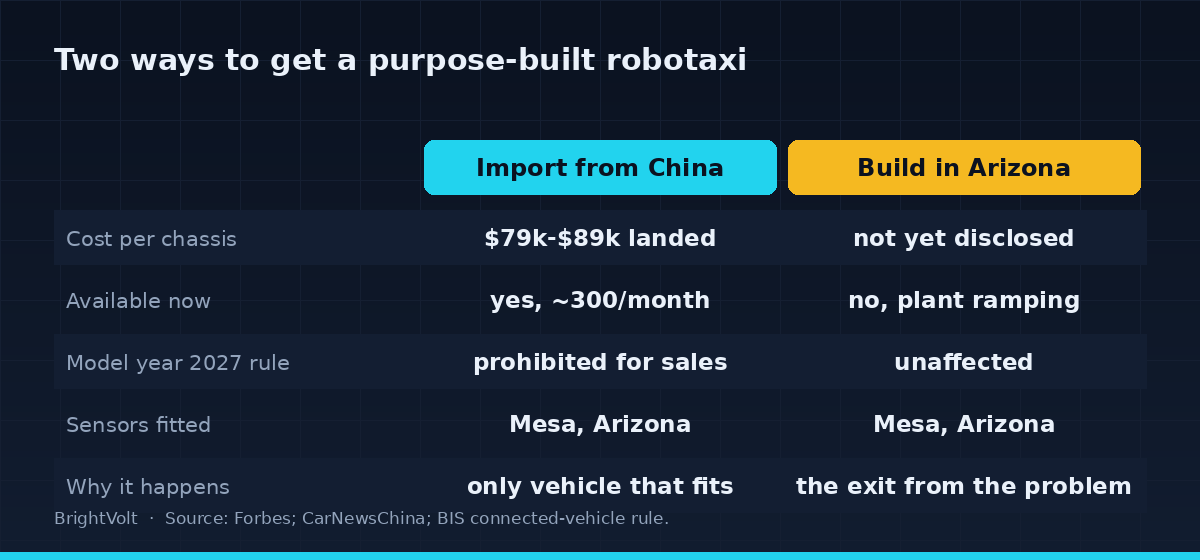
Waymo’s own exit is already under construction: a plant with Magna in Arizona to build robotaxis domestically. Every Zeekr landed between now and then is a vehicle that does not depend on how that rule is interpreted.
What this says about the wider market
There is a lesson here that generalises past robotaxis. The United States has made Chinese electric cars commercially impossible to sell and, so far, has not made the specific vehicles that some American businesses need. When a company wants a purpose-built electric platform — a robotaxi, a compact delivery van, a low-cost city car — the supply is Chinese, and a 100% tariff is a tax rather than a barrier. It changes the price; it does not change where the thing is made.
It is also the other half of a story we covered this week from the Chinese end: domestic demand there is falling while exports surge. Chinese factories have capacity they cannot sell at home, American buyers have needs no domestic factory meets, and a tariff sits between them changing the price without changing either fact.
That is also why the political heat is rising rather than falling. A tariff that a well-capitalised buyer simply absorbs has not done what tariffs are supposed to do, and the response to a tariff that fails is usually not a smaller tariff.
What to watch
Three things. Whether the import rate holds at roughly 300 a month as model year 2027 approaches, because a sharp acceleration would confirm the stockpiling read. Whether the Magna plant in Arizona starts producing, and at what unit cost — if a domestically built robotaxi lands anywhere near $89,000, the Zeekrs stop making sense on economics alone. And whether Congress passes a bill that reaches operated fleets rather than sold vehicles, which is the only change that would force the issue outright.
Until one of those moves, the position is stable and slightly absurd: the most visible American autonomous-driving company runs on Chinese cars, legally, at double price, because no one else builds what it needs.
Photo: Waymo