
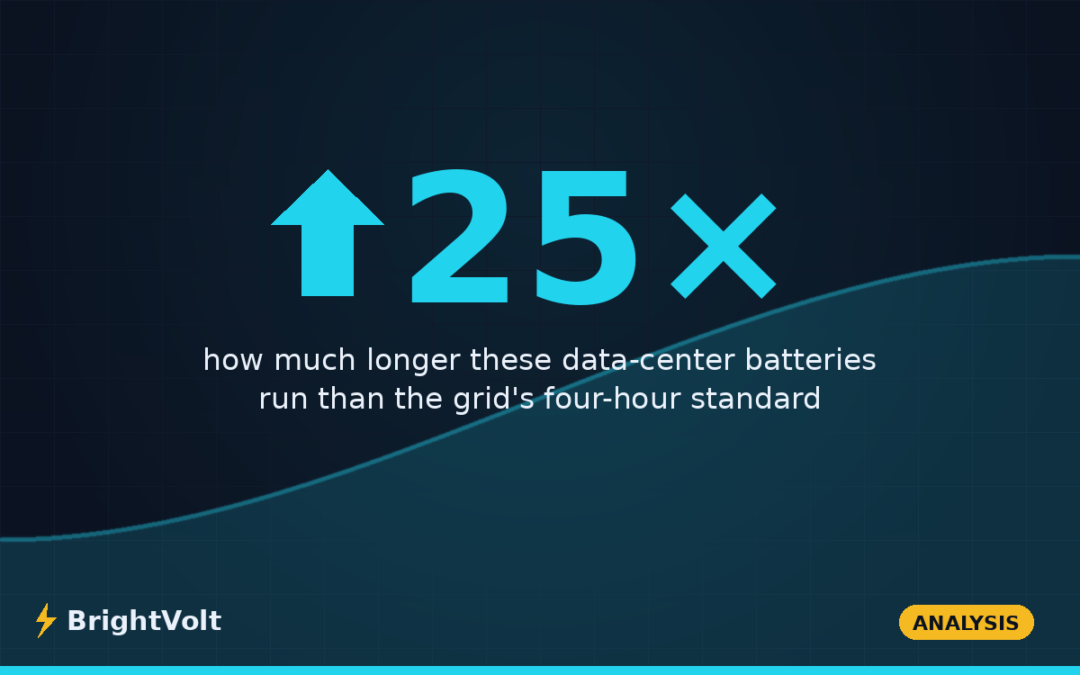
On 13 August, Noon Energy and Sabanci Renewables signed an agreement to build up to 1 GW — 100 GWh — of storage that discharges for more than 100 hours, and to aim all of it at AI data centers. This is not a bigger version of the battery already on the grid. The standard grid lithium pack runs for about four hours. This one runs for four days.
The number that matters in that deal is not the gigawatt. It is the ratio between the two durations, because it explains why a technology that has spent a decade looking for customers suddenly has one with a chequebook.
What Noon and Sabanci actually signed
The structure is a co-development agreement — Noon’s own release calls it a “strategic agreement”, trade coverage has called it a joint venture, and no separate entity has been announced. Sabanci Renewables brings project development, capital and an ERCOT footprint of 790 MWdc of solar already operating or under construction in Texas; Noon Energy brings the cells. Projects will be sold as power purchase or capacity offtake agreements, co-located with new wind and solar, with the first deployments possible as early as 2027. The target over five years is a 1 GW / 100 GWh fleet.
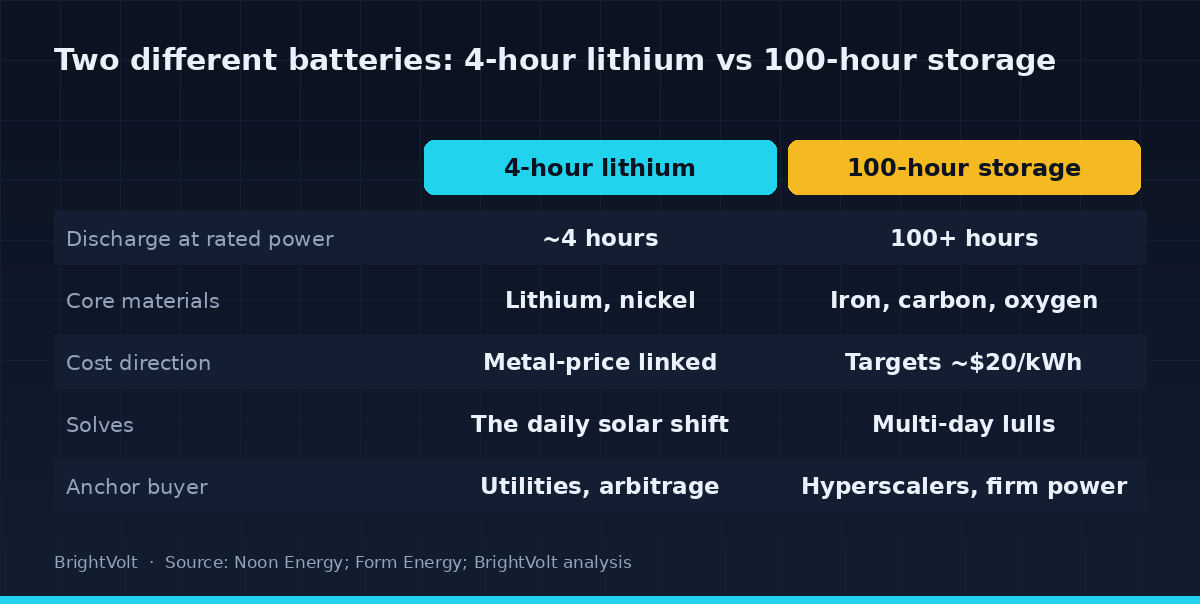
Noon’s cell is the unusual part. It is a carbon-oxygen battery — a reversible solid-oxide cell that, on charge, uses electricity to split carbon dioxide into solid carbon and oxygen, then recombines them on discharge to give the electricity back. The active ingredients are carbon and air, not lithium and nickel. In January the company said it had run a 100-hour cell for months and measured more than 200 hours of capacity, and it is targeting \$20 per kilowatt-hour — an order of magnitude below lithium’s energy cost. CEO Chris Graves claims the pack is five to fifty times more energy-dense than rival long-duration systems, small enough that a 150 MW data center’s storage would occupy a fraction of the lithium footprint.
Those are the company’s own numbers, and a pilot is not a product. Nor, yet, is this a sale: unlike the Form Energy deals below, no power has been contracted here — the agreement is to develop projects and then sell them under PPAs. Sabanci is a real balance sheet betting the cell holds at scale, which is a stronger signal than another funding round, but it is still a bet on hardware that has not been built by the gigawatt-hour.
The battery utilities would not buy
Long-duration storage has never had a technology problem so much as a customer problem. Iron-air, flow, thermal and now carbon-oxygen cells have all demonstrated multi-day discharge. What they lacked was anyone willing to pay for it.
The reason is in how power markets pay. A wholesale market rewards a battery for arbitrage — buy cheap at midday, sell dear at the evening peak — and a four-hour lithium pack captures almost all of that spread. Pay for the fifth hour, or the fiftieth, and the market offers almost nothing back, because it prices energy and short bursts of capacity, not multi-day firmness. So the storage that got built was short, and the storage that could ride out a windless week stayed in the lab. Venture funding for long-duration storage fell 72% in 2025. The technology was maturing and the money was leaving at the same time, which tells you the barrier was never the physics.
A four-hour battery and a hundred-hour battery are not two points on one scale. They solve different problems and answer to different buyers.
Why the data center is the buyer
A hyperscaler values firm power in a way no wholesale market does. A data center that goes dark loses far more than the spot price of the electricity it missed, and it needs the same power at 3am in a February high-pressure system as at noon in June. It cannot wait years in an interconnection queue for the transmission to import that firmness, and it is running headlong into the same grid-hardware shortages as everyone else. Multi-day storage co-located with wind and solar is one of the few ways to manufacture round-the-clock clean power behind a single meter — and the customer is rich enough, and desperate enough, to sign the fifteen-year contract that makes the battery bankable.
That contract is the actual product. It converts a merchant-market gamble into an infrastructure asset with a known buyer, which is exactly the shift that let utility-scale solar scale on corporate PPAs a decade ago. The template is already being copied. Form Energy, whose iron-air cells also run for 100 hours, has signed the two largest multi-day deals on record — both for data centers.
| Deal | Technology | Power / energy | Duration | Customer | Status |
|---|---|---|---|---|---|
| Form Energy–Google / Xcel | Iron-air | 300 MW / 30 GWh | 100 h | Google (Pine Island, MN) | Contracted, Feb 2026 |
| Form Energy–Crusoe | Iron-air | 12 GWh | 100 h | Crusoe | Contracted, Mar 2026 |
| Noon Energy–Sabanci | Carbon-oxygen | Up to 1 GW / 100 GWh | 100+ h | AI data centers (ERCOT) | Agreement to co-develop, Aug 2026 |
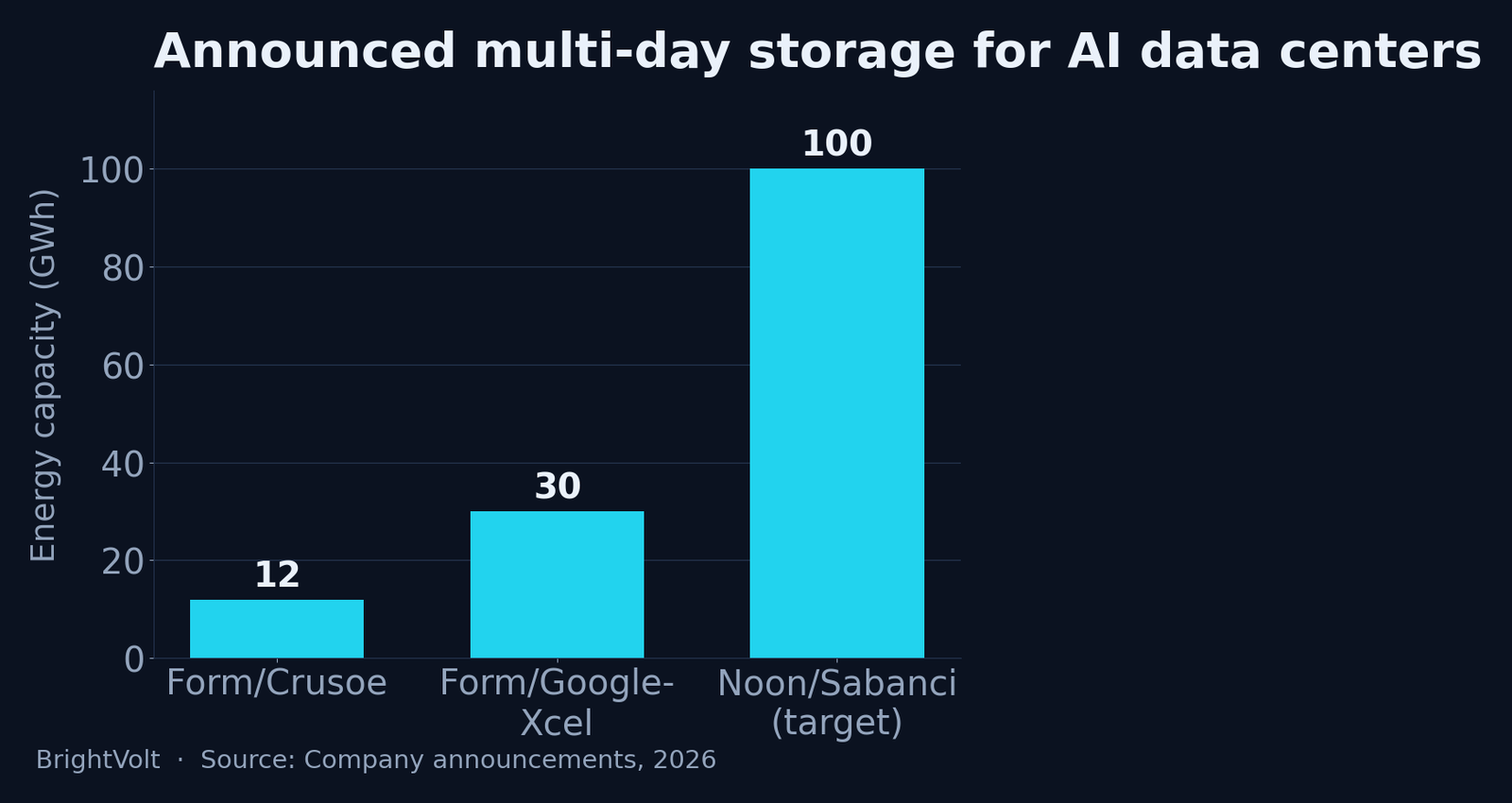
The Google project in Pine Island, Minnesota is the tell. It pairs a 300 MW, 30 GWh iron-air system — the largest battery yet announced by energy capacity — with 1,400 MW of wind and 200 MW of solar, and Google pays for the lot through its service agreement with Xcel. Form Energy calls it their first direct deployment for a data center. Six months later, the pattern has a third entrant using a different chemistry. That is no longer a one-off; it is a procurement channel.
What this leaves out
Two cautions keep this from being a clean victory lap. The first is that the megawatt-hours are being pointed at server halls, not at the grid everyone else depends on. This is private firmness, bought by the deepest-pocketed load on the system, at a moment when the public grid needs the same multi-day cover and no market is paying for it. If long-duration storage scales only where a hyperscaler is footing the bill, the grid gets the data centers’ leftovers, not a solved problem.
The second is that iron-air and carbon-oxygen are the Western, abundant-material challengers — and they are not what is actually being deployed at scale today. That title belongs to Chinese vanadium flow batteries, which make up the overwhelming majority of new long-duration installations, including a single 200 MW / 1,000 MWh plant in Xinjiang. The announcements stacking up in Texas and Minnesota are real, but they are still announcements. The gigawatt-hours are contracted, not commissioned.
Here is the test for whether this is a genuine turn. If, by the end of 2027, the Google, Crusoe and Noon–Sabanci projects are energised and delivering their rated multi-day discharge, and a market operator somewhere starts paying for multi-day capacity the way one customer just did, then the data center will have dragged long-duration storage across the line the grid could not. If instead these stay slideware while the flow batteries keep shipping from China, the buyer changed but the outcome did not — and the interesting question becomes why the cheapest energy storage on offer is being built on the wrong continent.
Photo by Heru Dharma on Pexels · Photo by panumas nikhomkhai on Pexels