
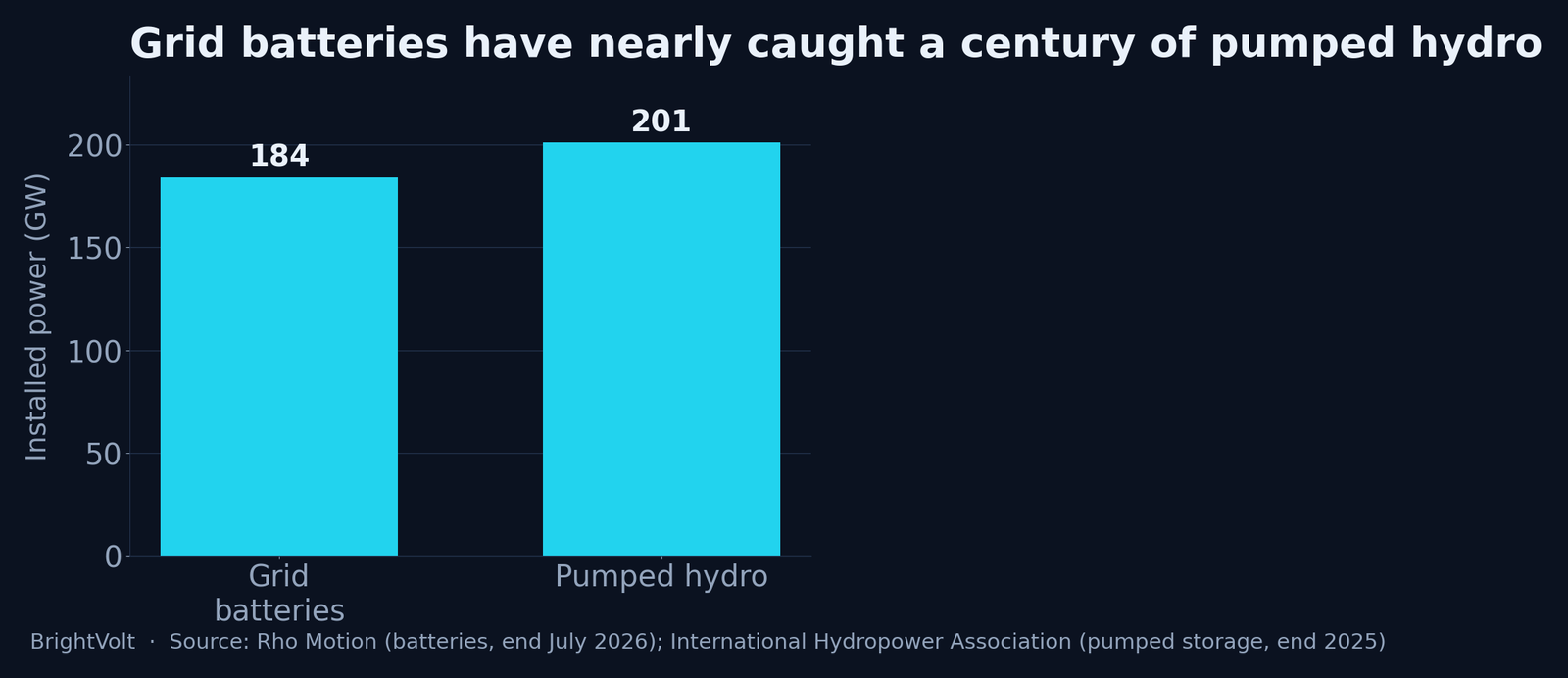
Grid-scale batteries reached about 184 gigawatts of installed power worldwide by the end of July 2026, according to Rho Motion’s monthly deployment database — within a decade’s-worth of catch-up of pumped hydro, the water battery that took a century to build to 201 gigawatts. On power, the race is almost over. On energy, it has barely started. And 70% of July’s additions went up in one country.
How grid batteries caught a century of pumped hydro
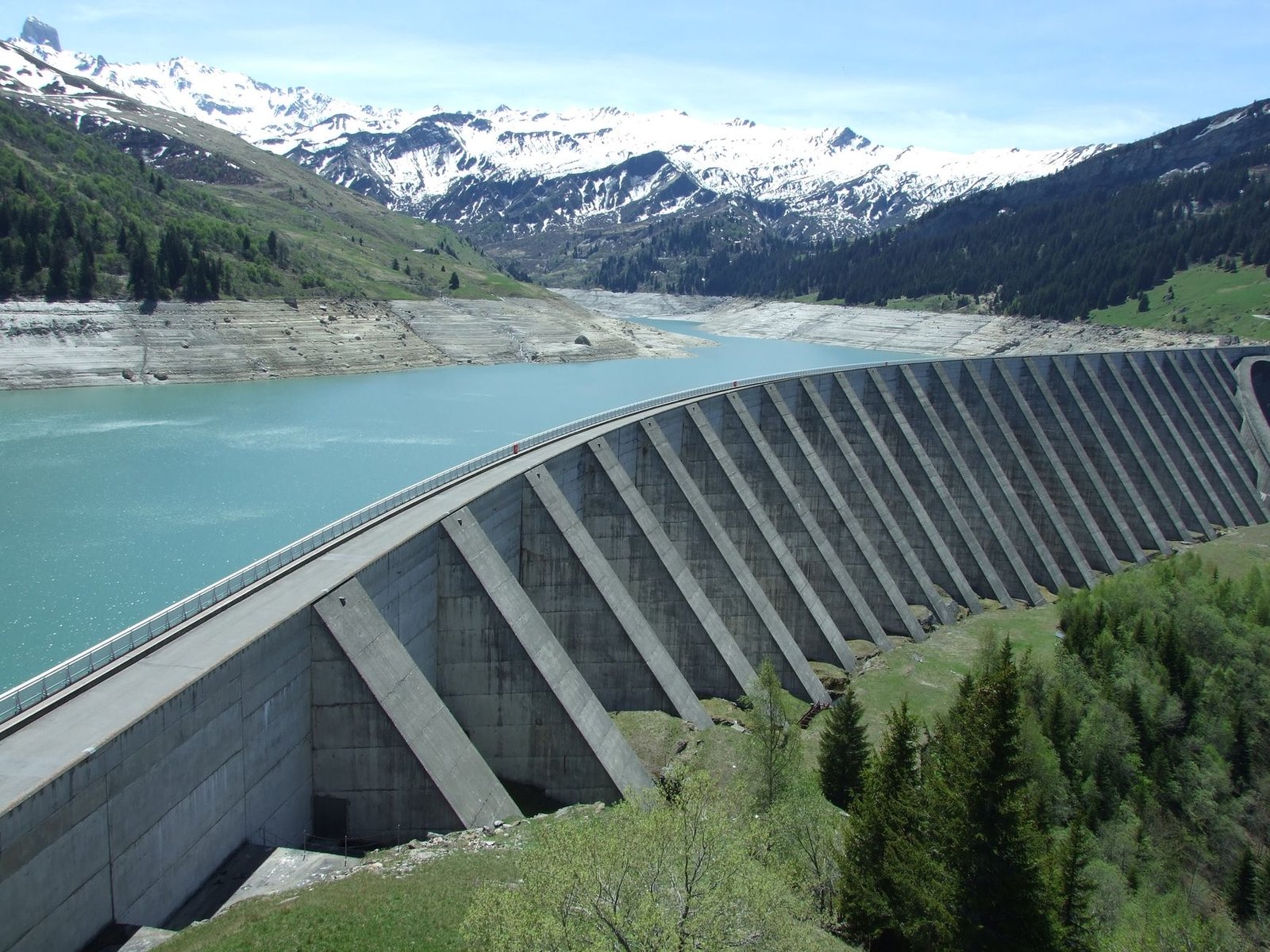
Pumped storage hydropower — pump water uphill when power is cheap, let it fall through a turbine when power is dear — was until recently the only form of grid storage that mattered at scale. It still holds the record for cumulative power: the International Hydropower Association put the global fleet at 201 GW at the end of 2025, having added a record 11.7 GW that year and crossed the 200 GW line for the first time.
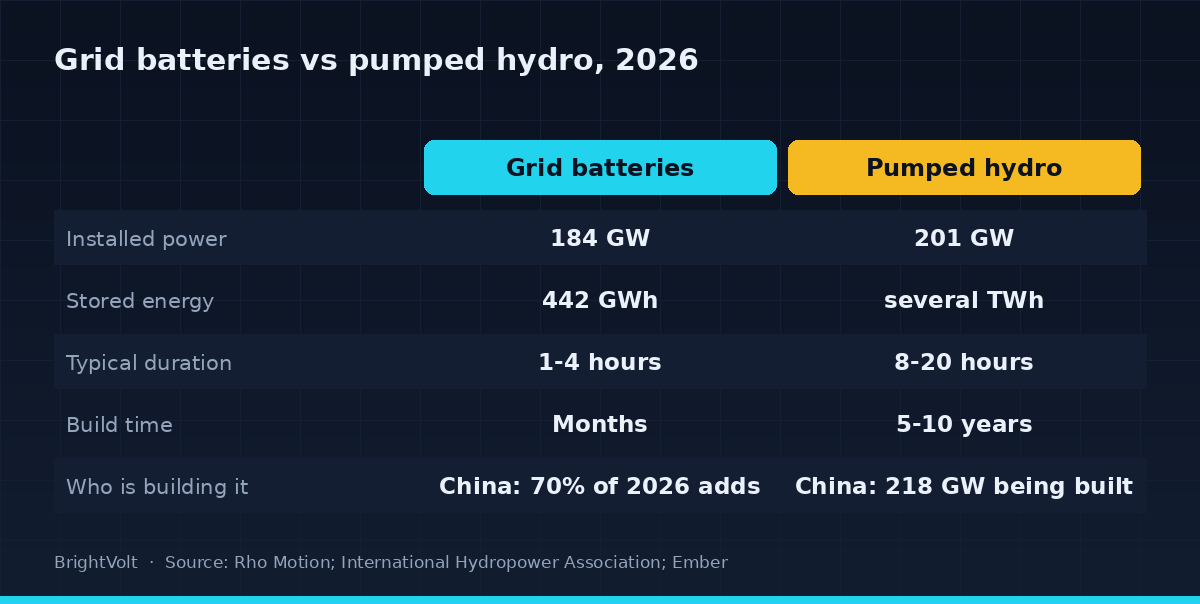
Grid batteries have taken about a decade to get within touching distance of that. Rho Motion’s tally has the world’s large-scale battery fleet at 184.4 GW and 442.2 GWh of energy as of end-July, with 18 GWh of new capacity coming online in July alone and the year-to-date total running 27% ahead of 2025. At that rate the two technologies cross on power inside a year — probably before this piece is twelve months old.
The speed is the part worth sitting with. A pumped-hydro scheme takes five to ten years to permit and build, needs two reservoirs at different heights and a mountain to put between them, and lasts fifty years once it exists. A battery site is a field of steel containers that goes from signed contract to first dispatch in months. One technology is geography; the other is manufacturing. Manufacturing scales faster, and it is scaling faster.
Why “batteries beat pumped hydro” is only half true
Here is where the headline needs an asterisk. Power is how fast a store can deliver; energy is how much it can deliver before it runs dry. The 184 GW battery fleet holds 442 GWh — a national average of well under three hours at full output. Pumped hydro stores far more: our own primer on the water battery puts the global pumped-storage fleet at several terawatt-hours, against the battery fleet’s 0.44. On the measure that a wind-and-solar grid actually strains against — days, not hours — pumped hydro is still an order of magnitude ahead, and will be for years.
So the two are not really competing for the same job. Batteries are the sub-four-hour instrument — they firm the evening ramp, ride out a cloud passing over a solar farm, hold the grid’s frequency in the second-to-second balancing that keeps the lights on. Pumped hydro is the multi-day buffer that carries a windless, sunless week. The build numbers say batteries are eating the short-duration role fast, because that is the role that pays today. They do not say batteries have solved the long one.
That distinction is not academic bookkeeping. It decides what a country has actually bought when it announces “200 GW of storage.” Two hundred gigawatts of four-hour batteries and 200 GW of ten-hour pumped hydro sound identical and are nothing alike, and a grid planner who treats them as interchangeable will discover the difference on the third still, dark day of a winter high-pressure system.
The build-out is almost entirely Chinese
Strip the global figures apart and one country does most of the work. China accounted for 70% of July’s 18 GWh, and it now holds more than half the world’s installed battery storage, up from just over 20% in 2021. In 2025 alone China added 189.5 GWh of what it calls “new energy storage,” roughly doubling its total in a single year, on figures compiled by Ember from the China Energy Storage Alliance and the China Electricity Council.
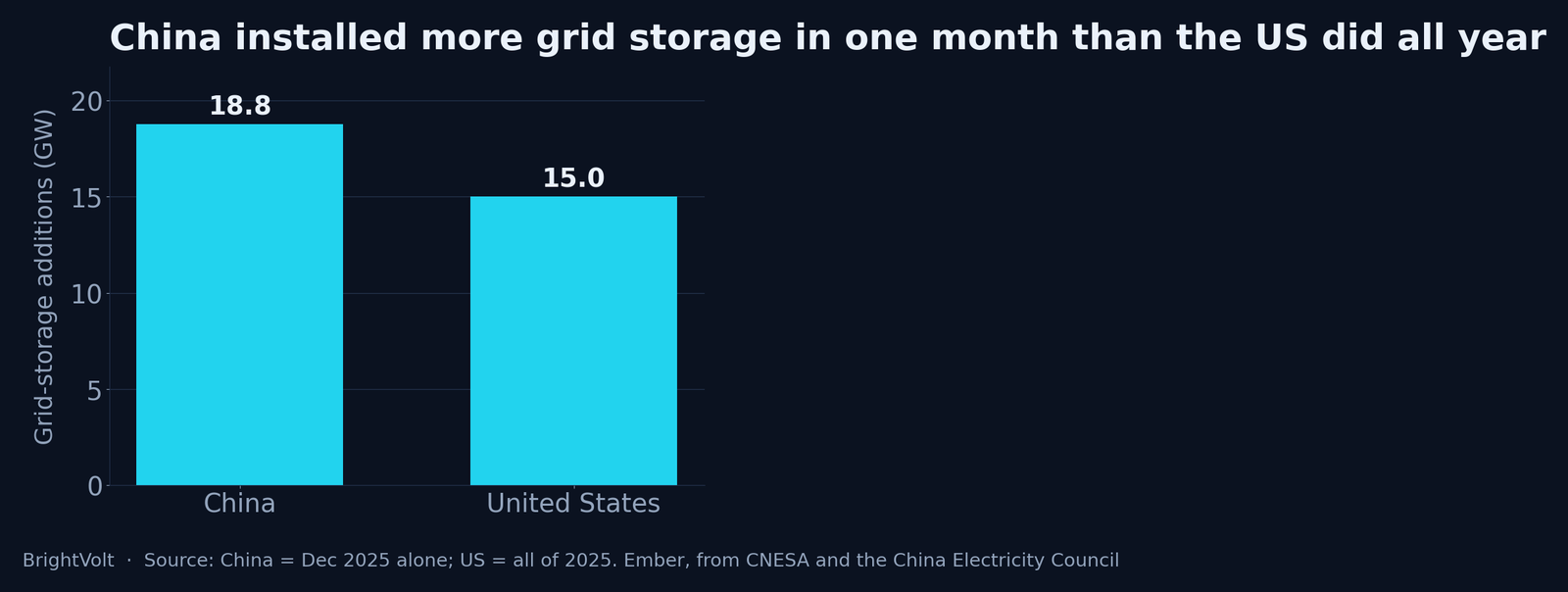
The comparison that lands hardest is with the world’s second-largest market. In December 2025, China installed 18.76 GW of grid storage. The United States installed about 15 GW in the whole of 2025. One country’s December beat the other’s year.
None of this is slowing. China’s updated 15th Five-Year Plan, published in June 2026, targets 300 GW of new energy storage by 2030 — more than the entire global battery fleet today, and it is a floor rather than a ceiling given the sector has beaten every previous plan. The same dominance runs through pumped hydro: the IHA counts 218 GW of pumped storage under construction in China, more than the rest of the world’s operating fleet combined. Whichever way you store electricity, the factory and the concrete are increasingly in the same place.
The United States, meanwhile, is walking the other way. Its storage build is real but a fraction of China’s, and the federal supports behind it are being pulled — the same tax-credit cliff now hanging over solar and wind, arriving just as the country tries to reshore battery manufacturing behind a tariff wall. A grid can buy cheap Chinese cells or it can build a domestic industry at higher cost, but the arithmetic of doing the second while withdrawing the subsidies that made the first affordable does not obviously close.
What to watch
The clean milestone is close enough to call: at the current pace, grid batteries pass pumped hydro on installed power within the next year, and the “batteries are now the world’s biggest grid storage” headlines will follow. Read them with the asterisk. They will be true on gigawatts and false on gigawatt-hours, and the gap between those two claims is the whole unsolved half of the storage problem.
The figure that would signal real progress is duration. If the average new battery moves from under three hours toward six or eight — as long-duration chemistries built for multi-day storage start shipping in volume — then batteries begin taking pumped hydro’s actual job rather than merely passing its nameplate. Until then, the honest way to read the 2026 numbers is that the world is building an enormous amount of short-duration storage, overwhelmingly in China, and calling it a victory over a technology that still does the harder thing better.
Photo by Griffin Wooldridge on Pexels · Photo by Heru Dharma on Pexels · Photo by ciboulette on Pexels