

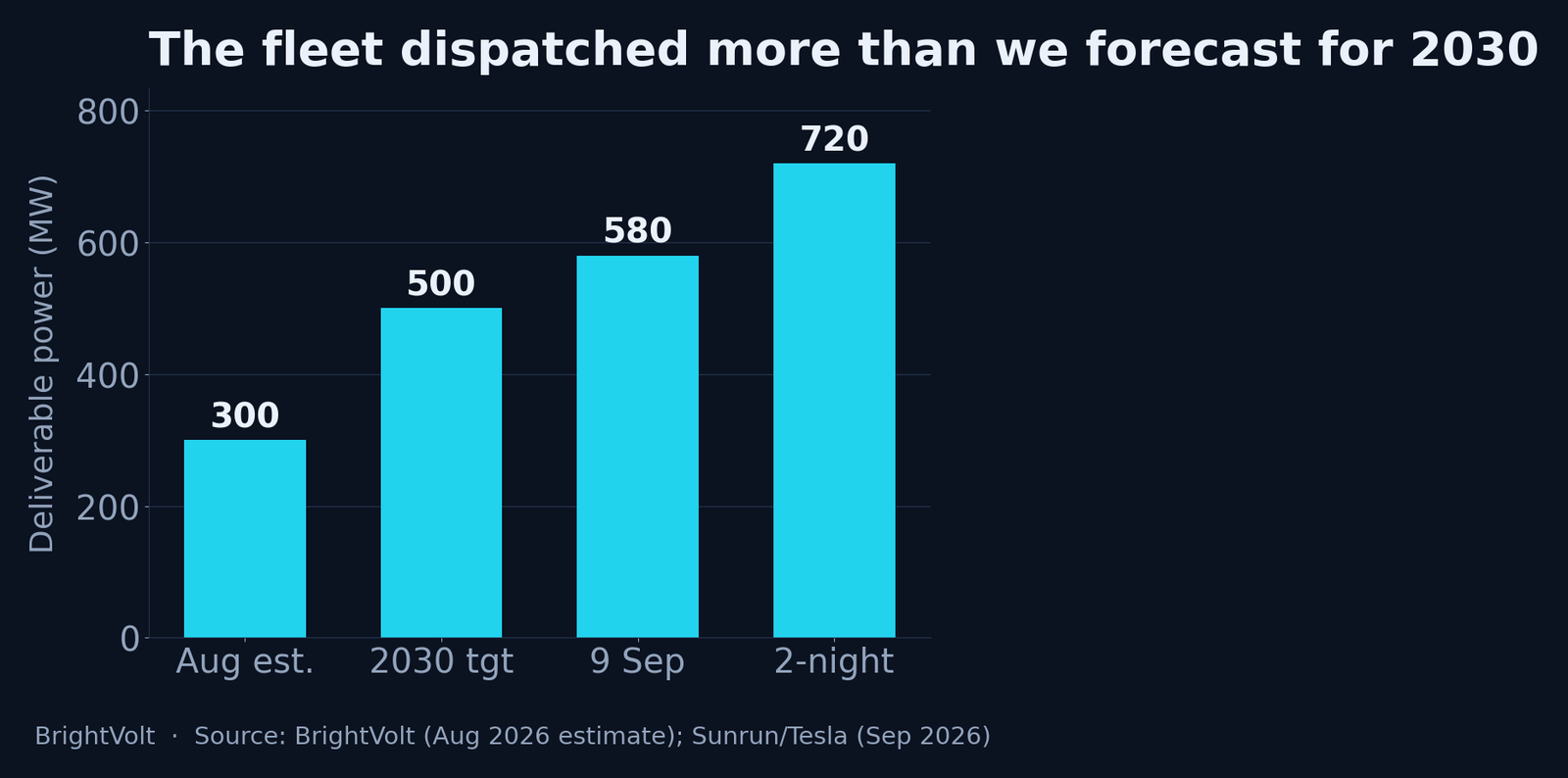
On 9 September 2026, Sunrun and Tesla dispatched 580 megawatts from roughly 140,000 home batteries into California’s grid during a heat wave — the largest residential virtual-power-plant event on record, and enough to match a mid-sized gas peaker. A month earlier, we put the same fleet’s real deliverable at about 300 MW. The record beat our number, and it beat the programme’s own 2030 target four years early.
That is an uncomfortable thing for a publication to write, so we will be precise about what we got right and what we got wrong. We said the “16.8 GW” that headlined this virtual power plant was not sixteen gigawatts of dispatchable power, and the 9 September event does nothing to rescue that figure. But we also implied the deliverable was a rounding error against it, and 580 MW is not a rounding error. It is a power station’s worth of electricity that nobody had to build.
What 580 megawatts actually was
The dispatch ran for a three-hour evening window on the worst day of a September heat wave, coordinated through two California programmes: the Energy Commission’s Demand Side Grid Support scheme and the Public Utilities Commission’s Emergency Load Reduction Program. Wholesale prices had climbed past $200/MWh, which is the condition under which paying a household for the energy in its wall becomes cheaper than firing a peaker. Of the 580 MW, about 517 came from 110,000 Tesla Powerwalls and 63 MW from a further 30,000 batteries of other makes. The next evening the fleet added 140 MW more.
Divide it out and each home gave back roughly four kilowatts. That is the number the “virtual power plant” language obscures. A Powerwall 3 is rated at 11.5 kW; a household running one into a VPP is not emptying it at full tilt, because the owner still wants backup, the batteries sit at different states of charge, and a three-hour call is limited by stored energy as much as by inverter power. Five hundred and eighty megawatts for three hours is about 1.7 gigawatt-hours — real, but a window, not a wall socket that stays open.

Why we said 300 and the grid got 580
Our August estimate came from the programme’s own near-term figure, and the behind-the-meter reading behind it still holds: the 16.8 GW folds in more than eight million smart thermostats, and a thermostat shifts load rather than supplying power. The battery share was quoted as rated capacity plus an hour of peak load-shifting — a theoretical maximum. Against that, the operator’s stated deliverable was around 300 MW now, rising to a planned 500 MW by 2030.
So why did the grid see 580? Three things we underweighted. The enrolled fleet kept growing through the summer, so the denominator was larger by September than the figure we quoted. An emergency programme pays differently from a routine one — ELRP compensation is high enough to pull a deeper discharge out of each battery than a standard demand-response tariff would. And the dispatch spanned all three big investor-owned utilities at once, which the earlier single-programme numbers did not assume. None of that makes 16.8 GW real. All of it makes 300 MW too cautious. The mechanism we described was right; the coefficient we borrowed was low.
The number that still doesn’t add up
Set the record against the headline and the gap is the whole story. A 580 MW dispatch is about 3.5% of the 16,800 MW the programme puts on its own front page, and about 1.1% of the 52 GW all-time peak California’s grid has had to serve. Both readings are true at once, and keeping them straight is the entire skill. The 16.8 GW is a marketing number built by adding a battery’s rated capacity to a thermostat’s load-shift and calling the sum “capacity.” The 580 MW is a metered fact. One is what the fleet is worth in a press release; the other is what it did when the operator called and the price justified the call.
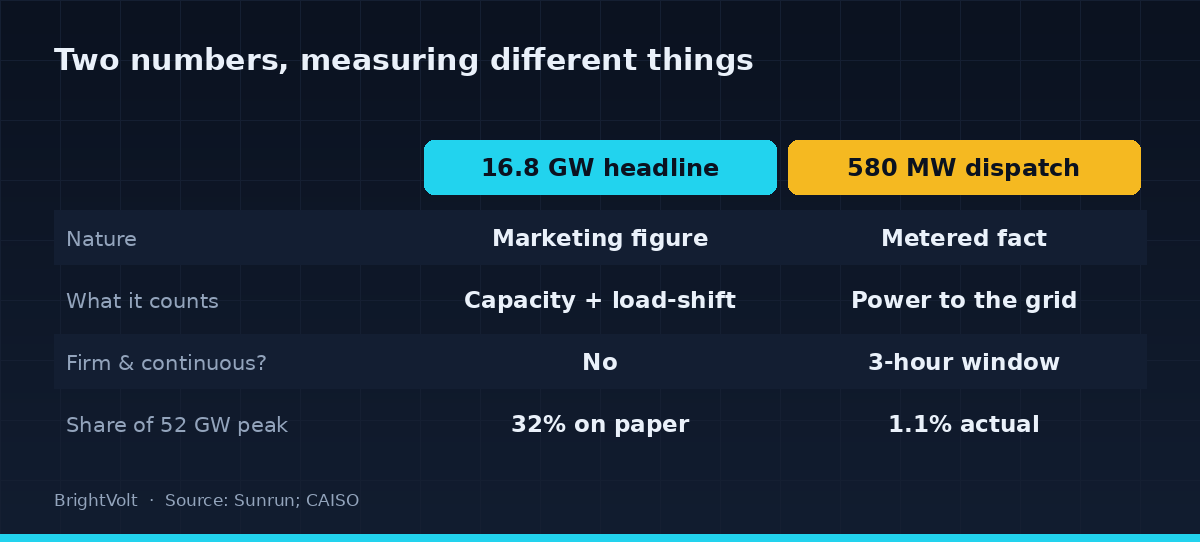
This matters beyond one company’s copy. Grid planners are being asked to count virtual power plants as resources, and the unit they count in decides whether the lights stay on. Count the headline and you have penciled in fifteen gigawatts that will not arrive on the evening you need it. Count the dispatch and you have a peaker you did not pay to build. The second number is the one that belongs in a resource adequacy filing.
Peaker-class, not grid-scale — yet
The strongest case for the boosters is a good one. Sunrun’s Mary Powell said the fleet is “operating at a scale larger than many peaker power plants combined,” and on the megawatts she is right: a gas peaker runs 50 to 250 MW, and this beat several of them at once. It did so at close to zero marginal cost, on batteries already bolted to walls, needing no new land, no transmission and no permit. The Brattle Group puts the model’s net saving to Californians at $206 million by 2028. A coordinated 720 MW across both evenings would have covered the shortfall that forced rolling blackouts in 2020. This is not a toy.
But peaker-class is not grid-scale, and the difference is duration and reliability, not peak output. A gas peaker can run for as long as the gas flows; this fleet gave three hours before stored energy and homeowner reserves became the binding constraint. And the dispatch was rougher than the megawatt total suggests — a PG&E demand-response engineer described the sudden injection as a “shock to the system” and asked for a ramping curve next time. A resource that needs the grid operator to smooth its edges is a young one.
| VPP dispatch (9 Sep) | Gas peaker | |
|---|---|---|
| Peak output | 580 MW | 50–250 MW |
| Sustained duration | ~3 hours | Hours to days |
| Marginal cost to fire | Near zero | Fuel + O&M |
| New land / transmission | None | Sited, permitted |
| Ramp control | Needs smoothing | Dispatchable |
What would change our mind
The honest position is that we were directionally right and numerically timid, and the correction runs one way: the deliverable is climbing faster than the operator’s own roadmap. So here is the falsifiable version. If a VPP sustains 500 MW or more for four hours, repeatedly, across a whole summer rather than on two flagged evenings, it stops being a peaker substitute and becomes a resource a planner can lean on. If the ratio of dispatched megawatts to headline capacity climbs toward 20%, the headline stops being marketing. Watch those two figures — duration and realized fraction — and ignore the gigawatt on the banner. On 9 September the fleet moved our own number. The next thing it has to move is the clock.
Photo by Kindel Media on Pexels · Photo by Kindel Media on Pexels