
Batteries did not unlock “anytime solar” in 2026. The Ember report that coined the phrase found that this year’s battery build could shift 34% of new daily solar generation into non-sunny hours — up from 18% last year. But that number is a theoretical ceiling, the fleet meant to deliver it is running a third idle, and even at full stretch it closes solar’s daily gap, not its seasonal one. “Anytime” is the marketing. The report itself is more honest than its title.
What the 34% actually counts
Ember modelled hourly electricity data from 14 countries covering 82% of global solar, then asked a narrow question: if every gigawatt-hour of battery expected to be installed in 2026 — about 459 GWh, half again on last year — were used to move solar from the middle of the day into the evening and night, how much of the year’s new solar could it shift? The answer was 34%, against 18% for 2025’s build. That is the number the headlines ran with.
Read the sentence that follows it in the report and the claim shrinks. Ember calls 34% a “theoretical ceiling,” and adds that “not every battery is used to shift solar to non-sunny hours and many remain underutilised.” It is a measure of what the batteries could do if operated perfectly, against new solar only, in a single year. It is not a statement that a third of the world’s solar now runs after dark. The phrase “anytime solar” describes the ceiling. The grid lives well below it.
This is not a pedantic distinction. The gap between what a battery fleet can do and what it does is the whole subject, and Ember has already measured it — in the country that owns most of the fleet.
The batteries meant to deliver it are a third idle
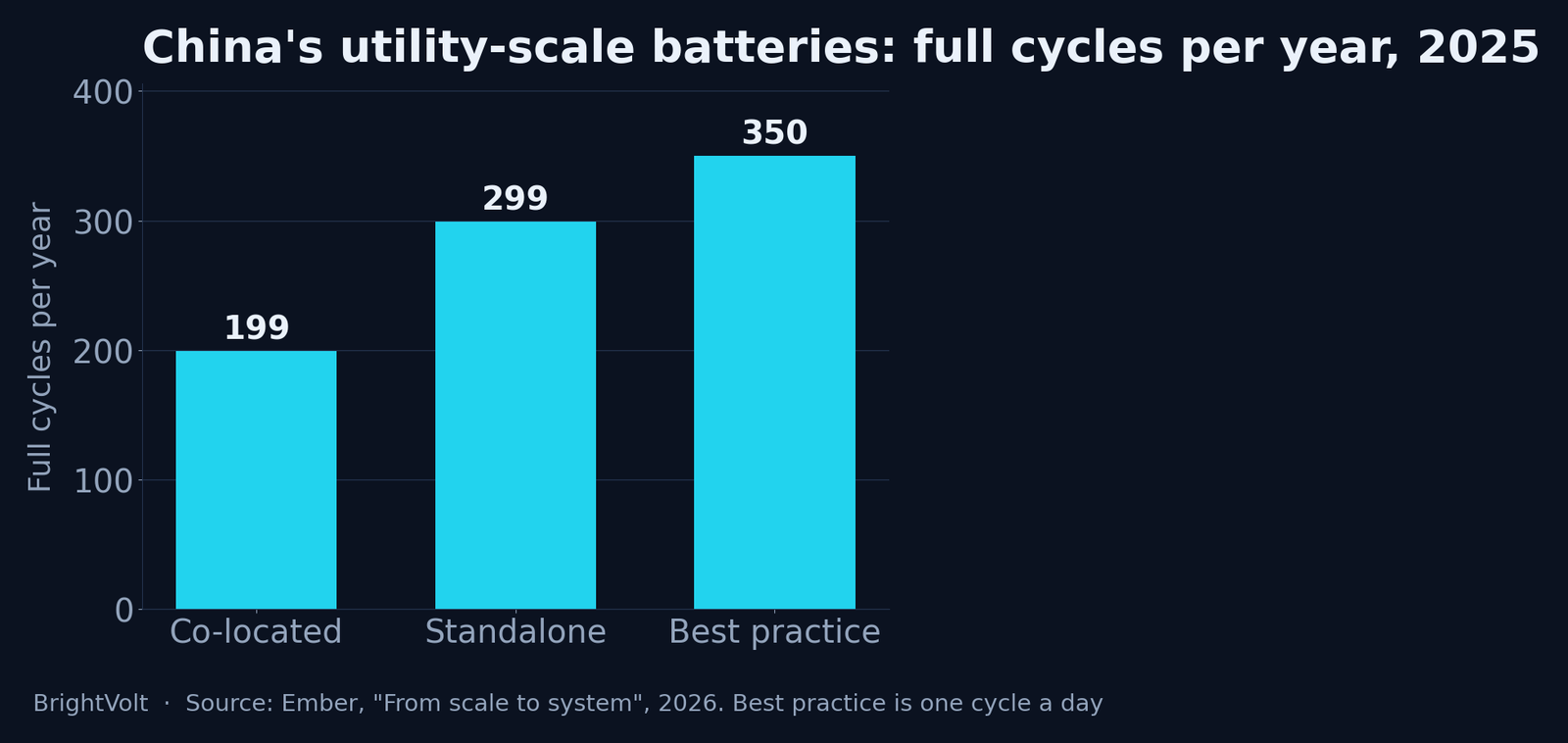
China finished the first quarter of 2026 with 155.2 GW / 400.8 GWh of new energy storage, nearly 150 GW of it lithium-ion — comfortably the largest battery fleet on earth. In 2025 it barely broke a sweat. Standalone systems averaged 299 full cycles for the year; batteries co-located with wind and solar managed 199. The benchmark for a storage asset earning its keep is roughly one cycle a day, about 350 a year. China’s co-located fleet ran at little more than half of that.
Ember’s own arithmetic on the waste is stark: run the existing fleet at the 350-cycle benchmark and it “could have shifted an extra 23.0 TWh of renewable energy to peak demand hours” in 2025 — enough, the report notes, to power Singapore for five months. That is not a shortfall of batteries. It is a shortfall of use of the batteries already built, standing on the same ground the 34% ceiling is calculated from.
The cause is not mysterious, and it is turning. Until February 2025 China mandated storage alongside new wind and solar; developers bolted on packs to clear a permitting rule and then left them parked. Document 136 scrapped the mandate, and by early 2026 standalone projects built to trade — not to tick a box — were 84.7% of new installs. Utilisation is climbing as the fleet shifts from compliance asset to market asset. But that is the point: the ceiling was never the constraint. Getting batteries to run was, and a fleet built to a ceiling figure while cycling at 199 is the reason “anytime” is a forecast, not a status.
Even at full tilt, it is the daily gap
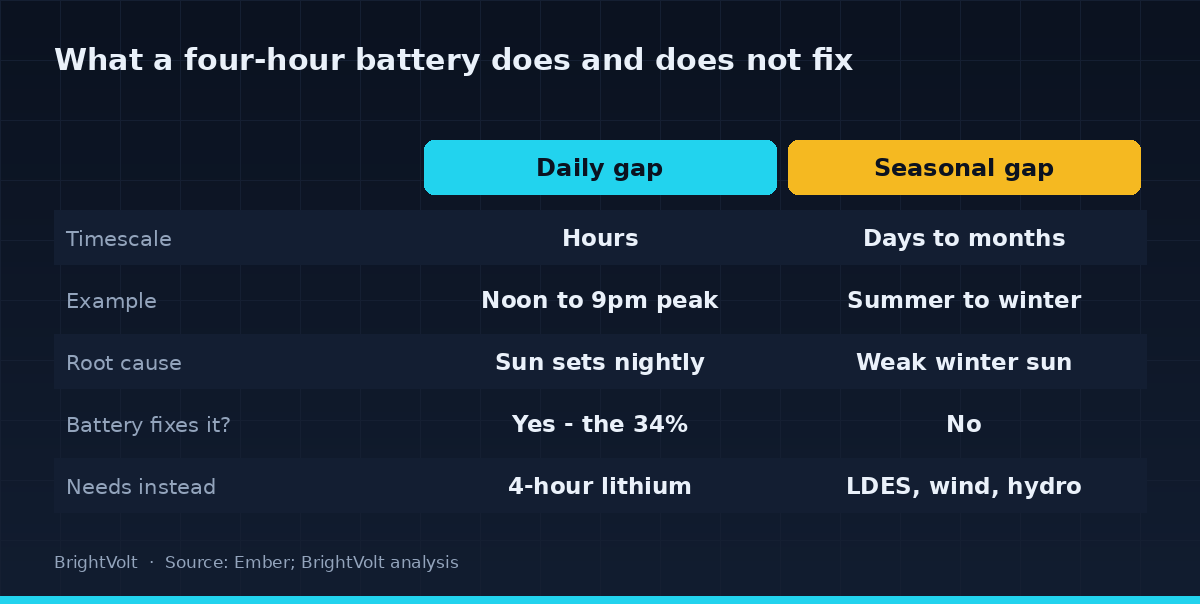
Grant the optimistic case its best hardware and its best dispatch — every pack cycling once a day, the full 34% realised. It still only moves sunlight a few hours down the clock. A four-hour battery discharged every evening solves the problem that solar stops at sunset. It does nothing for the problem that solar stops in winter. The distinction is one of power versus energy: four hours of lithium is plenty of gigawatts and very few gigawatt-hours, and a season-long lull is an energy problem that no amount of fast discharge can fix.
Ember says so plainly, naming Europe’s Dunkelflaute — the still, dark, windless spells that can sit over a continent for a week — as the limit a daily battery cannot cross. Shifting a sunny July afternoon into a July evening is a solved problem. Shifting a July afternoon into a January morning is not, and no amount of four-hour lithium changes that. That gap belongs to long-duration and seasonal storage, to overbuilt wind, to hydro and to firm capacity — technologies with their own unsolved economics, none of which “anytime solar” touches.
The two gaps get blurred precisely because the daily one is now so visibly closing. The distinction matters because the money does. A market that believes solar-plus-storage is “anytime” power will under-invest in the multi-day firmness the same grid still needs, and discover the shortfall on the coldest, darkest week of the year — the one week batteries were never going to cover.
The case for the optimists, in its strongest form
The bullish read is not wrong, and it deserves its best version. The reason 34% is even conceivable is a cost collapse that has no precedent in energy: installed battery-storage costs fell 95% between 2010 and 2025, from $2,634/kWh to about $140/kWh, on the IRENA figures Ember’s own report cites — and BloombergNEF put 2025 lithium-ion pack prices at a record $108/kWh, with stationary storage the cheapest segment at $70. Cheap enough that daily solar shifting now clears on economics alone, without a subsidy propping it up. And in the markets that got there first, the effect is real and measurable: in Bulgaria, batteries delivered 24% of evening demand in the first half of 2026, against almost nothing from solar three years earlier; in California, solar-plus-storage met over a quarter of the 7-to-9pm peak. Those are not ceilings. Those are meters.
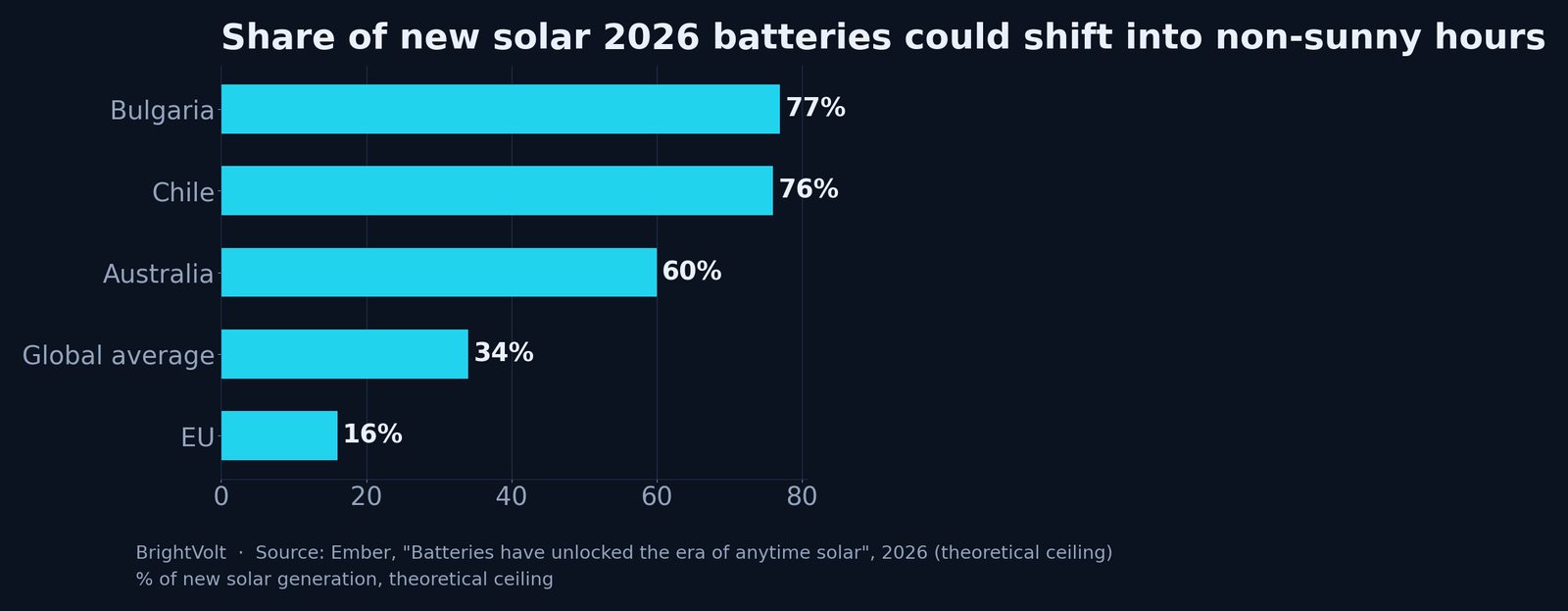
Two things stop that from rescuing “anytime.” The first is that the flagship markets are the exception that proves the scarcity — Bulgaria, Chile and Australia can shift 60 to 77% of new solar because they are sun-drenched and building storage fast, while the EU as a whole sits at 16% and the global figure only reaches 34% by leaning on China’s enormous, under-cycled fleet. The second is seasonality, which no cost curve erases. A cheaper battery shifts more hours. It does not shift more months.
What would change the read
This is a phrase getting ahead of a real achievement, not a fake one. The achievement — cheap batteries turning midday solar into evening power, on economics rather than mandate — is the most useful thing to happen to a solar-heavy grid, and it is the mechanism behind why more solar was earning less finally starting to reverse. Call it what the data supports: solar is becoming a strong evening resource, fast, in the sunniest places. That is worth more than the hype, because it is true.
The read flips the day two numbers move. If the global co-located fleet climbs from 199 cycles toward 350 — turning the 23 TWh of unused shifting into delivered power — then “anytime” starts describing dispatch rather than nameplate. And if a credible offtaker finally makes multi-day storage pencil out, the seasonal gap stops being the permanent asterisk on every solar-plus-storage claim. Neither has happened yet. Until they do, “anytime solar” is a ceiling with a marketing department, and the grid is still living underneath it.
Photo by Kindel Media on Pexels · Photo by Quang Nguyen Vinh on Pexels