
On 12 October, grid-scale batteries in New South Wales earned an estimated AU$5.63 million in about two hours as the wholesale electricity price spiked to AU$23,107 per megawatt-hour — a touch under the market ceiling. That is more than three-fifths of what every battery in the country earned across the whole previous week. It also arrived in a year when battery revenue is falling fast, and that is the part worth sitting with.
Both things are true at once. A handful of batteries can mint a quarter’s worth of money in an afternoon, and the fleet as a whole is earning less with every unit that connects. The spike and the slump are not a contradiction. They are the same mechanism seen from two ends.
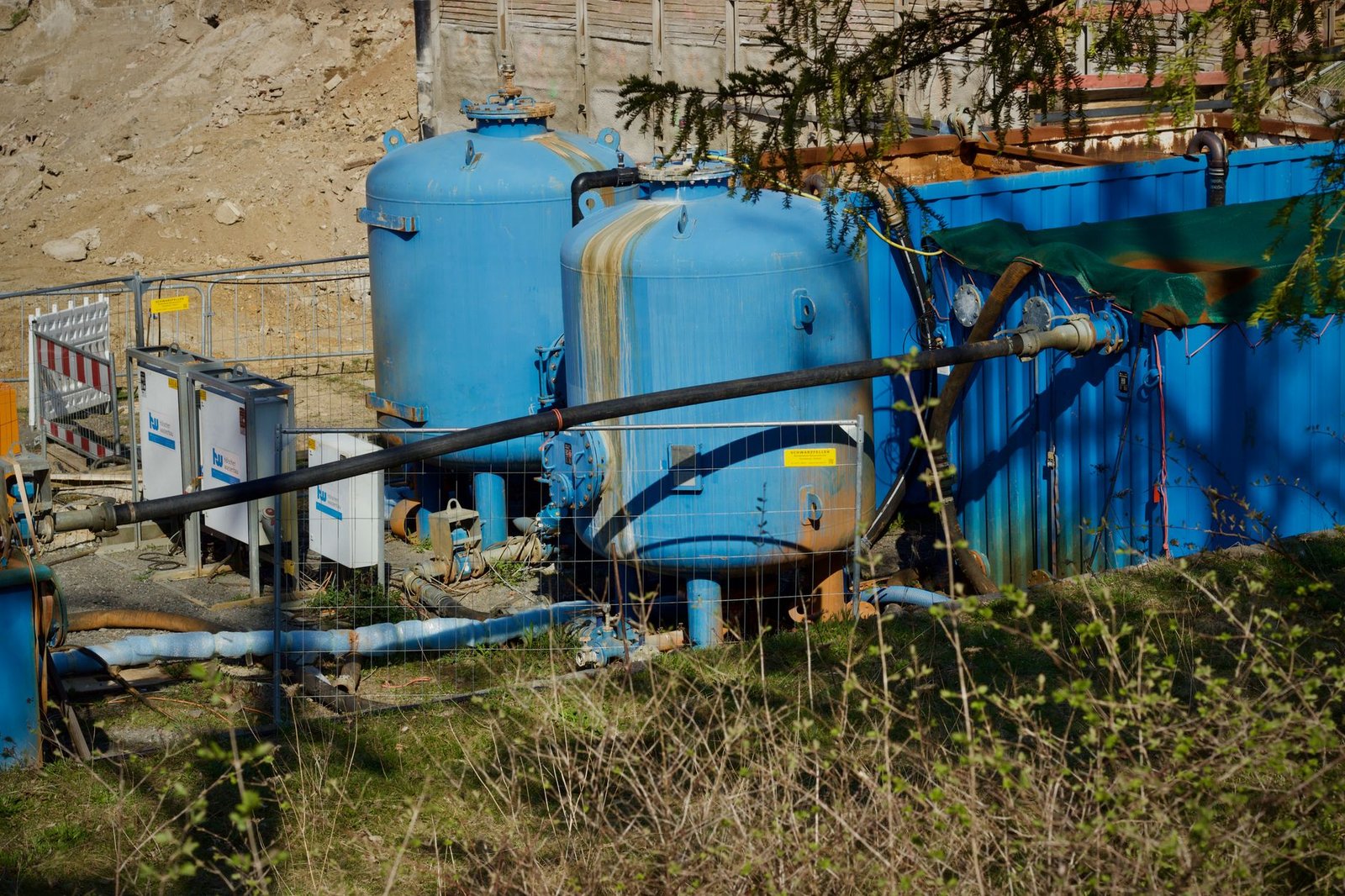
What NSW batteries earned in two hours
The event ran from roughly 14:10 to 16:05 on 12 October, when NSW demand jumped by close to 500 megawatts in a single five-minute interval and the price lurched between about AU$700 and AU$23,000/MWh from one interval to the next. The average across the window was AU$7,415/MWh. For context, the Australian Energy Market Commission lifted the market price cap to AU$23,200/MWh for 2026-27, so the peak that afternoon came within AU$93 of the highest price the market is allowed to set.
The revenue figures come from EnergyAustralia analyst Franz David Schaefer, who estimated each battery’s take from its dispatch targets rather than metered output — so treat them as well-informed approximations, not audited accounts. On that basis the NSW fleet earned about AU$47,000 a minute. ACEN’s two New England units led at a combined AU$1.82 million; the Waratah Super Battery, Origin’s Eraring battery and Akaysha Energy’s Orana site each cleared AU$850,000 or more. Of the 17 NSW batteries in the data, ten discharged into the spike, one was still charging, six sat idle, and one was offline.
Put that two-hour haul against the fleet’s ordinary earnings and the scale is almost absurd. Schaefer reckons the entire national battery fleet made around AU$9.1 million across the previous week; one state’s batteries took AU$5.63 million of that kind of money in 115 minutes. Victoria’s single best day all quarter was AU$2.42 million. A tenth of what every battery in the National Electricity Market netted over the previous three months arrived in one afternoon, in one state.
Why the quarter tells the opposite story
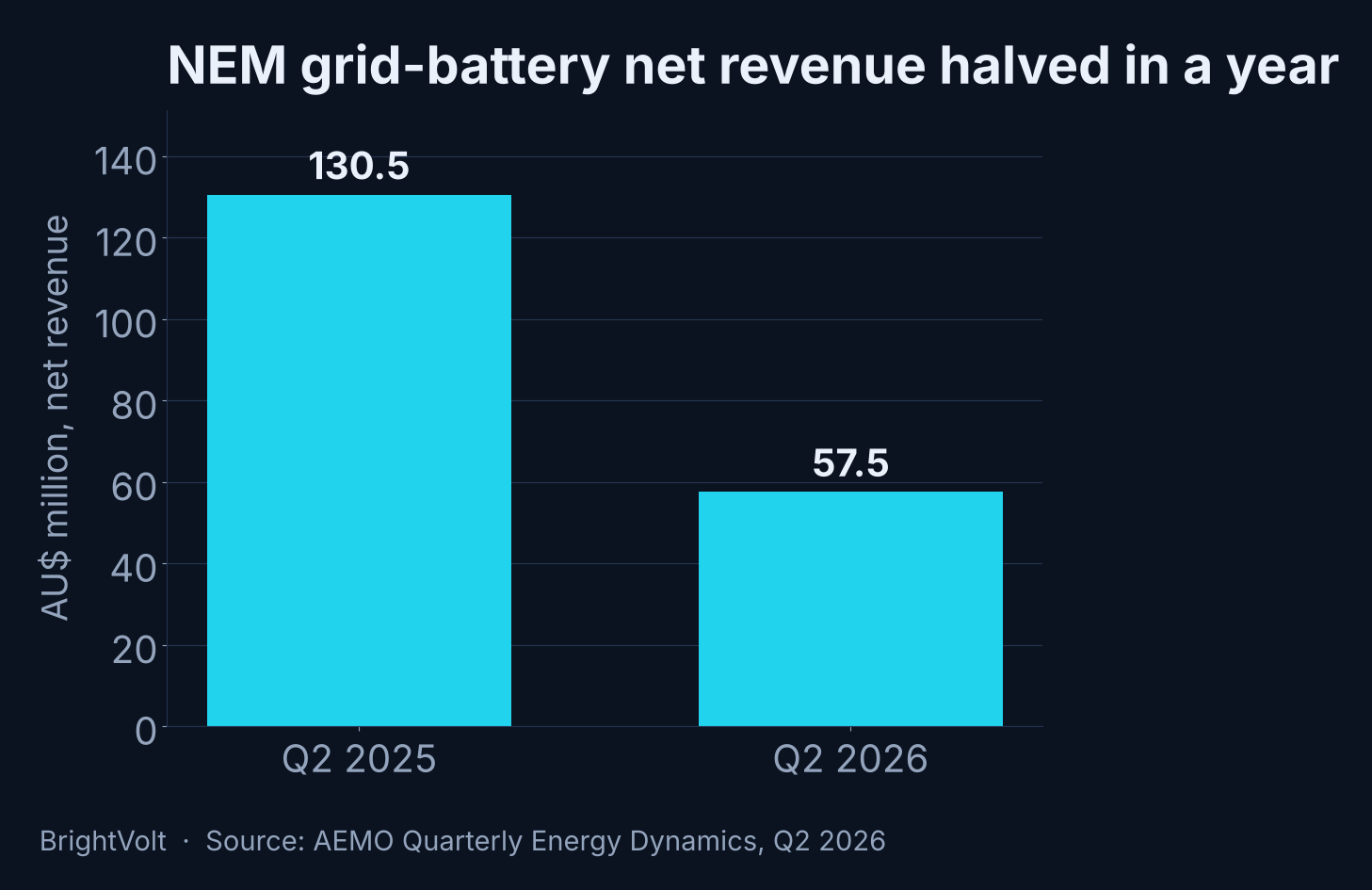
Zoom out and the picture inverts. The Australian Energy Market Operator’s latest quarterly figures put net battery revenue at AU$57.5 million for the second quarter of 2026, down from AU$130.5 million a year earlier. Revenue did not dip. It halved, a AU$73 million fall in twelve months, even as the grid-scale fleet passed 9,000 megawatts for the first time. More batteries, less money.
The driver is the price spread — the gap between the cheap hours a battery charges in and the expensive hours it sells into. That spread averaged AU$51/MWh in the quarter, down 85 percent from AU$342/MWh a year earlier. Energy arbitrage, the daily buy-low-sell-high trade that is now the fleet’s main business, brought in AU$52.8 million, off 56 percent. Frequency control — the fast-response grid-balancing service that was the first big battery’s original money-maker — managed AU$4.8 million, down 51 percent, and now accounts for barely 8 percent of the total.
That collapse is not a market failing. It is a market working. A battery makes money on the difference between the evening peak and the midday trough, so it charges when solar has pushed prices to the floor and discharges when the sun drops and demand climbs. Every battery that does this flattens the curve a little: buying in the trough lifts the floor, selling into the peak caps the ceiling. Do it with 9,000 megawatts of batteries and the spread they all depend on narrows toward the cost of a round trip. The fleet is eating its own lunch, and there are more diners every quarter.
The volatility batteries both need and destroy
This is the squeeze in one line: batteries earn on volatility, and deploying them at scale is the most effective way yet found to kill it. Everyday arbitrage is being competed away. What cannot be competed away, at least not yet, is the rare, violent event — a demand surge, a generator trip, a still evening after a cloudy day — that no amount of routine storage fully smooths. On those days the price runs to the cap and the batteries that are charged and available clean up.
So the fleet’s economics are migrating from the predictable to the unpredictable: from a steady daily spread that is shrinking to a handful of scarcity hours that are becoming the whole game. A grid dense with batteries has fewer volatile days, but the ones that remain pay spectacularly, because the price has to rise far enough to pull in the last idle battery and the most expensive gas peaker behind it.
| Routine (Q2 2026) | The 12 October spike | |
|---|---|---|
| Price measure | AU$51/MWh average spread | AU$23,107/MWh peak |
| Fleet earnings | ~AU$9.1m, whole NEM, one week | ~AU$5.63m, NSW only, two hours |
| Revenue trend | Down 85% year-on-year | ~10% of a national quarter in an afternoon |
| What it rewards | Being cheaper than the next battery | Being charged when nobody else is |
The NEM is an energy-only market: generators and batteries earn from selling power and balancing services, not from a separate payment for merely existing and being available. In a market like that, the scarcity price is doing double duty — it is both the signal to build and the reward for having built. The more the everyday spread erodes, the more of a battery’s lifetime return hangs on a few afternoons like 12 October that nobody can schedule and no model can promise will recur.
What to watch
The number that matters now is not the headline from any single spike. It is how often the spikes come, and whether they come often enough. A battery financed on the arbitrage spreads of 2024 was underwritten by a market that no longer exists; one financed now is a bet that scarcity events will stay frequent and lucrative as the fleet keeps growing. That is a far harder bet to model, and it is the one every new project in Australia is making.
Two things would tell us which way it breaks. If quarterly net revenue stabilises or ticks back up through 2027 even as capacity climbs, the scarcity-event income is doing the work the vanishing spread no longer can, and the build-out is sound. If revenue keeps sliding while the fleet grows, the spikes are too rare to carry it, and Australia will face the question an energy-only market always eventually asks: whether the price of reliability can really be left to a dozen afternoons a year. The batteries made a fortune on 12 October. The interesting figure is what they make on all the other days — and that one is heading in the wrong direction.
Photo by K on Pexels · Photo by Peter Dyllong on Pexels