
When a power grid gets close to running short, Texas does not pay anyone to keep a plant on standby. It raises the price instead. The Operating Reserve Demand Curve — the ORDC — adds an automatic premium to real-time electricity as spare capacity shrinks, climbing toward a $5,000/MWh cap. It is how an energy-only market signals “build more” without ever writing a cheque for capacity.
Every wholesale power market has to solve the same problem: the plants that run only a few hours a year still need to earn enough in those hours to stay open. A capacity market solves it by paying them a retainer. An energy-only market solves it with scarcity pricing, and the ORDC is the machinery that does it. It is quoted in every ERCOT market note and explained almost nowhere for anyone who does not already work in it.
What the ORDC actually is
The ORDC is an administrative adder — a premium bolted onto the market-clearing price of electricity, set not by any generator’s offer but by a formula that watches how much spare generation the grid is holding. ERCOT calls the result the Real-Time On-Line Reserve Price Adder, and it is added to the ordinary locational price to produce the price generators are actually paid.
The logic is a chain of three sentences. Enough spare reserves keep the grid from having to shed load. Avoiding a blackout has a value. Therefore holding reserves has that same value — and the tighter reserves get, the more each remaining megawatt of them is worth. When reserves are comfortable, the adder is a rounding error. As they fall, it climbs, gently at first and then very fast.
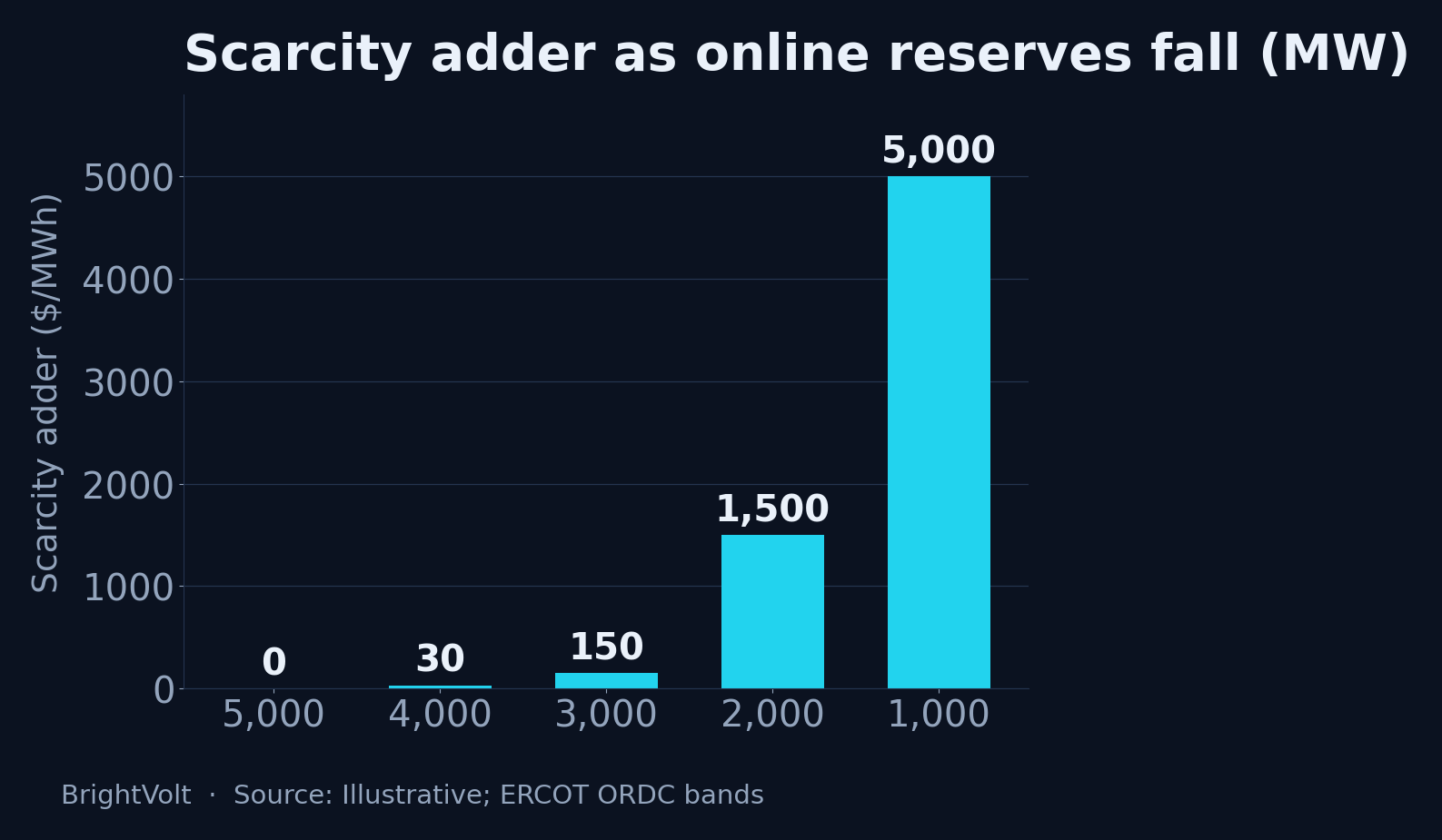
The cliff edge is a number called the Minimum Contingency Level, set at 3,000 MW. Above it, the curve is shallow. Approach it and the adder accelerates; drop below it and the formula treats a blackout as effectively certain, so the adder jumps to the full value of the power at risk. That is the point of the design — to make the price scream before the lights actually go out, not after.
Where the price comes from: LOLP times VOLL
The adder is the product of two numbers, and both are worth knowing because they are where the judgement is buried.
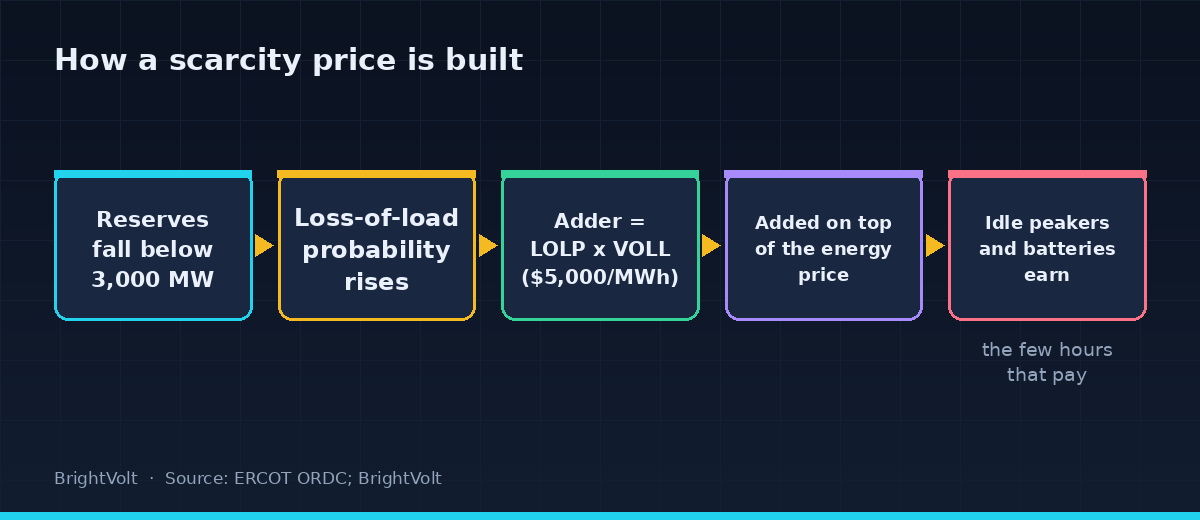
The first is the loss-of-load probability, or LOLP: the statistical chance, given the reserves on hand right now, that the grid will run short in the next interval. The second is the value of lost load, or VOLL — what a megawatt-hour of unserved demand costs the economy when the power simply is not there. ERCOT sets VOLL at $5,000/MWh in its protocols. Multiply the probability of a shortage by the cost of that shortage and you get the expected cost of the risk the grid is carrying. That number is the adder.
This is not a Texan invention. The mechanism was designed by the Harvard economist William Hogan and adopted by ERCOT in 2014, and variants now run in PJM, MISO and SPP. Its elegance is that it turns a reliability question — how close are we to the edge — directly into a price, with no committee vote in the loop. Its weakness is that VOLL is a policy choice dressed as a measurement. Set it high and scarcity pays richly; set it low and it barely pays at all. The number is an estimate of a cost nobody ever actually invoices.
Why a grid does this instead of paying for capacity
Every market has a “missing money” problem: at ordinary prices, a plant needed only for the worst few hours never earns back its cost, so nobody builds it and the grid runs short exactly when it can least afford to. There are two ways to put the money back. Pay generators up front for being available — a capacity market — or let the price spike high enough in the scarce hours to do the job. The ORDC is the second answer, made systematic.
That choice decides what gets built. A resource that is cheap to hold idle and can inject power the instant the adder appears — a peaker, a battery, a demand-response contract — is precisely tuned to a market that pays enormously for a few hours and little the rest of the time. It is no accident that Texas, with no capacity payment at all, built more grid batteries than any other US market. The scarcity signal is exactly what a fast asset wants to hear. The cost is that the signal is volatile: ERCOT battery revenue was pacing at roughly $29 per kilowatt-year in early 2026, a real income with no floor under it.
What it looks like when it bites
In normal operation the adder does nothing worth noticing. It matters on the handful of evenings a year when a heatwave, a cold snap or a plant outage pulls reserves down toward the contingency level. Then it moves in bands.
| Online reserves | What the grid is doing | Scarcity adder |
|---|---|---|
| Above 3,000 MW | Comfortable | Near zero |
| 2,000–3,000 MW | Watching closely | A modest premium |
| 1,000–2,000 MW | Tight | Hundreds to low thousands per MWh |
| Below 1,000 MW | On the edge | Toward the full $5,000/MWh |
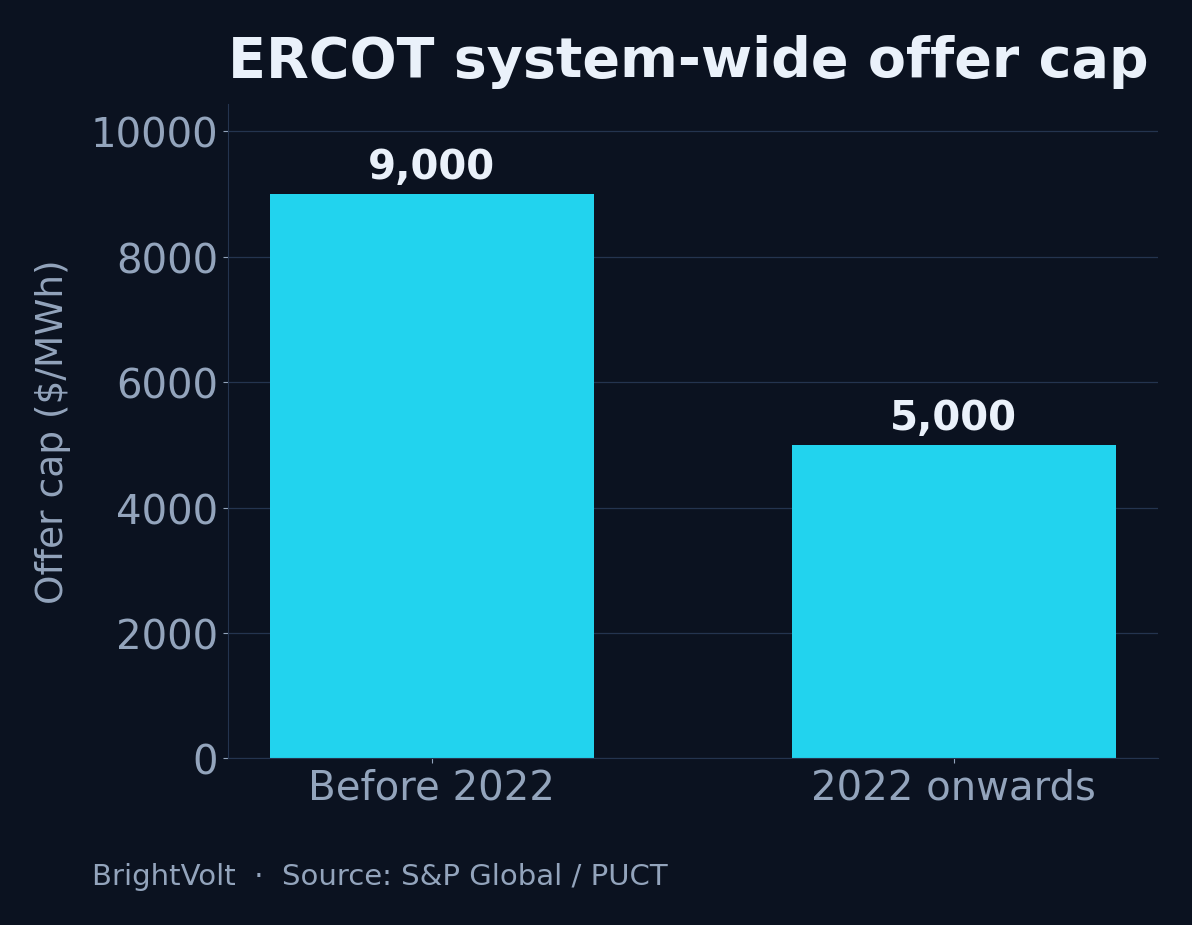
The extreme case is on record. During Winter Storm Uri in February 2021, reserves collapsed and prices sat pinned at the then-cap of $9,000/MWh for days, generating bills that bankrupted retailers and one large cooperative. The Texas legislature responded by cutting the system-wide cap to $5,000/MWh from the start of 2022 — a decision that lowered the ceiling on scarcity rents and, with it, the maximum reward for building the assets scarcity pricing is meant to attract. That is the standing tension in the design: the same spikes that keep peakers alive are the ones that torch consumers in a genuine crisis, and every adjustment trades one against the other.
What is changing
Scarcity pricing is being rebuilt even as it runs. ERCOT is rolling out real-time co-optimisation — pricing energy and reserves together in the same engine rather than layering the ORDC on afterwards — which folds the reserve adder into a set of ancillary-services demand curves and, in theory, sends a cleaner, less jumpy scarcity signal. The value of lost load itself is under periodic review, and because VOLL sets the height of every spike, a change to it quietly reprices the entire market.
The durable point survives all of it. In a grid without a capacity payment, the price in the scarce hours is not a market failing — it is the market doing the one job the design assigns it, converting how close the system came to the edge into how much a flexible plant earns for keeping it away from there. When a Texas summer evening prints a four-figure power price and the same megawatt-hour cost thirty dollars at lunchtime, the ORDC is usually the reason, and it is measuring the value of a blackout that did not happen. Whether $5,000 is the right price for that is the argument. That there should be a price for it at all is the whole idea. The alternative is to pay for capacity instead — and pay for it every year, whether the bad evening arrives or not.
Photo by Pok Rie on Pexels · Photo by Daryana Vasson on Pexels