
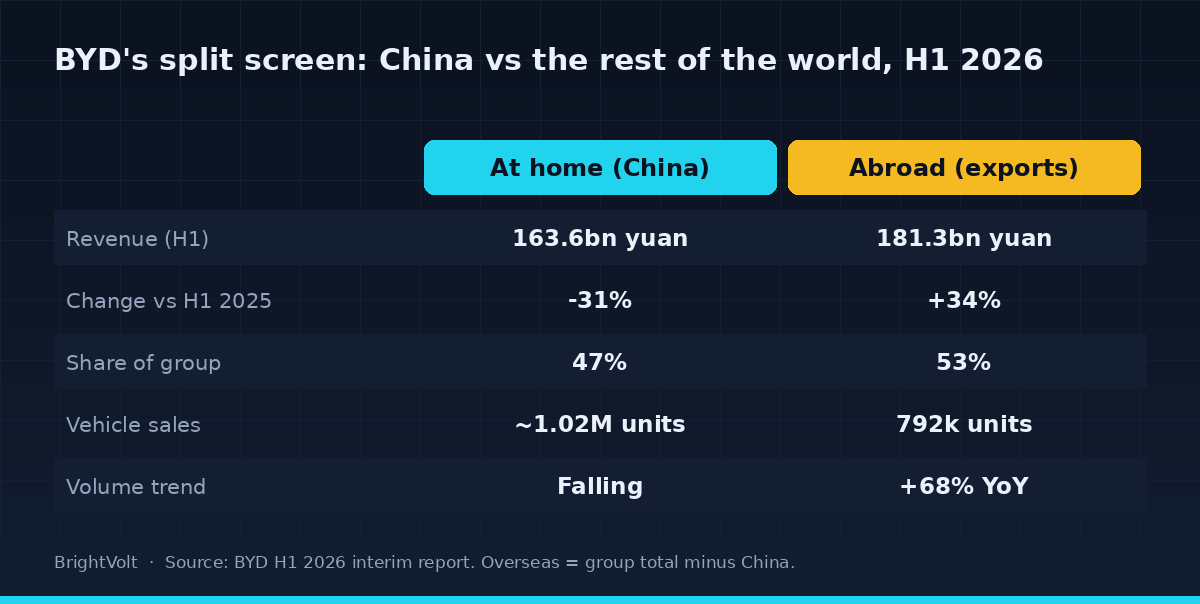
For the first time, BYD earns more from the rest of the world than from China. Overseas revenue reached 181.3 billion yuan in the first half of 2026 — 52.6% of the total, up 34% on a year earlier — while revenue at home fell 31%. The largest maker of electric cars on the planet has quietly become an exporter. That crossover is being read as a triumph. It is also the record of a home market coming apart.
The half-year BYD stopped being mainly Chinese
A year ago, roughly a third of BYD’s money came from abroad. In the six months to June 2026 it was more than half. Overseas revenue of 181.3 billion yuan sat against 135.4 billion a year earlier, and against a domestic figure that has gone the other way — down to about 163.6 billion, from 236 billion. The lines crossed inside twelve months.
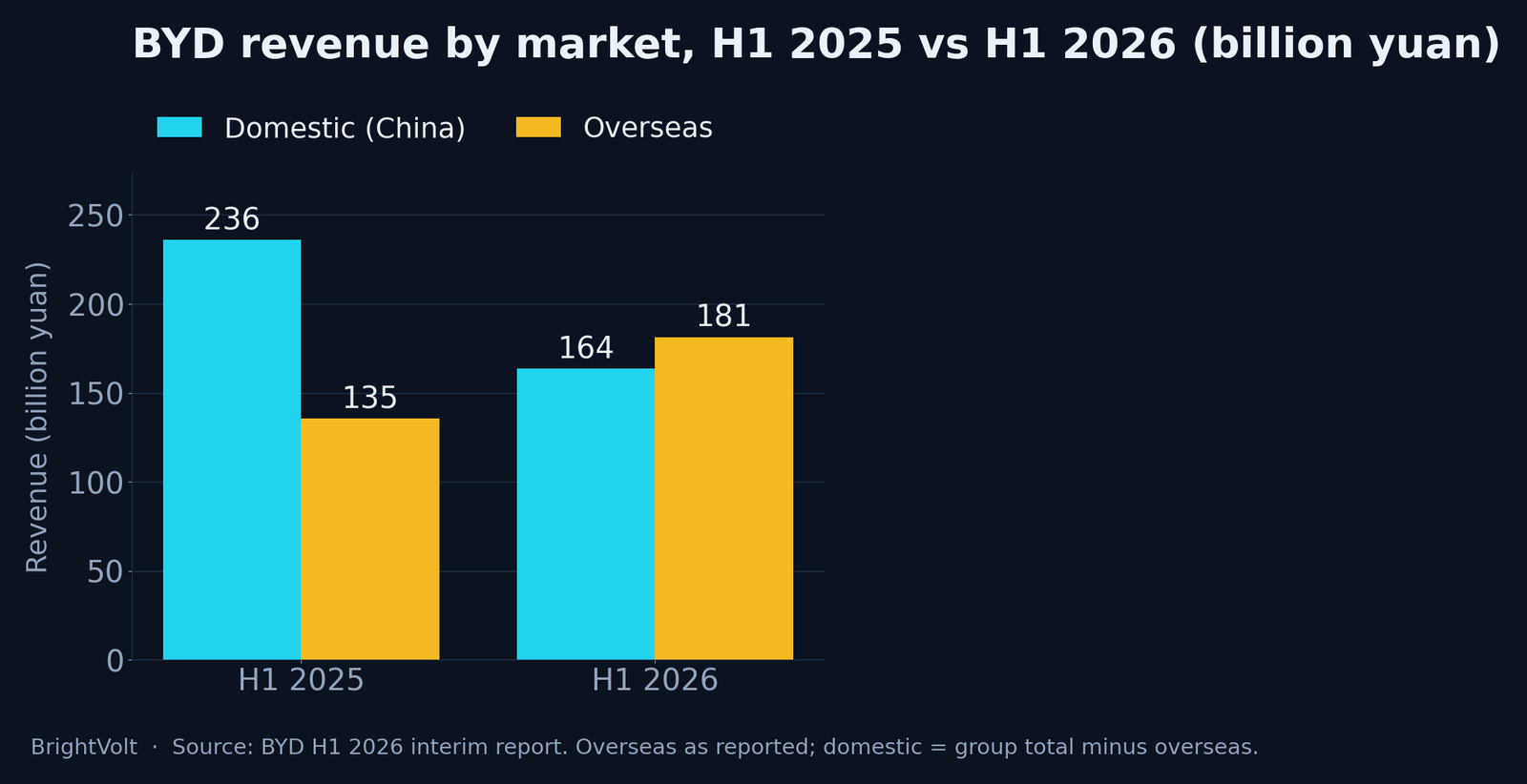
BYD reported the half-year on 28 August, and the overseas share is the number worth keeping. The company now sells in more than 120 countries, and the export column is the only large part of the business still growing. Everything else in the accounts points down.
What is going wrong at home
Group revenue fell 7.1% to 344.8 billion yuan, and net profit dropped 20.5% to 12.3 billion. For a company that spent five years compounding at 30% and more, a shrinking top line is the news. The cause is not exports, which surged. It is China, where BYD’s own price war has turned into a margin war it is now fighting against itself. The pattern is not BYD’s alone: we argued last month that China’s EV growth is now entirely exports, with domestic retail falling for seven straight months while the headline sales number kept rising. BYD’s accounts are that market-wide picture rendered on one company’s balance sheet.
| Metric | H1 2025 | H1 2026 | Change |
|---|---|---|---|
| Group revenue | 371.3bn yuan | 344.8bn yuan | −7.1% |
| Net profit | 15.5bn yuan | 12.3bn yuan | −20.5% |
| Overseas revenue | 135.4bn yuan | 181.3bn yuan | +34% |
| Overseas share of revenue | ~36% | 52.6% | +16 pts |
| Domestic revenue | 235.9bn yuan | 163.6bn yuan | −31% |
| Vehicle exports | ~472k | ~792k | +68% |
| Gross margin | 18.0% | 18.9% | +0.9 pts |
The tell is buried in the working-capital lines. Inventory turnover slowed to 109 days, from 79 a year earlier — a month of extra unsold cars sitting in the channel. That is what a saturated home market looks like on a balance sheet, and it is why BYD spent the spring cutting prices across the Dynasty and Ocean ranges. Total new-energy sales fell 15.7% over the half, with the whole of that drop landing in China; the second quarter’s 3.2% decline was at least an improvement on the first quarter’s 30% collapse.
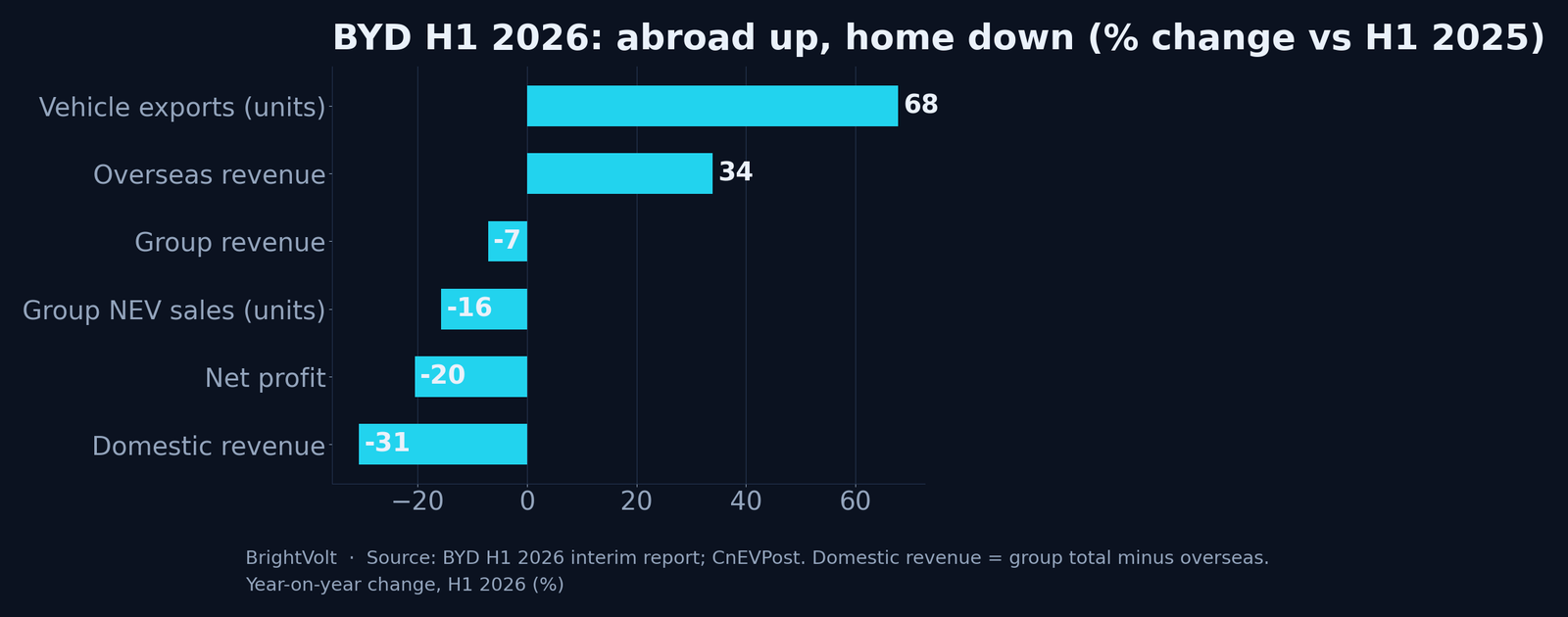
One number refused to fall, and it matters: gross margin actually rose, from 18.0% to 18.9%. BYD is selling fewer cars at home for less money, and still widening the margin — because the cars it is adding are the profitable ones sold abroad, and the premium Denza, Fang Cheng Bao and Yangwang brands, whose combined sales rose 61% to 12.8% of the passenger mix. The cheap domestic volume is being quietly swapped for dearer metal.
The export machine holding the line
BYD shipped about 792,000 vehicles out of China in the half, up 68%, and the momentum accelerated through the summer: July exports of roughly 180,000 and August of 188,746 put it within touching distance of Chery, the perennial export leader, which managed 196,984. Overseas is also where the margin is: gross margin on international sales was around 22%, comfortably above the group’s 18.9%.
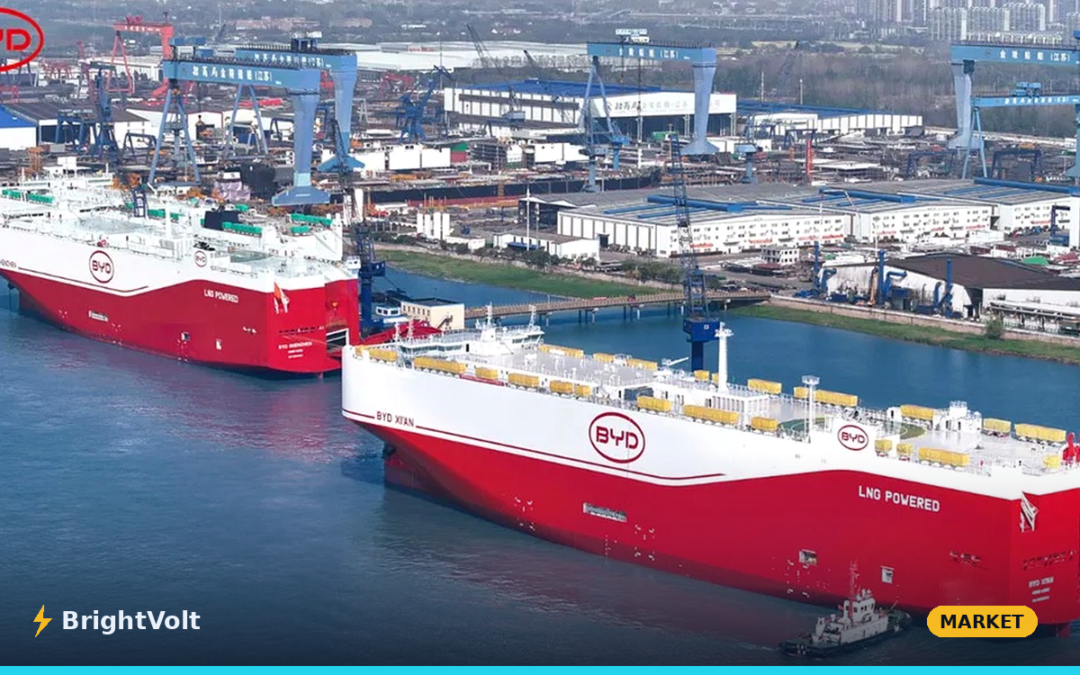
The company has built the physical means to keep this up. BYD now runs its own fleet of car carriers — the BYD Shenzhen, launched in 2025, is the largest roll-on/roll-off vessel in the world, with room for 9,200 cars — because chartering ships at spot rates was throttling the export plan. When a carmaker starts buying its own ocean freight, it is telling you where it thinks the growth is.
The risk moved offshore too
Here is the catch. BYD has moved its growth abroad at exactly the moment the door is being pulled shut. The European Union’s definitive anti-subsidy duties, in force since late 2024, add 17% to BYD’s cars on top of the standard 10% import tariff — 27% all in — and BYD got off lightly. Geely pays 18.8% and SAIC 35.3%. Brussels and Beijing are still negotiating a minimum-price arrangement to replace the duties, but nothing is signed, and a company earning most of its money abroad is now hostage to a trade file it does not control.
Its answer is to stop being an importer. BYD began trial production in Hungary in January, at a Szeged plant designed for 200,000 cars a year and building the Dolphin Surf — the small hatchback sold at home as the Seagull — with series production due in the second quarter. A car assembled inside the EU pays none of the tariff. Plants in Brazil and Thailand follow the same logic on other continents. This is the same captive-versus-exposed calculation that runs through BYD’s battery business: control the thing that can be used against you, and the leverage disappears.
What to watch next
The optimistic read is that the domestic bleeding is slowing — the second-quarter decline was a tenth of the first quarter’s — and that a fully localised export network turns a tariff threat into a footnote by 2027. The pessimistic read is simpler: the margin held up only because a richer, more international sales mix replaced cheap domestic volume, and underneath it BYD is a company whose core market is shrinking faster than its new ones are filling the gap — with profit already down a fifth, and foreign-exchange losses adding to the squeeze rather than easing it.
The thesis is falsifiable, which is what makes it worth stating. If the overseas share holds above half and export volumes keep climbing while China stabilises, BYD has genuinely re-based itself as a global exporter and the 2026 profit dip was the cost of the pivot. If instead the tariff walls and local-content rules bite the overseas margin, or export growth stalls before China recovers, then the exports were running to stand still — and a maker that earns most of its money in the one place it has the least control is not diversified. It is merely somewhere else.
Image: BYD