
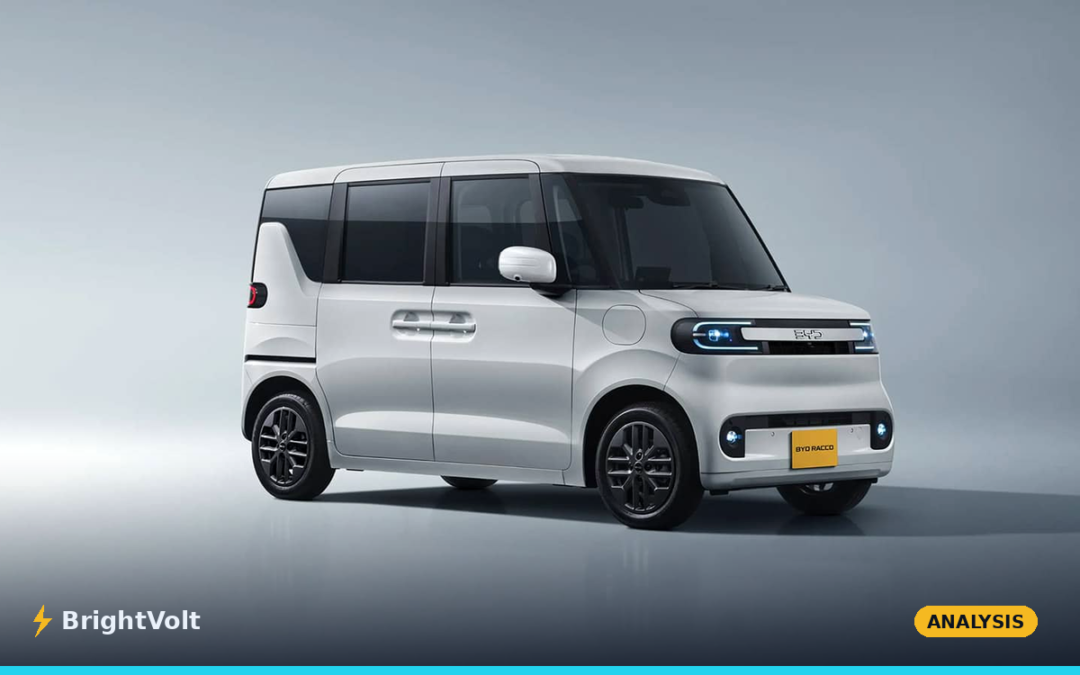
A kei car — from kei jidōsha, “light vehicle” — is a uniquely Japanese class of tiny car defined by law rather than by taste: to qualify it must stay within 3,400 mm long, 1,480 mm wide and 2,000 mm tall, and in return it attracts lower tax, cheaper insurance and, in much of Japan, exemption from the proof-of-parking rule that applies to larger cars. They account for roughly a third of new car sales in Japan, and they have been the near-exclusive preserve of Suzuki, Daihatsu and Honda for decades.
The first battery-electric kei car to break 300 km of range is not made by any of them. BYD launched the Racco on 28 July at ¥2.145 million including consumption tax, roughly $13,100, with a top specification rated at 320 km on the WLTC cycle. A Chinese manufacturer has arrived first in the most distinctly Japanese segment of the Japanese car market.
Why the kei class is the hard one to enter
Those dimensional limits are the whole difficulty. The Racco measures 3,395 mm by 1,475 mm by 1,800 mm — five millimetres inside the legal ceiling on length, five on width. Every kei car is built to those same limits, which is precisely why the segment has resisted outside entry: there is no room to differentiate on footprint, so competition happens on interior space, running cost and brand familiarity, all of which favour incumbents.
Honda’s N-Box alone sold more than 56,000 units in the first quarter of 2026.
What BYD actually brought
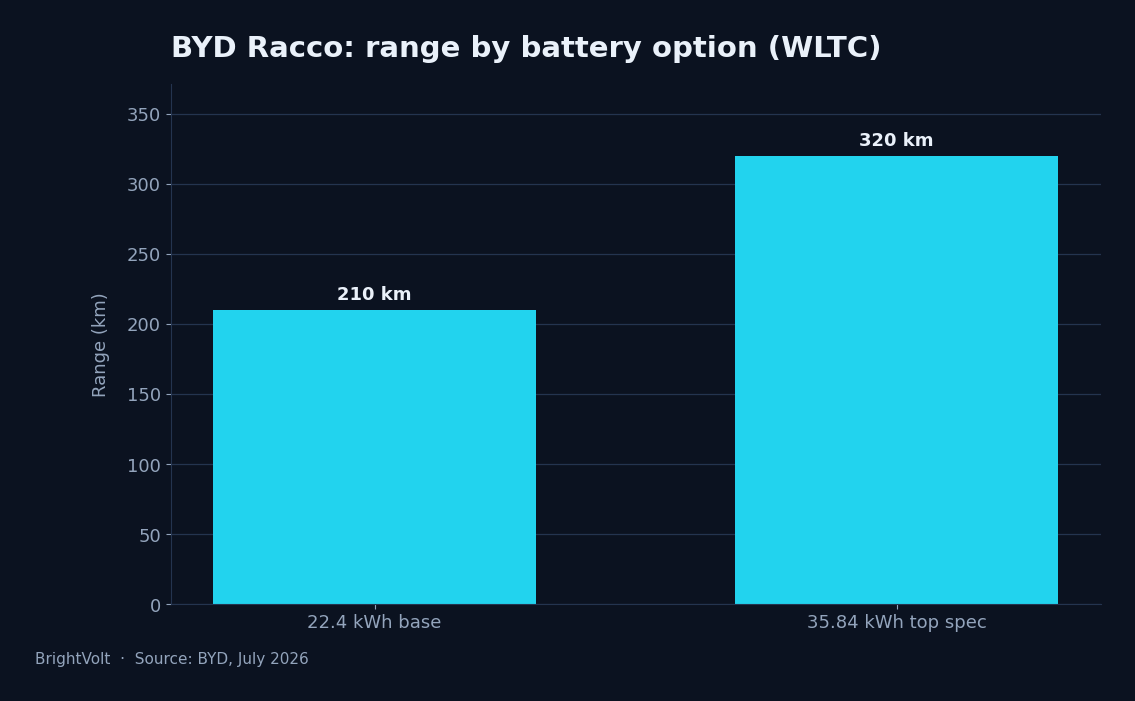
Two battery options: 22.4 kWh in the base car for 210 km WLTC, and 35.84 kWh in higher trims for 320 km. DC fast charging peaks at 50 kW, which is the same ceiling as the Honda N-ONE e — so BYD has matched rather than beaten the incumbents on charging speed.
The range figure is where it separates. No previous battery-electric kei car had exceeded 300 km, and the reason is straightforward: the class’s dimensional limits leave very little floor area for a pack. Fitting 35.84 kWh inside a 3,395 mm footprint while retaining usable interior space is a packaging result, and packaging is the thing kei buyers actually judge.
| BYD Racco (top spec) | BYD Racco (base) | |
|---|---|---|
| Range (WLTC) | 320 km | 210 km |
| Battery | 35.84 kWh | 22.4 kWh |
| Max DC charging | 50 kW | 50 kW |
| Price from | — | ¥2.145m (~$13,100) |
| Dimensions | 3,395 × 1,475 × 1,800 mm | as above |
Pricing is the other half. At ¥2.145 million before the ¥150,000 national EV subsidy, the Racco undercuts the Nissan Sakura — the incumbent electric kei benchmark — while offering materially more range.
The detail that says this was deliberate
BYD hired a former Nissan kei-car executive to develop the Racco. That is not a company opportunistically shrinking an existing platform to fit a foreign regulation; it is a company acquiring the specific domain knowledge that the segment requires and building to it.
It matters because the usual failure mode for outsiders in the kei class is treating it as a small-car problem. It isn’t. It is a tightly constrained optimisation with its own conventions about sliding doors, seat height, boot lip and turning circle, and buyers notice when those conventions are missed. Hiring for that knowledge rather than assuming it is the difference between a serious entry and a curiosity.
What to watch
The obvious metric is sales against the Sakura over the next two quarters. But the more revealing one is whether Suzuki and Daihatsu respond with electric kei cars carrying packs above 30 kWh. Both have so far treated the electric kei as a short-range city proposition — a reasonable reading of how the class is used, and one that conveniently avoided the packaging difficulty. If the Racco demonstrates that buyers will pay for 300-plus km in this format, that reading stops being defensible.
The counter-case is worth stating plainly: kei buyers are famously loyal, the segment skews older and more rural than the Japanese average, and a 320 km figure may simply not be what they are optimising for when their typical journey is under 20 km. Range that goes unused is a cost, not a feature. If the Racco sells modestly despite clearly better specifications, that will tell us the incumbents read the customer correctly and BYD read the spec sheet.
Image: BYD