
China launched more than 600 new vehicle models in the first half of 2026 — close to four a day — and the man whose company builds the batteries in a third of them thinks that is the problem. At the World Power Battery Conference in Yibin in early September, CATL chairman Robin Zeng warned that compressed development schedules are already producing “batch failures” in power batteries. When the supplier with 70% of the market says quality is slipping, the sensible response is to check whether he is right rather than whether he is talking his own book.
He is doing both. That is what makes the warning worth a whole piece.
The velocity everyone admires
The number is genuinely hard to believe. China put more than 650 new models into its market in the first six months of 2026 — most of them facelifts and trim updates rather than clean-sheet cars, but even counting generously that is three to four launches every day, in one country, in one half of one year. For scale, the United States is planning around 159 new models between now and 2030. BYD’s own founder has called the pace unsustainable.
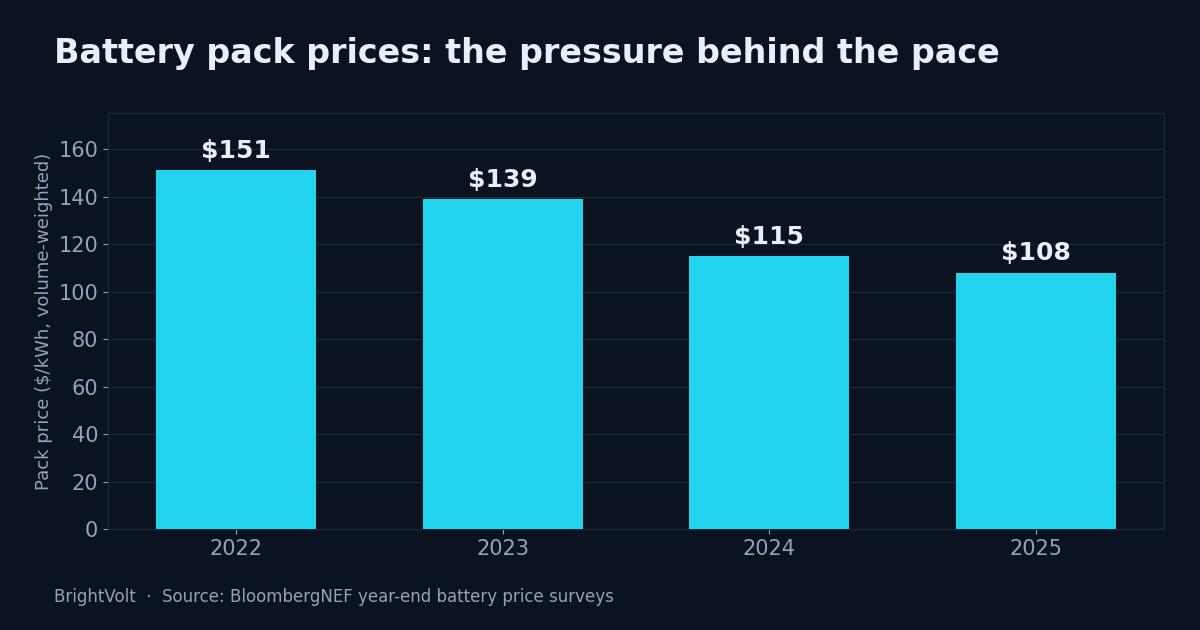
What drives it is not demand. It is a price war that has pushed battery costs to a level that would have looked like a rounding error two years ago. BloombergNEF’s volume-weighted battery pack price fell to $108/kWh in 2025, down from $151 in 2022, and Chinese lithium iron phosphate cells now change hands at around 0.4 yuan per watt-hour — a record low. When the cell is that cheap and the next competitor ships in a fortnight, the thing that gets cut is not the marketing budget. It is the months of validation testing that turn a working prototype into a car that survives eight years and 300,000 kilometres of a stranger’s driving.
What Zeng actually said
Zeng did not hedge. The industry, he told the conference, is racing “on speed, specifications, and price, squeezing development cycles ever shorter — at the expense of product quality and consumer trust.” He put the stakes in numbers: roughly 30 million vehicles worldwide now run on Chinese-made power batteries, so a defect rate that looks negligible in a lab becomes a recall campaign at fleet scale. CATL’s internal target, as reported, is one defective cell per billion — a thousand times tighter than the one-per-million that passes for good elsewhere — which is both a real engineering standard and, conveniently, a wall its cut-price rivals cannot climb.
That last point is the tell. Zeng branded his answer “CATL Quality,” defined as safety, reliability and long life, and he came armed with proof: a pack that held 88% of capacity after six years and 840,000 kilometres. This is a keynote and a sales pitch wearing the same suit. The question is whether the danger it describes exists independently of the man describing it.
The failures are already on the road
It does, and you can read it off this year’s recall notices. These are not hypotheticals or lab warnings; they are cars pulled back in 2026 for battery faults, from three different suppliers.
| Vehicle | Date | Battery issue | Scale | Response |
|---|---|---|---|---|
| Zeekr 001 | Feb 2026 | Battery-related defect | ~38,000 units | Formal recall |
| Smart #1 / #3 | Mar 2026 | Cell inconsistency → thermal-runaway risk | 18,217 units | Free battery replacement |
| GAC Aion S (CALB cells) | Jul 2026 | Swelling, leakage, insulation faults | 182 complaints in two weeks | Warranty extended to 300,000 km |
The GAC Aion S case is the instructive one, because it shows the shape of the problem the warranty numbers try to hide. The failures clustered between 150,000 and 300,000 kilometres — well inside a battery’s expected life, but often just past the original eight-year, 150,000-kilometre cover. GAC’s fix was to extend the warranty to 300,000 kilometres rather than issue a recall, and the supplier, CALB, launched a quality overhaul it internally called the “banana battery” cleanup after the shape of the swollen cells. A pack that bulges at 200,000 kilometres is not a manufacturing fluke. It is validation that stopped short of the mileage real cars reach.
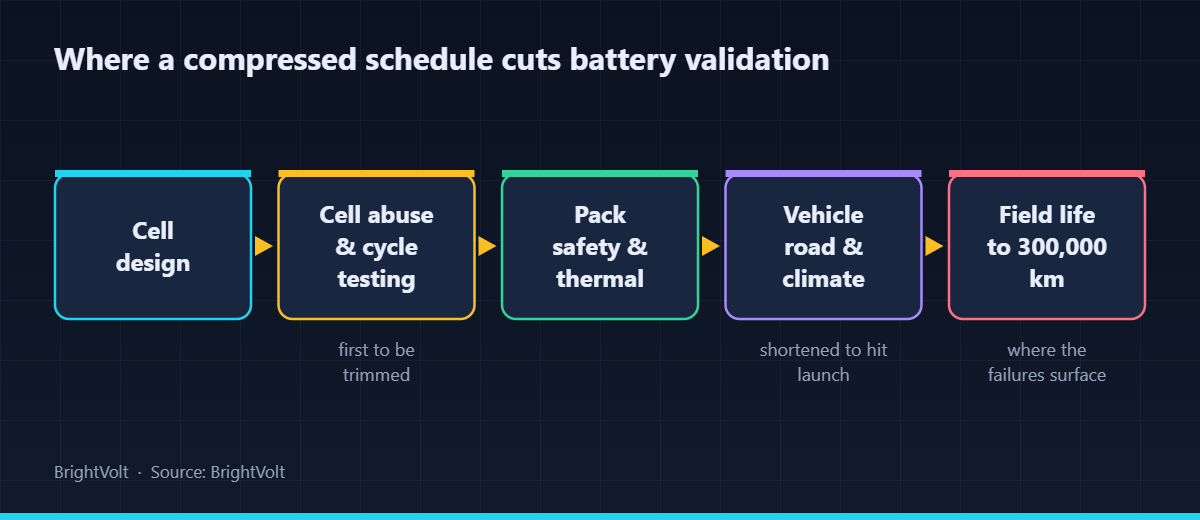
The mechanism is not mysterious, and it is worth drawing, because every step that gets shortened moves a failure from the test bench to the customer.
The man warning you also sells the cure
So take the strongest version of the sceptic’s case. Zeng runs the company that wins if buyers flee to safety. His “one defect per billion” standard is a marketing moat as much as an engineering one, and a chairman who spends a keynote describing his rivals’ batteries as time bombs is not a neutral witness. All true.
It still does not rescue the cheap end of the market, because the regulator has reached the same conclusion without a commercial motive. China’s industry ministry spent 2026 running surprise inspections at BYD, Geely, GAC Aion, XPeng, Chery and Nio, and in August it moved to bar inadequately tested products from sale outright. From July, every new EV battery sold in China must meet a new national standard that forbids fire or explosion after a cell fails — the strictest in the world. A government does not write its toughest-ever battery rule and raid six carmakers in the same year the industry is in perfect health. Zeng profits from the message; that does not make the message false.
What would prove us wrong
The falsifiable version of this Take is simple. If the 2026 model year’s field-failure and recall rates come in flat or lower than 2024’s, despite three times the launch volume, then rapid iteration is compatible with quality and the warning was noise. That is the number to watch, and it will take a year to read.
Until then, the balance of evidence points the other way: a launch cadence set by a price war, a supplier and a regulator independently flagging the same rot, and three recalls already on the board. The part that should concern buyers outside China is that this is now an export story. Chinese brands are expanding hard into Europe and beyond, and the cars leaving the factory gate at four a day are the same cars arriving in Rotterdam. A market that has learned to celebrate Chinese EV velocity is about to find out what velocity costs when the batteries were validated in a hurry. The supplier that makes seven of every ten of those batteries has said so out loud. It is a strange thing to have to argue, but the market leader talking down the market is the most credible witness it has.
Photo by Heru Dharma on Pexels · Photo by Heru Dharma on Pexels · Photo by Ayyeee Ayyeee on Pexels