
China’s new plan for its car industry sets one headline target: new-energy vehicles should reach 70% of passenger-car sales by 2030. The market already passed 65% in August. Five points over five years, against a number the market is brushing this year — that gap is the tell. The most important line in the document is not the growth target everyone reported. It is the first capacity-warning system Beijing has ever written into an auto plan.
The 15th Five-Year plan for the intelligent connected new-energy vehicle industry, dated 9 September and issued jointly by nine government departments led by the Ministry of Industry and Information Technology, does the things a Chinese industrial plan always does. It names targets, sets efficiency floors, gestures at autonomous driving. But underneath the familiar language it does something no previous auto plan has done. It tells the industry to stop building.
A target the market has almost hit
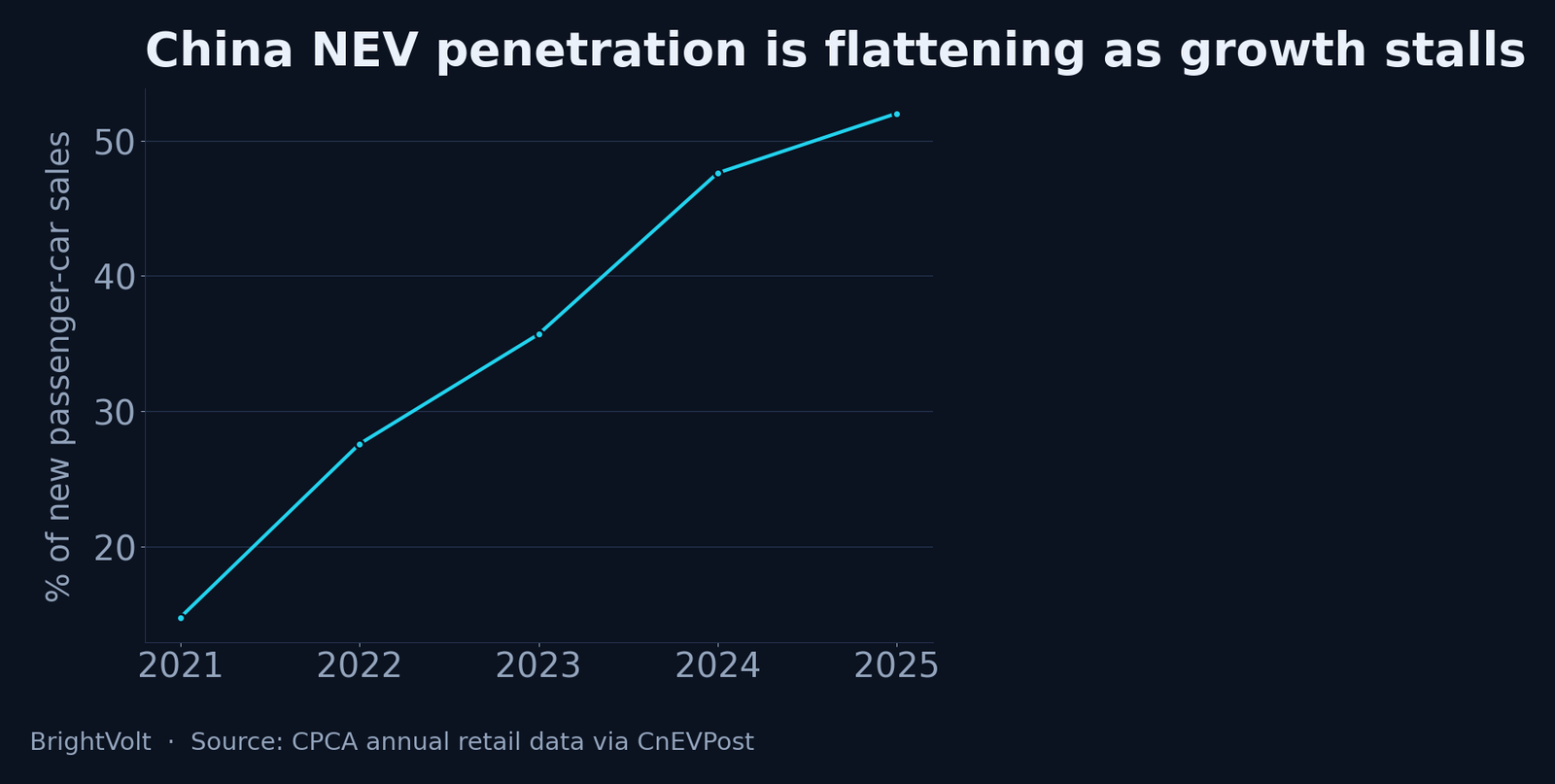
The 70% figure is the one Bloomberg and everyone else led with, alongside a matching 40% for commercial vehicles. It is also close to meaningless. NEV penetration in China hit a record 65.2% in August 2026. A 2030 floor set five points above a 2026 record is not an ambition. It is a formality — a number chosen so the plan cannot miss.
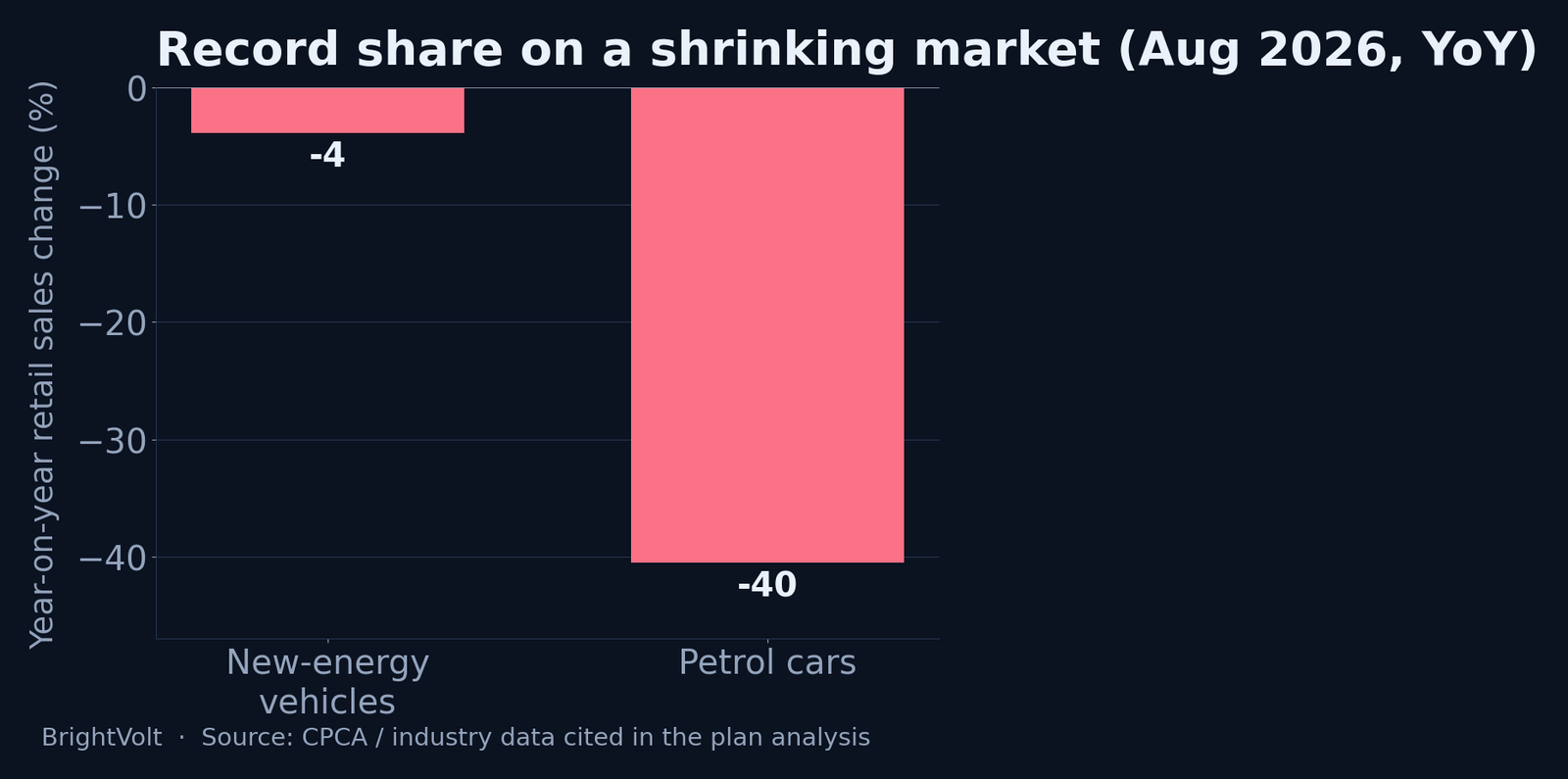
The record itself is doing something stranger, and it undercuts the target further. NEV sales did not surge to 65%. They fell. Retail volumes of new-energy passenger cars dropped 3.9% year on year in August; petrol-car sales fell 40.5%. Penetration is a fraction, and China’s is climbing mostly because the denominator underneath it is collapsing faster than the numerator. Across the first half of 2026, NEV retail volumes were down 13% to 4.734 million units. The share goes up while the market goes down.
That is what a maturing market looks like from the inside: the S-curve bends over, growth in units stalls, and the only line still rising fast is a ratio flattered by a shrinking base. Setting a volume-share target into that is like setting a speed limit above the speed of traffic. Which raises the obvious question — if the target is a formality, what is the plan actually for?
The line that actually changed
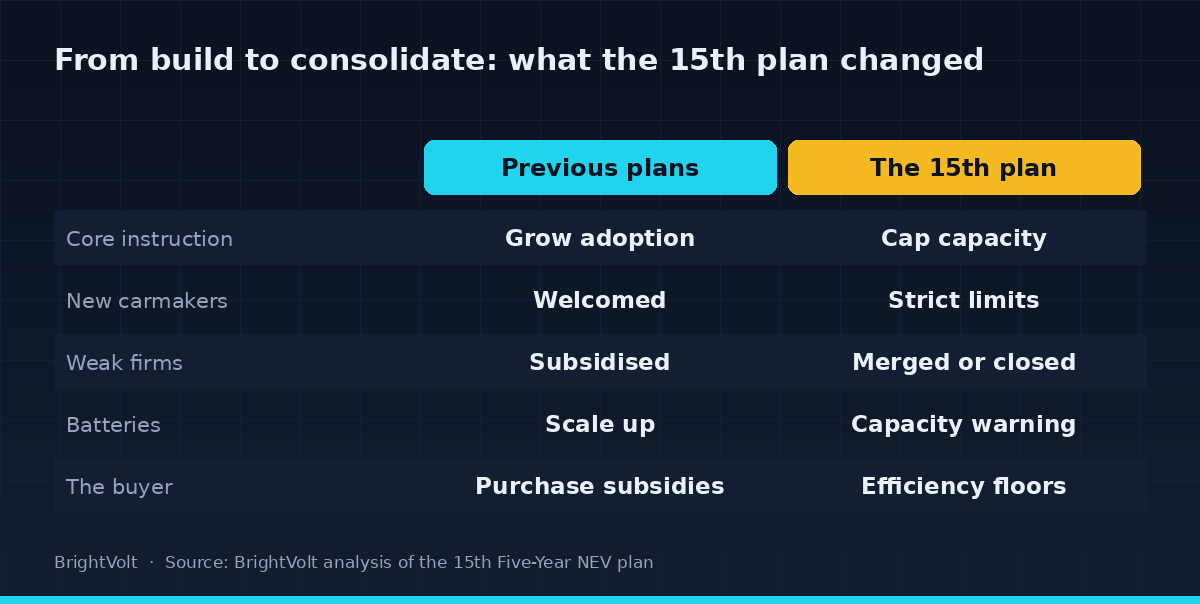
For a decade every Chinese auto plan carried the same instruction: grow. Subsidise the buyer, welcome the entrant, pour the foundation. The 15th plan breaks the pattern. It introduces, for the first time, a capacity-warning mechanism for vehicle manufacturing — and extends it, explicitly, to power batteries. It sets “strict conditions” on projects that would establish new standalone NEV makers, and it calls for “mergers, restructuring and cross-regional consolidation” to phase out inefficient capacity through market means. Read without the diplomatic varnish, it says: stop building, and start closing.
The reason is in the utilisation numbers. Chinese car plants ran at 70.3% of capacity in the first quarter of 2026 and 70.8% in the second — below the 75% mark the industry treats as the floor for a healthy business. A sector running its factories two-thirds full does not need a target telling it to sell more cars. It needs one telling it to build fewer factories, and this is the first plan to say so.
What a shakeout looks like
Only three of China’s thirty NEV-focused manufacturers — BYD, Xiaomi and Leapmotor — made a full-year profit in 2025; the consultancy AlixPartners expects seven to break even by 2030. The industry’s profit margin fell to 3.8% in the first half of 2026, with total profit down about 20% year on year, a per-vehicle gross profit of roughly 13,000 yuan. Dealer inventories reached an alert index of 57.2% in June. And the cost war is beginning to show in the metal: CATL warned this month of a rise in “batch” battery failures as corner-cutting spreads down the supply chain. This is the neijuan — the ruinous involution — that Beijing has spent two years trying to end, arriving now in a five-year plan rather than a consumption tax.
The pressure valve is export, and the plan leans on it hard. Chinese brands are on track to ship close to 10 million vehicles abroad in 2026, up from 7.1 million in 2025; EV exports alone jumped 155% in August. A plan that tells the industry to consolidate at home while flooding the world abroad is not contradicting itself. It is the same policy seen from both ends: too many cars for one market, so thin the makers here and send the metal there. That is the strategy BYD is already running, now written into national policy.
| The 15th plan’s 2030 targets | Target | Where it stands |
|---|---|---|
| NEV share of new passenger-car sales | 70% | 65.2% (Aug 2026, a record month) |
| NEV share of new commercial-vehicle sales | 40% | Well below, the lagging segment |
| Battery-electric car energy use | ~11.5 kWh/100 km | A first-time efficiency floor |
| Conventional car fuel use | 3.3 L/100 km | Tightens the screw on petrol |
| Labour productivity | +15% vs 2025 | The consolidation dividend |
What would prove this read wrong
The honest counter-argument is that five-year plans set floors, not ceilings, and that the forward-looking content sits elsewhere — the push for highly automated driving on highways and city roads by 2030, the efficiency floors, the 15% productivity gain that consolidation is meant to deliver. That is a fair reading of the same document, and if the autonomy targets are what the plan is remembered for, this analysis will look overwrought.
But the tell is what is new against what is repeated. Adoption targets appear in every plan China has written; a capacity-warning mechanism, strict limits on new entrants and an explicit order to merge appear in none of them before this one. The clearest signal is the smallest: batteries got their own capacity-warning line, which means the planners are worried about the same overbuild one rung down the supply chain, in the sector that is supposed to be China’s crown jewel. You do not write a warning system for an industry you think is about to grow into its factories.
So here is the falsifiable version. If NEV unit sales — not the penetration ratio, the actual number of cars — resume double-digit growth, and plant utilisation climbs back above 75% without a single maker closing, then this was a growth plan wearing austere language and the shakeout never comes. Watch the other outcome instead: the first denied licence for a new NEV brand, and the first merger the state arranges rather than the market. That is where a shrink order shows up first, and it is what this plan was written to produce.
Photo by Luke Miller on Pexels · Photo by Hyundai Motor Group on Pexels