

COP31’s headline energy pledge asks the world to raise electricity’s share of final energy consumption to 35% by 2035, up from about 22% today. Over the past 15 years that share rose by 4.3 percentage points in total. The pledge needs roughly 13 points in ten years, a pace four to five times faster than anything the global data has recorded.
That is the arithmetic of the 35-by-35 Global Electrification Pledge, which the Turkish presidency has made the centrepiece of the Antalya talks. It is non-binding. The surprise is where the difficulty sits. Getting enough electricity is the easier half. The harder half is burning less oil, gas and coal directly in engines, boilers and furnaces, and the pledge never says so.
What the 35-by-35 pledge actually commits countries to
The pledge commits participants “to increase electricity’s share of total final energy consumption, to reach 35% globally by 2035”. It describes that as consistent with 1.5°C pathways, citing IEA and IRENA analysis that the share needs to pass 50% by 2050. Beyond that, the commitments are qualitative: stronger networks “together with storage and system flexibility”, concessional finance for the poorest countries, and a review of collective progress against IEA and IRENA reporting.
The target is global, and each country “retains full authority to determine its own electrification policies”. There are no national quotas. There are also no figures for renewables, grids or investment.
Support so far is thin at the top, and the presidency has not published a list. By Climate Home News’ count on 12 November, at least 14 countries have endorsed it: Australia, Ethiopia, Germany, Norway, Finland, South Korea, Pakistan, Zimbabwe, Eswatini, Togo, Liechtenstein, Palau, Seychelles and the Solomon Islands. The EU is expected to follow. China, the United States and India are the three largest electricity consumers, and none of them is on that list.
How far is 22% from 35%?
Nobody agrees on the starting line, and the disagreement is larger than it looks. The IEA’s own World Energy Outlook 2025 says electricity “accounts for only 21% of total final consumption globally”. A year later, at the Electrify Now launch and in an interview with Anadolu, IEA chief Fatih Birol put it at 23%. The UNFCCC’s June announcement said “just over 20%”. Enerdata’s energy yearbook puts it at 22% for 2025.
| Source | Baseline share | Implied gain needed by 2035 |
|---|---|---|
| UNFCCC, June 2026 | “just over 20%” | ~15 points |
| IEA, WEO 2025 | 21% | 14 points |
| Enerdata, 2025 data | 22% | 13 points |
| IEA (Birol), 2026 | 23% | 12 points |
Some of that spread is a moving year, and some is definition: whether non-energy uses such as petrochemical feedstocks sit in the denominator. It matters because three percentage points is a decade of progress at the historical rate. A target pegged to a baseline that its own sponsors cannot agree on will be easy to declare met or missed, depending on who does the counting.
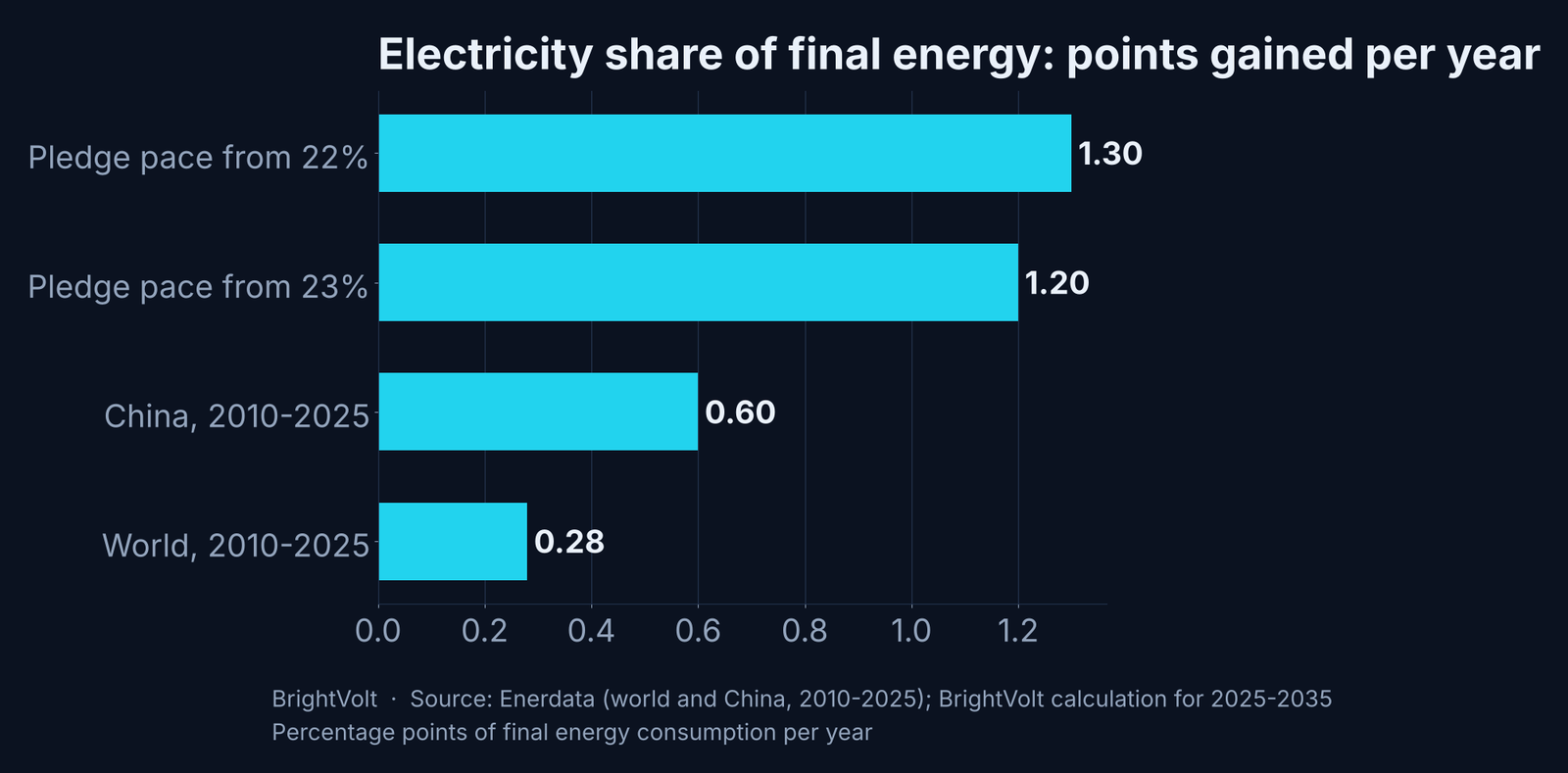
Take Enerdata’s series, which is the only one here with a consistent history. Electricity’s share was 17.8% in 2010 and 22% in 2025, a gain of 0.28 points a year. Reaching 35% by 2035 needs 1.3 points a year. China, the fastest-electrifying large economy, went from about 20% to 29% over the same 15 years, or 0.6 points a year. The pledge asks the whole world to move at more than twice China’s pace.
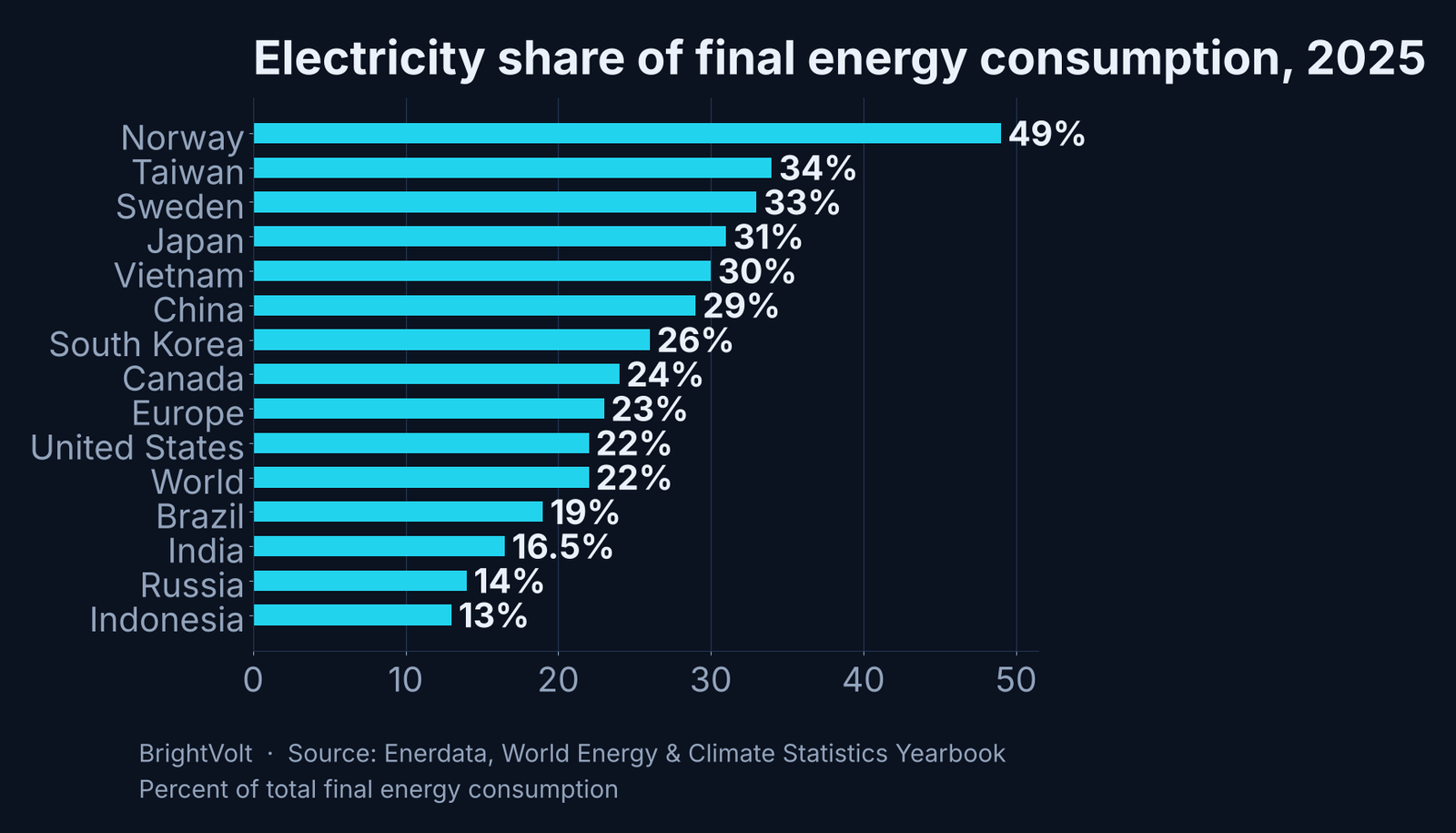
The US and the EU have hardly moved. A report by the US-China Economic and Security Review Commission last year put the US at 21% and the EU at 23%, and described both shares as stable over 15 years. Enerdata has the US at about 22% in 2025. Japan, at 31%, is ahead of China. Norway, at 49%, is in a league of its own.
Why the electricity half is the easy half
A share has a numerator and a denominator, and the pledge only talks about the numerator.
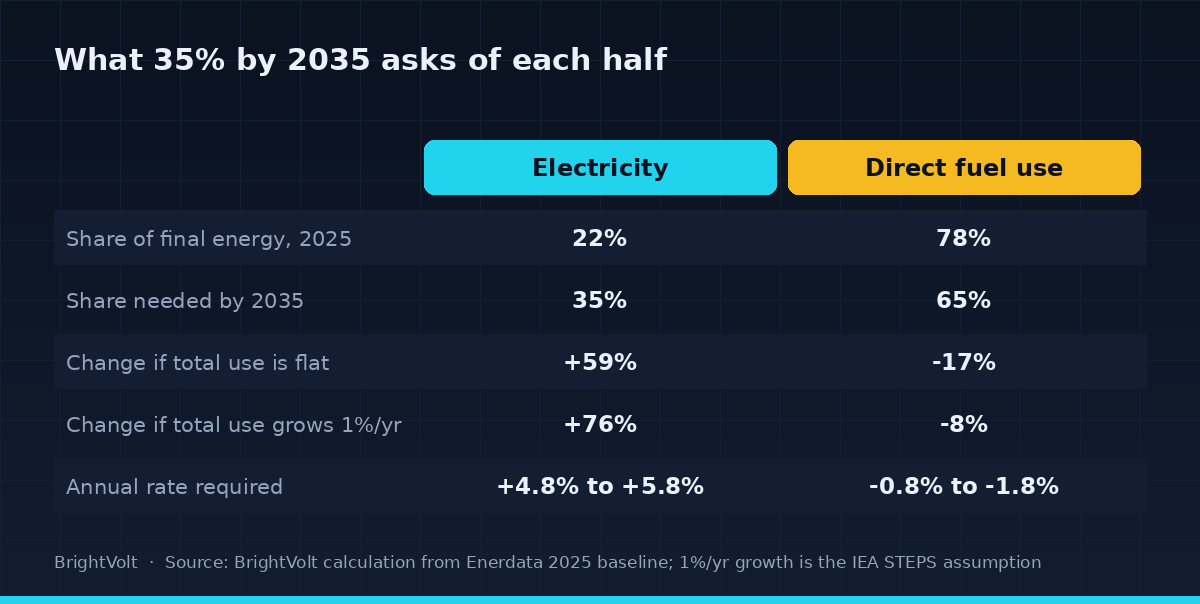
Say total final energy use stays flat to 2035. Moving electricity from 22% to 35% then means electricity use grows 59%, or about 4.8% a year. If total final use instead grows 1% a year, which is the IEA’s stated-policies assumption, electricity has to grow about 5.8% a year. The IEA estimates that global electricity consumption rose 4.3% in 2024. The electricity half is a stretch, not a fantasy. Birol names AI, EVs and air conditioning as the forces already pulling demand up, none of which needs a pledge.
The other side of the ledger is where it gets hard. Everything that is not electricity, meaning petrol in tanks, gas in boilers and coal in kilns, has to fall from 78% of final energy to 65%. If total demand is flat, that is a 17% cut in direct fuel use in a decade. If total demand grows 1% a year, it is still an 8% cut. The share barely moved over the last 15 years for exactly this reason: direct fuel use grew alongside electricity.
So 35-by-35 is mainly a target for fossil fuels burned at the point of use, which have to peak and fall. It has simply been written in the vocabulary of electricity. That is why heat pumps and electric trucks matter more to it than another gigawatt of data centres. A server farm adds to the numerator. A heat pump adds to the numerator and takes several times as much gas out of the denominator. Whether households make that swap still depends mostly on the ratio of electricity to gas prices, and the pledge has nothing to say about that.
Does electrification cut emissions if the grid burns coal?
This is the strongest objection, and Saudi Arabia’s energy minister made it most bluntly: electrification “does not necessarily mean cutting emissions, so long as we do not consider the sources of its production”. Some of the pledge’s own signatories, and climate advocates, made the same point from the other direction. Palau warned that electrification “must not become a substitute or a distraction” from leaving fossil fuels, and Seychelles that electrifying while still burning fossil fuels “will not deliver the full economic or climate benefits”.
The objection is right about the text and wrong about the physics. The pledge does not mention clean generation, and a cynic could sign it while building coal plants. But electric end-uses are efficient enough that they usually come out ahead even on dirty grids. Australia’s Chris Bowen argued in Antalya that an EV cuts emissions by about 60% on a coal-fired grid and 90% on solar. And generation is decarbonising faster than end-use. The Electrify Now statement says 83% of new power capacity installed last year was renewable, and even China, still the coal capital, saw coal fall below half its generation this year. Locking in a gas boiler for 20 years locks in its emissions. An electric heater gets cleaner every year the grid does.
The finance complaint is harder to answer. Pakistan’s prime minister, Shehbaz Sharif, said “momentum without finance cannot be sustained”. The pledge promises concessional finance but puts no number on it. Birol’s own view is that the binding constraint is “delivering this electricity to homes and factories through power grids”. That points to a familiar choke point of transformers and long-lead grid equipment, which a pledge cannot hurry along.
What would show the pledge is working
The first thing to watch is whether the IEA really is given the annual monitoring role Birol expects, and whether its first report fixes one baseline and one definition of final consumption. Without that, the 2035 verdict will be argued over rather than counted.
The second is the denominator. The likelier outcome is that 35% is missed by a wide margin unless direct fossil fuel use in final consumption peaks before 2030. If the IEA’s next data show electricity growing at 5% a year while direct fuel use keeps rising, the share will creep up by half a point a year and the target is already lost. If the share gains a full point in any single year before 2028, that reading is wrong, and the pledge is working faster than its arithmetic suggests.
The third is who signs. Fourteen countries have endorsed so far, and the three largest consumers of electricity are not among them. China is already electrifying at twice the world’s pace and loses little by signing. If it stays off, the pledge is a diplomatic flag, not a plan.
Photo by alpha innotec on Pexels · Photo by Pixabay on Pexels · Photo by Petr Ganaj on Pexels