
A wind farm burns no fuel, so almost everything it will ever cost is spent before it sends out a single kilowatt-hour — and most of that money is borrowed. This is why the cost of capital, not the turbine, sets the price of clean power. For a utility-scale solar project the financing alone accounts for 20 to 50% of the electricity’s lifetime cost, and for offshore wind it sits at the top of that range. Change the interest rate on the money and you change the price of the power, without touching a bolt.
Why a zero-fuel technology lives and dies on interest rates
Every power plant’s electricity price is the sum of three things: the upfront cost of building it, the cost of running and fuelling it over its life, and the cost of the money that paid for it while it earns that money back. What separates a wind farm from a gas plant is where the weight sits.
A gas plant is cheap to build and expensive to run, because it spends its whole life buying gas. Most of the price of its electricity is the fuel, so when the gas price moves, the power price moves with it, and the interest rate is almost an afterthought. A wind or solar farm is the mirror image. It is expensive to build and nearly free to run — the fuel is weather, and weather is free. That means there is no fuel bill to dominate the price, and the thing that takes its place is the cost of servicing the capital that built it.
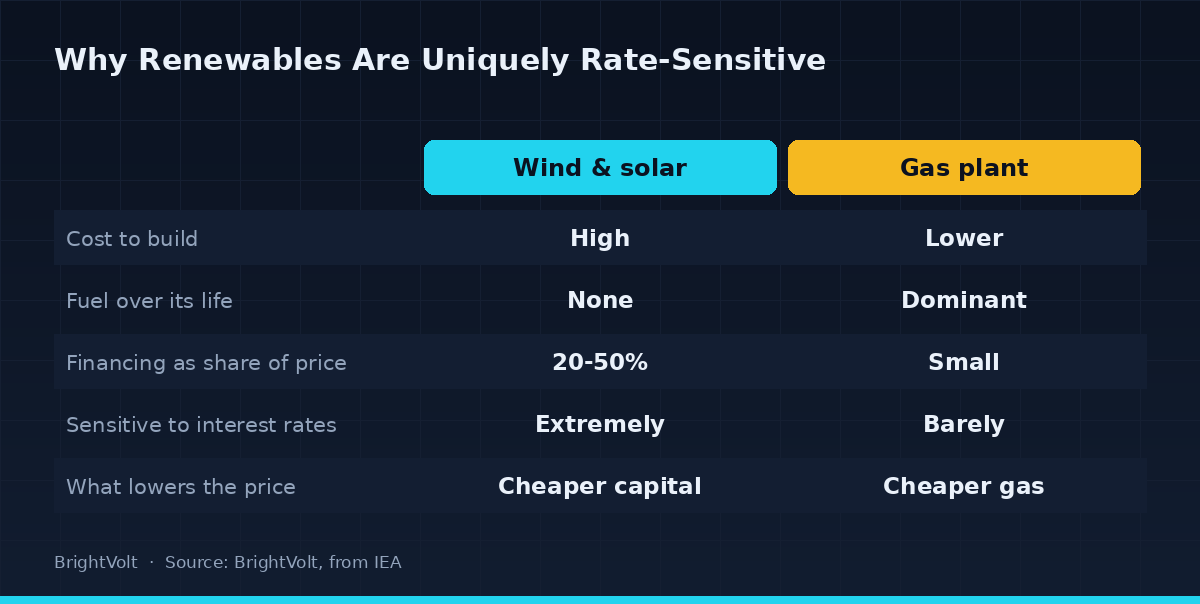
The consequence is counterintuitive but exact: the technology with no fuel cost is the one most exposed to the price of money. A gas plant shrugs off a two-point rise in interest rates because fuel still dwarfs financing. A wind farm cannot, because for a wind farm the financing very nearly is the cost. This is the single most important fact about renewable-energy economics, and it is the one most often left out of the story, because “clean power is now the cheapest electricity in history” is true only at a low cost of capital and quietly false at a high one.
The same panels, a different price
Because financing is such a large share of the cost, the interest rate a developer pays becomes a direct input to the price of the electricity — and that rate varies enormously by where and by whom the project is built. The IEA’s Cost of Capital Observatory exists to track exactly this, and the spread it finds is startling.
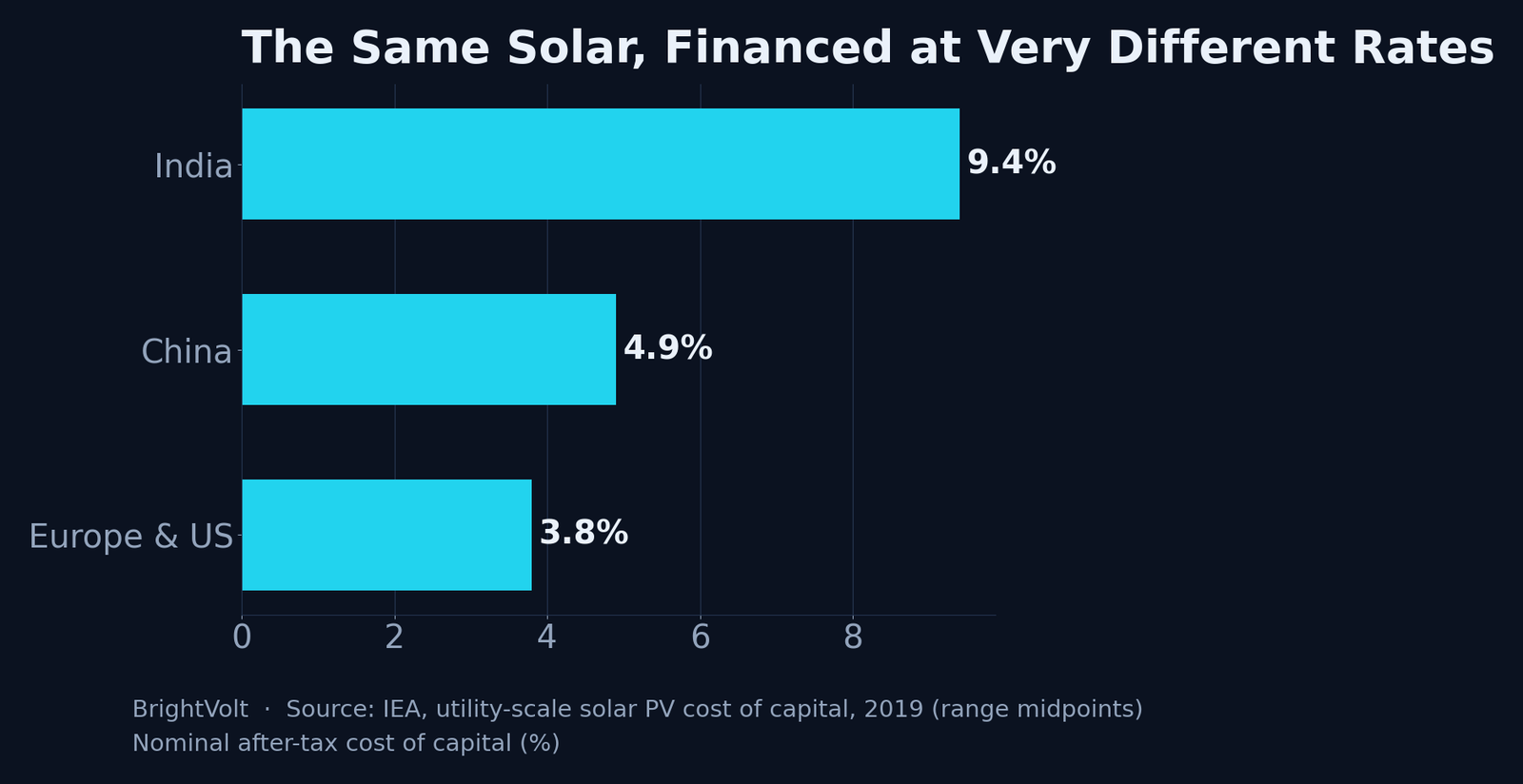
For utility-scale solar, the nominal after-tax cost of capital runs at roughly 2.6 to 5.0% in Europe and the United States, 4.4 to 5.4% in China, and 8.8 to 10.0% in India. Across emerging and developing economies as a whole, financing costs can be up to seven times higher than in the advanced economies. The panels are identical — often from the same Chinese factory. The sunlight in India is better than in Germany. And yet the electricity can cost more, because the money costs more. A developing country pays a renewables premium that has nothing to do with engineering and everything to do with the risk a lender prices in: currency, policy, the chance of not being paid. The hardware got cheap; the capital did not.
What happened when capital got expensive
This is not a theoretical sensitivity. The world ran the experiment in 2022 and 2023, when central banks raised rates to fight inflation and the cost of capital jumped across every market at once. Renewables did not get cheaper that year despite falling hardware costs — they got dearer, and some of the most advanced projects on earth were cancelled outright.
| What happened | When | Why |
|---|---|---|
| Ørsted cancels Ocean Wind 1 and 2 (New Jersey), takes a ~$4bn writedown | Nov 2023 | Rising interest rates and costs made the fixed-price contracts unbuildable |
| UK offshore wind auction (AR5) secures zero bids | Sept 2023 | The strike price on offer no longer covered the risen cost of capital |
| Developers demand indexed strike prices and higher ceilings across Europe | 2023–24 | The financing assumptions under old auctions had broken |
Nothing about the wind changed. No turbine got worse. What changed was the interest rate, and because financing is most of the cost of an offshore wind farm, a rate rise the gas industry barely noticed was enough to strand billions of dollars of the cleanest generation being built. When people say high rates “hit renewables hardest,” this is the mechanism — not sentiment, arithmetic.
How to make clean power cheap: lower the risk, not the turbine
If the cost of capital sets the price, then the highest-leverage way to cut the price is to cut the cost of capital — and the way you do that is to make the project’s future revenue certain. A lender charges for risk. Guarantee the income and the risk falls, so the interest rate falls, so the price of the electricity falls, without a single improvement to the technology.
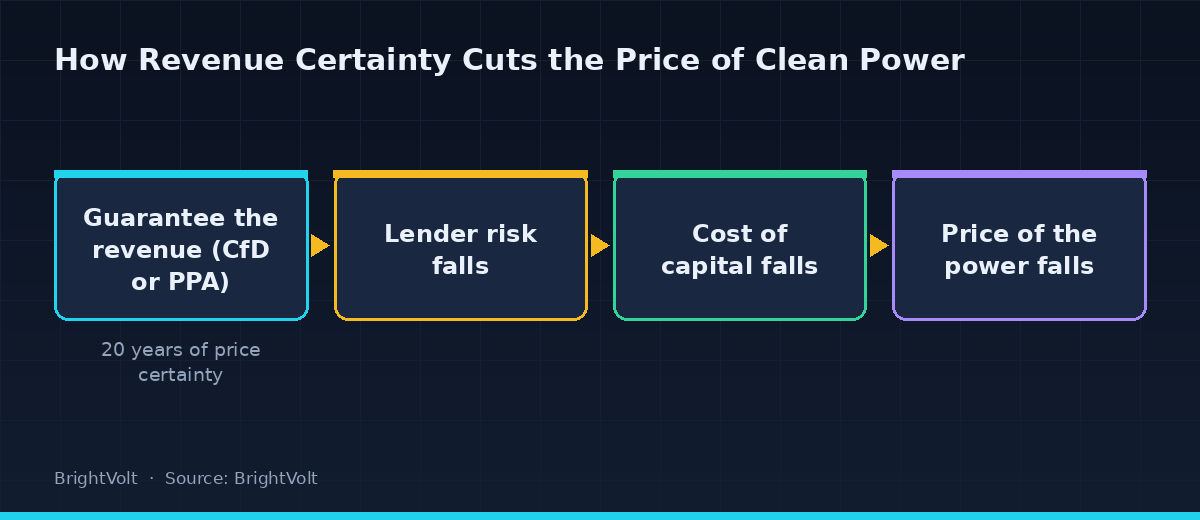
This is the entire logic behind a Contract for Difference or a corporate power-purchase agreement: they hand the developer two decades of price certainty, and that certainty is worth more to the final electricity price than almost any engineering gain, because it attacks the largest cost component directly. It is also why policies that inject revenue risk — a subsidy cliff, or an auction that makes developers bid to pay for the seabed — raise the price of clean power even when they hand out no money, because a riskier revenue stream is a more expensive one to finance.
So the cheapest lever on the price of wind and solar in 2026 is not a better blade or a denser cell. It is a lower interest rate and a credible guarantee that the power will be bought. Watch two things from here: whether central-bank rates ease, which quietly cuts the price of every renewable project in the pipeline at once; and whether the next auctions index their strike prices to the cost of capital rather than fixing them and hoping rates behave. The turbine is nearly finished as an engineering problem. The financing is where the price of clean power is now won and lost.
Photo by Damir K on Pexels · Photo by ZhiCheng Zhang on Pexels