
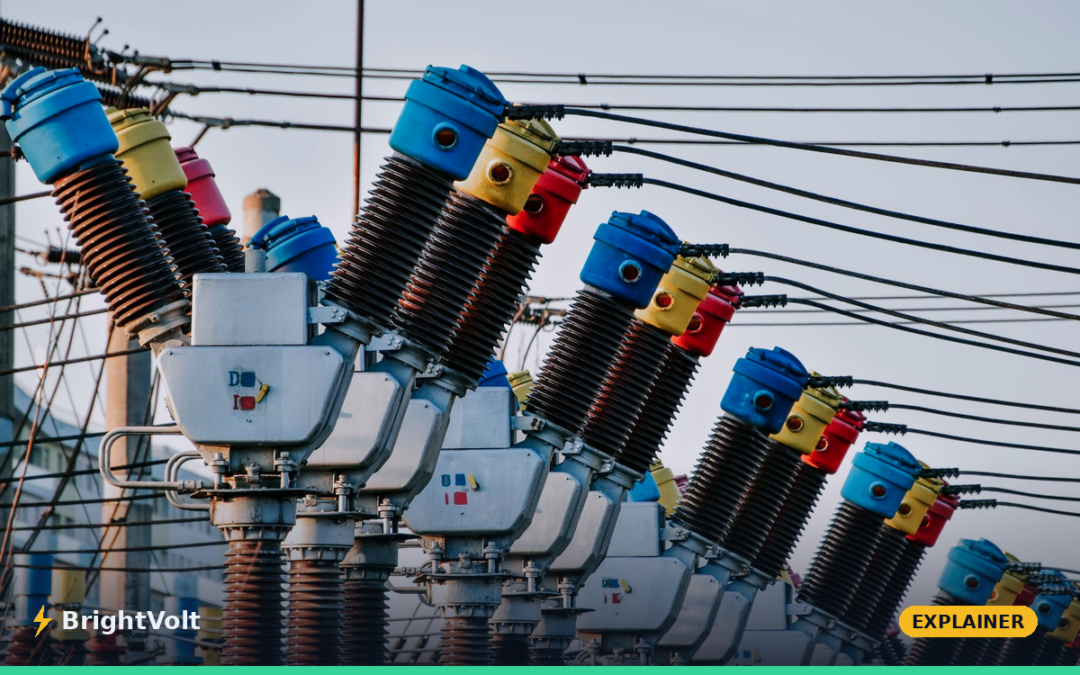
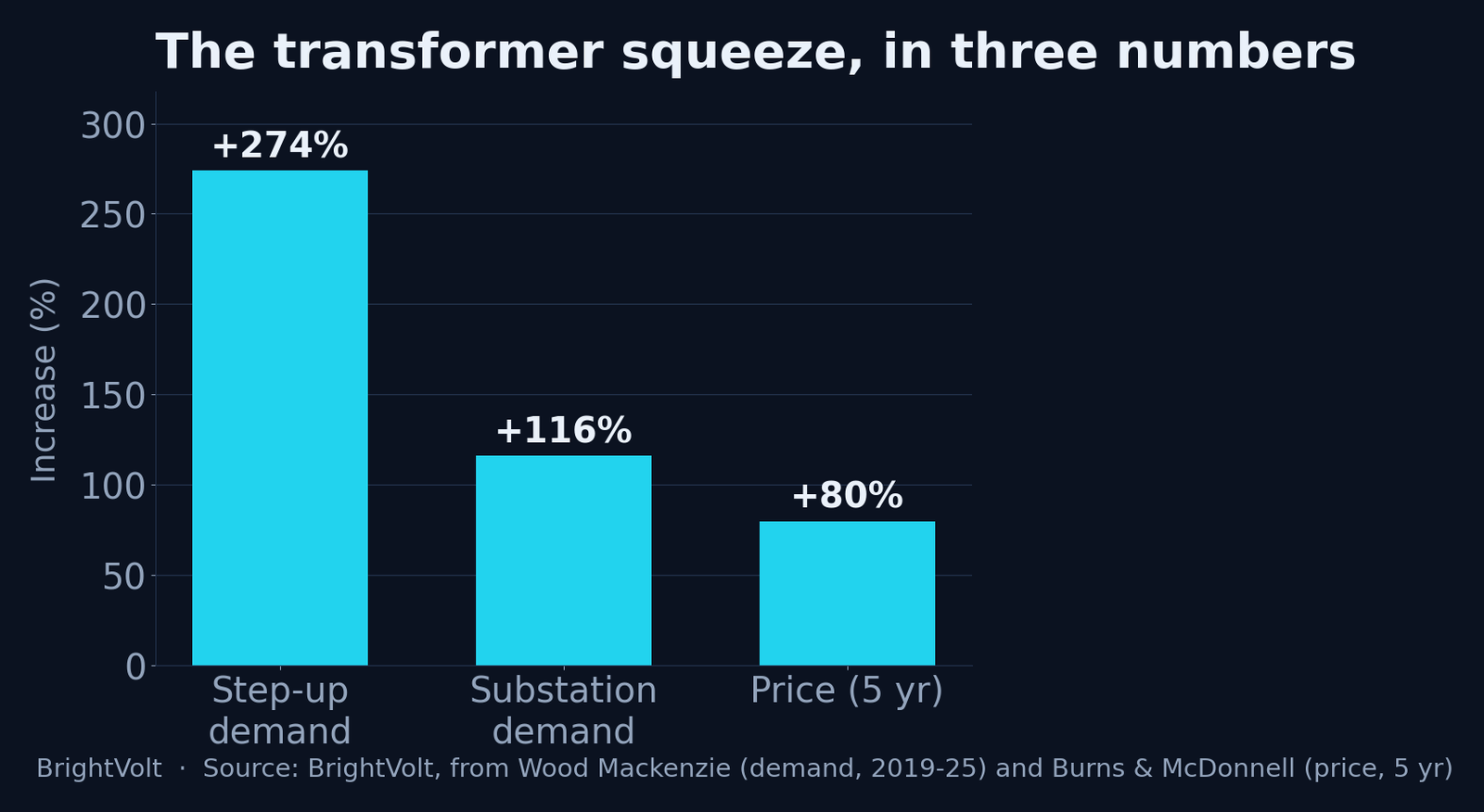
Almost every transformer on the power grid — the humming boxes that step voltage up at a power plant and back down on your street — is built around a core of grain-oriented electrical steel. In the United States, exactly one mill still makes it. That single dependency now sits behind transformer lead times of up to four years and prices that have climbed roughly 80% in five.
It is the least glamorous material in the entire energy transition, and one of the very few that has no ready substitute. Here is what it is, why one obscure alloy decides how efficiently the grid runs, and why the shortage of it will not clear on the timescale anyone building a data centre would like.
What grain-oriented electrical steel actually is
Grain-oriented electrical steel — GOES — is an iron alloy with about 3% silicon, cold-rolled and heat-treated so that its crystal grains nearly all line up in one direction: the direction the transformer’s magnetic field will run. The name is literal. The grains are oriented, and that orientation is the whole point.
A transformer core is magnetised and demagnetised fifty or sixty times a second, and every cycle loses a little energy as heat. Engineers call it core loss, and it comes in two forms. Hysteresis loss is the effort of flipping the steel’s magnetic domains back and forth; aligning the grains with the field makes them flip far more easily, which is what the “grain-oriented” processing buys. Eddy-current loss comes from little circulating currents the changing field induces in the steel itself; the 3% silicon raises the metal’s electrical resistance to choke those currents, and the steel is rolled into thin insulated sheets — laminations around a quarter of a millimetre thick — so the currents have nowhere to circulate. The result is a steel that gives up very little energy when it is magnetised along the grain.
That directionality is also why it is a specialist product. Line the flux up with the grain and losses are tiny; cross the grain and they balloon. So GOES goes into transformers, where the field points steadily one way, while its cousin non-grain-oriented steel — grains pointing every which way — goes into motors and generators, where the field rotates.
Why a fraction of a percent decides the design
The reason utilities pay for the good steel is that core loss never stops. A transformer sits energised twenty-four hours a day for forty years, so even a loss of half a percent of the power passing through it adds up to an enormous quantity of wasted electricity over the machine’s life — energy the utility pays for and no one ever uses. Shaving that loss is worth a lot of money spread over decades, which is why the grade of the steel, not merely the cleverness of the design, sets a transformer’s lifetime efficiency.
Now multiply one core by the count on the grid: every generator step-up transformer at every power plant, every substation transformer, every pole-top can on every street. The efficiency of the entire electricity system is, in a real sense, decided one lamination at a time — and the metal that decides it comes from a very short list of mills.
The single-supplier problem
In the United States that list has one name on it. Cleveland-Cliffs’ Butler Works in Pennsylvania is the sole domestic producer of grain-oriented electrical steel; there is no real number two. Any transformer built from American steel traces back through that one plant, and everything else is either imported steel or an imported transformer.
Cliffs is expanding — a $195 million hot-mill project, $75 million of it a Department of Energy grant, adding about 25% of capacity by 2028. The trouble is that demand has sprinted away from supply. Between 2019 and 2025, Wood Mackenzie put demand for generator step-up transformers up 274% and for substation transformers up 116%, driven mostly by AI data centres and the broader push to electrify. Lead times for the largest units now reach four years, and grain-oriented steel and copper are the two materials the industry keeps naming as the binding constraints. This is the material story sitting underneath the transformer shortage and the interconnection queue: a project can have its panels, its turbines and its permit and still wait years for the boxes that connect it.
The amorphous wrinkle
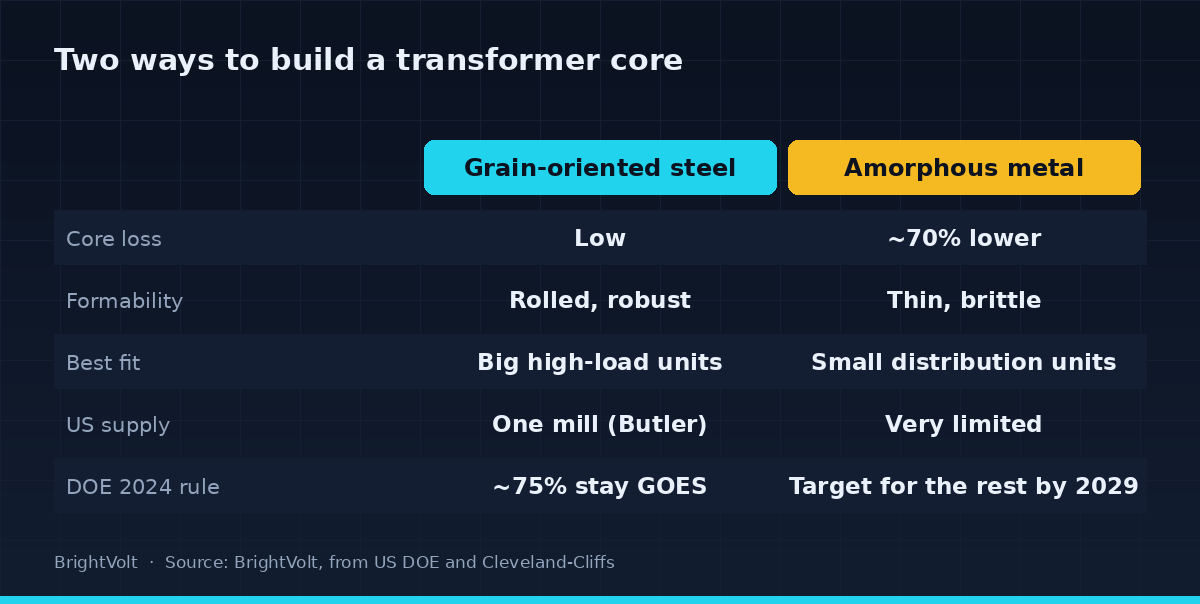
There is a rival core material, and a government rule trying to promote it. Amorphous metal is iron cooled so fast that its atoms never settle into a crystal lattice, and a core made from it loses roughly 70% less energy than one made from silicon steel. The DOE’s 2024 transformer-efficiency rule originally pushed distribution transformers toward amorphous cores, then softened to let about 75% of them keep grain-oriented steel, with compliance pushed to 2029.
So why not simply switch and end the dependence on one mill? Because amorphous ribbon is thin, glassy and brittle, awkward to wind into a core, and it suits small distribution transformers far better than the big, heavily loaded units that carry most of the grid’s power. Cliffs’ chief executive argues it is unsuitable for 90 to 95% of the transformers the country actually uses. Amorphous takes some pressure off grain-oriented steel; it does not replace it, and it has a thin supply chain of its own.
The three families of electrical steel divide the work like this:
| Family | Composition | Magnetic behaviour | Where it goes |
|---|---|---|---|
| Grain-oriented (GOES) | ~3% silicon iron, grains aligned | very low loss along one direction | transformers |
| Non-grain-oriented (NGOES) | 2–3.5% silicon iron, random grains | uniform in every direction | motors, generators |
| Amorphous metal | iron-boron-silicon, no crystal lattice | ~70% lower core loss, but brittle | small distribution transformers |
What to watch
The grid’s transformer bottleneck is, one layer down, a materials bottleneck — and materials bottlenecks move slowly. New capacity is coming: Cliffs’ 2028 expansion, plus $1 billion-plus from Hitachi Energy and $421 million from Siemens on new US transformer plants. Whether that closes a gap this wide, whether the DOE’s amorphous push holds, and whether import dependence deepens are the three things to track. The signal that the squeeze is easing would be simple: lead times falling back toward a year. Nothing in the 2026 figures points that way yet.
Photo by Diana ✨ on Pexels · Photo by Diana ✨ on Pexels