
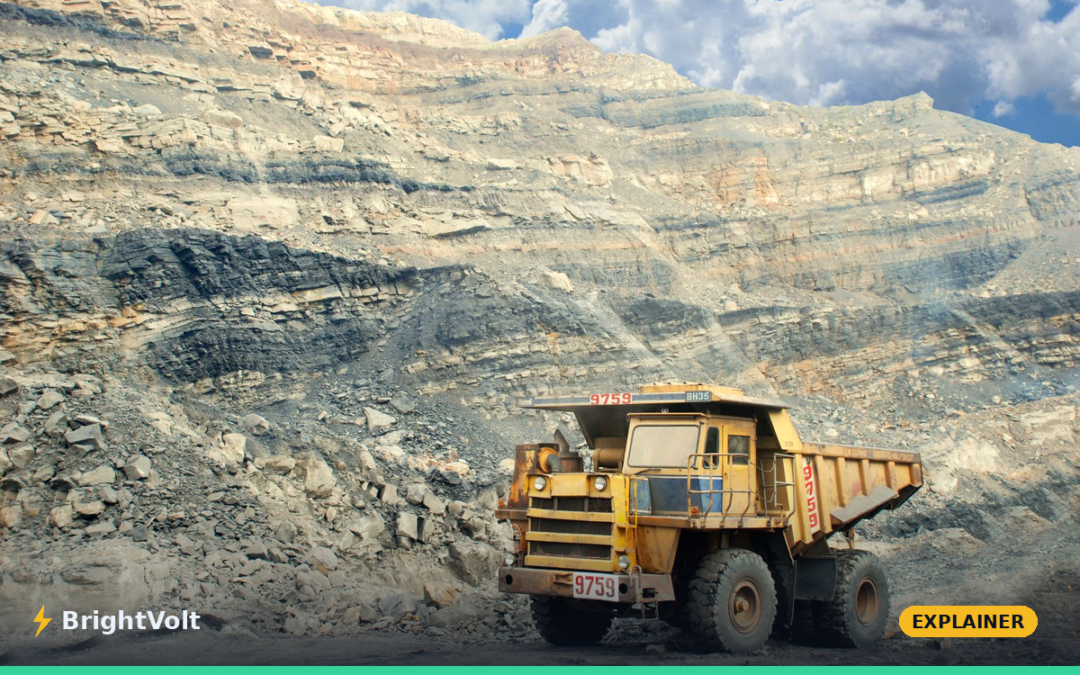
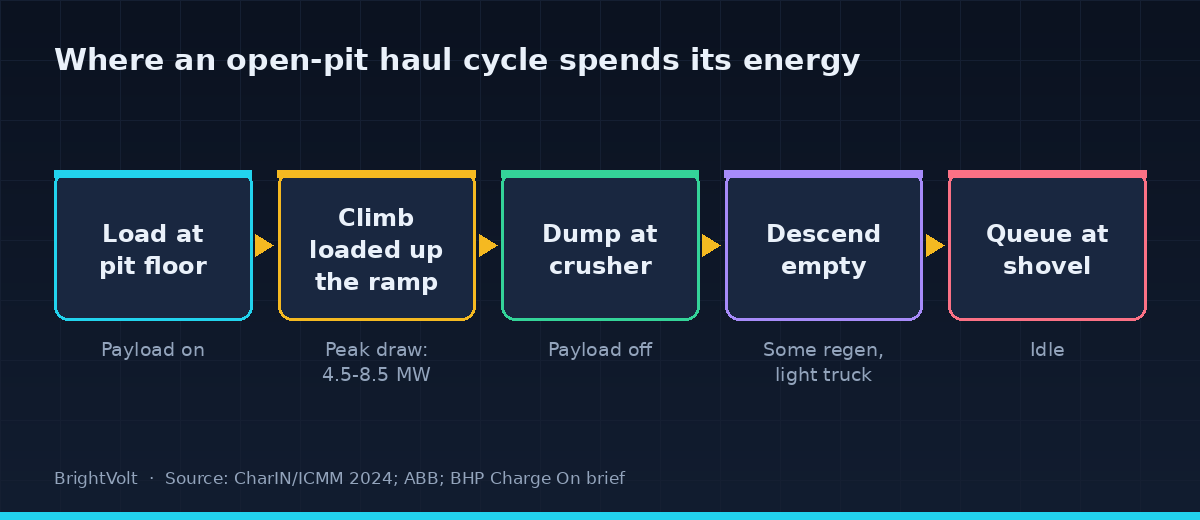
A loaded mining haul truck climbing out of an open pit draws between 4.5 and 8.5 MW, according to the CharIN/ICMM mining task force — the output of a small wind farm, for one truck. There are two ways to feed that electrically: carry a very large battery and refill it at a static charger, or carry a smaller one and plug the truck into an overhead line on the climb, known as trolley assist.
Which one a mine should choose is not a question about batteries. It is a question about the shape of the hole.
What trolley assist is
Trolley assist is the tram idea applied to a 200-tonne dump truck. A pantograph on the truck’s front deck reaches up to a pair of overhead DC conductors strung along the haul ramp — typically a 2.6 kV bus today, per the CharIN paper — and the truck’s electric drive motors run from the line instead of the on-board engine or battery. At the top of the ramp the pantograph drops and the truck carries on under its own power.
The idea predates the battery. Many of the largest haul trucks are diesel-electric: the engine drives a generator and the wheels are turned by electric motors, so the truck already has the drivetrain a wire needs. Trolley assist simply bypasses the engine for the hardest part of the cycle. That is why the early installations were retrofits on diesel fleets, and why the numbers they produce are diesel savings.
Why the loaded climb is the whole game
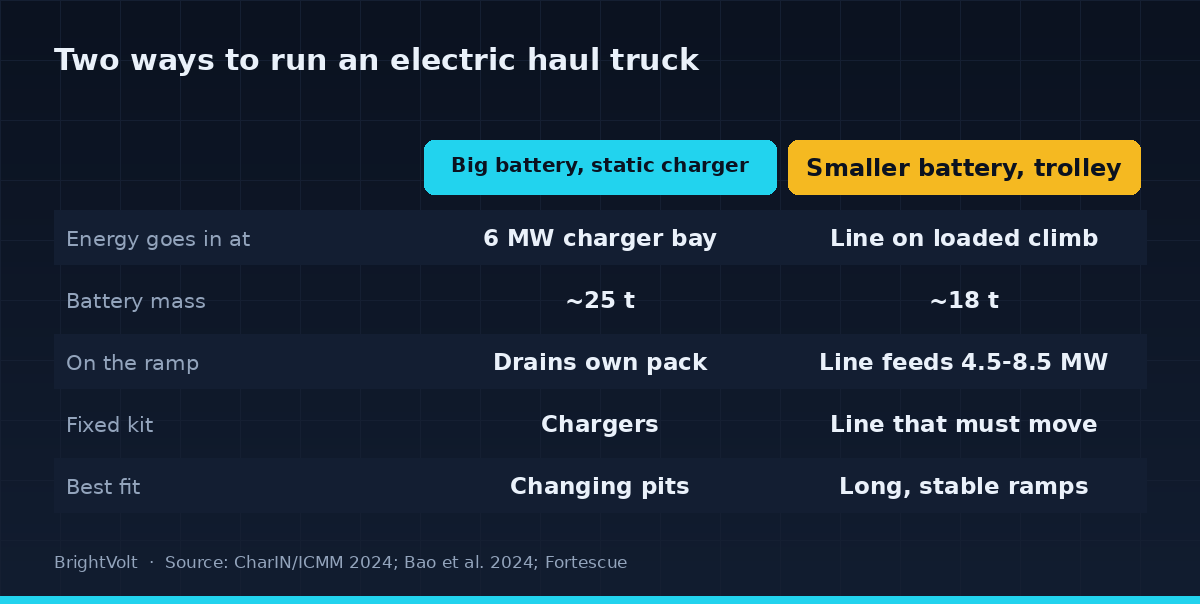
In an open pit, ore is dug at the bottom and the crusher sits at the top. So the truck climbs full and descends empty, and the climb is where almost all the energy goes. ABB puts a large truck’s diesel burn at 300–400 litres an hour climbing, against 30–50 litres an hour on a trolley line. Hudbay gives almost the same figure for its Copper Mountain line in British Columbia: about 400 litres an hour displaced.
The trucks also go faster. Caterpillar says a loaded 795F reaches 28 km/h on a 10% grade under trolley, up to twice its diesel speed. At Copper Mountain, Komatsu’s case study records seven trucks on a 900-metre uphill line cutting ramp time by 38.9%, from 3 minutes 54 seconds to 2 minutes 23, and saving 28.66 litres of diesel per run.
Speed matters more than it sounds. A truck that climbs faster completes more cycles per shift, so a trolley line can do the work of a larger fleet. The fuel saving is the visible benefit; the productivity is often the larger one.
How much battery the wire saves
Now swap the diesel engine for a battery. A battery-only truck must carry the energy for the whole cycle, climb included. A battery-trolley truck gets the climb from the line and can top its pack up on the way, so it needs to carry much less.
A 2024 modelling study in Energies put numbers on that for the same haul cycle. Our read of its results: the wire cuts the energy a truck has to carry per cycle by roughly 27%, from 645 kWh for battery-only to 471 kWh for a battery-trolley truck charged statically, and the required lithium iron phosphate pack falls from about 25 tonnes to about 18. Every tonne of battery not carried is a tonne of ore that can be.
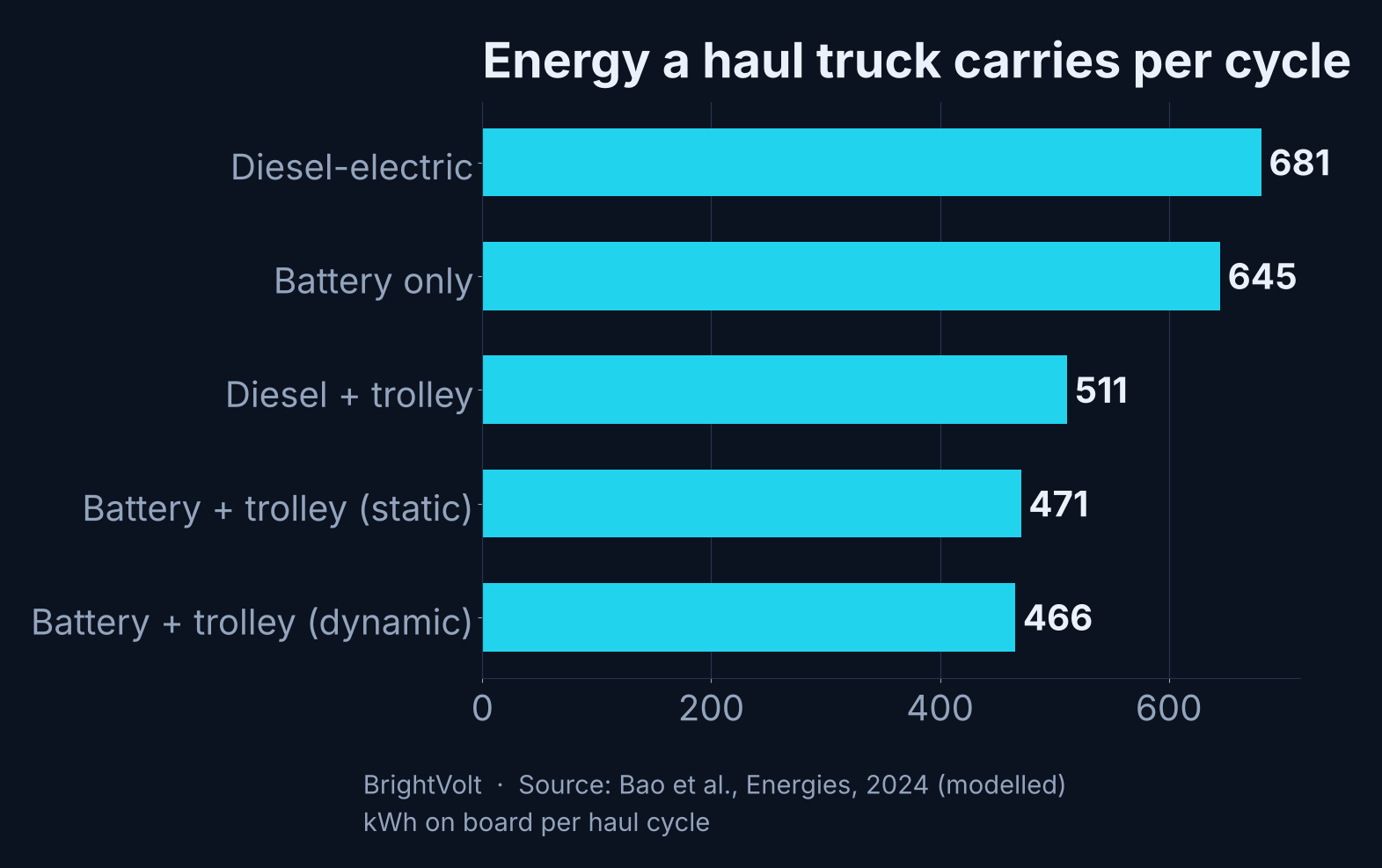
The same study found a subtlety worth keeping. Charging dynamically — while driving under the line — needed the least on-board energy, but the static-charging variant came out cheapest on battery cost over 20 years. Neither design wins every column.
For scale, the miners’ own Charge On Innovation Challenge brief cited about 400 kWh per haul cycle and called for multi-megawatt charging. The same organisers, BHP, Rio Tinto and Vale, said diesel haul fleets cause up to 80% of a mine’s emissions.
The case for the big battery
Fortescue is the counter-example, and a serious one. In Western Australia’s Pilbara it is building toward a fleet of battery-electric Liebherr T 264 trucks — a deal reported to cover 360 of them — refilled at 6 MW static chargers in under about 30 minutes. Its 240-tonne “Roadrunner” prototype carried a 1.4 MWh pack on a 3 MW charger.
The reason is that a trolley line is fixed infrastructure in a place that is constantly being dug up. Ramps move as a pit deepens, and the line, its poles and its substation have to move with them. Boliden learned this the hard way. Its 700-metre pilot at Aitik in Sweden, commissioned in 2018, saves about 830,000 litres of diesel a year. But a planned 3-kilometre extension there was taken down after a rockfall and has not been reinstated, International Mining reported in December 2025, and the Kevitsa line in Finland runs 630 metres rather than the 1.8 km announced in 2019. A charger in a bay does not care where the ramp goes next year.
The geometry rule
So the rule is about the hole. A deep pit with a long, stable loaded climb — the copper pits at Copper Mountain, Aitik and Kevitsa — is where trolley lines pay, because the climb is most of the energy and the ramp will stay put long enough to amortise the copper. A wide pit with changing haul roads favours the big battery and the charger bay.
And a few sites invert the problem entirely. Where a quarry sits above its crusher, the truck descends full, and a battery truck can regenerate on the way down: the Swiss “eDumper” recovers about 40 kWh on each loaded descent. There, neither a charger nor a wire is the main answer — gravity is.
The equipment makers have stopped pretending one system fits every mine. Caterpillar’s Dynamic Energy Transfer, with BHP as first trial customer, feeds both diesel-electric and battery trucks from a rail, and Caterpillar’s own model mine mixes 64 MW of in-motion charging with 24 MW of static chargers. Komatsu, which has run an autonomous truck on a trolley line, says it expects mines to use both. Hitachi has had a full battery-trolley truck on trial at First Quantum’s Kansanshi mine in Zambia since June 2024.
That mixed future is the real answer. Batteries make the truck independent of the wire; the wire makes the battery small. The mines that get the cheapest tonnes will be the ones that put a line on the one stretch of road that never moves, and let the battery handle everything else. The question to ask of any electric-mine announcement is therefore not how big the battery is, but how long, how steep and how permanent the loaded climb is. For why mines electrify before cars in the first place, see our explainer on the duty-cycle argument; for what a 6 MW charger asks of a battery, see megawatt charging.
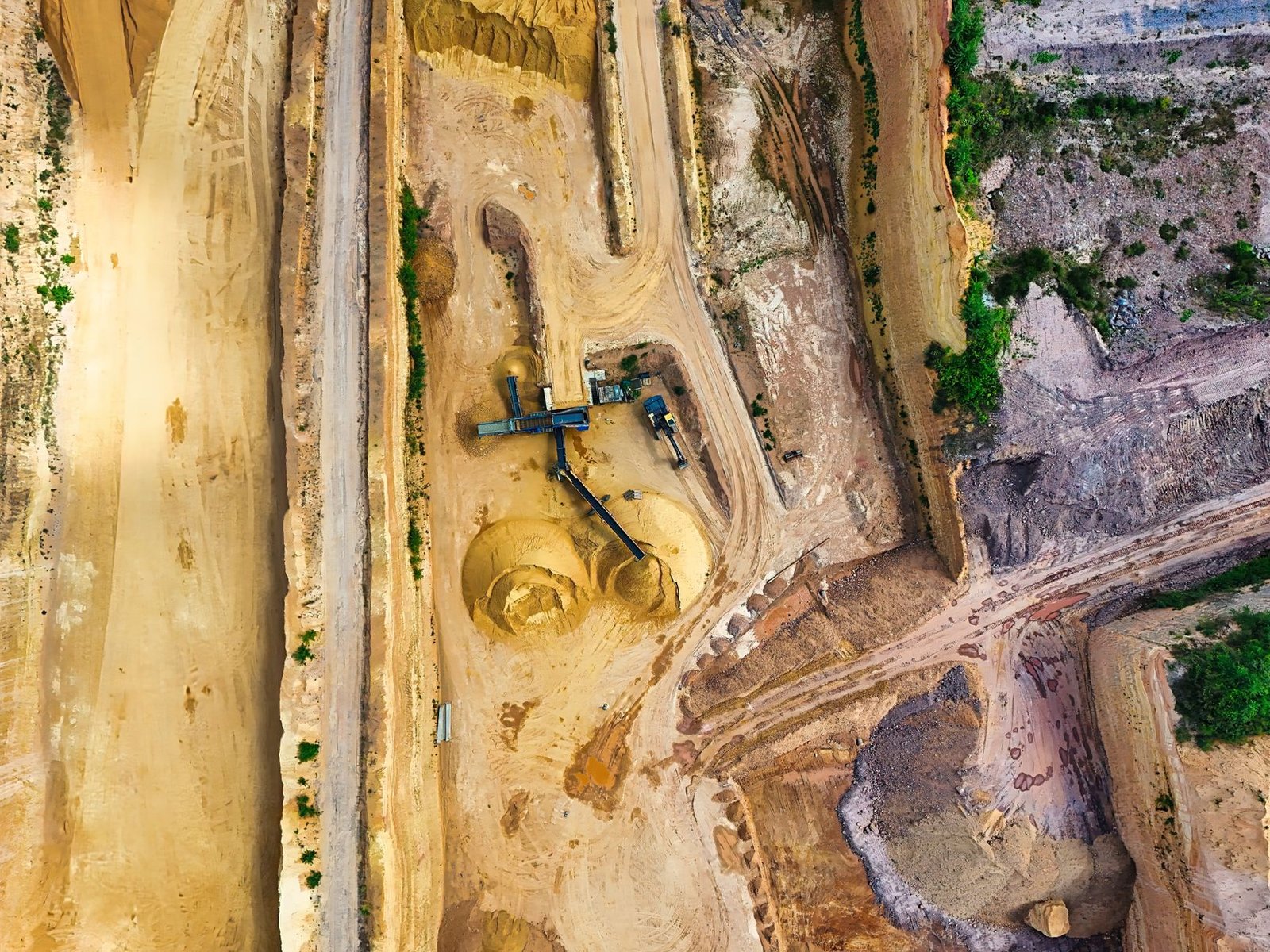
Photo by Gansham Ramchandani on Pexels · Photo by Volker Braun on Pexels