
The Dutch government has set its first national benchmark for grid batteries: 110 GWh of large-scale storage by 2040, against about 2.1 GWh at the end of 2025. Its own policy agenda translates that into roughly 28 GW of battery power, which is more than the Netherlands’ entire peak electricity demand. The number is not the hard part. Connecting it is.
The benchmark was announced on 9 November in a joint statement by the government and the energy sector, alongside a 25-point Beleidsagenda Energieopslag agreed with the grid operators’ association Netbeheer Nederland, the trade body Energy Storage NL, the regulator ACM and regional governments. It is a richtwaarde, a guideline, not a binding target, and it comes with no new subsidy.
How big is 110 GWh for the Netherlands?
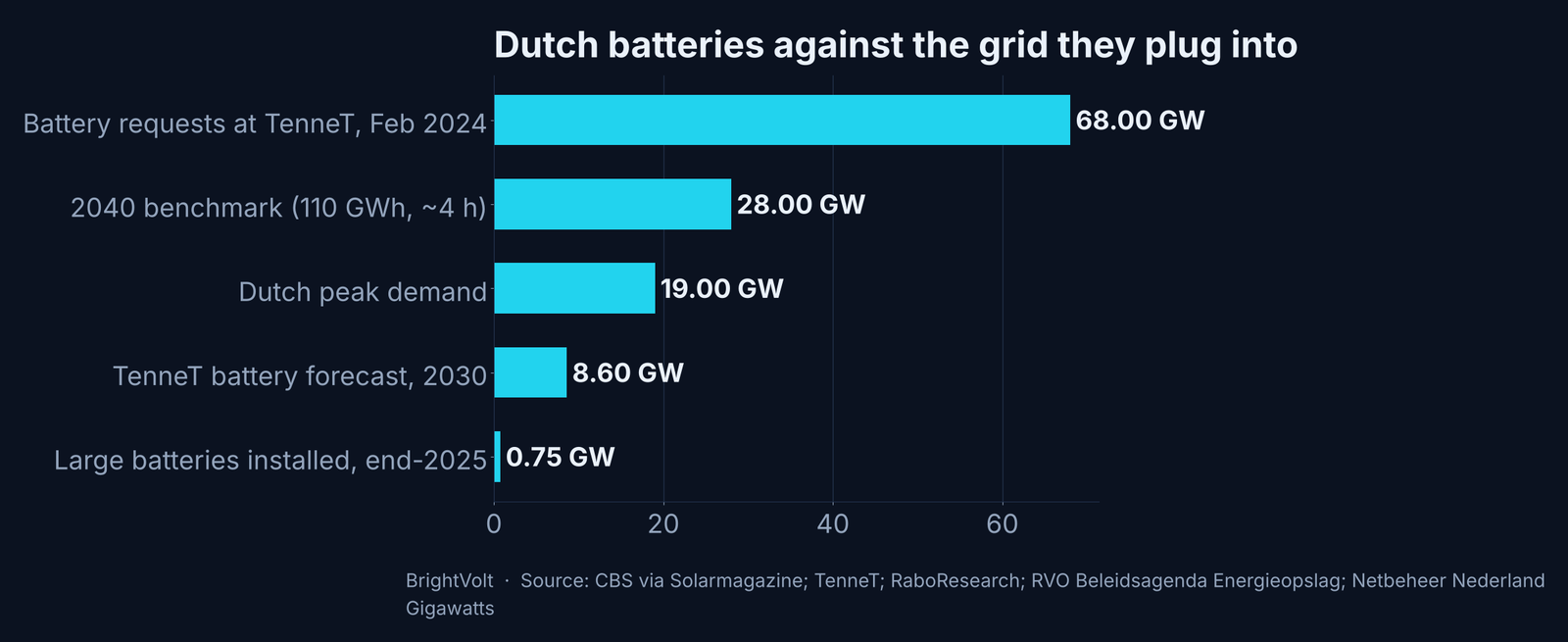
Big enough to need a second unit. The policy agenda sent to parliament pairs the 110 GWh with 28 GW of power, taken from the national energy-system plan, which works out at an average of about four hours of storage per battery. That distinction matters, because a battery’s energy (GWh) says how long it can run while its power (GW) says how hard it can push — the difference our power-vs-energy explainer is built around.
Set 28 GW against the grid it would sit on. Dutch peak demand is about 19 GW, according to RaboResearch. A battery fleet that can discharge more power than the whole country draws at its busiest hour is not a backup. It is a market participant on the scale of the conventional power fleet, absorbing North Sea wind and midday solar and selling it back, and in a country this interconnected we would expect a good share of that trade to cross borders.
Is the target ambitious?
Less than it looks, on the growth rate. Getting from 2.1 GWh to 110 GWh in fifteen years takes compound growth of about 30% a year. The large-battery fleet grew far faster than that in 2025: Statistics Netherlands (CBS) counted 286 systems of at least 1 MWh at the end of the year, totalling 753 MW and 1,575 MWh, up from 84 systems and 620 MWh a year earlier.
In absolute terms, though, the arithmetic is harsher. The benchmark needs an average of about 7.2 GWh of new batteries every year from 2026 to 2040. On the CBS count, 2025 added 0.96 GWh. The country has to build seven to eight times last year’s volume, every year, for fifteen years.
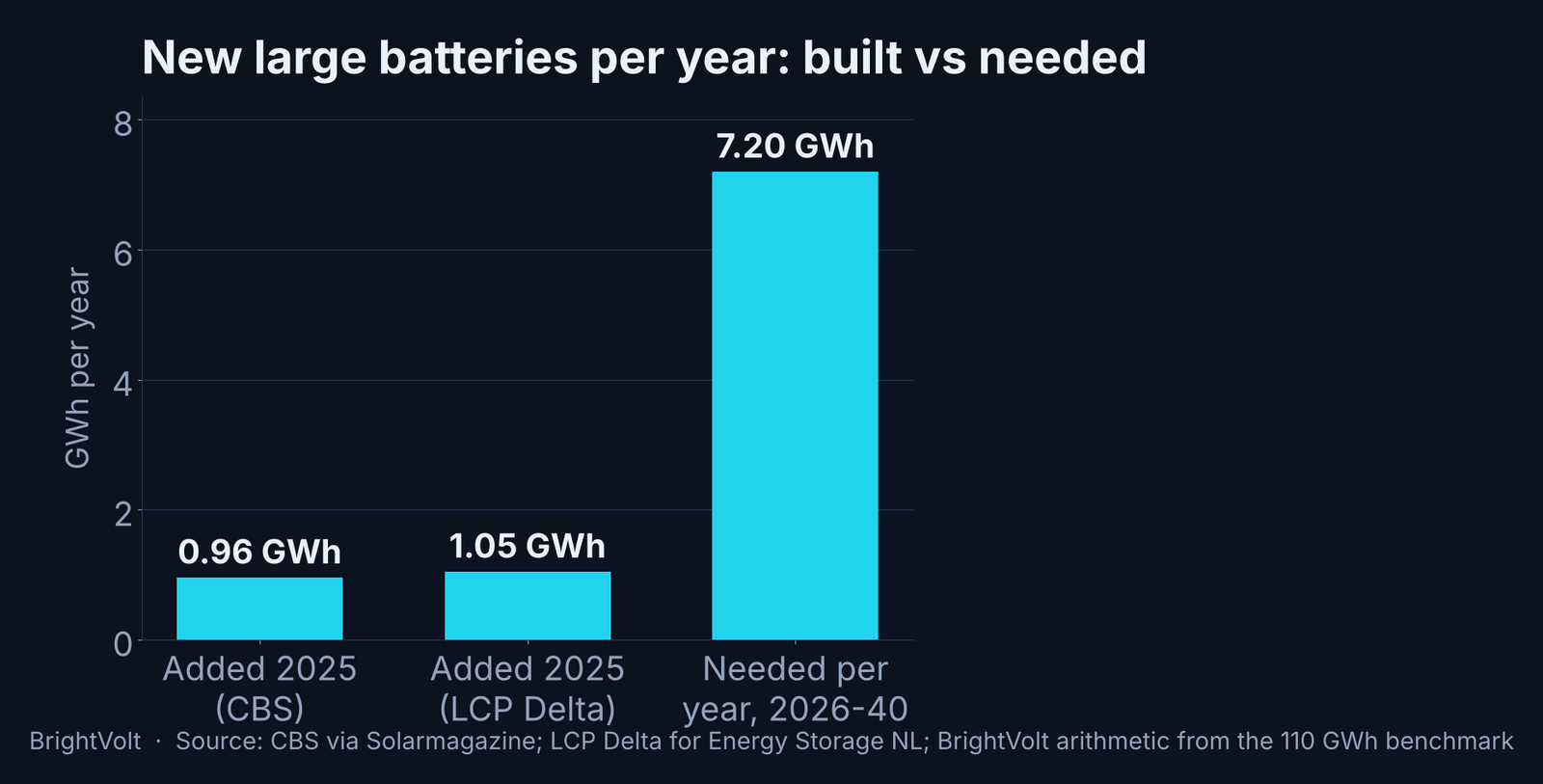
The base figure itself is not settled. The government’s “more than 50 times” comparison only works on its own 2.1 GWh starting point; on the CBS figure the multiple is closer to 70. A July 2026 LCP Delta study for Energy Storage NL puts Dutch battery storage at 2.7 GWh and 2025 additions at 1,050 MWh, but counts more than grid-scale systems. The gaps come from the cut-off (CBS counts systems of 1 MWh and up) and the date, not from anyone being wrong. They do mean nobody should quote the 50-fold figure as precise.
Why the queue, not the money, sets the pace
Developers are not short of appetite. In February 2024 Netbeheer Nederland reported that 243 of the 375 requests waiting at TenneT, the high-voltage operator, came from battery projects, together asking for 68 GW. In October 2025 TenneT allocated roughly 6 GW of its remaining 9.1 GW of off-peak capacity to batteries, and warned that more than half of applicants would not get the full amount they had asked for. By December it was telling the market that waits for new battery connections could run to eight years.
That is the same pattern as Japan’s 170 GW battery queue and the American interconnection queues: the projects exist on paper, the wires do not. A target set in gigawatt-hours does nothing about a constraint measured in gigawatts of grid access. Which is why the most consequential line in the agenda is not the 110.
The flexible contract becomes the default
The agenda states that grid operators will connect large-scale storage as standard under a capacity-limiting or redispatch contract. In plain terms, a new big battery no longer gets a firm, always-on connection by default. It gets one the operator can throttle when the network is congested, in exchange for getting connected at all.
The template already exists. TenneT’s time-dependent transport right guarantees transport at least 85% of the time and lets the operator restrict the other 15%, with a day’s notice; TenneT has said flexible users can save up to 65% on grid tariffs by combining it with time-dependent tariffs. In April the operator signed its first battery under a capacity-control contract as a “congestion relief” asset, Green Energy Storage’s roughly 200 MW Sequoia project in Oosterhout, due online in 2027, which was moved up the waiting list in return.

The rest of the 25 actions, listed in full by Solarmagazine, are smaller and slower: ACM will study a network-tariff discount for storage, time-dependent regional tariffs are pencilled in for 2028, permitting is to be standardised across municipalities and provinces, and the government agency RVO will publish an annual monitor, with a promise to adjust course if build-out falls behind. Households are being drawn in too. Since 1 November, suppliers in Gelderland, Utrecht, Flevoland and Noord-Brabant can pay customers for running home batteries, heat pumps and chargers at grid peaks, with the rest of the country to follow next year.

How the Netherlands compares
Most European targets are written in power, for 2030. The Dutch one is written in energy, for 2040, which makes it look larger than it is.
| Country | Official storage goal | Unit and year | Starting point |
|---|---|---|---|
| Netherlands | 110 GWh (about 28 GW) | Batteries, 2040, guideline | About 2.1 GWh, end-2025 |
| Great Britain | 23–27 GW | Batteries, 2030 | 4.5 GW of batteries |
| Spain | 22.5 GW | All storage, 2030 | — |
| Italy | 10 GWh contracted | First MACSE auction, 2028 delivery | — |
| Germany | No national figure | — | About 23 GWh stationary, July 2025 (BSW estimate) |
Sources: Rijksoverheid; UK Clean Power 2030 Action Plan; Spain’s PNIEC via ESS News; ESS News on MACSE; Clean Energy Wire.
Britain’s 23–27 GW by 2030 is a steeper climb in a shorter time. Germany has no official number at all, and its solar industry is lobbying for 100 GWh by 2030. Against that field the Dutch benchmark is not the most aggressive. What sets it apart is that it arrives bundled with a rule about how batteries plug in.
What to watch
Two numbers will decide whether this works, and neither is 110. The first is the RVO monitor’s annual build figure: anything consistently below 3–4 GWh a year by the late 2020s means the curve has already bent away from the benchmark. The second is how often TenneT actually uses the 15% of hours it can restrict. If curtailment stays rare, the flexible contract is a near-free ticket onto the grid and the queue starts moving. If it bites in the windy, sunny hours batteries most want to charge in, the business case erodes, and developers who asked for 68 GW will discover that a connection you can be switched off from is worth less than the one they queued for.
Our read: the benchmark is a sensible number with a weak legal status. The contract rule is the policy. Judge the agenda on whether connection waits fall from years to months, not on whether anyone hits 110.
Photo by Ramesh Kambattan on Pexels · Photo by Altaf Shah on Pexels